
Eliphas Levi
Architect of the Modern Occult Revival

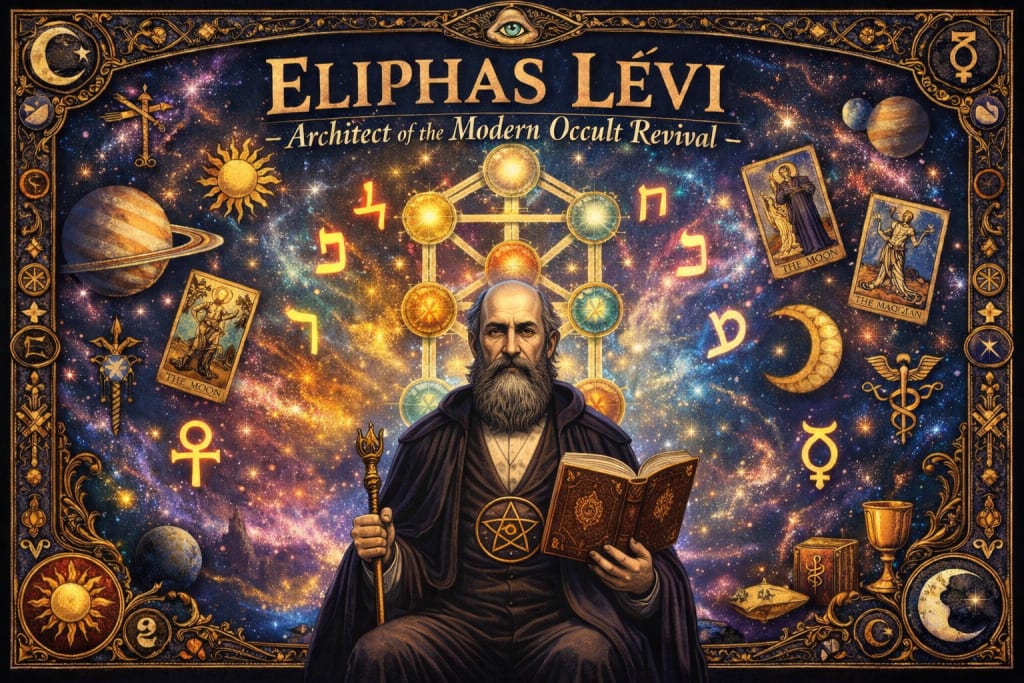
The Reconstruction of Western Esoteric Thought
Nineteenth century France stood at a volatile intersection of political transformation, technological advancement, and intellectual reorientation. The aftermath of the French Revolution continued to reshape social hierarchy, while industrial expansion accelerated urban growth and altered labor structures. Scientific innovation challenged established religious doctrine and traditional metaphysical frameworks. Within this environment of ideological confrontation and spiritual searching, Alphonse Louis Constant, later recognized under the adopted name Eliphas Levi, emerged as a central architect in the revival and reinterpretation of Western esoteric philosophy.
Born in Paris in 1810, Constant received formal education within Roman Catholic seminaries, where rigorous theological training cultivated extensive familiarity with Christian doctrine, liturgical symbolism, and scholastic philosophy. Early immersion in religious scholarship established a structural foundation that later informed complex symbolic interpretations found throughout Levi’s writings. Seminary education, however, did not culminate in permanent clerical ordination. Intellectual divergence, political involvement, and attraction toward alternative spiritual traditions redirected Constant toward independent scholarship and radical social commentary.
During the mid nineteenth century, European intellectual circles experienced renewed fascination with ancient wisdom traditions. Translations and rediscovery of Hermetic texts, Kabbalistic manuscripts, and Renaissance magical treatises stimulated academic and philosophical discussion. Constant entered this environment as both historian and innovator. Adoption of the Hebrew inspired name Eliphas Levi symbolized deliberate alignment with mystical scholarship and signaled commitment to synthesizing religious symbolism with esoteric philosophy.
Levi’s most influential contributions materialized through major publications such as Dogme et Rituel de la Haute Magie, released in two volumes between 1854 and 1856. Within this work, Levi systematized ceremonial magic into a coherent philosophical and symbolic structure. Detailed analysis connected Tarot imagery to Kabbalistic cosmology, particularly through association with the twenty two paths of the Tree of Life. Levi’s interpretation transformed Tarot from a primarily divinatory card system into a symbolic map representing spiritual ascent, metaphysical correspondence, and universal archetypal structure. This conceptual framework later shaped ritual practices and symbolic hierarchies adopted by influential esoteric organizations including the Hermetic Order of the Golden Dawn during the late nineteenth century.
Levi’s intellectual method relied upon integration rather than invention. Jewish Kabbalah, Christian sacramental symbolism, Renaissance Hermetic philosophy, Neoplatonic metaphysics, and contemporary socialist theory converged within Levi’s corpus. Levi maintained strong interest in social reform movements circulating throughout France during the 1830s and 1840s. Early association with utopian socialist thinkers, including followers of Charles Fourier and Félicité de Lamennais, contributed to Levi’s conviction that spiritual knowledge and social transformation shared intrinsic connection. Such ideological overlap produced an unusual synthesis linking mystical illumination with ethical and political evolution.
Symbolism occupied central importance throughout Levi’s scholarship. One of the most enduring contributions appeared through the illustration and philosophical description of the Baphomet figure, presented as a symbolic representation of equilibrium between opposing forces rather than an embodiment of malevolent supernatural agency. Levi utilized complex allegorical imagery to communicate metaphysical unity between matter and spirit, light and darkness, intellect and instinct. This symbolic language influenced subsequent occult literature, ritual iconography, and modern interpretations of esoteric philosophy.
Historical evaluation of Levi’s legacy reveals a scholar whose work bridged medieval magical traditions and structured modern occultism. Levi’s writings established terminological clarity, introduced systematic correspondence tables, and revived ceremonial ritual as a philosophical discipline rather than a collection of fragmented folklore practices. Through literary clarity, artistic symbolism, and interdisciplinary synthesis, Eliphas Levi redefined the intellectual boundaries of Western esoteric study and created a lasting blueprint that continues to inform contemporary magical theory, symbolic interpretation, and mystical scholarship.
Origins of Scholarship and Spiritual Defiance
Alphonse Louis Constant was born on February 8, 1810, in Paris during the final years of Napoleonic influence over France. Family circumstances reflected modest economic stability within the Parisian working class. Maternal devotion to Catholic observance and moral instruction created an early environment shaped by religious structure and disciplined education. Catholic tradition influenced childhood instruction and encouraged pursuit of ecclesiastical scholarship as a viable path toward social advancement and intellectual development.
Formal education advanced through admission to the Petit Séminaire de Saint-Nicolas-du-Chardonnet and later through enrollment at the Seminary of Saint-Sulpice, one of the most respected theological institutions in France. Seminary training demanded rigorous study of Latin, biblical exegesis, scholastic theology, patristic writings, and canonical law. Instruction emphasized precision in interpretation of sacred texts and strict adherence to ecclesiastical hierarchy. Academic performance demonstrated intellectual aptitude and literary fluency, qualities that attracted attention from instructors within the seminary system.
Saint-Sulpice training operated within a broader historical context marked by tension between restored Catholic authority and lingering revolutionary ideology. The Bourbon Restoration and subsequent political fluctuations intensified debate regarding church authority, civil governance, and social reform. Constant encountered theological education during a period when Catholic institutions sought to reassert cultural influence following decades of political instability. Exposure to both institutional discipline and external ideological conflict shaped intellectual development and encouraged exploration beyond orthodox theological boundaries.
Clerical ordination appeared increasingly likely during seminary progression. Institutional expectations positioned Constant for entry into the priesthood. Emotional relationships and emerging theological divergence disrupted advancement toward holy orders. Romantic attachment to Adèle Allenbach, a young woman connected to the seminary environment, produced scandal within clerical circles and contributed to dismissal from the seminary structure. Additional disputes involving doctrinal interpretation and philosophical independence reinforced separation from formal priestly vocation.
Withdrawal from seminary life did not extinguish spiritual interest or theological inquiry. Religious study gradually shifted toward mysticism, symbolism, and comparative spiritual traditions. Catholic sacramental imagery continued to influence intellectual expression, though interpretation moved toward allegorical and philosophical analysis rather than doctrinal conformity. Interest expanded toward broader metaphysical questions concerning divine authority, moral evolution, and the relationship between spiritual knowledge and social transformation.
Political and social conditions during the 1830s and 1840s exposed Constant to emerging movements advocating reform of economic inequality and labor exploitation. Interaction with followers of utopian socialist thinker Charles Fourier and Catholic reform advocate Félicité de Lamennais introduced concepts linking spiritual morality with social justice. Writing produced during this period reflected strong advocacy for human dignity, education reform, and restructuring of hierarchical social systems. Essays and pamphlets circulated within progressive intellectual networks and attracted attention from government authorities wary of revolutionary agitation.
Publication of La Bible de la Liberté in 1841 intensified conflict with governmental and religious institutions. The text promoted symbolic reinterpretation of biblical narrative as a framework supporting social liberation and moral equality. Authorities interpreted the publication as subversive and politically destabilizing. Legal prosecution resulted in imprisonment at the Sainte-Pélagie prison in Paris. Confinement placed Constant among political dissidents, radical journalists, and intellectual reformers, creating an environment conducive to philosophical reflection and literary development.
Periods of incarceration allowed extended engagement with mystical literature, Renaissance magical texts, and philosophical works addressing symbolic theology. Study during imprisonment introduced deeper familiarity with Hermetic writings, early Kabbalistic translations, and esoteric Christian traditions circulating among nineteenth century intellectual circles. Political radicalism gradually receded as metaphysical investigation gained prominence. Intellectual transformation accelerated during this period, establishing foundations for later adoption of the name Eliphas Levi and subsequent development of systematic esoteric philosophy.
Rebirth Through Identity: The Emergence of Eliphas Levi
The transformation of Alphonse Louis Constant into Eliphas Levi marked a deliberate philosophical and spiritual reinvention. The name “Eliphas Levi” derives from a Hebrew-inspired adaptation of the birth name, translating roughly as “God is my strength” and “Levite.” This linguistic choice established immediate symbolic resonance with Jewish mystical traditions, particularly Kabbalah, which would form a central component of later esoteric scholarship. Hebrew served as more than a linguistic vehicle; it functioned as a conduit for connecting Christian symbolism, Hermetic philosophy, and ancient mystical systems into a unified framework accessible to European intellectual audiences.
The selection of a new name reflected conscious construction of authority within the realm of occult philosophy. In nineteenth century Europe, pseudonyms were commonly employed by writers and scholars to navigate political censorship, intellectual debate, and esoteric circles. Beyond practical considerations, the adoption of a mystical identity functioned as a performative act, signaling initiation into a lineage of spiritual knowledge and philosophical inquiry. The name Eliphas Levi carried symbolic weight, suggesting mastery over hermetic and cabalistic wisdom and projecting legitimacy within emerging occult networks.
The name also encapsulated the synthesis of multiple intellectual currents. “Eliphas” emphasized divine strength and moral alignment, echoing biblical traditions and resonating with themes of spiritual ascent found in mystical texts. “Levi” invoked the priestly lineage of the Hebrew Levites, reinforcing connection to sacred ritual, ethical service, and metaphysical insight. Together, the name signified continuity with historical sacred traditions while asserting independence from conventional clerical structures.
Public adoption of this identity coincided with the period in which major works such as Dogme et Rituel de la Haute Magie were prepared for publication. Under the name Eliphas Levi, scholarship assumed both literary and mystical authority, distinguishing philosophical interpretations of ceremonial magic from anecdotal accounts or folkloric superstition. Symbolic nomenclature thus became inseparable from intellectual project, bridging personal reinvention with broader cultural revival of esoteric thought.
The emergence of Eliphas Levi represents a calculated act of self-fashioning, demonstrating how identity in nineteenth century occultism functioned as both philosophical declaration and social signal. The transformation embodied the convergence of religious training, political experience, and mystical exploration, establishing a figure whose intellectual authority would endure in Western esoteric traditions for generations.
France at the Crossroads of Science, Symbol, and Spirit
Nineteenth century France existed in a state of perpetual flux, alternating between monarchy, empire, and republic while society confronted rapid industrialization and urban expansion. Scientific innovation challenged long-standing religious orthodoxy, with discoveries in chemistry, electricity, and geology prompting reassessment of cosmic order and human purpose. Simultaneously, Romanticism elevated imagination, intuition, and symbolic interpretation, offering alternative frameworks for understanding existence beyond empirical science. Intellectual salons and public lectures provided fertile ground for exploration of spiritualism, mesmerism, and mystical phenomena, blending rigorous debate with aesthetic appreciation for the mysterious.
Interest in animal magnetism, first popularized by Franz Anton Mesmer in the late eighteenth century, remained influential. Hypnotic suggestion, invisible fluidic forces, and theories of subtle energy captivated both elite and popular audiences. These phenomena intersected with philosophical inquiry into consciousness, will, and moral development. Integration of Mesmeric ideas into esoteric interpretation provided tools for analyzing the interaction of mind, spirit, and material world, a synthesis that informed Levi’s reinterpretation of Kabbalistic symbolism and ritual practice.
Occult revival in France drew upon a rich historical and intellectual lineage. Antoine Fabre d’Olivet advanced mystical Catholic thought through philological and symbolic study of Scripture, emphasizing correspondence between language, numbers, and cosmic order. Joseph de Maistre, through writings on authority and divine providence, framed metaphysical reflection within social and political discourse. Renaissance precedents supplied additional grounding: Heinrich Cornelius Agrippa codified ceremonial magic and natural philosophy, while Paracelsus integrated alchemy, medicine, and spiritual insight. Levi absorbed these multiple currents, distilling centuries of mystical, philosophical, and scientific thought into a coherent framework accessible to nineteenth century readers.
The French intellectual climate of this era combined political turbulence, scientific revolution, aesthetic exploration, and spiritual curiosity. Exposure to conflicting authorities—both secular and ecclesiastical—cultivated critical perspective and intellectual flexibility. Within this dynamic environment, the synthesis of Hermeticism, Kabbalah, Christian mysticism, and emerging social philosophy became both possible and compelling. Levi’s work can only be fully appreciated against this backdrop, as it represents a conscious engagement with, and reinterpretation of, inherited traditions through the lens of contemporary French thought.
Dogme et Rituel de la Haute Magie: Architecture of Esoteric Thought
The publication of Dogme et Rituel de la Haute Magie in 1854 and 1856 represented the culmination of decades of scholarship, spiritual inquiry, and philosophical synthesis. The work, divided into two volumes, established a comprehensive system of ceremonial magic. The first volume, Dogme, articulated metaphysical principles, addressing the nature of the universe, the interplay of forces, and the structure of spiritual realities. The second volume, Rituel, provided detailed instructions for magical practice, including ritual operations, symbolic correspondences, and ethical guidance for the practitioner. This dual approach combined theoretical rigor with practical application, distinguishing Levi’s methodology from fragmented or anecdotal accounts of magic prevalent at the time.
Central to Levi’s philosophy was the concept of the Astral Light, a subtle universal medium mediating thought, will, and magical influence. The Astral Light functioned as an explanatory principle connecting disparate traditions, synthesizing elements of Hermeticism, Kabbalah, Christian mysticism, and contemporary theories of magnetism. Etheric currents, celestial emanations, and moral energy converged within this framework, offering a systematic explanation for both natural phenomena and occult operations. Levi emphasized the ethical dimension of magical practice, arguing that alignment with universal laws ensured effectiveness and spiritual elevation.
Levi’s illustration of Baphomet, appearing in Dogme et Rituel, conveyed complex symbolic meaning rather than literal or sensationalist interpretation. The figure’s androgyny, wings, raised torch, pentagram, and the inscription Solve et Coagula communicated the reconciliation of dualities: masculine and feminine, spirit and matter, light and darkness. The image functioned as an allegorical map for understanding balance in nature and consciousness, demonstrating Levi’s commitment to symbolism as a vehicle for philosophical and spiritual insight. Baphomet became a focal point for later occult movements, but within Levi’s original work, the figure served primarily as a visual synthesis of metaphysical principles.
The text also established systematic correspondences across multiple domains: planetary influences, elemental forces, Tarot symbolism, numerology, and Kabbalistic pathways. Ritual instructions integrated these correspondences into structured operations, emphasizing intentionality, moral preparation, and meditative focus. Dogme et Rituel de la Haute Magie thus codified ceremonial magic into a coherent discipline, bridging centuries of esoteric knowledge with contemporary intellectual currents.
Levi’s work reshaped Western occultism, providing terminology, frameworks, and visual symbolism that informed later esoteric organizations, including the Hermetic Order of the Golden Dawn and other ceremonial orders. The text remains a foundational reference for study of magical theory, symbolic philosophy, and the integration of mysticism with systematic reasoning. It demonstrates how nineteenth century scholarship, religious heritage, and mystical inquiry combined to create a body of work whose influence persists in modern esoteric thought.
Correspondence and Cosmic Order
The doctrine of correspondences formed one of the most influential structural principles within Eliphas Levi’s esoteric philosophy. This doctrine originated in Hermetic literature, particularly texts attributed to the legendary figure Hermes Trismegistus. The maxim “As above, so below” expressed the belief that patterns governing celestial and divine realms manifested within earthly and human dimensions. Within Levi’s framework, the universe functioned as an integrated symbolic organism governed by consistent metaphysical laws. Each visible phenomenon reflected an invisible cause, and each material structure mirrored a spiritual archetype.
Levi interpreted humanity as a microcosmic reflection of the greater cosmic order. Intellectual faculties, emotional impulses, and physical form corresponded with universal forces and spiritual hierarchies. Such an interpretation placed moral responsibility at the center of magical philosophy. Ritual activity, symbolic meditation, and disciplined study were not designed as tools for domination of supernatural forces but as methods for harmonizing human consciousness with universal equilibrium. Alignment with natural and spiritual law formed the foundation of effective magical operation according to Levi’s system.
The Tarot occupied a central position within this doctrine. Levi connected the twenty two Major Arcana to the twenty two paths linking the ten Sephiroth of the Kabbalistic Tree of Life. This connection created a structured symbolic map linking human psychological development, spiritual ascent, and cosmic architecture. Each card embodied archetypal forces representing stages of transformation, ethical growth, and metaphysical awareness. Levi’s interpretation shifted Tarot study from fortune telling practice into a philosophical and initiatory discipline grounded in symbolic literacy.
Planetary symbolism reinforced this network of correspondences. Classical astrology associated planets with psychological traits, elemental energies, and stages of spiritual influence. Levi integrated planetary forces with ceremonial ritual, linking each planet to colors, metals, incense, sacred names, and geometric figures. Such correspondences created ritual frameworks designed to align practitioner intention with specific cosmic energies believed to influence intellectual clarity, moral development, and spiritual insight.
Hebrew letters contributed another essential dimension within Levi’s system. Each letter possessed numerical value, phonetic vibration, and symbolic association within Kabbalistic cosmology. Levi emphasized the sacred alphabet as a representation of creative divine force expressed through language and number. Study of Hebrew letters allowed interpretation of sacred texts as symbolic codes revealing metaphysical structure. Numerical relationships between letters formed the basis of gematria, a method Levi considered essential for decoding hidden spiritual correspondences within scripture and symbolic tradition.
Elemental attributions completed the symbolic network. Fire, water, air, and earth represented fundamental forces governing both natural phenomena and psychological temperament. Levi connected these elements to Tarot suits, ritual tools, astrological influences, and stages of spiritual purification. Each element represented both creative and destructive potential, reinforcing Levi’s emphasis upon balance and equilibrium as central goals of esoteric practice.
Levi’s doctrine of correspondences transformed symbolic study into a comprehensive philosophical methodology. Observation of nature, examination of sacred literature, and engagement with ritual symbolism all functioned as interconnected pathways toward spiritual understanding. The doctrine established a systematic language through which invisible relationships could be studied, interpreted, and experienced. Through this symbolic architecture, Levi constructed one of the most enduring intellectual foundations within modern Western esotericism.
Tarot as Esoteric Scripture
Prior to the nineteenth century, Tarot functioned primarily as a European card game known as Tarocchi, which emerged in northern Italy during the fifteenth century. By the eighteenth century, French occult writers such as Antoine Court de Gébelin and Jean-Baptiste Alliette, known as Etteilla, introduced theories proposing ancient mystical origins and divinatory significance. Eliphas Levi transformed these earlier speculative interpretations into a structured philosophical system, elevating Tarot into a symbolic text designed to convey universal metaphysical principles.
Levi’s most influential innovation involved the systematic association between the twenty two Major Arcana and the twenty two letters of the Hebrew alphabet. Earlier authors had suggested connections between Tarot imagery and ancient wisdom traditions, yet Levi presented a coherent and integrated correspondence linking each card to specific paths within the Kabbalistic Tree of Life. This framework created a symbolic map of spiritual evolution, portraying Tarot as a visual representation of cosmic order, moral transformation, and intellectual awakening.
Within Levi’s interpretive system, each Major Arcana card represented a stage in spiritual and psychological development. The Magician embodied conscious will, intellectual direction, and the capacity to direct creative force through knowledge and intention. The High Priestess symbolized concealed wisdom, intuitive understanding, and guardianship of esoteric knowledge. The Fool represented spiritual pilgrimage, innocence, and the courage required to embark upon transformative experience. Levi interpreted these figures not as isolated archetypes but as interconnected stages within a structured initiatory journey.
Levi further aligned Tarot symbolism with classical elements, astrological forces, and numerical philosophy. Suits of the Minor Arcana corresponded to elemental energies: Wands associated with fire, Cups with water, Swords with air, and Pentacles with earth. Numerical sequences within each suit illustrated progressive stages of manifestation, development, and dissolution. Through this multilayered symbolic network, Tarot became a comprehensive visual language capable of expressing metaphysical laws, ethical instruction, and cosmological structure.
Influence of Levi’s Tarot philosophy extended rapidly across European esoteric circles. Gérard Encausse, known as Papus, expanded Levi’s symbolic interpretations through systematic occult manuals and initiatory teachings during the late nineteenth century. The Hermetic Order of the Golden Dawn later refined and elaborated upon Levi’s correspondences, incorporating astrological attributions, ritual symbolism, and complex color scales. Golden Dawn adaptations eventually shaped twentieth century Tarot decks such as those designed by Arthur Edward Waite and Pamela Colman Smith, as well as the Thoth Tarot developed by Aleister Crowley and Lady Frieda Harris.
Levi’s reinterpretation transformed Tarot from recreational pastime and fortune telling instrument into a philosophical and initiatory system. Symbolic imagery, numerical structure, and Kabbalistic alignment created a visual theology of spiritual ascent and universal correspondence. Contemporary Tarot study, ritual application, and symbolic analysis continue to reflect the structural foundations established through Levi’s scholarship, demonstrating the enduring intellectual legacy of this nineteenth century reinterpretation.
Kabbalah Recast for Western Esotericism
Eliphas Levi’s engagement with Kabbalah emerged through the intellectual channels available in nineteenth century France, which relied largely upon Christian Cabalistic interpretation rather than direct study within rabbinic scholarly tradition. Renaissance Christian mystics such as Giovanni Pico della Mirandola and Johannes Reuchlin had previously introduced Jewish mystical concepts into European philosophical discourse, presenting Kabbalah as a universal theological system compatible with Christian doctrine. Levi inherited this interpretive tradition and expanded its symbolic application within ceremonial magic and occult philosophy.
Access to primary Hebrew manuscripts remained limited in Levi’s environment. Knowledge of Kabbalistic doctrine developed primarily through Latin and French translations, alongside commentaries derived from earlier Christian Cabalistic writers. Texts attributed to the Zohar, a central compilation of medieval Jewish mystical commentary traditionally associated with Moses de León during the late thirteenth century, influenced Levi’s symbolic framework through secondary interpretation rather than direct textual scholarship. These mediated sources introduced concepts of divine emanation, symbolic language, and metaphysical structure that Levi integrated into ceremonial and philosophical systems.
The Kabbalistic Tree of Life functioned as the architectural centerpiece of Levi’s esoteric synthesis. The diagram contained ten Sephiroth representing progressive stages of divine manifestation descending from infinite unity toward material existence. Levi interpreted these spheres as expressions of creative intelligence, moral law, and cosmic balance. Each Sephirah corresponded to attributes such as wisdom, understanding, mercy, strength, beauty, and sovereignty, forming a hierarchical structure that explained both universal creation and spiritual ascent.
Levi expanded this diagrammatic structure by linking the Sephiroth to planetary forces derived from classical astrology, Tarot symbolism, and ritual correspondences. The twenty two connecting paths between the Sephiroth became associated with the twenty two letters of the Hebrew alphabet and the twenty two Major Arcana of the Tarot. This integration produced a symbolic map allowing practitioners to visualize spiritual development as a journey through interconnected spheres of consciousness and metaphysical influence. Ritual practice, meditation, and symbolic contemplation operated within this structured cosmological system.
Levi’s Kabbalistic interpretation emphasized allegorical and philosophical meaning rather than adherence to traditional Jewish theological doctrine. Critics within academic and Jewish mystical scholarship later identified interpretive inaccuracies, including simplified representation of complex rabbinic traditions and creative reinterpretation of symbolic correspondences. Despite scholarly debate regarding authenticity, Levi’s synthesis profoundly shaped Western occultism by introducing Kabbalistic symbolism into ceremonial ritual, Tarot interpretation, and modern esoteric philosophy.
Influence of Levi’s Kabbalistic framework extended into later occult organizations, particularly through ritual systems developed by the Hermetic Order of the Golden Dawn during the late nineteenth century. Subsequent esoteric movements adopted Levi’s symbolic correspondences as foundational instructional tools, reinforcing the Tree of Life as one of the most recognized diagrams within Western mystical practice. Levi’s reinterpretation thus served as a bridge between medieval Jewish mysticism and modern esoteric tradition, ensuring continued engagement with Kabbalistic symbolism within contemporary occult scholarship.
Astral Light and the Hidden Medium of Influence
Astral Light occupied a central position within Eliphas Levi’s metaphysical cosmology and served as a theoretical explanation for magical causation, symbolic transmission, and spiritual interaction. Levi described Astral Light as a subtle, all-pervading medium that retained impressions of thought, emotion, and intention. This invisible substance functioned as both repository and conduit, allowing human consciousness to interact with universal forces through disciplined will and symbolic ritual.
Levi’s formulation drew upon several intellectual traditions circulating throughout Europe during the eighteenth and nineteenth centuries. Hermetic philosophy described a luminous ether connecting celestial and terrestrial realms. Renaissance natural philosophers, including Heinrich Cornelius Agrippa, proposed the existence of subtle fluids capable of transmitting spiritual influence through natural correspondences. Scientific speculation regarding ether as a medium for light and energy further contributed to philosophical acceptance of invisible energetic fields. Levi synthesized these traditions into a unified concept that integrated mystical theology, occult ritual, and contemporary scientific speculation.
Influence from Franz Anton Mesmer’s theory of animal magnetism also contributed to Levi’s interpretation. Mesmer proposed the existence of a universal fluid governing physical and psychological health through magnetic interaction. Public demonstrations of mesmerism and hypnotic phenomena gained widespread attention throughout European intellectual and social circles during the early nineteenth century. Levi incorporated elements of Mesmeric theory while expanding interpretation beyond physiological healing. Within Levi’s system, Astral Light functioned not only as a therapeutic medium but also as the substrate through which magical symbols, ritual gestures, and focused intention produced spiritual and psychological transformation.
Levi emphasized that human thought and moral character directly influenced the Astral Light. Emotional intensity, disciplined imagination, and ethical clarity were considered essential for effective magical operation. Ritual ceremonies, incantations, and symbolic diagrams served as structured methods for directing willpower into this subtle medium. Failure to maintain intellectual and moral discipline, according to Levi, produced chaotic or ineffective results due to distortion within the Astral Light itself. Magical success therefore required personal purification, concentration, and alignment with universal harmony.
Symbolism played a vital role in interacting with the Astral Light. Levi regarded sacred alphabets, ritual instruments, and geometric figures as vibrational keys capable of organizing subtle energy into coherent patterns. Tarot imagery, planetary correspondences, and Kabbalistic diagrams were interpreted as symbolic languages designed to communicate with this universal medium. Through these symbolic systems, ritual activity functioned as a method of imprinting structured intention upon an invisible yet responsive field of cosmic influence.
Later interpretations of Astral Light have varied widely. Psychological theorists and modern occult scholars have suggested parallels between Levi’s concept and models of subconscious influence, archetypal memory, or collective psychological fields. Within Levi’s historical context, Astral Light represented an ambitious attempt to reconcile spiritual philosophy with emerging scientific curiosity regarding unseen forces and energetic transmission.
Levi’s doctrine of Astral Light provided a comprehensive explanatory mechanism connecting magical theory, symbolic practice, and metaphysical cosmology. By presenting an invisible medium capable of transmitting thought and spiritual force, Levi established one of the most enduring theoretical concepts within modern Western esoteric tradition, influencing ceremonial ritual, occult philosophy, and symbolic psychology for generations of practitioners and scholars.
Ethics, Authority, and the Evolution of Levi’s Worldview
Moral discipline formed a defining element of Eliphas Levi’s philosophy of magic. Levi presented magical practice as inseparable from ethical responsibility, arguing that ritual knowledge without moral structure produced instability within both individual consciousness and broader social order. Spiritual authority, within Levi’s framework, required cultivation of wisdom, intellectual clarity, emotional restraint, and adherence to universal law. Magical power was interpreted as an extension of natural and divine harmony rather than a tool for personal dominance or material gain.
Levi frequently warned that misuse of esoteric knowledge created psychological and spiritual imbalance. Ritual practice required preparation through meditation, symbolic study, and moral reflection. Levi’s interpretation positioned the magus as a philosophical and spiritual scholar whose role involved restoration of harmony between human consciousness and cosmic structure. Ceremonial magic was therefore framed as a disciplined science grounded in symbolic literacy, ethical awareness, and metaphysical understanding. This perspective sharply contrasted with popular nineteenth century portrayals of sorcery as theatrical illusion, superstition, or demonic invocation.
Levi’s ethical model drew heavily from Catholic theological training and Renaissance Hermetic philosophy. Christian sacramental symbolism contributed concepts of purification, redemption, and moral accountability. Hermetic traditions emphasized equilibrium between opposing forces and harmony within universal correspondences. Levi merged these influences to construct a moral code in which magical success depended upon alignment between intellectual intention, ethical conduct, and spiritual aspiration.
Political philosophy during Levi’s early career reflected strong engagement with social reform movements circulating throughout France during the 1830s and 1840s. Exposure to utopian socialist theory encouraged advocacy for economic equality, educational reform, and liberation from authoritarian structures. Levi contributed essays and pamphlets promoting social justice and moral regeneration, frequently connecting political transformation with spiritual renewal. Publication of La Bible de la Liberté in 1841 exemplified this fusion of religious symbolism and revolutionary political thought, resulting in legal prosecution and imprisonment.
Later writings demonstrated gradual ideological transformation. Mystical scholarship replaced direct political agitation as the primary vehicle for addressing social and spiritual concerns. Levi increasingly emphasized hierarchical symbolism, cosmic order, and structured metaphysical authority. This shift did not represent abandonment of social idealism but rather reorientation toward spiritual education as the foundation for societal transformation. Levi’s mature philosophy suggested that ethical and intellectual enlightenment among individuals created sustainable cultural evolution more effectively than political upheaval alone.
Historical analysis of Levi’s intellectual development reveals continuity beneath apparent ideological contrast. Early revolutionary enthusiasm and later mystical conservatism both reflected commitment to moral reform and human development. Imprisonment, exposure to political instability, and immersion in symbolic scholarship contributed to the redirection of intellectual focus from external revolution toward internal transformation. Levi’s philosophical evolution illustrates a broader nineteenth century pattern in which political turbulence stimulated exploration of spiritual and metaphysical solutions to social conflict.
Levi’s synthesis of magical ethics and evolving political philosophy established a model of occult practice grounded in responsibility, intellectual discipline, and symbolic order. This integration reinforced Levi’s reputation as a scholar who sought to transform ceremonial magic into a structured spiritual science guided by moral accountability and philosophical reflection.
Circles of Influence and Occult Legacy
Eliphas Levi cultivated intellectual relationships that extended influence across European esoteric and philosophical communities. Lectures, published essays, and private correspondence connected Levi with scholars, artists, and occult enthusiasts interested in symbolic theology and ceremonial magic. Parisian salons and literary gatherings provided opportunities for discussion of mystical philosophy, comparative religion, and symbolic interpretation. Levi maintained a reputation as both teacher and interpreter of ancient traditions, attracting audiences seeking structured explanations of Hermeticism, Kabbalah, and ritual symbolism.
Although Levi never established a formal magical fraternity or initiatory order, Levi’s writings provided conceptual infrastructure later adopted by organized occult societies. Levi’s systematic correspondences, Tarot interpretations, and Kabbalistic framework offered practical instructional models that later groups expanded into ritual curricula. Levi’s emphasis on symbolic literacy, ethical discipline, and ceremonial structure encouraged development of hierarchical initiatory systems that would define late nineteenth century Western occult revival.
The Hermetic Order of the Golden Dawn, founded in London in 1888 by William Wynn Westcott, Samuel Liddell MacGregor Mathers, and William Robert Woodman, drew extensively from Levi’s philosophical and symbolic framework. Mathers played a crucial role in disseminating Levi’s ideas through English translations of key works, including Transcendental Magic, Its Doctrine and Ritual, an English adaptation of Dogme et Rituel de la Haute Magie. These translations introduced Levi’s system to a rapidly expanding English speaking audience and helped establish Tarot, Kabbalistic symbolism, and ceremonial correspondences as central components of Golden Dawn ritual structure.
Golden Dawn ritual teachings elaborated upon Levi’s symbolic correspondences by integrating astrological attributions, ceremonial invocations, and color symbolism derived from Kabbalistic Sephiroth. Initiatory grades within the order mirrored spiritual progression along the Tree of Life, a structural concept strongly influenced by Levi’s interpretation of Kabbalistic cosmology. Through Golden Dawn publications, rituals, and teachings, Levi’s philosophical system reached practitioners throughout Britain, Europe, and eventually North America.
Aleister Crowley, one of the most influential occult figures of the twentieth century, acknowledged Levi as a foundational intellectual predecessor. Crowley studied Levi’s writings extensively during early occult training and incorporated Levi’s symbolic structures into Thelemic magical philosophy. Crowley’s adoption of “Baphomet” as a magical motto during leadership of the Ordo Templi Orientis demonstrated continued engagement with Levi’s iconographic legacy. While Crowley diverged from Levi’s moral and theological framework by emphasizing individual spiritual sovereignty and personal revelation, symbolic and ceremonial influences remained evident throughout Crowley’s ritual and philosophical system.
Levi’s intellectual influence also extended to French occult revival figures such as Gérard Encausse, known as Papus, and Joséphin Péladan, both of whom promoted esoteric education and initiatory traditions grounded in symbolic mysticism. These later thinkers expanded Levi’s integration of Christian symbolism, Hermetic philosophy, and Kabbalistic structure, contributing to broader cultural fascination with mystical traditions during the late nineteenth century.
Through literary scholarship, symbolic innovation, and philosophical synthesis, Levi established a network of intellectual influence that extended far beyond individual authorship. Absence of formal institutional leadership did not diminish Levi’s impact. Instead, Levi’s work functioned as a foundational blueprint that shaped ceremonial magic, occult symbolism, and initiatory systems across multiple generations of Western esoteric tradition.
Beyond Transcendental Magic: Expanding the Esoteric Canon
Eliphas Levi’s intellectual legacy extended far beyond Dogme et Rituel de la Haute Magie. A series of later publications deepened philosophical interpretation, expanded historical analysis, and refined symbolic methodology. These writings collectively formed a comprehensive corpus that integrated historical scholarship, metaphysical speculation, and ritual theory, reinforcing Levi’s reputation as one of the principal architects of modern Western occult philosophy.
Histoire de la Magie, published in 1860, presented an ambitious historical narrative tracing magical traditions from ancient civilizations through medieval and Renaissance periods into the nineteenth century. The work explored Egyptian priesthood, Greek mystery schools, Jewish mystical traditions, Gnostic sects, and Renaissance ceremonial magic. Levi framed magical knowledge as a continuous philosophical tradition preserved through symbolic language and initiatory transmission. Historical analysis emphasized recurring themes of sacred symbolism, moral discipline, and spiritual transformation. Levi portrayed historical magicians and mystics as custodians of esoteric wisdom who preserved symbolic knowledge during periods of intellectual repression and cultural upheaval.
La Clef des Grands Mystères, published in 1861, expanded Levi’s metaphysical system through detailed discussion of universal law, symbolic correspondences, and spiritual hierarchy. The text explored relationships between divine emanation, cosmic equilibrium, and human consciousness. Levi elaborated upon ritual symbolism and philosophical interpretation of sacred numbers, geometric forms, and allegorical imagery. Discussion of the Astral Light reappeared with additional emphasis upon moral responsibility and intellectual discipline as prerequisites for spiritual authority. The book functioned as a philosophical continuation of earlier works, refining theoretical foundations while clarifying symbolic methodology.
Le Grand Arcane, completed during Levi’s later years and published posthumously in 1898, offered extended reflection upon Tarot symbolism, initiatory philosophy, and ceremonial correspondences. The manuscript presented detailed allegorical interpretation of the Major Arcana as stages of spiritual evolution and intellectual enlightenment. Levi emphasized the role of symbolic study as a method for internal transformation, presenting Tarot imagery as a philosophical map guiding spiritual development and moral introspection. The work reinforced earlier correspondences linking Tarot, Hebrew letters, and Kabbalistic pathways while providing expanded commentary on ritual symbolism and meditative practice.
Fables et Symboles, published in 1862, explored allegorical storytelling as a vehicle for transmitting esoteric knowledge. Levi employed parables, mythological narratives, and symbolic tales to illustrate philosophical and moral concepts. Each narrative functioned as a multilayered teaching device, demonstrating how symbolic language could communicate metaphysical truth through accessible literary form. This work reflected Levi’s belief that allegory allowed preservation of spiritual knowledge across cultural and historical boundaries, ensuring continuity of mystical tradition through imaginative expression.
Together, these publications formed an interconnected intellectual system that combined historical narrative, philosophical speculation, and ritual instruction. Levi’s writings consistently emphasized symbolic literacy as the foundation of spiritual education, presenting history, mythology, and ritual practice as complementary methods for understanding cosmic structure and moral law. Through this expanded literary corpus, Levi transformed scattered esoteric traditions into a coherent philosophical framework that continues to influence ceremonial magic, symbolic interpretation, and modern occult scholarship.
Debate, Misinterpretation, and Enduring Reputation
Eliphas Levi’s writings generated admiration as well as sustained scholarly criticism. Historians of religion and academic researchers frequently identify limitations in Levi’s historical methodology. Levi approached magical history through a Romantic intellectual lens that emphasized symbolic continuity across civilizations. Narrative structure often prioritized philosophical coherence over documentary precision. Descriptions of ancient priesthoods, secret initiatory orders, and hidden transmissions of esoteric knowledge sometimes relied upon speculative interpretation rather than verifiable archival evidence. Nineteenth century fascination with lost wisdom traditions influenced Levi’s presentation of historical magical lineages as unified and uninterrupted.
Criticism also arises from Levi’s treatment of Kabbalah. Jewish mystical scholarship, rooted in rabbinic tradition and Hebrew textual analysis, contains complex theological frameworks developed across medieval and early modern Jewish communities. Levi accessed Kabbalistic concepts primarily through Christian Cabalistic sources derived from Renaissance thinkers such as Pico della Mirandola and Johannes Reuchlin. This interpretive pathway produced a philosophical adaptation that integrated Kabbalistic symbolism with Hermetic philosophy, Christian theology, and Western occult ritual. Jewish scholars frequently note that Levi’s synthesis simplified doctrinal intricacies and recontextualized sacred traditions outside original cultural and theological settings. Levi’s work therefore represents a Western esoteric reinterpretation rather than direct continuation of Jewish mystical scholarship.
Levi’s syncretic methodology also invited debate regarding the blending of distinct mystical systems. Hermetic philosophy, Christian mysticism, Renaissance alchemy, ceremonial magic, and Kabbalistic symbolism were combined into a unified metaphysical structure. Critics argue that this synthesis occasionally blurred historical distinctions between traditions that evolved independently across different cultures and historical periods. Supporters, however, view Levi’s integrative approach as an innovative intellectual effort to identify universal symbolic patterns underlying diverse spiritual traditions.
Public controversy surrounding Levi intensified through interpretation of the Baphomet illustration published in Dogme et Rituel de la Haute Magie. Later sensational literature and anti occult polemics frequently associated Baphomet with satanic worship and clandestine ritual practice. Levi’s original description, however, presented Baphomet as an allegorical representation of equilibrium between opposing forces within nature and human consciousness. The winged figure, torch, pentagram, and inscriptions symbolized philosophical reconciliation of duality rather than literal devotional imagery. Misinterpretation of this symbolism contributed to enduring cultural myths that often-overshadowed Levi’s intended metaphysical message.
Despite academic criticism and cultural misunderstanding, Levi’s influence within modern occult discourse remains profound. Levi introduced systematic symbolic correspondences linking Tarot, Kabbalah, astrology, and ceremonial ritual into a structured philosophical framework. Later occult societies, symbolic psychologists, and comparative religion scholars continued to engage with Levi’s interpretive models regardless of debates surrounding historical accuracy. Levi’s legacy rests upon transformation of fragmented esoteric traditions into a coherent intellectual system that shaped Western mystical scholarship, ritual practice, and symbolic philosophy throughout the late nineteenth and twentieth centuries.
Golden Dawn Transmission and Lasting Esoteric Authority
The Hermetic Order of the Golden Dawn played a decisive role in transforming Eliphas Levi’s philosophical system into structured initiatory practice. Founded in London in 1888 by William Wynn Westcott, Samuel Liddell MacGregor Mathers, and William Robert Woodman, the order constructed ceremonial rituals, instructional grades, and symbolic teaching frameworks that reflected strong dependence upon Levi’s synthesis of Tarot symbolism, Hebrew alphabet correspondences, and Kabbalistic cosmology. Levi’s interpretive architecture provided a conceptual blueprint that allowed Golden Dawn founders to organize mystical instruction into a systematic initiatory curriculum.
Samuel Liddell MacGregor Mathers contributed significantly to the transmission of Levi’s ideas through English translation and adaptation of key works. Mathers’ translation, Transcendental Magic, Its Doctrine and Ritual, introduced English speaking audiences to Levi’s symbolic correspondences and ceremonial theory. Publication of this translation during the late nineteenth century expanded Levi’s influence beyond France and continental Europe, facilitating rapid dissemination of esoteric philosophy throughout Britain and eventually North America. Golden Dawn instructional manuscripts incorporated Levi’s correspondences linking Tarot trumps to Hebrew letters and pathways upon the Kabbalistic Tree of Life, forming the structural foundation for ritual progression and symbolic meditation within the order.
Golden Dawn grade structures mirrored spiritual ascent through Sephirothic symbolism, reflecting Levi’s interpretation of the Tree of Life as a diagram of cosmic emanation and intellectual development. Each initiatory level corresponded with specific planetary forces, elemental symbolism, and ritual instruction, reinforcing Levi’s emphasis upon symbolic literacy and disciplined ceremonial practice. Ritual tools, sacred geometry, and color symbolism within Golden Dawn ceremonies demonstrated direct continuity with Levi’s metaphysical correspondences and ceremonial methodology.
Arthur Edward Waite expanded Levi’s symbolic legacy through literary and artistic interpretation. Waite’s scholarly writings and involvement in the Golden Dawn influenced development of the Rider Waite Tarot deck, illustrated by Pamela Colman Smith and published in 1909. Symbolic imagery within this deck reflected Levi’s philosophical interpretation of Tarot as an initiatory and allegorical system rather than a purely divinatory instrument. Waite’s scholarly commentary further reinforced Levi’s framework within twentieth century esoteric literature.
French occult scholar Gérard Encausse, known as Papus, also extended Levi’s intellectual tradition through systematic occult manuals and initiatory teachings. Papus incorporated Levi’s Kabbalistic correspondences, Tarot symbolism, and ceremonial philosophy into instructional texts that reached broad European readership. Papus contributed to institutionalization of Levi’s ideas within organized occult societies, ensuring continuity of symbolic and ritual methodology across multiple esoteric traditions.
Twentieth century ceremonial magic developed largely through the lineage established by Golden Dawn instruction and literature influenced by Levi’s synthesis. Ritual structures, symbolic correspondences, and initiatory models utilized by later occult organizations demonstrate enduring reliance upon Levi’s metaphysical framework. Many contemporary ceremonial traditions continue to employ Tarot symbolism, Kabbalistic pathways, and planetary correspondences derived directly or indirectly from Levi’s writings.
Modern esoteric publishing continues to preserve Levi’s legacy. Editions of Transcendental Magic, the English translation of Dogme et Rituel de la Haute Magie, remain widely available in occult bookstores, academic collections, and digital archives. Continued readership reflects sustained scholarly and practitioner interest in Levi’s integration of mystical symbolism, philosophical structure, and ceremonial methodology. Through Golden Dawn transmission and subsequent esoteric literature, Levi’s intellectual contributions remain foundational to modern Western occult practice and symbolic philosophy.
Baphomet: Symbolism, Alchemy, and Cultural Resonance
Eliphas Levi introduced one of Western esotericism’s most recognizable visual creations through the Baphomet illustration first published in Dogme et Rituel de la Haute Magie in 1854 and 1856. The image functioned as a symbolic synthesis of Hermetic philosophy, alchemical doctrine, and mystical anthropology. Each anatomical feature and inscription conveyed layered metaphysical meaning intended to express equilibrium between opposing forces.
The goat head represented instinctual vitality, natural fertility, and untamed elemental energy. Levi selected the goat not as a symbol of malevolence but as a representation of raw nature requiring spiritual discipline and intellectual refinement. Horns crowned with a burning torch illustrated the ascent of illumination emerging from primal matter. The flame symbolized awakened intellect, divine wisdom, and the spark of spiritual consciousness rising from physical existence.
An upright pentagram placed upon the forehead signified spiritual authority governing material forces. Within Western esoteric tradition, the upright pentagram corresponded with harmony between the four classical elements of earth, water, air, and fire unified under the dominion of spirit. Levi intentionally emphasized this orientation to distinguish philosophical balance from inverted interpretations associated with material dominance over spiritual awareness.
Raised and lowered arms created a gesture derived from the Hermetic axiom "as above, so below," expressing correspondence between celestial and terrestrial realms. Latin inscriptions Solve and Coagula inscribed upon each forearm referenced fundamental alchemical processes. Solve indicated dissolution, purification, and separation of essential principles. Coagula represented recombination, manifestation, and reintegration into perfected form. Together, both terms described cyclical transformation central to alchemical and spiritual evolution.
The caduceus positioned at the groin symbolized generative force and energetic polarity. Serpents intertwined around a central staff reflected equilibrium between masculine and feminine currents, echoing ancient Hermetic and medical symbolism associated with healing and energetic harmony. Female breasts integrated into the torso reinforced Levi’s emphasis on androgyny as a sacred symbol of unity between dual creative principles. This synthesis reflected long standing mystical traditions linking divine completeness with reconciliation of gendered opposites.
Bat wings extending from the back introduced additional symbolic complexity. Within esoteric allegory, wings frequently signified transcendence and spiritual mobility. The nocturnal nature of bats suggested hidden knowledge, mysteries concealed within darkness, and initiation through confrontation with unknown realms of consciousness. Levi’s inclusion highlighted transformation achieved through exploration of shadow aspects of existence.
Levi consistently clarified that Baphomet embodied philosophical equilibrium rather than idolatry or literal worship. The figure represented reconciliation between science and spirituality, intellect and instinct, matter and spirit, and light and darkness. Contemporary misunderstandings frequently reduced the image to associations with diabolism, yet Levi described Baphomet as an emblem of universal harmony rooted in Hermetic synthesis.
The illustration exerted lasting influence across multiple cultural domains. Late nineteenth century occult revival movements adopted Baphomet imagery as a visual shorthand for esoteric initiation and symbolic knowledge. Twentieth century ceremonial magic traditions incorporated design elements into ritual iconography and magical diagrams. Modern artistic and musical subcultures, particularly within heavy metal visual aesthetics, adapted Baphomet symbolism to convey rebellion, mystique, and philosophical duality. Popular media representations of occultism frequently drew aesthetic inspiration from Levi’s original composition, reinforcing lasting recognition of the image within global cultural consciousness.
Levi’s Baphomet remains a landmark achievement in symbolic illustration. The composition united theology, alchemy, Kabbalistic philosophy, and Hermetic doctrine within a single allegorical figure. Continued scholarly analysis and artistic reinterpretation demonstrate the enduring intellectual and cultural significance embedded within Levi’s visionary synthesis.
Final Years and Enduring Legacy
Eliphas Levi passed away on May 31, 1875, in Paris, concluding a life marked by intellectual daring, spiritual inquiry, and literary influence. Interment took place at Montparnasse Cemetery, a resting place for numerous figures of French cultural and intellectual history. Levi’s death did not mark the end of his impact; posthumous editions, compilations, and translations ensured that his ideas continued to circulate widely, reaching audiences far beyond France. Works such as Transcendental Magic, Its Doctrine and Ritual, the English translation of Dogme et Rituel de la Haute Magie, and later editions of Histoire de la Magie and La Clef des Grands Mystères introduced Levi’s philosophy to an expanding international readership.
The late nineteenth century occult revival relied heavily upon Levi’s framework. Hermetic societies, mystical study groups, and early ceremonial lodges incorporated Levi’s symbolic correspondences, Tarot interpretations, and Kabbalistic structures into ritual practice and philosophical instruction. Levi’s influence in Britain, facilitated by translations from Samuel Liddell MacGregor Mathers and other English occultists, contributed directly to the formation of the Hermetic Order of the Golden Dawn in 1888, which codified Levi’s correspondences and ritual methodology into formal initiatory systems.
By the early twentieth century, Levi’s authority became widely acknowledged across diverse esoteric movements. Rosicrucian societies employed Levi’s writings as theoretical foundations for teachings on spiritual hierarchy, cosmic harmony, and ceremonial ritual. Theosophical circles integrated aspects of Levi’s metaphysical interpretation and ethical framework into their philosophical discourse. Occult lodges, Tarot study groups, and scholarly examinations of Western esotericism cited Levi as a pivotal figure, situating his work at the intersection of historical scholarship, symbolic philosophy, and ritual practice.
Levi’s posthumous reputation rested not on invention of entirely new doctrines but on synthesis, reinterpretation, and systematization of centuries of mystical and philosophical traditions. Historical analysis, ethical instruction, and symbolic architecture combined in Levi’s work to create a lasting intellectual infrastructure for Western esotericism. The continued study, publication, and ceremonial application of Levi’s texts demonstrate that influence extended well beyond the lifespan of the author, embedding Levi’s vision of magic, morality, and cosmic order within the ongoing development of modern occultism.
Through careful translation, scholarly study, and ceremonial adaptation, Levi’s writings became a central reference point for subsequent generations of practitioners, thinkers, and artists, solidifying a legacy that remains foundational to contemporary understandings of Tarot, Kabbalah, Hermetic philosophy, and ceremonial magic.
Recommended Reading: #commissionearned
Eliphas Lévi and the French Occult Revival (Western Esoteric Traditions) by Christopher McIntosh
Nineteenth century France was a crucible of mysticism, politics, and intellectual experimentation, and this book explores how those currents converged to shape Eliphas Lévi’s thought. The text situates Lévi within a network of occultists, literary figures, and revolutionary thinkers, tracing interactions that influenced his symbolic philosophy. Examination of salons, secret societies, and mystical orders reveals the exchange of ideas across social and cultural boundaries. Lévi’s transformation from seminary student to esoteric scholar is analyzed alongside broader developments in magnetism, spiritualism, and Rosicrucian revival. The narrative emphasizes how Lévi’s synthesis of Hermeticism, Kabbalah, and mystical Catholicism resonated with contemporaries seeking alternatives to conventional religion. Connections between literary Romanticism and mystical symbolism highlight the cultural dimension of his work. Readers gain insight into the historical forces that shaped modern Western occultism through a detailed reconstruction of Lévi’s intellectual environment.
Transcendental Magic: Its Doctrine and Ritual by Eliphas Levi
Ceremonial magic is elevated to philosophical and practical rigor in this seminal work, presenting a cohesive system of theory and practice. Philosophical sections explore cosmic correspondences, the ethical responsibilities of the magician, and the function of the Astral Light as a universal medium for thought and will. Ritual instruction provides detailed guidance on ceremonial procedures, symbolic tools, and meditative practices designed to align consciousness with universal law. The integration of Tarot symbolism, Kabbalistic correspondences, and planetary influences creates a comprehensive framework for esoteric study. Ethical and moral considerations are emphasized throughout, distinguishing Lévi’s system from superstition or theatrical magic. Later magical orders, including the Golden Dawn, drew directly upon the conceptual structure and terminology established in this text. The enduring presence of Transcendental Magic reflects its central role in shaping Western ceremonial and symbolic traditions.
Spiritual discipline and practical instruction converge in this exploration of Lévi’s approach to esoteric wisdom. Ritual, symbolic study, and reflective practice are presented as tools for cultivating inner transformation and ethical mastery. Techniques for working with Tarot correspondences, meditation on archetypes, and engagement with the Astral Light illustrate Lévi’s integration of theory and lived experience. The text emphasizes moral responsibility and conscious alignment with universal principles as prerequisites for effective practice. Historical context situates Lévi within Hermetic, Kabbalistic, and mystical Catholic traditions, highlighting continuity and innovation. Exercises and commentary encourage structured engagement with symbolic systems as a means of personal and spiritual development. The work reframes magic as an active path of disciplined consciousness rather than mere ceremonial display.
A Biographical And Critical Essay Of Eliphas Levi by Professor Arthur Edward Waite
Historical reconstruction and critical insight combine in Waite’s detailed portrait of Lévi’s life and intellectual contributions. Personal experiences, including seminary training, revolutionary activism, and imprisonment, are contextualized alongside Lévi’s emergence as a key figure in the French occult revival. Themes such as the Astral Light, ethical obligation in magic, and Tarot correspondences are examined within Lévi’s broader philosophical framework. The essay balances narrative biography with interpretive commentary, illustrating both historical circumstances and esoteric significance. Connections between Lévi’s writings and later occult movements, including the Golden Dawn, are highlighted, emphasizing long-term influence. The interplay between personal development and intellectual achievement underscores the depth and complexity of Lévi’s contributions. This text remains a definitive source for understanding Lévi as both historical figure and philosophical innovator.
The Rosicrucian Practices of Eliphas Levi by Rev. Mathieu G. Ravignat M.A.
Mystical and ceremonial practices are examined through the lens of Rosicrucian influence in Lévi’s work, showing how symbolic systems underpin spiritual transformation. Ritual structure, sacred geometry, and moral instruction are analyzed in relation to historical Rosicrucian traditions. The text highlights how allegory and symbolic correspondences contribute to both inner development and comprehension of universal law. Cross‑cultural links between Hermetic, Kabbalistic, and Christian mystical thought are explored to demonstrate continuity in ceremonial philosophy. Attention to historical context situates Lévi within broader esoteric networks, clarifying his role in the occult revival of nineteenth century France. Detailed commentary on ritual tools, planetary forces, and ethical requirements reinforces the practical application of Lévi’s symbolic frameworks. Readers gain insight into the integration of historical precedent and innovative synthesis within ceremonial magic.
Eliphas Levi and the Kabbalah by Robert L. Uzzel
Connections between Jewish mystical tradition and Western esotericism are explored through Lévi’s adaptation of Kabbalistic symbolism. The book traces Lévi’s creative reinterpretation of Sephirothic structure, Tarot correspondences, and ceremonial principles into a unified philosophical system. Influence on later esoteric figures, including Waite, Papus, Crowley, and Pike, illustrates the diffusion of Lévi’s adapted Kabbalah across multiple movements and traditions. Uzzel analyzes textual evidence demonstrating how Lévi’s syncretic approach balanced symbolic innovation with historical precedent. Chapters examine ethical dimensions of Kabbalistic practice as reframed for Western ceremonial applications. Emphasis on interpretive strategy and philosophical intent clarifies the distinction between traditional Jewish sources and Lévi’s Christianized adaptation. The book deepens understanding of how Lévi’s Kabbalistic synthesis became foundational for modern symbolic and ritual practice.
THE MAGICAL RITUAL OF THE SANCTUM REGNUM OF TAROT by Eliphas Lévi and William Wynn Westcott
Tarot is presented as an operational instrument in this detailed exposition of ceremonial procedure, showing how Major Arcana symbolism can guide structured spiritual initiation. Ritual stages, invocations, and correspondences are meticulously aligned with metaphysical principles to create a functional system for inner transformation. Westcott’s translation contextualizes Lévi’s theoretical innovations within practical ceremonial use, emphasizing conscious engagement with symbolic archetypes. Correlations between Tarot cards, planetary forces, and hierarchies of spiritual power are systematically illustrated, providing a blueprint for ritualized meditation and magical work. The text demonstrates how symbolic study of Tarot functions as both cognitive framework and experiential practice. Influence on the Golden Dawn and subsequent ceremonial orders is evident in structured initiation and grade work. The work solidifies Lévi’s vision of Tarot as a dynamic instrument for disciplined spiritual exploration.
Persistent Patterns: Lévi’s Place in Contemporary Spiritual Culture
Eliphas Lévi remains one of the most frequently referenced figures within modern Western esoteric practice, a presence that extends across ceremonial orders, Tarot scholarship, symbolic psychology, and academic study. Ritual structures used by contemporary ceremonial magic groups draw directly upon correspondences first articulated in Lévi’s work, especially the integration of Kabbalistic Sephirothic pathways with planetary forces and meditative exercises. The Tree of Life, configured as a map of cosmic emanation and human consciousness, appears in manuals, instructional guides, and initiation systems used by practitioners worldwide. The diagram functions as both philosophical architecture and practical tool for spiritual exploration, linking ethical formation, symbolic understanding, and ritual progression.
Tarot practice in the twenty‑first century continues to reflect Lévi’s interpretive influence, particularly in decks and guidebooks that incorporate the associations between the twenty‑two Major Arcana and the twenty‑two Hebrew letters. Lévi’s system helped establish a model of Tarot as structured symbolic language rather than mere divinatory pastime. Tarot decks used in contemporary occult, meditative, and psychological contexts often adopt correspondences rooted in the lineage of Lévi’s scholarship, refined later through English occultists such as A. E. Waite and members of the Hermetic Order of the Golden Dawn. Instructional curricula for students of Tarot frequently include exploration of symbolic correspondences, planetary associations, and archetypal roles that trace back through Lévi’s integrative methodology.
Translations of Lévi’s writings remain in print and continue to influence esoteric publishers, occult bookstores, and specialized curricula. Editions of Transcendental Magic and related texts are regularly reissued, sometimes accompanied by contemporary commentary, annotations, or comparative studies that situate Lévi within broader currents of spiritual history. Theologians, historians, and practitioners alike cite Lévi’s articulation of the Astral Light, ceremonial correspondences, and symbolic frameworks as foundational reference points for understanding the transmission of Western mystical ideas from Renaissance Hermeticism into modern occult movements.
New Age and neo‑Hermetic movements often adapt Lévi’s complex doctrines to contemporary sensibilities. In some strands of these movements, symbolic correspondences are simplified and recontextualized within broader metaphysical or holistic paradigms. Despite these adaptations, structural patterns linked to Lévi’s work—such as correspondences between symbolic systems and ethical dimensions of practice—remain embedded in the framework of modern spiritual teaching. Meditation systems, energy work practices, and symbolic analysis methods used in contemporary metaphysical schools frequently echo underlying principles first articulated in Lévi’s synthesis.
Academic fields such as Western Esotericism treat Lévi as a pivotal transitional figure, one who bridged early ceremonial magic, Christian mystical thought, Renaissance Cabalistic engagement, and the organized occult revival of the late nineteenth century. Scholars examine Lévi’s work not only for its influence on later magical orders and symbolic systems but also for its historical role in shaping the conceptual vocabulary of modern esoteric movements. Conferences, university courses, and scholarly journals on mystical history and ritual studies routinely reference Lévi’s contributions in discussions of symbolic language, initiatory structures, and the transformation of occult philosophy.
Beyond ritual and scholarship, Lévi’s imagery and symbolic innovations have penetrated visual culture, literature, and artistic expression. Representations of figures such as Baphomet, Tarot archetypes, and metaphysical diagrams appear in artistic practice, conceptual design, and cultural commentary, testifying to the deep and persistent reach of Lévi’s symbolic imagination. Lévi’s synthesis continues to animate both scholarly inquiry and lived spiritual practice, preserving patterns of thought that link past traditions to evolving expressions of metaphysical exploration in the present age.
Measuring Influence and Innovation
Eliphas Lévi stands among the most consequential figures in the shaping of modern Western esoteric tradition, not because every statement can withstand empirical testing, but because the structures he articulated provided intellectual currency for later generations of spiritual thinkers, ritualists, and symbolic scholars. Lévi’s writings reveal a deliberate blend of imaginative reconstruction and wide‑ranging scholarship drawn from sources as diverse as Renaissance Hermetic treatises, Christian mystical theology, Jewish Cabalistic motifs interpreted through Christian Cabalistic channels, classical astrology, and occult folklore circulating in early nineteenth century France. In his historical narratives, claims about ancient mystery schools, priestly lineages, and secret transmission of arcane doctrines sometimes rely upon generalized continuity rather than documented succession, reflecting a period in which symbolic truth was valued alongside literal historicity.
Speculative leaps occur most frequently in Lévi’s treatment of Kabbalah. Traditional Jewish Kabbalistic scholarship, grounded in centuries of rabbinic exegesis and Hebrew linguistic nuance, was largely inaccessible to Lévi; the version of the Tree of Life and the mystical alphabet presented in his works emerged primarily through mediated Christian Cabalistic interpretation. As a result, correspondences between Sephiroth, Hebrew letters, and cosmic pathways reveal creative adaptation rather than direct translation of original Jewish mystical sources. Alchemical metaphors, too, appear at times less as documentary history than as symbolic architecture intended to illustrate processes of inner transformation.
Despite these historiographical limitations, Lévi’s synthesis produced a coherent philosophical and ritual framework that became foundational for Western esotericism. By linking Tarot imagery with Cabalistic structure, numerological logic, planetary forces, and ethical discipline, Lévi established correspondences that offered a symbolic grammar for ceremonial practice and contemplative work alike. The diagram of the Tree of Life, reconfigured through Lévi’s influence, became a structural map used by later orders, instructional manuals, and initiatory systems. Ritual clarity and symbolic coherence found later in the Hermetic Order of the Golden Dawn’s grade work, meditative exercises, and ceremonial liturgies trace directly to Lévi’s systematization of correspondences and metaphysical principles.
Innovation in Lévi’s work emerges from selective recombination of historical, theological, and mystical sources shaped into a unified intellectual edifice. Rather than presenting isolated fragments of occult lore, he arranged symbolic elements into a programmatic philosophy that encouraged disciplined study, ethical preparation, and reflective engagement with symbolic language. Ritual and meditative practice were not ornamental extras but integral components of a structured spiritual science. In placing moral responsibility at the center of magical training, Lévi distinguished ceremonial work from theatrical performance or sensational spectacle.
Examining Lévi’s contributions illuminates the dynamics of transmission and reinterpretation that characterise the evolution of esoteric thought. Symbolic languages, when structured thoughtfully, allow traditions to adapt to new cultural and intellectual environments without losing coherence. Lévi’s innovation lay in showing how symbolic systems could be organized into an interconnected architecture, making formerly disparate sources intelligible to a generation seeking alternatives to both scholastic religion and materialist philosophy.
The enduring influence of Lévi’s frameworks in contemporary Tarot practice, ceremonial magic lodges, symbolic psychology, and academic study confirms his role not simply as a transmitter of ideas but as a catalyst for intellectual transformation. Ongoing scholarship in Western Esotericism treats Lévi as a bridging figure whose work helped transition European mystical heritage from Renaissance magic into the organized occult revival of the late nineteenth and early twentieth centuries. Deep engagement with Lévi’s symbolic language continues to yield insights into the nature of ritual, the role of symbolism in consciousness, and the ways in which structured imagination can shape spiritual inquiry across eras.
Paths to Independent Exploration
Eliphas Levi occupies a pivotal role in the development of modern Western esotericism, bridging Renaissance magic, Kabbalistic tradition, Hermetic philosophy, and nineteenth century French mystical thought. Understanding Levi’s contributions requires direct engagement with his writings, including Transcendental Magic, Histoire de la Magie, and La Clef des Grands Mystères, rather than reliance on secondary summaries or popular interpretations. Primary texts reveal the precision of symbolic correspondences, the philosophical rigor of moral and ritual principles, and the depth of Levi’s integration of ethical, mystical, and metaphysical concepts. Subtle details of Tarot associations, the structure of the Tree of Life, and the nature of the Astral Light often become distorted or oversimplified in abridged accounts.
Free public libraries provide reliable access to critical editions and historical translations, offering an opportunity to examine these works in their original language or high-quality English renderings. Supplementing direct reading with scholarly analysis illuminates historical context, tracing the influence of French political turbulence, revolutionary thought, Romanticism, and spiritualist movements on Levi’s philosophical evolution. Biographical studies, including the work of Arthur Edward Waite and modern historians, clarify the intersections of Levi’s seminary training, political activism, and mystical innovation. Careful attention to these sources allows readers to differentiate between documented ideas, interpretive synthesis, and later mythologized representations of Levi.
Online resources can be useful for preliminary research, yet caution is essential. Many freely available versions are incomplete, poorly annotated, or influenced by sensationalized interpretations of occult imagery, particularly regarding Baphomet, Tarot, and Kabbalistic adaptations. Critical evaluation of online materials and cross-referencing with scholarly publications safeguards against misinformation and ensures a nuanced understanding of the philosophical, symbolic, and ethical frameworks Levi developed.
Independent inquiry also benefits from comparative study of broader esoteric traditions. Exploration of Renaissance Hermeticism, Christian mysticism, alchemical symbolism, and Rosicrucian practice situates Levi’s work within a continuum of spiritual thought. Contextual study demonstrates how Levi synthesized inherited knowledge while innovating symbolic correspondences, ritual structure, and ethical paradigms for a modern readership. Reflection on these intersections encourages critical engagement with both the achievements and limitations of his system.
Curiosity, disciplined study, and ethical reflection remain essential companions for anyone engaging with esoteric literature. Reading with attention to historical, cultural, and symbolic nuance allows for a direct encounter with Levi’s intellectual daring. Examination of ritual, ethical guidance, and symbolic networks within Levi’s writings offers insight into the architecture of modern occult practice and illuminates how symbolic traditions continue to resonate in contemporary spiritual culture. Pursuing independent research nurtures both understanding and discernment, empowering a thoughtful engagement with a figure whose influence spans nearly two centuries.
About the Creator
Marcus Hedare
Hello, I am Marcus Hedare, host of The Metaphysical Emporium, a YouTube channel that talks about metaphysical, occult and esoteric topics.
https://linktr.ee/metaphysicalemporium
Keep reading
More stories from Marcus Hedare and writers in BookClub and other communities.
The Baphomet
Symbol, Accusation, and Esoteric Transformation Few figures within Western esoteric history generate sustained fascination, controversy, reverence, suspicion, and scholarly debate equal to Baphomet. Documentary evidence traces the earliest known appearances of the name to the early fourteenth century during inquisitorial proceedings against members of the Knights Templar. Records from the trials between 1307 and 1312 include testimonies alleging ritual veneration of a mysterious head or idol identified under variations of the name Baphomet. Surviving trial transcripts remain inconsistent and often emerged under coercive interrogation, leaving historians divided regarding literal worship, political fabrication, or linguistic corruption of other religious terminology, including possible distortions of the name Muhammad circulating through Crusader era rhetoric.
By Marcus Hedarea day ago in BookClub
Rachel Reviews: Lunch Tales: Teagan by Lucille Guarino
Well, I did enjoy this! Sometimes, all you need is just great storytelling and this is what Lucille Guarino delivers here. There's no big message to this book; it's just about folks and families, living their lives and coping with everything that's being thrown at them and finding their way. But when it's done well, like it is here, then you have characters to whom you can relate, tension which leaves you rooting for a better outcome, attraction which has your heart racing and an urge, as a reader, to see the characters happy with the people with whom they belong.
By Rachel Deeming5 days ago in BookClub
7 Books About Leaving Yourself Behind
Leaving yourself behind doesn’t mean abandoning who you are—it means releasing outdated identities, limiting beliefs, and unconscious patterns that no longer serve your growth. At some point, many of us feel an internal friction: the life we’re living no longer matches the person we sense we’re becoming. That tension is the quiet invitation to change.
By Diana Meresc5 days ago in BookClub


Comments
There are no comments for this story
Be the first to respond and start the conversation.