
Albert Einstein Foresaw It — New Deep Space Observations Confirm Time Bends Around Distant Galaxies
A century after Einstein’s revolutionary theory, modern telescopes reveal stunning evidence that time itself is distorted by massive galaxies across the universe.

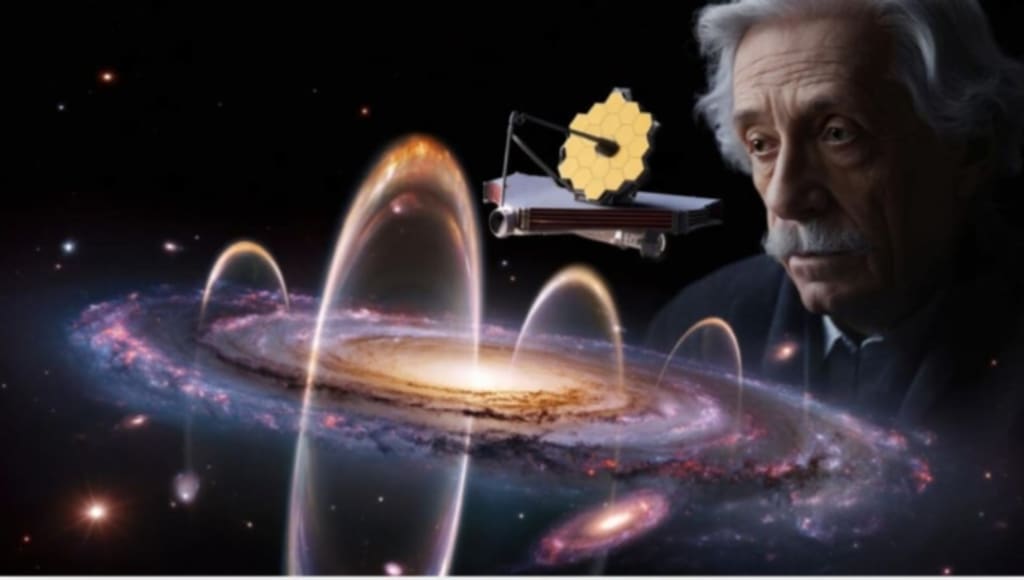
More than one hundred years ago, Albert Einstein proposed an idea so radical that even many scientists doubted it: time is not fixed. Instead, it bends and stretches under the influence of gravity. His theory of general relativity suggested that massive objects such as stars and galaxies warp the fabric of space and time, creating a cosmic landscape where clocks tick at different speeds depending on their surroundings.
For decades, this idea remained mostly theoretical, supported by small-scale experiments near Earth and observations of black holes and neutron stars. Now, thanks to powerful deep-space telescopes and improved imaging techniques, astronomers have found compelling new evidence that confirms Einstein’s prediction on a grand, intergalactic scale: time bends around distant galaxies.
These recent observations mark one of the most significant confirmations of relativity in modern astronomy and open a new window into how the universe truly operates.
Einstein’s Vision of a Flexible Universe
Einstein’s theory of general relativity, published in 1915, transformed humanity’s understanding of gravity. Rather than describing gravity as a simple force between objects, Einstein proposed that massive bodies curve spacetime itself. In this model, planets orbit stars not because they are pulled by invisible strings, but because they follow the curved paths created by warped spacetime.
One of the most astonishing consequences of this idea is time dilation. Near a massive object, time slows down compared to regions with weaker gravity. A clock near a black hole would tick far more slowly than a clock on Earth. This effect has already been measured with satellites and GPS systems, which must account for relativistic time differences to function accurately.
But until recently, observing this effect around distant galaxies remained extremely difficult.
What the New Observations Revealed
Using advanced space telescopes and deep-field imaging, scientists studied light traveling from extremely distant galaxies and quasars. These objects lie billions of light-years away, meaning their light has crossed vast stretches of warped spacetime before reaching Earth.
As the light passed near massive galaxies on its journey, researchers noticed something extraordinary: the passage of time appeared distorted. The signals arriving from background galaxies showed slight but measurable delays compared to what would be expected if space and time were flat.
This phenomenon is closely related to gravitational lensing, where massive galaxies bend and magnify light from objects behind them. But the new observations go further by showing that not only light paths are bent — time itself is stretched in these regions of strong gravity.
In essence, distant galaxies act like cosmic time lenses, slowing down the apparent motion of events occurring behind them.
Why This Matters
This discovery is more than a confirmation of an old theory; it reshapes how scientists understand the large-scale structure of the universe.
First, it provides direct evidence that Einstein’s equations still hold true even across billions of light-years. This strengthens confidence in general relativity as one of the most accurate descriptions of nature ever created.
Second, it gives astronomers a new tool for studying dark matter. Because dark matter does not emit light, it can only be detected through its gravitational effects. By measuring how much time and light are bent around galaxies, scientists can map invisible dark matter halos with greater precision.
Third, this research deepens our understanding of cosmic evolution. If time behaves differently near massive galaxies, then the history of distant stars and galaxies may appear altered when observed from Earth. This helps astronomers refine models of how galaxies formed and how the universe expanded over time.
A Universe That Defies Intuition
To the human mind, the idea that time can bend sounds like science fiction. We experience time as steady and uniform. Seconds tick by at the same pace whether we are walking, sleeping, or thinking.
But on a cosmic scale, the universe does not obey human intuition. Time slows near heavy objects, speeds up in empty space, and stretches across expanding cosmic distances. These effects are tiny in daily life but become dramatic near galaxies and black holes.
The new findings remind us that reality is far stranger and more beautiful than it appears. The universe is not a rigid stage where events unfold — it is a living fabric that twists and reshapes itself around matter and energy.
Looking Toward the Future
With next-generation observatories such as the James Webb Space Telescope and upcoming space missions, scientists expect even more precise measurements of time distortion in deep space. These instruments will allow researchers to observe earlier epochs of the universe and test whether relativity holds under extreme conditions.
Future studies may even help bridge the gap between general relativity and quantum physics, two theories that currently describe different parts of reality but remain incompatible. Understanding how time behaves at cosmic scales could be key to unlocking a unified theory of nature.
Einstein’s Legacy Lives On
Albert Einstein once said that imagination is more important than knowledge. His vision of a universe where space and time bend under gravity was born from imagination and mathematical insight long before technology could verify it.
Now, over a century later, modern astronomy is proving him right again.
The bending of time around distant galaxies is not just a scientific triumph — it is a reminder that human curiosity can reach across billions of light-years to uncover the deepest truths of existence. What Einstein foresaw with equations and thought experiments is now visible through the eyes of powerful telescopes, showing that time itself is woven into the vast cosmic dance of galaxies.
And as we continue to explore the universe, one truth becomes clear: the clock of the cosmos does not tick the same everywhere — it bends, stretches, and flows with the gravity of the stars.
About the Creator
Sajida Sikandar
Hi, I’m Sajida Sikandar, a passionate blogger with 3 years of experience in crafting engaging and insightful content. Join me as I share my thoughts, stories, and ideas on a variety of topics that matter to you.
Keep reading
More stories from Sajida Sikandar and writers in Beat and other communities.
Buried for 33 Years: The Dream to Revive One of the Country’s Largest Gold Mines Suddenly Back on the Map
For more than three decades, one of the country’s most valuable natural resources lay dormant beneath layers of dust, disputes, and missed opportunities. Hidden deep in the rugged terrain of Balochistan, the legendary gold and copper mine remained silent — its potential buried along with the dreams of economic transformation it once inspired.
By Sajida Sikandarabout 10 hours ago in Trader
Perfect Girl: Lauren Minear’s Bold Exploration of Womanhood and Perfection
New York–based alt-pop singer-songwriter Lauren Minear returns with “Perfect Girl,” a razor-sharp, darkly playful exploration of what it means to be a woman expected to shapeshift endlessly to please others. Written from the perspective of a fictional, satirical character, the track leans into the absurdity of “perfection” and the way chasing it strips away humanity in the process.
By Chris Adams5 days ago in Beat




Comments
There are no comments for this story
Be the first to respond and start the conversation.