LUCCIAN LAYTH
Bio
L.LUCCIAN is a writer, poet and philosopher who delves into the unseen. He produces metaphysical contemplation that delineates the line between thinking and living. Inever write to tellsomethingaboutlife,but silences aremyway ofhearing it.
Stories (29)
Filter by community
Chapter XVIII: The Ice Bear’s Solitude,
The Arctic is a land of paradoxes. A place where the sun never rises in winter and never sets in summer; a place where ice glitters turquoise in the moonlight and cracks like glass; a place where the loudest sound is silence itself. It is here where the polar bear; Ursus maritimus, "sea bear" is both king and captive of this frozen throne. To know the ice bear is to learn the language of isolation so profound it becomes a means of survival and an elegy for a world that so desperately strives to remain.
By LUCCIAN LAYTH10 months ago in Journal
Chapter II: The Optics of the Soul
The gallery smelled of varnish and dust, a kind of hideout for creative things. Ivan Nikolayevich stood still in front of the Magritte painting, *The False Mirror*. He felt like his fingers had been unwittingly strumming some invisible instrument. The eye in the painting was huge and never blinked. The swirling blue iris seemed like the sky overhead filled with clouds and completely unsure about answering questions. Encapsulated in the glass was Ivan's whirling stream of consciousness; he couldn't help but wonder if this eye was a portal, or if just the opposite was true, another trap entangling him in another dubious reality. He cycled through the question- is it more advantageous to know a real sheeple world, or to wish it to be something else entirely? Did it really even matter? He could see his own tired, bloodshot eyes in the glass and questioned what person he was in relation to the artwork engulfed in both separate mirrors. There lay two Ivans, one searching for dream awareness and another person desperate to meet the day, the absolute vacant spirit.
By LUCCIAN LAYTH10 months ago in Critique
Chapter IV: The Fool’s Lament Beneath the Comet’s Eye
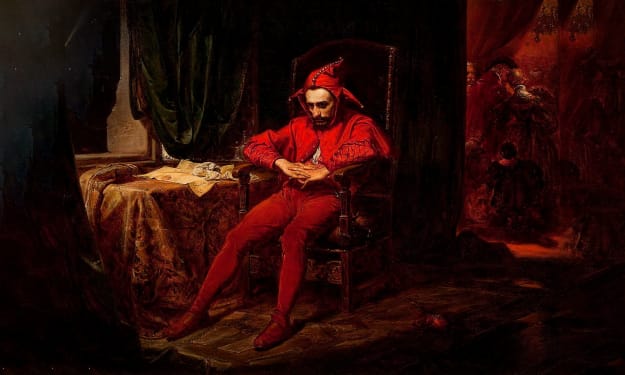
Kraków was engulfed in night like a heavy coat that thickened and resisted shedding, as if there were an invisible force rejecting all life around. Inside a chamber dark as the depths of a comet’s tail spilling through a window, glowing a faint grey, sat a man alone. His clothes were a strange mixture of bright red and black, adorned with jingle bells that rang out laughter, as though whatever once caused them to do so was simply an echo now devoid of sound. This man was Stańczyk, the court jester, yet the expression on his face was anything but jovial. He appeared astonishingly forlorn, his haunted gaze lost deep within the throes of a letter weightily spread open on the table before him. All Stańczyk could notice was a broken, worn wax seal that appeared flaccid like human desire, and the letter whispered softly with the simple phrase 'Smolensk is lost.'
By LUCCIAN LAYTH10 months ago in Psyche
CHAPTER I:The Well of Unspoken Melodies
At times, late into the night, just before dawn arrives, I find myself standing at the brink of the well behind my apartment, which is but the lame remains of a stone opening from which an unwelcome dampness and an inexplicable nostalgic odor egress. The woman I have fallen in love with exists in the silence of the well, although she has never visited, lived, or moved into this space. She could reside in the negative spaces: the interval between the drops of water, the shadow that hugs the bricks, the remembered laughter of a laugh I dreamed once. I have made a secret of her name even to myself.I met her in a jazz bar in Shinjuku, Tokyo, while the saxophone's vapid breath fogged the windows and the ice in my whiskey would freeze in time. She sat two barstools down from me and was reading from an old edition of The Wind-Up Bird Chronicle, her fingers slowly stroking the book's spine as if it were an artifact of divine significance. Her hair settled as a curtain of protection between us, and every time she turned a page, the sound rumbled like nearby thunder. I made myself order another drink that I didn't want, to remain comfortable to the warm silence while she had not left. She left before the set was over and left a hair clip, which was shaped like a small sparrow.I concealed it within my pocket, where it buzzed against my thigh like a caged cicada.The hairpin now rests upon my poor, sad desk next to an unwanted stack of letters that regretfully, I have never sent. Of an evening, when the pulse of the city becomes somewhat relaxed, I will press it to my ear and imagine I can hear something—a jazz standard played backward or a train running on tracks too far out of the imagination to fully comprehend. I write her about these oddities; “The well is deeper than it seems,” I scrawl once, and crumple the paper. The language fails. It lays claims to the canted shape of desire.The dreams started in October. I am trapped in a hotel with a winding labyrinth of a space; a corridor might break into the sky without stars, an elevator opening into a field of wheat, not a cloud, or an elevator. She is always there, just out of reach type of way; a shadow out of a window, and a voice, somewhere down a corridor. At one point, a cat, a black stray that seemed to be unchanged in my likeness was about to meet me like a time traveler. Flicking its tail like a pendulum, I made eye contact, finding my girl's reflection on the solid blackness of its iris. “You are chasing a ghost, you know,” it said, though it had no working mouth. “The question is, isn't that the point of the story, for you to chase a ghost?"
By LUCCIAN LAYTH10 months ago in Chapters
Chapter VII: The Ontology of Silence
From every corner of experience quiet, in its variations, is the sound of existence itself, the sound of absence. Silence has varied qualities. Think about the silence of dawn in the woods where the light of day pierces the top of the trees each moment like God holding its breath a split second longer; unmistakably old silence vibrating with memories of a forming world. Or, consider the silence of the city at sleep, thick with human noise, its asphalt heating up from the day's activity, not yet dissipated, a whole inhabited unconscious simmering like neurons firing in synchronization. Or, think about the silence before storm, a stretch, poised like a bow-and-arrow, the sound of silence true, always an inevitability; and, then there is the silence after-storm the world emerged as if it was hollowed out from a gutting, shaken pure everything is deemed newborn
By LUCCIAN LAYTH10 months ago in Confessions
Chapter III: The Painter’s Paradox — Creation as Annihilation
There is a man whose artwork is not composed with a brush dipped in paint, but rather dipped in existence itself. The bristles of his paint brush, dipped in a white so bright it worships the very idea of painting, are believed to be the extract of the very marrow of the soul itself. Each stroke is not just light on canvas, but light imagined; he contains the power to release light into the fathomless void lurking around the periphery of life. He is a painter of the endless dark, a witness to a subjectless mute whose silence speaks louder than any tangible utterance. Language fails here; any word on the edge of the subject's tongue is siphoned away, absorbed, dissolved, and regurgitated onto the dried slick of basanit slate as pigment. What else could it be called but a sacrament? His brush as chalice; his white, the dictated libation of a soul grasping at meaning in its own frailty.But as the light escapes his brush, the shadow is also introduced.
By LUCCIAN LAYTH10 months ago in Psyche