Stories (111)
Filter by community
White Label App Development Costs in Maryland 2026
Maryland’s tech corridor—stretching from the Baltimore innovations hubs to the federal contracting clusters in Bethesda and Rockville—has seen a significant shift in 2026. As local businesses move away from the high overhead of custom ground-up builds, white label solutions have become the primary vehicle for market entry. This guide breaks down the current cost structures, regional price drivers, and implementation risks for Maryland-based organizations.
By Devin Rosarioabout a month ago in Journal
Houston App Development Costs 2026 Startup Budgeting
Building a mobile application in Houston in 2026 requires a different financial strategy than in previous years. The local tech environment, centered around the Ion District and the East End, has matured significantly. While Houston remains more affordable than Silicon Valley, the cost of specialized talent has risen lately. Developers now use automated coding agents to speed up basic builds and reduce manual labor. However, the complexity of integrating private artificial intelligence models and meeting strict data privacy standards has increased. Startups often underestimate the total capital needed to move from a prototype to a market-ready product. Expenses now focus on secure data architecture and real-time processing capabilities for the modern user. This guide breaks down the actual numbers for Houston startups based on recent market data observations.
By Devin Rosarioabout a month ago in Journal
Minnesota App Development Costs 2026: Startup Budgeting Guide
Building a mobile application in Minnesota in 2026 requires a new approach. You must move away from 2023-era budgeting methods. The region remains a very cost-effective alternative to Silicon Valley. However, several factors have shifted where your money actually goes. These factors include generative AI and new spatial computing needs. Stricter data privacy laws also play a major role now. For startups, cost is no longer just about hourly developer rates. It is about the long-term debt of old frameworks. You must weigh this against the cost of future-proofed systems. AI-integrated systems have higher upfront costs but better longevity.
By Devin Rosarioabout a month ago in Journal
The Real Cost of Virginia App Development in 2026
The Virginia tech landscape presents a unique cost-value proposition in 2026. It spans from the dense data centers of Ashburn to hubs in Richmond and Norfolk. Startups must look past simple hourly rates to understand development expenses. They must consider the shift toward AI-integrated architecture. Heightened security compliance is also a major factor now. This guide breaks down current capital requirements for a market-ready application. It focuses on the standards required within the Commonwealth.
By Devin Rosarioabout a month ago in Journal
Louisiana App Development Costs 2026 for Startups
Building a mobile application in Louisiana has changed. The shift is significant as we enter 2026. The "Silicon Bayou" still offers a cost advantage. It is cheaper than Austin or Atlanta. However, local startups face a complex pricing landscape. This is driven by new AI requirements. There is also a tight market for senior talent.
By Devin Rosarioabout a month ago in Journal
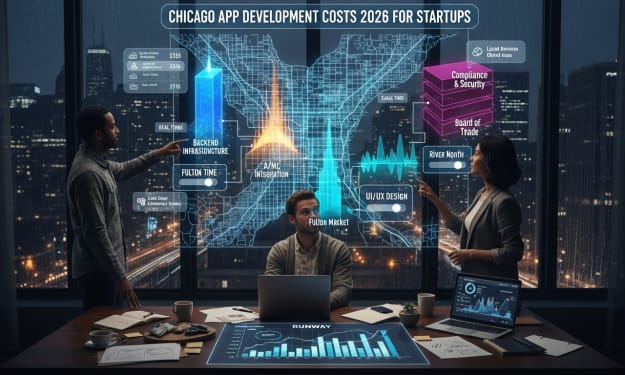
Chicago App Development Costs 2026 for Startups
Building a mobile app in Chicago in 2026 requires a deep strategy. It is about more than just having a budget. Founders must understand a maturing tech ecosystem. In this market, Midwestern labor rates now meet coastal quality standards. The "Chicago discount" compared to San Francisco has narrowed significantly. This change occurred because local firms now specialize in high-stakes fields. These fields include fintech, logistics, and healthcare. These industries require high levels of precision and reliability. Startups benefit from this by getting world-class engineering locally. This proximity can improve the return on your investment.
By Devin Rosarioabout a month ago in Journal
Dallas App Development Costs in 2026: Startup Budgeting Guide
The Dallas-Fort Worth metroplex is now a top tech hub. People often call this region the "Silicon Prairie." In 2026, the local tech scene is very mature. Many elite workers moved here from coastal cities. This move created a very competitive talent market. It also made development more expensive for local startups. Founders must now understand local labor rates very well. They must also understand modern development frameworks. These frameworks help manage high 2026 costs.
By Devin Rosarioabout a month ago in Journal
Georgia App Development Costs 2026: Founder's Guide
Developing a mobile application in Georgia has changed significantly. It used to be a budget-friendly secret. Now it is a strategic regional hub. It serves startups from Europe and Central Asia. By early 2026, international tech talent has flooded the country. The local ecosystem has matured. This has normalized pricing across the board. Technical standards have also risen. Startup founders must calculate costs carefully. Do not just look for the cheapest labor. Instead, evaluate the cost-to-quality ratio. Georgia is now a mid-market European tech corridor.
By Devin Rosarioabout a month ago in Journal
North Carolina App Development Costs for Startups in 2026
Building a mobile application in 2026 is complex. It requires a sophisticated financial strategy. This is more true now than in previous years. North Carolina remains a strong competitive alternative. It rivals Silicon Valley or New York City. AI-driven development has changed the market. Specialized local talent costs have risen too. These factors shifted the baseline for startup budgets.
By Devin Rosarioabout a month ago in Journal