
THE MYSTICAL RELATIONSHIP BETWEEN BACH AND BEETHOVEN - ALEXIS KARPOUZOS
Bach: Music as the Archetype of Cosmic Harmony – Beethoven: Music as the Struggle of Human Consciousness

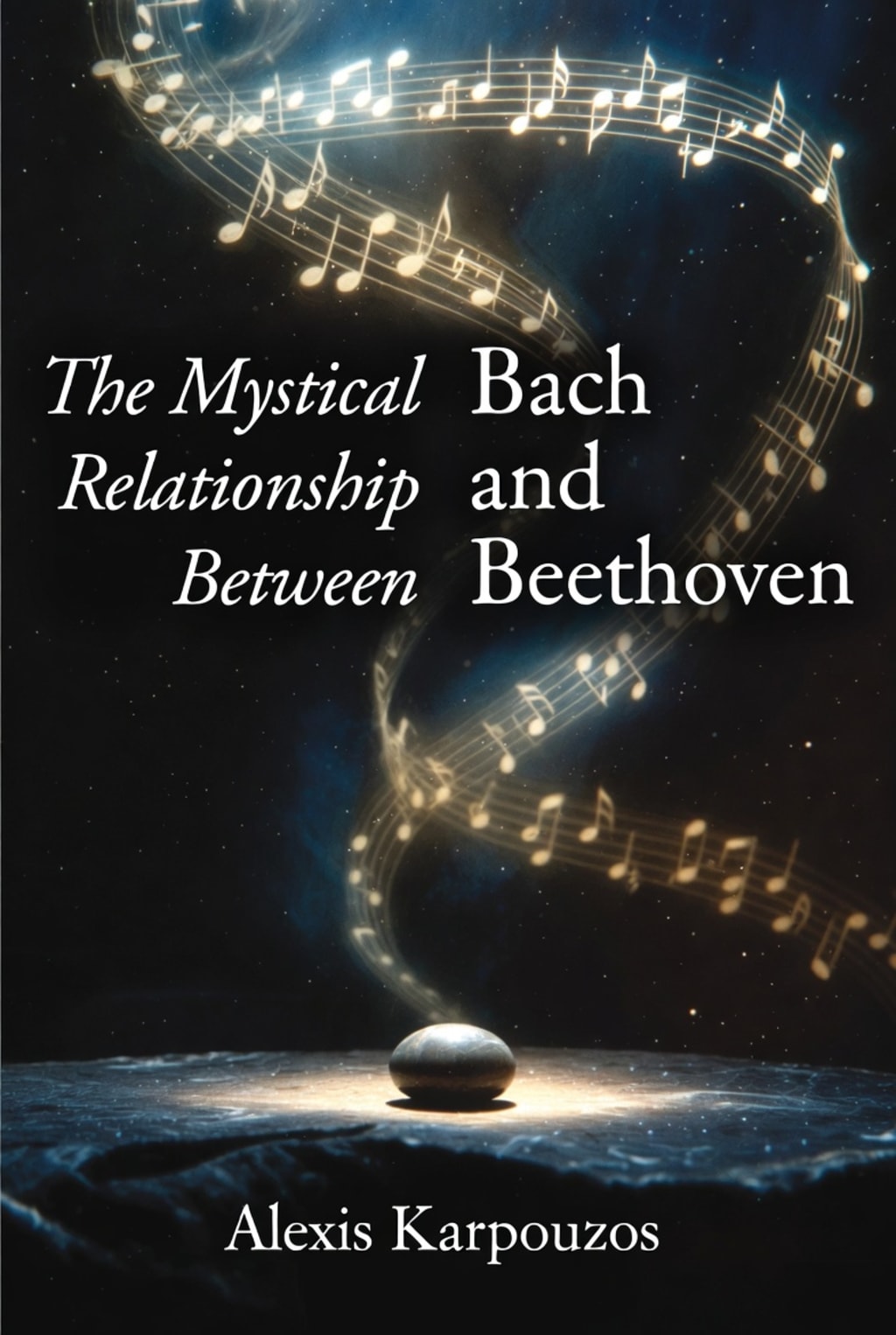
THE SECRET OF THE DIALECTICAL RELATIONSHIP BETWEEN BACH AND BEETHOVEN
Music, as an art of time, constitutes the deepest field where consciousness meets the universe in its primordial ontological dimension, in its uninterpretable form. In this ontological dimension, the forms of music are not mere aesthetic expressions but ways of revealing Being. Two of the most pivotal ways of this revelation emerge through the music of Johann Sebastian Bach and Ludwig van Beethoven. Their comparison cannot be external; it constitutes a comparison of two anthropological and cosmological principles, two forms of relationship between Humanity and the World, two primordial possibilities of existence: necessity and freedom, cosmic order and human transformation.
Bach: Music as the Archetype of Cosmic Harmony
Bach's music does not merely present a structure but emerges as an archetype of cosmic geometry, expressing the law-like dimension of the world, the harmony of cosmic necessity. His music, full of polyphony and counterpoint, captures a perpetual harmony that arises from the interaction of voices. His fugues and compositions incorporate a determined musical canon that is independent of the composer's will, but expresses the necessary order of the world. Bach's music follows strict compositional rules, yet simultaneously, through this layered structure, the freedom to combine voices and create new sonic possibilities is born. In other words, Bach creates within limits, but through these limits, he expresses maximum creativity. Necessity in Bach does not suppress creation but enhances and integrates it within a structured system. Bach's music is an experience of the world's order. Identity and repetition are elements that define his artistic method. There is nothing random in his composition: every voice is an essential element that fits into the complete structure of the musical work. Necessity is the foundation upon which the music develops.
Bach is the mystic of affirmative universality: he accepts that there is a unity pre-existing human will and makes it audible through music. In this context, music becomes a form of ontological memory; it reminds us that we belong to a world where everything has its place, every phenomenon fits into a sequence of meaning. His aesthetic is the aesthetic of necessity: there is nothing accidental, nothing superfluous. His musical writing is like a mirror where the world rises as order. Bach is considered the musical composer who presented the universe as a geometric structure: his work reflects the harmony of worlds, where every element fits into a universal, predestined order. This order, however, is not merely external and exogenous to humanity. On the contrary, it constitutes the endogenous dimension of reality, which the human spirit recognizes and conforms to. Bach composes in such a way that music reveals this necessity of reality. The harmony of the world, expressed through fugues and counterpoints, recalls Schelling's philosophy of the coherence and dialectical unity of nature. Schelling, in his "Philosophy of Nature," argues that spirit and nature are connected in such a way that spirit is embedded in nature and recognizes natural laws as fundamental and immutable. In Bach, music becomes the imprint of this natural necessity: a series of sounds and combinations that follow determined paths, without any possibility of arbitrary intervention or deviation from the flow of cosmic lawfulness.
Beethoven: Music as the Struggle of Human Consciousness
If Bach represents necessity, Beethoven is the voice of freedom. In him, music does not express a pre-existing harmony; it constructs it, claims it, fights for it. The morphology of his symphonies, the dramatic intensity, the constant penetration of personal passion into the universal, highlight a worldview where existence does not accept order as given but as something to transcend in order to rediscover it at a higher level. Beethoven introduces the tragic element into art: the struggle of humanity with its limits, the endless effort to reconcile with the world without losing its inner flame. In his work, music becomes an ethical force: it calls upon humanity to become what it is, to realize its freedom through conflict and transformation. In contrast to Bach, it does not offer us a ready-made harmony, but a harmony-as-goal, an unattainable but necessary ideal. Especially in his symphonies, such as the 9th Symphony, Freedom is the driving force revealed through conflict and tension. Beethoven destroys and recreates, bridging the gap between universal order and personal, spiritual freedom. In his most intimate compositions, such as Piano Sonata No. 32, freedom is expressed as inner revolution. The element of subversion is in every phrase, in every dynamic change. In Beethoven's art, harmony is not given but is constantly conquered through human will and the need to overcome the limits imposed by nature or the world. The emotion and passion of Beethoven reveal the explosion of freedom expressed through his music, and at the same time, it transcends the principles of necessity.
The Dialectical Unity of Necessity and Freedom
Bach's music captures Being as lawfulness. Beethoven's music captures Being as becoming. Their philosophical unity highlights Being as a living contradiction that generates creation. The synthesis of two opposing but complementary musical and philosophical worlds constitutes the unified and multidimensional cosmic spacetime, empty and full at the same time, the rhythm of the abyssal World.
Bach (J.S. Bach): Order, Structure, and Eternity
Bach represents the perfect Form, the architecture and logic of music. He symbolizes:
Eternity and the Transcendent: His music, with its fugues and antiphonies, is strictly structured, free from subjective emotion and time. It brings to the surface the timeless cosmic order.
Structure and Canon: He represents the Principle (Logos) and spiritual discipline. It is the music of Inner Stability and Divine Construction.
Beethoven (L.V. Beethoven): Passion, Conflict, and the Hero
Beethoven represents conflict, human drama, and revolution. He symbolizes:
Subjective Passion and Action: It is the music of human struggle, heroic will, and emotional explosion.
Transcendence of the Canon: He represents the Romantic era, where the individual spirit breaks the boundaries of classical form. It is the music of Search and Struggle for freedom.
The Synthesis of Bach-Beethoven is not merely a sum, but spiritual completion: The Spiritual Principle (Bach) meets Human Struggle (Beethoven). Order meets Chaos and Passion, incorporating it. It is the idea that spiritual enlightenment is not isolation in order, but the incorporation of order (Bach) into the dramatic, contradictory experience of human existence (Beethoven).
The hidden secret of the synthesis of Bach and Beethoven reveals the dialectical union of the seemingly contradictory principles of necessity and freedom. In their work, this encounter is expressed in a way that is not immediately apparent, but arises from the dialectical process of synthetic creation. Just as contradiction in Hegel's philosophical theories leads to higher unity through the transcendence of oppositions, so too their music incorporates the tension between these two elements, providing the possibility for a new world of aesthetics and existence. This synthesis, as a convergence of two seemingly opposing principles, highlights the metaphysical necessity of freedom. Bach's musical world, full of necessity and lawfulness, acquires meaning only when it accepts the dynamic freedom of Beethoven. Conversely, Beethoven's freedom can be realized only through the necessary structure offered by Bach's cosmic order. This secret highlights humanity's need to participate in the continuous creation of the world and not merely accept it as given.
The dialectical synthesis of Bach and Beethoven is not merely a musical phenomenon, but a philosophical and ontological revelation. These two great musicians express the basic principles of human existence: lawfulness and freedom, which are not contradictory, but complementary, mutually shaping, mutually destroying, and transforming each other. The synthesis of these two worlds is, like life itself, an eternal process of creation and destruction, order and passion. This hidden secret of the synthesis is the recognition of the dialectical relationship between humanity and the world: humanity can find its true freedom only when it recognizes the necessity of the world and when its freedom becomes the creation of a new world — just as Beethoven's music and Bach's cosmic harmony do.
Cosmo-aesthetics, as asymmetric symmetry, as realization of multidimensional unity, is not focused on the level of music; it becomes an existential direction. Humanity must not choose between submission to order and its denial, but understand that freedom is the deepest manifestation of order, when order becomes conscious. In this spirit, music ceases to be an aesthetic object; it becomes a path of Knowledge — Wisdom. It reveals to us that existence is not one-dimensional, but a symphony of oppositions and contradictory elements — just as the encounter of Bach and Beethoven.
Necessity as an Ontological Category
Necessity is a category that refers to what is necessary, immutable, and universal. In Hegel's philosophy, necessity is connected to the concept of the world's meaning and dialectical evolution. All existence, according to Hegel's dialectic, has an internal goal or purpose, a destination, which advances through the interaction of contradictions and oppositions. This goal or purpose is determined by the ongoing becoming of the world and not by an external force or chance. The necessary is that which constitutes the basis of every existence and, at the same time, that which drives the evolution of the world. From this perspective, Bach's music expresses a necessity of order. His polyphony and fugues are not merely forms produced by coincidence, but organized, fundamental expressions of a universal plan that connects all voices and parts to each other. In essence, Bach's music is an image of the world as universal order. Every part of the composition, whether the theme or the counterpoint, is part of a larger functional unity, where the composer's choices are limited by the structure and rules of the musical language, which by their nature are necessary and immutable.
Freedom as Transcendence of Necessity
Freedom, on the other hand, is the subject's ability to act according to its own reason and personal will, while at the same time recognizing and interacting with the universal and the necessary. Freedom is not merely the ability to act without restrictions, but the ability to determine and shape our destiny, even within the field of the world's needs and limitations. In Hegel's philosophy, freedom is intertwined with the recognition of the self as law. Hegel argues that only through the distinction between the self and the world can humanity acquire true freedom — that is, to transcend necessity not by denying the world, but by shaping it according to human consciousness and will. This concept of freedom is clearly expressed in Beethoven's music. His music is not merely a continuous flow or development, but a conflict and transcendence of contradictions. In Beethoven's work, the internal tensions and changes in rhythm, the emotional climaxes and harmonic upheavals express the human desire to create and transform the world, to free itself from destiny and the limited conditions of it. Beethoven's music, therefore, is an embodiment of freedom through constant conflict with necessity, a continuous subversive process that seeks to transcend the established order.
About the Creator
alexis karpouzos
Alexis karpouzos (09/04/1967, born in Athens) is a philosopher, psychological theorist and author. His work focuses mainly on creating an "universal theory of consciousness.
Keep reading
More stories from alexis karpouzos and writers in Art and other communities.
THE PHIILOSOPHY OF MEDITATION - ALEXIS KARPOUZOS
The Paradox of Non-Striving in the Philosophy of Meditation: Agency, Awareness, and the Limits of Intentionality Meditation, a practice rooted in contemplative traditions, presents a paradoxical challenge for philosophical inquiry. In meditation, practitioners often aim for a state of effortless awareness—a state free from striving and intentional effort. Yet, meditation as a practice seems to require intentional effort to reach such a state. This paradox raises crucial philosophical questions about the nature of agency, intentionality, and selfhood. This paper explores the paradox of non-striving by examining the philosophical implications of meditation across different traditions, including Buddhist, Daoist, and phenomenological perspectives. The paper argues that the paradox invites a rethinking of agency as a dynamic, non-dualistic skill and suggests that non-striving is not the negation of effort but the cultivation of an effortless, fluid relationship to the present moment. The study of meditation, therefore, offers new insights into the nature of conscious experience, intentionality, and the self, challenging traditional distinctions between effort and non-effort. Meditation has become an object of both popular interest and philosophical inquiry, particularly in recent years. Beyond its applications in therapeutic and mindfulness practices, meditation has a long tradition as a path to self-awareness and liberation. A central theme across many contemplative traditions is the cultivation of effortless awareness, a state in which the practitioner is present in the moment without striving or attachment to goals. This ideal of non-striving is, however, paradoxical: in order to achieve such a state, one must often engage in deliberate effort. This tension forms the central paradox of meditation: how can one strive to reach a state of non-striving? This paradox is not just a theoretical curiosity; it points to fundamental questions about the nature of agency, intentionality, and the self. In particular, it challenges the dominant Western conception of agency as intentional, goal-directed, and willful. By examining the paradox from a variety of philosophical perspectives, this paper aims to illuminate the deeper philosophical issues at play and to reconsider how meditation might offer a new understanding of agency, intentionality, and the nature of consciousness itself.
By alexis karpouzos3 months ago in Education
me, me, me
when i read back my poetry it screams “me, me, me” on my screen in bold letters and i can’t shut it up — most days, i cannot make any other words out; i want to throttle a thousand versions of the me gone by, i want to throw myself from a figurative balcony, i want to sink a sword into every pen i’ve held
By angela hepworth2 days ago in Poets




Comments
There are no comments for this story
Be the first to respond and start the conversation.