
From Blank Canvas to Masterpiece
How confronting my biggest fear led to breakthrough creations and helped me finally embrace my true artistic potential

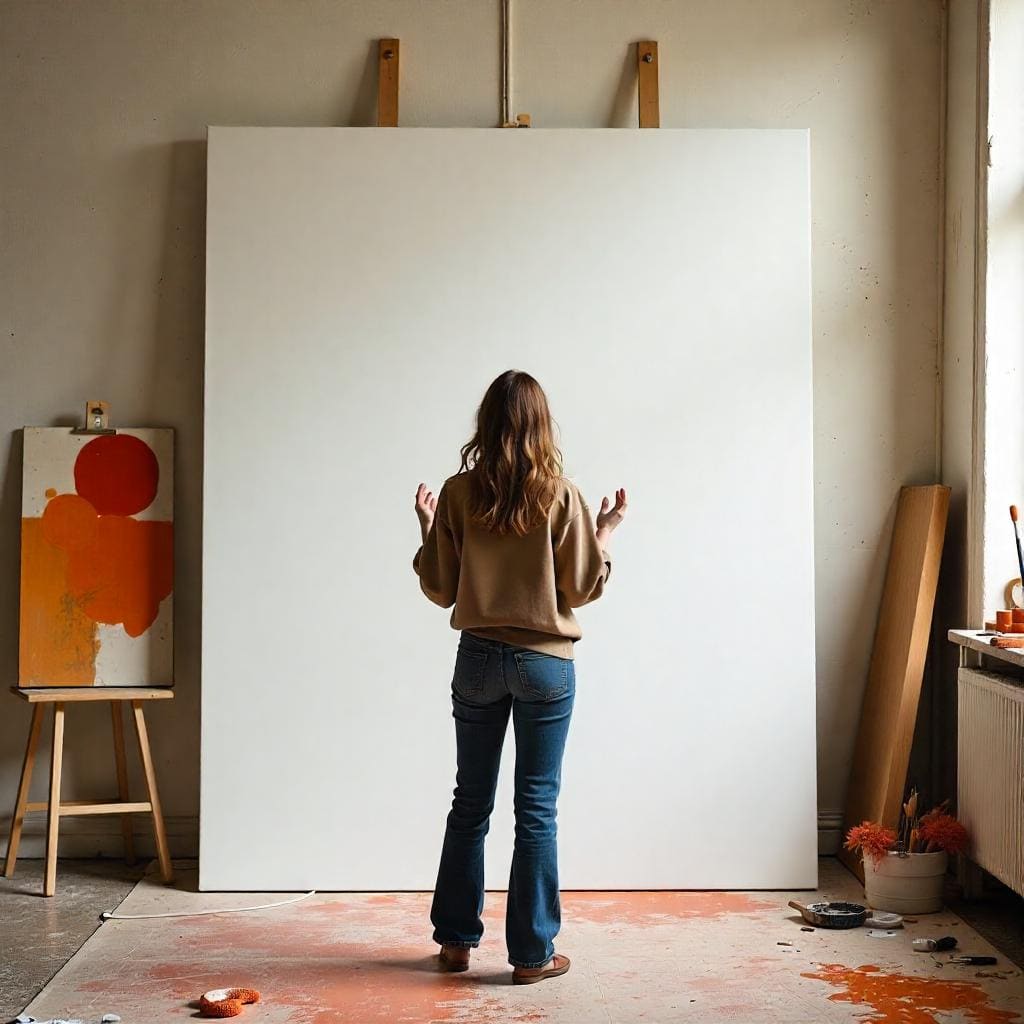
It’s funny how something so simple can become a mountain. A blank canvas—a mere square of white fabric stretched on wood—held a world of possibilities, yet for me, it felt like an insurmountable wall. Every time I stood before it, my mind went blank, and the weight of my fear—fear of failure, of imperfection—would paralyze me.
I’d always loved art. I’d admired it from a distance, studied it, even tried my hand at it in small, experimental bursts. But the real challenge was never the technique, the materials, or the learning curve. It was the fear of beginning. Every new project felt like stepping off a cliff, unsure of whether I would soar or fall.
The walls of my apartment were bare. The supplies were all stacked neatly in my art corner—brushes, paints, and sketchbooks—waiting to be used, yet I avoided them. I told myself it wasn’t the right time. There was always something more pressing to do—work, life, everything but art.
Then one day, while scrolling through social media, I saw something that struck me. It was a quote by one of my favorite artists: “The blank canvas is not a prison. It’s a promise.” I read it over and over. It was like a light bulb flickered on in my mind. The blank canvas wasn’t an obstacle. It was the beginning of something beautiful. I had been treating it like a threat, but I needed to see it for what it truly was: a fresh start.
So, I decided that it was time to face my fear. I gathered my supplies, took a deep breath, and placed a fresh, blank canvas on my easel. For the first time, I wasn’t concerned with perfection. I wasn’t worried about making something “good enough.” I was simply going to create.
I dipped my brush into a rich shade of blue, feeling the soft bristles absorb the paint, and before I could second-guess myself, I swiped the brush across the canvas. The first stroke. It felt powerful and terrifying at the same time. My hands trembled slightly, but I continued, adding more strokes—gentle curves, sharp angles. I watched as the blue began to spread across the white space, creating patterns, shapes, and movement.
It wasn’t perfect. It wasn’t even close to what I had imagined in my head, but in that moment, something shifted. I wasn’t worried about whether it looked “right.” I wasn’t trying to make something that would impress others or fit a certain standard. I was just letting the paint flow. I was letting go of control.
The next day, I returned to the canvas. I added splashes of green and yellow. I layered colors, blending them, watching them bleed into each other. The piece started to take form, but still, I didn’t know where it was going. I didn’t have a plan. And that’s when I realized: it didn’t matter. It didn’t need to be “finished.” The process of creation was enough.
Over the next few days, I painted furiously—dipping into bright reds, deep purples, and soft oranges. With each stroke, the fear that had once gripped me slowly loosened its hold. I realized something profound: art was not about control. It was about freedom—the freedom to make mistakes, to experiment, to explore.
At one point, I started to feel a little frustrated. My piece wasn’t coming out how I’d envisioned it. The edges were uneven, the colors clashed in ways that didn’t make sense, and yet, it felt... real. It felt raw. It was me—my emotions, my fears, my struggles—laid bare on the canvas. It wasn’t polished, but it was honest.
That’s when I had an epiphany: creativity thrives in imperfection. I had spent so much time striving for perfection that I had forgotten the true magic of creating—of making something from nothing, without worrying about how it would be judged. I had been trapped in the idea of producing “perfect” art, and in doing so, I had paralyzed myself. But by embracing the messiness of the process, I allowed myself to finally create something that felt authentic.
As I continued working on the piece, I found myself lost in the rhythm of painting. Time passed without me noticing. The anxiety that had once haunted me was gone. What remained was pure joy—joy of creating, joy of expressing myself without limitations. And by the time I finished, I didn’t see a finished masterpiece. What I saw was a reflection of my journey, a visual diary of how I overcame my fears and doubts.
That painting is still on my wall today, hanging proudly, not because it’s perfect, but because it represents a turning point in my life. It was the moment I stopped fearing failure and allowed myself the freedom to explore. Every time I look at it, I’m reminded that the most important part of creating is starting, and that sometimes, the greatest works come from letting go.
From that day forward, I approached each new art project with the same mindset. I stopped holding myself to impossible standards. I began to embrace the unpredictability of the process. I allowed myself to be messy, imperfect, and free. And with every new painting, I discovered more about myself—about my creative potential and the joy that comes with simply creating.
It hasn’t always been easy, of course. There are still days when I feel that old fear creeping back. But now, I know how to push past it. I know that the only way to truly create is to embrace the process, no matter how uncertain or imperfect it may be.
So, if you’re standing in front of your own blank canvas—whether literal or metaphorical—don’t be afraid to make the first stroke. Don’t let the fear of imperfection stop you from starting. The canvas is waiting for you, full of promise. And all it takes is one brave step to begin.
About the Creator
Muhammad Sabeel
I write not for silence, but for the echo—where mystery lingers, hearts awaken, and every story dares to leave a mark
Keep reading
More stories from Muhammad Sabeel and writers in Art and other communities.
The Forgotten Sketchbook That Solved a 50-Year-Old Murder
It started with a house I didn’t even want. The property had been abandoned for decades, nestled on the edge of a sleepy countryside town where secrets age like wine—gaining strength with time. My grandfather left it to me in his will, a place I had only heard about in passing. I was a city artist with a studio above a noisy café, not someone who remodeled creaky old homes. But after a rough breakup and a string of failed commissions, I found myself packing up and heading there—if only for a change of scenery.
By Muhammad Sabeel10 months ago in Art
South Korea’s Construction Equipment Market: Innovation, Growth, and Future Outlook
Why Construction Equipment Is Gaining Attention in South Korea South Korea’s skyline is changing rapidly. From new residential complexes to high-tech infrastructure projects, construction activity is more dynamic than ever. Behind these developments lies an often-overlooked hero: construction equipment. Cranes, excavators, loaders, and other machinery are quietly enabling some of the country’s most ambitious building projects.
By Kim Soo hyun7 days ago in Art
Australian Woman Dies After Becoming Snagged in Ski Lift in Japan
A tragic accident in Japan has claimed the life of an Australian woman who became snagged in a ski lift, prompting renewed discussions about safety standards at winter sports resorts. Authorities confirmed the incident occurred at a major ski resort, where the victim was reportedly attempting to disembark from the lift when the accident happened.
By Aarif Lashari3 days ago in Art


Comments
There are no comments for this story
Be the first to respond and start the conversation.