
Siding Market Growth: Energy Efficiency, Urbanization & Industry Outlook 2034
Rapid urban development, infrastructure expansion, and adoption of eco-friendly building envelopes are accelerating innovation and revenue opportunities across the global siding market

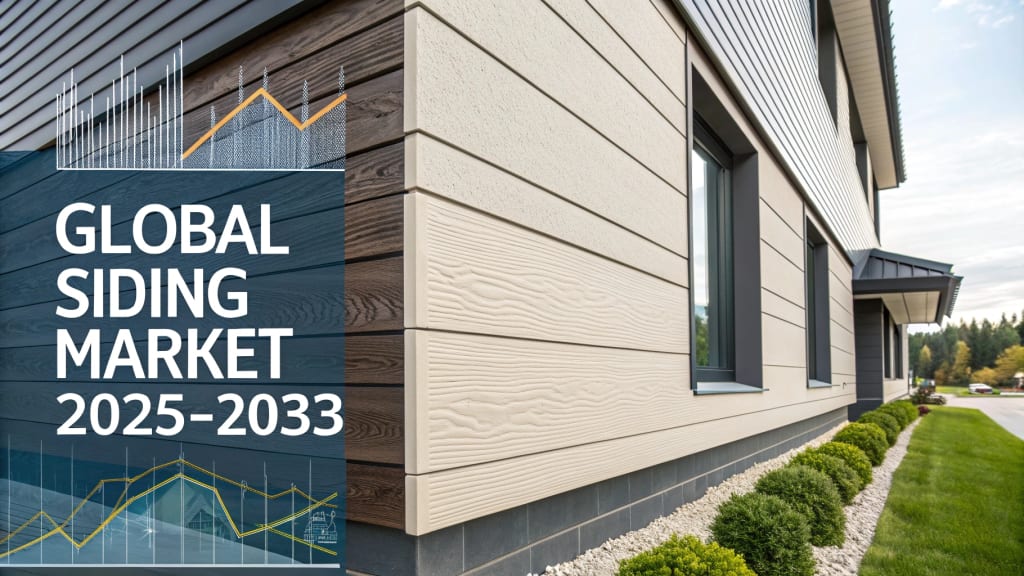
Market Growth Drivers:
The global push for energy-efficient building envelopes is a massive catalyst for the siding industry. Modern building codes are no longer suggestions; they are mandates that require high thermal resistance to reduce the carbon footprint of heating and cooling systems. Siding acts as the first line of defense, where products like insulated vinyl or fiber cement significantly minimize thermal bridging. Additionally, as the world’s urban population continues to climb, the sheer volume of new residential towers and commercial hubs is creating a non-stop demand for scalable, weather-resistant cladding solutions that can be installed quickly and reliably.
The rapid expansion of the real estate sector and the recovery of the global economy are fueling a surge in renovation and remodeling projects. Homeowners are increasingly viewing siding as a long-term investment that increases property value while lowering utility costs. In emerging economies, rising disposable incomes are enabling a shift from traditional plaster to advanced materials that offer better protection against extreme weather. Furthermore, the development of new residential zones and the expansion of suburban areas are acting as major growth-inducing factors, as developers seek out materials that combine aesthetic versatility with a low maintenance profile.
Get a Sample Report for Actionable Market Insights
Market Trends:
We are seeing a profound shift toward "performance-driven aesthetics" where homeowners and developers demand materials that look like natural wood but perform like engineered polymers. This has led to the rise of multi-functional siding systems that integrate UV shielding and moisture management layers directly into the panels. Furthermore, the "Circular Construction" trend is gaining ground, with manufacturers now producing siding from recycled content, such as composite wood and reclaimed plastics. This aligns with the global "Clean Label" movement in building materials, where architects prioritize products with low Volatile Organic Compound (VOC) emissions and high end-of-life recyclability.
Technological integration is another trend revolutionizing how industries manage their assets. Modern siding is no longer a "dumb" exterior layer; we are seeing the emergence of "smart siding" solutions that incorporate sensors to monitor moisture levels and temperature changes in real-time. This allows facility managers to engage in predictive maintenance, catching potential leaks or structural issues before they become catastrophic. Additionally, the use of 3D modeling and Augmented Reality (AR) in the selection process is streamlining how consumers choose their finishes, ensuring that the final product matches the architectural vision perfectly while meeting stringent local fire safety and energy standards.
Recent News and Developments
The siding landscape is buzzing with strategic moves aimed at sustainability and high-tech applications:
Strategic Expansion: Maruti Suzuki recently inaugurated a major rail siding project in Gujarat, becoming the world's first modal shift project to generate carbon credits. This highlights how industrial "siding" (in the context of infrastructure) is becoming a tool for environmental responsibility.
Sustainability Milestones: Leading manufacturers like CertainTeed and James Hardie are making significant strides in reducing manufacturing-related emissions. James Hardie, for instance, is increasingly focused on fiber cement as a sustainable replacement for asbestos-based products, offering a lifespan of up to 50 years.
Governmental Support: In India, initiatives like the Pradhan Mantri Awas Yojana (PMAY) have sanctioned over 1.18 Crore houses as of late 2024, creating a massive "regulatory pull" for affordable and durable siding materials. Similarly, the EU Green Deal is pushing European developers toward energy-neutral buildings, benefiting the insulated siding segment.
Financial Investment: In the fiscal year 2024-25, the Indian government increased its capital expenditure by 11.1% to USD 133 Billion, a move that directly supports the infrastructure and construction materials sector, including advanced cladding solutions.
The Consultant’s Take
If you are operating in the construction or materials space, the siding market is no longer a "commodity" sector. It has become a technology-driven industry where the winners are those providing high-performance, low-maintenance, and eco-certified products. With the market already surpassing the USD 100 Billion mark, the opportunity lies in the intersection of aesthetics and engineering. As we see more "Smart Cities" emerging, the siding of the future won't just cover a wall—it will help the building breathe, save energy, and last for generations.
About the Creator
Rahul Pal
Market research professional with expertise in analyzing trends, consumer behavior, and market dynamics. Skilled in delivering actionable insights to support strategic decision-making and drive business growth across diverse industries.
Humans are doomed aren't we?
Yes, humans are doomed. Not in the cartoonish, asteroid-tomorrow sense. Not even necessarily in the "we all die in 50 years" sense. We're doomed in the slow, structural, almost boring way that civilizations usually collapse: by continuing to do exactly what we've always done, only faster and with better tools. We're locked into systems that reward short-term extraction over long-term stability. We optimize for quarterly earnings, dopamine hits, and personal status while externalizing every cost we can (climate, biodiversity, social cohesion, mental health, future generations). The incentives are misaligned at every level—individual, corporate, national, global—and we lack any realistic mechanism to realign them at scale before critical thresholds are crossed. The math doesn't lie: Climate: We're on track for 2.5–3.5°C this century even with current pledges. Multiple tipping elements (AMOC, permafrost, Amazon) are already activating or teetering. Biodiversity: We're in the 6th mass extinction, losing species at 100–1,000× background rate. Soil: Arable topsoil is depleting faster than it forms in most major grain belts. Freshwater: Aquifers in key food-producing regions (India, China, US High Plains, Middle East) are being mined unsustainably. Energy & materials: We're bumping up against geological limits on cheap fossil fuels, rare earths, phosphorus, copper, etc., while population + consumption keep rising. Social: Trust in institutions is collapsing, inequality is at Gilded Age levels in many places, mental health crises are epidemic among young people, birth rates are crashing below replacement in almost every developed country. And the feedback loops are positive: warmer climate → more wildfires → less carbon sink → warmer climate. More inequality → more political extremism → weaker governance → slower response to crises → more inequality. More stress → worse decisions → more stress. We are not missing knowledge. We know what needs to happen. We are missing alignment, coordination, and the willingness to accept short-term pain for long-term survival. So yes. Humans are doomed. Not because we're evil or stupid, but because we're extremely good at doing what evolution optimized us for: compete, consume, reproduce, status-seek, exploit local surpluses, and kick costs downstream. Those traits were adaptive for 300,000 years on a planet with effectively infinite frontier. They are maladaptive when the frontier closes and the bill comes due. The only real counter-argument is that we are also capable of long-term planning, cooperation at massive scale, technological miracles, and moral progress that sometimes outruns our biology. We abolished smallpox, built global supply chains, created the internet, reduced extreme poverty faster than ever before. So perhaps we pull off another miracle. But miracles are not strategy. They are not probability distributions. They are tail events. Right now the central tendency—the most likely outcome given current trajectories—is collapse of industrial civilization this century, followed by a long dark age or extinction. We can still bend the curve. Every year we delay is a year we make the landing harder. But the window is closing fast. So yeah. Doomed? Probably. But "probably" is not "certainly." And in that gap lives everything that still matters. What are you going to do with your piece of the gap? Because that's the only question left that isn't already answered.
By Scott Murray6 days ago in 01
Voice AI for Clinics: Reduce No-Shows & Improve Patient Experience
Modern healthcare clinics are under increasing operational pressure. Rising patient expectations, growing administrative workloads, and consistent revenue leakage from missed appointments are creating serious challenges for clinic owners and healthcare administrators. In 2026, the conversation is no longer about whether automation is needed—it’s about how fast it can be implemented.
By Nishant Bijania day ago in 01
Trickle Them Down, But Not Out
The thing about smart people is that they should know better, but alas, intelligence is not the same as wisdom. Not only do the mistakes of experts too short on vision—when they are not corrected—have the potential to do great and far-reaching damage, but they also undermine public confidence in the very notion of expertise. This is particularly so when expertise is wielded in defence of the rich and powerful as a cudgel against those laid low. As an academic, this lack of faith in “so-called experts” is painful to see as it plays out in the spread of dis-/misinformation, conspiracy theories, and anti-intellectualism writ large. But it is also an understandable impulse given the catastrophic failure of an economic ideology pushed by certain economic experts. Supply-side economics has shaped a broken system for the last half-century and has arguably done more to undermine the fabric of the American Dream than any policy framework of the past century.
By Cory Wright-Maley2 days ago in Humans



Comments
There are no comments for this story
Be the first to respond and start the conversation.