
Industrial Batteries Market Outlook: Backup Power Systems & Growth to 2034
Increasing focus on sustainable energy storage and electrification of industrial operations is boosting growth in the global industrial batteries market.

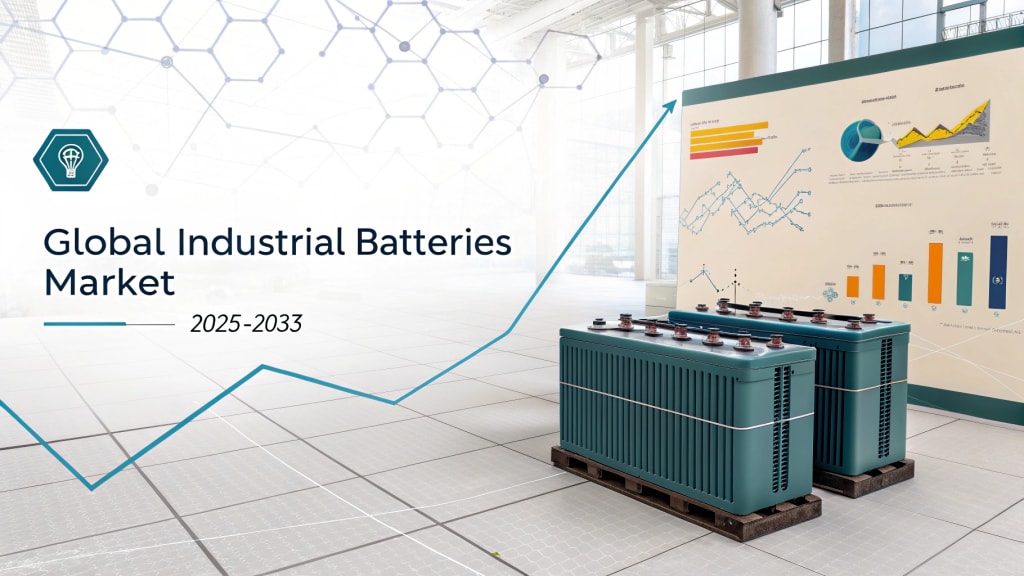
While consumer electronics often grab the headlines, the real heavy lifting of the global energy transition is happening in warehouses, data centers, and power grids. The industrial battery market has evolved from a secondary support sector into a primary driver of industrial efficiency and energy security. As businesses move toward "always-on" operations and greener logistics, the demand for robust, high-capacity energy storage has never been more critical.
Market Insights: A Quantitative Look at the Sector
The global industrial battery market has reached an impressive valuation of USD 23.97 Billion. This growth is a direct reflection of the rapid electrification occurring across the industrial landscape. Current market analysis indicates that this sector is on a clear upward trajectory, with its value expected to climb to USD 42.66 Billion in the near future.
Strategic Market Segmentation: Understanding the market requires looking at the specific technologies and applications keeping the lights on:
By Battery Type:
Lead-Acid Batteries: Despite the hype around new tech, lead-acid remains the workhorse of the industry, currently holding approximately 60.36% of the market share due to its reliability in telecom and UPS applications.
Get a Sample Report for Actionable Market Insights
Lithium-Based Batteries: The fastest-growing segment, favored for its energy density and long cycle life in motive power and grid storage.
Others: Includes Nickel-based and emerging Sodium-ion technologies.
By Application:
Forklifts (Motive Power): This is the dominant application segment, accounting for roughly 31.94% of the market as global logistics hubs automate their fleets.
Telecom & Data Communication: A critical segment ensuring 5G networks and cloud servers remain operational during outages.
Uninterruptible Power Supply (UPS): Essential for hospitals, banks, and manufacturing plants.
Grid-Level Energy Storage: The fastest-rising application, used to balance renewable energy inputs.
By Geography:
Asia-Pacific: The global leader with a 48.46% market share, centered around the manufacturing powerhouses of China, India, and South Korea.
Market Growth Drivers:
The aggressive push toward warehouse automation and the "Amazon effect" on logistics is fundamentally reshaping battery demand. To maintain 24/7 operations, modern distribution centers are replacing manual labor with Automated Guided Vehicles (AGVs) and electric forklifts. These machines require high-performance batteries that support "opportunity charging"—fast bursts of power during short breaks—eliminating the need for time-consuming battery swaps. As e-commerce continues to penetrate global markets, the sheer volume of material-handling equipment requiring industrial-grade power is creating a massive, sustained demand for both lithium-ion and advanced lead-acid solutions across the global supply chain.
Another critical driver is the global necessity for grid stabilization as more renewable energy comes online. Solar and wind power are notoriously intermittent; they don't produce energy when the sun goes down or the wind stops. Industrial batteries act as the "buffer" for the modern power grid, storing excess energy and releasing it during peak demand. Governments worldwide are mandating energy storage targets to prevent blackouts, which is forcing utility companies to invest billions in large-scale Battery Energy Storage Systems (BESS). This transition from traditional fossil-fuel backup to battery-centric grid management is a permanent structural shift in how nations manage power.
Market Trends:
We are currently witnessing a massive trend toward the "localization" of battery supply chains to mitigate geopolitical risks. Major economies are no longer content relying on a few international hubs for their energy storage needs. This has led to the rise of "Gigafactories" in North America and Europe, supported by massive industrial subsidies. In India, for example, the government is aggressively pushing the National Programme on Advanced Chemistry Cell (ACC) Battery Storage, aiming to establish a domestic manufacturing capacity of 50 GWh. This shift ensures that industrial users have a more stable, local supply of critical components while reducing the overall carbon footprint of transport.
Digitalization and the "Internet of Batteries" (IoB) is another trend revolutionizing how industries manage their assets. Modern industrial batteries are no longer "dumb" boxes of chemicals; they are now equipped with sophisticated Battery Management Systems (BMS) and IoT sensors. These systems provide real-time data on temperature, state of charge, and health, allowing plant managers to perform predictive maintenance. By catching a potential failure before it happens, companies can avoid costly downtime in data centers or production lines. This move toward "smart" power allows for a significantly lower total cost of ownership (TCO) over the lifespan of the battery.
Recent News and Developments
The sector is moving fast, with several high-profile developments occurring just this year:
Strategic Investments: Leading manufacturers like Reliance New Energy and Ola Cell Technologies are making significant strides in the Indian market. Ola has already commenced pilot production at its Giga-scale plant, which is a major milestone for domestic cell manufacturing in the region.
New Tech Frontiers: In early 2026, the International Energy Agency (IEA) highlighted that global lithium-ion deployment has reached record levels, with energy storage for power systems growing 20-fold over the last five years.
Governmental Support: The EU Green Deal and India's Production Linked Incentive (PLI) scheme (with a total outlay of roughly USD 2.1 Billion) are acting as catalysts. These schemes are designed to reduce import dependence and have already attracted billions in private investment for new manufacturing lines.
Recycling Milestones: Companies like Campine and various Indian startups are scaling up hydrometallurgical recycling facilities. These plants are now capable of recovering high-purity lithium and nickel from spent industrial cells, feeding them back into the production loop and supporting a circular economy.
Final Perspective from the Field
For any stakeholder in the industrial space, the message is clear: batteries are no longer just an "accessory" to the equipment—they are the heart of the operation. With the market already surpassing USD 23 Billion, the focus has shifted from "can we power it?" to "how efficiently and sustainably can we power it?" As we see grid-scale additions rising by nearly 38% year-over-year, the industrial battery is firmly established as the most important tool in the modern industrial toolkit.
About the Creator
Rahul Pal
Market research professional with expertise in analyzing trends, consumer behavior, and market dynamics. Skilled in delivering actionable insights to support strategic decision-making and drive business growth across diverse industries.
Strategic Decision Making in Small Markets: Doug Stevenson Bowdoinham Maine on Leading With Clarity
In large metropolitan business environments, leaders often rely on scale, capital access, and rapid experimentation to drive results. In smaller markets, strategy requires a different kind of discipline. Doug Stevenson of Bowdoinham, Maine explains that in close-knit communities, every decision carries greater visibility and longer-term impact. Strategic clarity is not optional. It is foundational.
By Doug Stevenson Bowdoinham Mainea day ago in 01



Comments
There are no comments for this story
Be the first to respond and start the conversation.