
Rechargeable Battery Market Outlook: Lithium-Ion Innovation & Grid Storage Demand
Growing investments in grid-scale storage infrastructure and sustainable mobility solutions are driving adoption of rechargeable batteries across diverse end-use industries.

In an era where "wireless" is the default and "sustainability" is the mandate, the humble rechargeable battery has graduated from a consumer convenience to a global strategic asset. Whether it’s the smartphone in your pocket or the electric vehicle (EV) in your driveway, these energy storage systems are the silent engines of the 21st century.
Market Snapshot: The Numbers Behind the Energy
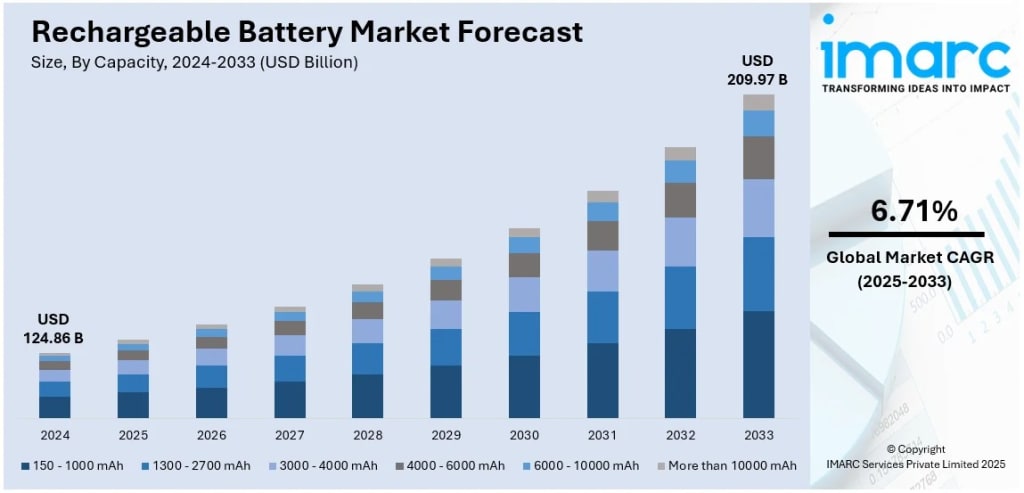
The global rechargeable battery market has reached a staggering valuation of USD 124.86 Billion. As we move deeper into a decentralized energy landscape, the scale of this industry is only expanding, with projections suggesting it will climb to USD 209.97 Billion in the coming years.
Key Market Segments: To understand where the money is flowing, we have to look at how the market is broken down:
Get a Sample Report for Actionable Market Insights
By Battery Type: The industry is led by Lithium-ion (Li-ion) batteries, which currently command roughly 65.8% of the total market share. Other significant segments include Lead-Acid, Nickel-Metal Hydride (NiMH), and Nickel-Cadmium (NiCd) batteries.
By Capacity: Batteries in the 6000 – 10000 mAh range represent the largest segment, offering the "sweet spot" of power for high-drain portable electronics and mid-sized industrial tools.
By Application: While Consumer Electronics was the historical foundation, Automobile Applications have surged to the forefront. Industrial and Defense sectors follow, representing critical growth areas for backup power and specialized equipment.
By Geography: The Asia Pacific region is the undisputed heavyweight, holding over 49.8% of the global market share, thanks to its massive manufacturing hubs and aggressive EV adoption.
Market Growth Drivers:
The accelerating transition toward electric mobility is the primary engine propelling the rechargeable battery sector. As urban centers implement stricter air-quality mandates, the demand for high-capacity Lithium-ion cells has skyrocketed. Beyond personal cars, we are seeing a massive push in public transit; for instance, many cities are replacing diesel fleets with electric buses, which requires battery packs with immense energy density. Furthermore, the sheer volume of the Internet of Things (IoT) market—valued at over USD 1,022 Billion—creates a continuous need for long-lasting, reliable power sources for billions of connected sensors and wearable devices worldwide.
Market Trends:
A significant shift is occurring in grid-scale energy storage as nations integrate more solar and wind power. Because renewable energy is intermittent, large-format battery installations are becoming essential for "peak shaving"—storing energy during high production and releasing it during peak demand. We are also seeing a "localization" trend in manufacturing. Countries are moving away from offshore reliance and establishing "Battery Valleys." For example, the United States and Europe are seeing massive investments in domestic cell manufacturing to secure supply chains, while India has surpassed 200 GW of renewable capacity, necessitating a domestic surge in industrial-grade storage solutions.
Recent News and Developments
The industry is currently defined by rapid-fire innovation and strategic infrastructure projects:
Technological Breakthroughs: In early 2025, researchers at KAUST and Aramco announced the development of high-temperature rechargeable batteries capable of operating at up to 130°C. This is a game-changer for subsurface industrial applications and EVs operating in extreme climates.
Capacity Expansion: Neuron Energy recently opened a 1.5 GWh Lithium-ion plant in India, specifically targeting the EV and telecom sectors. This aligns with a broader global trend of massive capital expenditure (CapEx) in battery "gigafactories."
Governmental Support: The U.S. Inflation Reduction Act and the EU’s Green Deal continue to provide multi-billion dollar tailwinds through tax credits and subsidies for companies that manufacture batteries domestically. In Asia, China’s subsidies for zero-emission vehicles led to the sale of nearly 2 million electric cars in a single year, a 35% increase that directly feeds the battery production pipeline.
Circular Economy Moves: Recycling is no longer an afterthought. Major players like Campine are acquiring lead-acid recycling plants to increase capacity by tens of thousands of tonnes annually, ensuring that the "green" revolution remains sustainable by reclaiming critical raw materials.
The Consultant’s Take
If you are looking at the rechargeable battery market, don't just see a component—see a catalyst. The convergence of 5G, electric mobility, and renewable energy grids means that demand is no longer cyclical; it is structural. For businesses and investors, the focus is shifting from simple energy storage to "energy intelligence"—batteries that charge faster, last longer, and can be recycled efficiently. With the market already surpassing the USD 124 Billion mark, the race to power the future is officially in high gear.
About the Creator
Rahul Pal
Market research professional with expertise in analyzing trends, consumer behavior, and market dynamics. Skilled in delivering actionable insights to support strategic decision-making and drive business growth across diverse industries.
The Evolution of Utility Tokens in a Data-Driven Digital Economy
The cryptocurrency market has grown far beyond simple peer-to-peer payments. These days, blockchain projects are all about fixing problems in the real world, like supply chain verification and data validation, as well as decentralized finance and digital identity.
By Muhammad Irfan Afzal2 days ago in 01
Transforming Digital Video Delivery with VPaaS Solutions and Video Platforms
In today’s digital-first world, video has become one of the most powerful tools for communication, marketing, education, and entertainment. Businesses, content creators, and educational institutions rely heavily on video to engage audiences, convey messages, and deliver information efficiently. However, managing, hosting, and distributing video content at scale presents unique challenges, including bandwidth limitations, latency, storage management, and maintaining high-quality playback across different devices. To address these challenges, organizations are increasingly turning to VPaaS solutions (Video Platform as a Service) and video platforms as integrated solutions for end-to-end video management and delivery.
By Bushra Rajpoot4 days ago in 01




Comments
There are no comments for this story
Be the first to respond and start the conversation.