
Mobile-First or Mobile-Only? The Strategic Decisions Behind Crypto Wallet App Development in 2026
Why Mobile Strategy Is the Defining Factor for Crypto Wallet Success in 2026

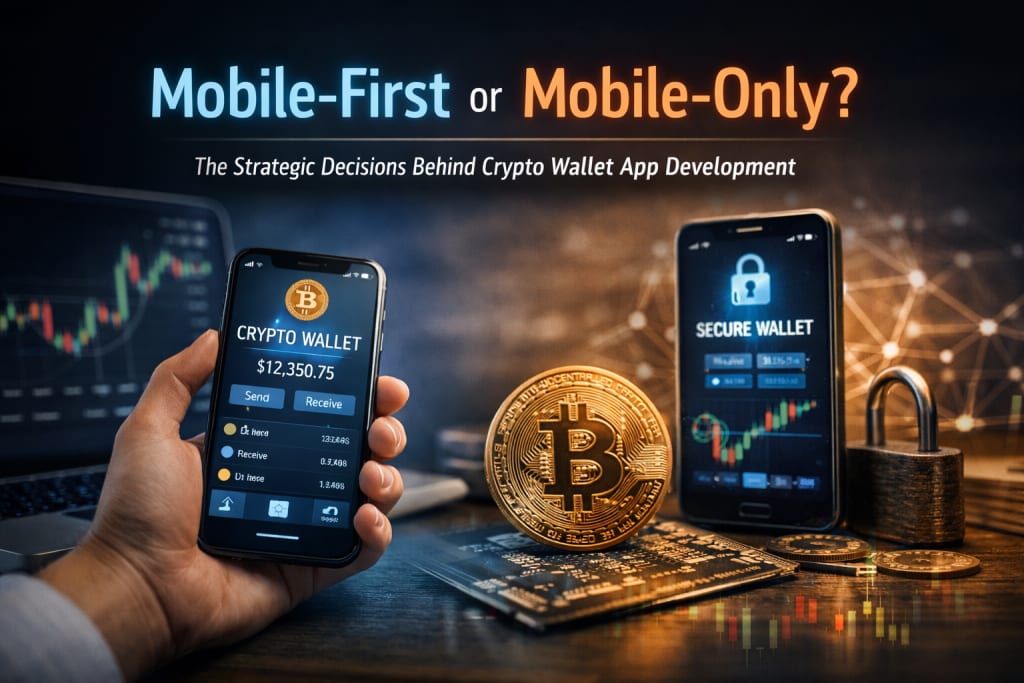
The mobile revolution has fundamentally transformed how users interact with cryptocurrency. Over 78% of crypto transactions now originate from mobile devices, making mobile strategy one of the most critical decisions in crypto wallet app development. Yet the question facing every cryptocurrency wallet development company isn't simply whether to build mobile apps—it's whether to pursue mobile-first, mobile-only, or multi-platform strategies.
This strategic choice profoundly impacts development costs, user acquisition, feature sets, and competitive positioning. Organizations working with crypto wallet development services must understand the tradeoffs between different mobile approaches before committing substantial resources to implementation. Getting this decision right can accelerate growth; getting it wrong can cripple even well-capitalized ventures.
The Case for Mobile-Only Wallet Development
Mobile-only strategies, where wallets exist exclusively as smartphone applications without web or desktop versions, have gained significant traction. Leading crypto wallet app development company providers increasingly recommend this approach for specific use cases.
Cost efficiency represents the most obvious advantage. Building one mobile application costs significantly less than maintaining separate mobile, web, and desktop implementations. Development teams can focus resources on creating exceptional mobile experiences rather than spreading effort across platforms. For startups with limited budgets, this concentration of resources often produces better outcomes than attempting multi-platform development with insufficient resources.
User behavior increasingly supports mobile-only approaches. Younger cryptocurrency users, particularly those under 35, demonstrate strong preferences for mobile-native experiences. They're accustomed to managing financial services entirely through smartphones and don't consider desktop access essential. For wallets targeting this demographic, desktop support might represent wasted investment.
Security benefits also favor mobile-only architecture. Professional cryptocurrency wallet development companies can leverage mobile-specific security features including biometric authentication, secure enclaves, and hardware-backed keystores. These capabilities are either unavailable or less secure on desktop platforms. Mobile-only design also eliminates entire classes of security vulnerabilities associated with web applications.
Faster iteration cycles enable mobile-only teams to respond quickly to user feedback and market changes. Without coordinating updates across multiple platforms, crypto wallet development services can deploy improvements weekly or even daily. This agility provides significant competitive advantages in fast-moving markets.
When Multi-Platform Development Makes Sense
Despite mobile's dominance, certain use cases still demand multi-platform crypto wallet app development. Professional cryptocurrency wallet development services help clients honestly assess whether their situation requires desktop and web support.
Power users and traders often prefer desktop interfaces for serious portfolio management. Large screens enable monitoring multiple assets simultaneously, complex charts display more information, and keyboard shortcuts accelerate common operations. Wallets targeting active traders or serious investors might struggle with mobile-only limitations.
Enterprise and institutional clients frequently require desktop access for operational workflows. Finance teams managing corporate crypto holdings need capabilities that mobile apps struggle to provide—bulk transaction processing, detailed reporting, integration with accounting systems, and collaboration features for multi-user approval workflows. Crypto wallet development companies serving institutional markets typically need desktop implementations.
DeFi interactions often benefit from desktop interfaces. Complex smart contract interactions, liquidity provision, yield farming strategies, and governance participation involve workflows that mobile interfaces handle awkwardly. Users executing sophisticated DeFi strategies appreciate desktop wallets' additional capabilities.
Browser extension wallets serve specific use cases that mobile apps cannot satisfy. Users interacting with decentralized applications through web browsers need wallet extensions that integrate seamlessly with dApp interfaces. Leading crypto wallet app development company teams often build browser extensions alongside mobile apps to capture this important segment.
Native vs Cross-Platform Development Frameworks
Once organizations commit to mobile development, they face another critical decision: native development for iOS and Android separately, or cross-platform frameworks that deploy to both from a single codebase.
Native development using Swift for iOS and Kotlin for Android produces the highest quality mobile experiences. Applications leverage platform-specific features fully, achieve optimal performance, and deliver user experiences that feel genuinely native to each platform. Professional cryptocurrency wallet development companies pursuing native development typically deliver superior apps but at substantially higher cost and with longer timelines.
React Native has become the dominant cross-platform framework for crypto wallet app development. This framework allows developers to write most code once and deploy to both iOS and Android, reducing costs by 40-60% compared to separate native implementations. Performance is generally excellent for most wallet operations, and the large React Native ecosystem provides extensive libraries and tools.
Flutter represents an alternative cross-platform approach gaining traction in cryptocurrency wallet development services. Google's framework offers excellent performance and beautiful user interfaces. However, its smaller ecosystem and less mature blockchain libraries make it less popular than React Native for crypto-specific applications.
Hybrid approaches combine cross-platform frameworks with native code for performance-critical or security-sensitive components. Experienced crypto wallet development companies might use React Native for user interface and general functionality while implementing cryptographic operations and key management in platform-native code. This strategy balances cost efficiency with security and performance requirements.
Mobile Security Considerations
Security requirements significantly influence mobile crypto wallet app development decisions. Mobile platforms offer unique security capabilities that professional cryptocurrency wallet development companies must leverage correctly.
Secure Enclave on iOS and StrongBox Keystore on Android provide hardware-backed key storage that prevents extraction even if the device is fully compromised. Elite crypto wallet app development services store private keys exclusively in these secure elements, performing all cryptographic operations within protected hardware.
Biometric authentication using Face ID, Touch ID, or Android biometrics provides convenient security that users actually use. Professional crypto wallet development implementations combine biometric authentication with device-bound keys, ensuring that even if biometric data is somehow compromised, attackers still cannot access wallet keys from other devices.
App sandboxing on both iOS and Android isolates applications from each other and from system resources. Experienced cryptocurrency wallet development services design around these constraints, understanding that certain capabilities available on desktop platforms simply don't exist in mobile environments.
Jailbreak and root detection helps identify compromised devices that might have disabled security protections. While determined attackers can bypass these checks, they provide defense-in-depth by warning users when their devices lack standard security protections.
User Experience Design for Mobile Wallets
Mobile user experience differs fundamentally from desktop, requiring specialized design approaches that crypto wallet app development company teams must master.
Touch interfaces demand larger tap targets, simplified navigation, and gesture-based interactions that desktop users rarely employ. Professional cryptocurrency wallet development companies conduct extensive usability testing to ensure that transaction approval flows, settings navigation, and portfolio management all work smoothly on small touchscreens.
Information density poses challenges on mobile screens. Desktop wallets can display extensive data simultaneously; mobile interfaces must prioritize essential information and hide advanced details behind additional taps. Successful crypto wallet development services master the art of progressive disclosure—showing users what they need when they need it without overwhelming limited screen space.
One-handed operation matters for mobile applications used on the go. Critical functions should remain accessible with thumb reach, avoiding forcing users to adjust their grip or use second hands for common operations. Leading crypto wallet app development implementations position frequently-used controls in the lower third of the screen where thumbs naturally rest.
Offline functionality becomes more important on mobile devices that frequently lose connectivity. Professional cryptocurrency wallet development services implement robust offline capabilities, allowing users to view portfolio values, prepare transactions, and access settings without network access. Transactions queue automatically and broadcast when connectivity returns.
Performance Optimization for Mobile Platforms
Mobile devices have limited processing power and battery life compared to desktop systems. Experienced crypto wallet development companies optimize performance specifically for mobile constraints.
Battery consumption requires careful management. Continuous blockchain synchronization, frequent price updates, and persistent network connections drain batteries quickly. Professional crypto wallet app development services implement intelligent background refresh strategies, updating data when devices are charging or connected to Wi-Fi while reducing activity when battery life is limited.
App size matters on mobile platforms where users have limited storage and slower download speeds. Leading cryptocurrency wallet development companies carefully manage dependencies, implement code splitting, and optimize assets to minimize application size. Users are more likely to install and retain applications that don't consume excessive storage.
Memory constraints on mobile devices require efficient data handling. Applications must carefully manage memory usage to prevent crashes and maintain smooth operation even on older devices with limited RAM. Professional crypto wallet development services implement memory-efficient algorithms and data structures specifically designed for mobile constraints.
Network efficiency reduces data consumption and improves performance on slower mobile connections. Experienced crypto wallet app development company teams implement intelligent caching, compress network requests, and prioritize critical data over nice-to-have information. These optimizations particularly benefit users in regions with limited or expensive mobile data.
App Store Strategy and Distribution
Distributing mobile wallets involves navigating app store policies, review processes, and promotional opportunities that significantly impact success.
Apple's App Store has strict guidelines around cryptocurrency applications. Professional cryptocurrency wallet development services understand these requirements intimately, designing applications that satisfy Apple's policies while maintaining security and functionality. Violations can result in rejection or removal, so compliance must be built into the design from day one.
Google Play Store has more lenient policies but still requires careful attention. Applications must avoid prohibited content, implement appropriate age ratings, and follow security guidelines. Experienced crypto wallet development companies maintain relationships with platform representatives to expedite reviews and resolve issues quickly.
App Store Optimization (ASO) determines visibility in store search results. Professional crypto wallet app development services optimize app titles, descriptions, keywords, screenshots, and videos to maximize organic discovery. The difference between ranking on the first page versus the third page dramatically impacts installation rates.
Alternative distribution channels provide options when app store policies become constraining. Direct distribution on Android through APK files, third-party app stores, and progressive web apps all offer alternatives. While these channels reach smaller audiences, they provide valuable fallbacks when mainstream app stores prove difficult.
Push Notifications and User Engagement
Mobile platforms enable direct communication with users through push notifications, creating engagement opportunities unavailable on desktop.
Transaction notifications keep users informed about wallet activity immediately. Leading cryptocurrency wallet development companies implement real-time alerts for incoming transactions, successful withdrawals, failed operations, and security events. These notifications provide both convenience and security—users quickly detect unauthorized activity.
Price alerts help users monitor portfolio values and trading opportunities. Professional crypto wallet app development services allow customizable alerts based on percentage changes, absolute price levels, or volume thresholds. However, notification frequency must be carefully managed—too many alerts train users to ignore all notifications.
Security notifications require immediate user attention. Experienced crypto wallet development services prioritize security alerts, using distinct notification styles that stand out from routine updates. Login attempts from new devices, withdrawal requests, and security setting changes should always trigger notifications.
Engagement notifications about new features, market insights, or educational content can enhance user experience when used judiciously. However, cryptocurrency wallet development companies must resist the temptation to over-communicate. Users quickly disable notifications from applications that become annoying, losing the channel for critical security alerts.
Mobile-Specific Features and Innovations
Mobile platforms enable unique features that differentiate forward-thinking crypto wallet app development company products from competitors.
QR code scanning simplifies address entry and reduces errors. Rather than typing long hexadecimal addresses, users simply scan QR codes. Professional cryptocurrency wallet development services implement QR code scanning for address entry, WalletConnect sessions, and even seed phrase backups (though encrypted backups are preferable for security).
NFC support enables contactless payments and peer-to-peer transfers. Some advanced crypto wallet development implementations allow users to simply tap phones together to transfer cryptocurrency, creating experiences as frictionless as traditional contactless payments.
Camera-based features extend beyond QR codes. Leading crypto wallet app development services implement features like document scanning for KYC verification, visual verification of paper wallet seeds, and even augmented reality experiences for crypto-enabled retail locations.
Geolocation features enable interesting use cases including nearby peer-to-peer trading, location-based merchant discovery, and geofenced security policies that restrict transactions when users are in unfamiliar locations. However, privacy-conscious cryptocurrency wallet development companies implement these features carefully, ensuring users maintain control over location sharing.
Testing and Quality Assurance for Mobile Wallets
Mobile testing introduces complexity beyond what desktop applications require. Professional crypto wallet development services implement comprehensive testing strategies covering the wide variety of devices, operating system versions, and network conditions users encounter.
Device fragmentation on Android requires testing across hundreds of device configurations with different screen sizes, processor capabilities, and Android versions. Experienced cryptocurrency wallet development companies maintain device labs or use cloud testing services to verify functionality across representative device samples.
Network condition testing ensures wallets function properly under various connectivity scenarios—3G, 4G, 5G, Wi-Fi, and transitions between networks. Applications must handle connection drops gracefully, resume interrupted operations, and maintain security even when networks are unreliable.
Beta testing programs provide real-world feedback before public release. Leading crypto wallet app development company teams recruit engaged users to test pre-release versions, identifying issues that internal testing missed. TestFlight on iOS and beta tracks on Google Play facilitate controlled beta distribution.
Making the Strategic Choice
The mobile-first versus mobile-only versus multi-platform decision should align with target market, available resources, and competitive positioning rather than following industry trends blindly.
Startups with limited resources and mobile-focused target audiences should strongly consider mobile-only strategies. The concentration of resources produces better mobile experiences than spreading thin across platforms. Professional crypto wallet development services can deliver exceptional mobile-only wallets within reasonable budgets.
Organizations targeting power users, traders, or institutional clients likely need multi-platform implementations despite higher costs. These users demand desktop capabilities that mobile apps simply cannot provide. Working with experienced cryptocurrency wallet development companies helps optimize resource allocation across platforms.
Most importantly, the decision should be deliberate and informed rather than accidental. Too many cryptocurrency wallet development projects pursue multi-platform development reflexively without honestly assessing whether all platforms are necessary. This wastes resources that could create differentiation through superior mobile experiences.
The future of cryptocurrency is undeniably mobile. Whether organizations pursue mobile-only or multi-platform strategies, excellence in mobile crypto wallet app development is non-negotiable for success in 2026 and beyond.
About the Creator
Tarun Nagar
Tarun Nagar is the CEO of Dev Technosys, a leading blockchain development company. With a vision for innovation, he drives the company to deliver cutting-edge solutions in blockchain and decentralized technologies.
Keep reading
More stories from Tarun Nagar and writers in 01 and other communities.
Beyond Hot and Cold: The Multi-Layered Security Architecture Every Crypto Exchange Must Implement in 2026
Security breaches have cost cryptocurrency exchanges over $3 billion in the past five years. Despite this staggering toll, many organizations still approach crypto exchange development with inadequate security frameworks. The distinction between exchanges that survive and those that become cautionary tales increasingly depends on implementing comprehensive, multi-layered security architecture rather than relying on basic protections.
By Tarun Nagar5 days ago in 01
ERP Implementation Strategy: Master Your Go-Live (2026)
Real talk, if you are fixin' to start a software roll-out, you are probably already losing sleep. I reckon half the people reading this have survived a legacy migration that felt like a slow-motion car crash. By 2026, you would think we would have sorted this out, but the erp implementation strategy landscape is still hella messy. Systems are getting smarter, yet humans are still making the same old mistakes. It is like trying to fix a plane while it is doing 500 knots, and someone forgot to pack the parachutes. We are seeing more AI agents than ever, but if your underlying data is rubbish, your shiny new bot is just going to hallucinate your quarterly earnings into the bin.
By Sherry Walker6 days ago in 01
Boundless
A geographical map could take you there. To the places I've been, to the sights I've seen, to the landscapes I've climbed. But no compass could point you in the direction of my memories. To the experiences I've lived, to the happiness I've felt, to the wonder I've held so close to my heart.
By Alyssa Musso3 days ago in Writers




Comments
There are no comments for this story
Be the first to respond and start the conversation.