
ERP Implementation Strategy: Master Your Go-Live (2026)
Discover leading ERP implementation strategies for 2026 to ensure project success and maximize ROI. Learn best practices and master your go-live. Explore our expert guide now!

Real talk, if you are fixin' to start a software roll-out, you are probably already losing sleep. I reckon half the people reading this have survived a legacy migration that felt like a slow-motion car crash. By 2026, you would think we would have sorted this out, but the erp implementation strategy landscape is still hella messy. Systems are getting smarter, yet humans are still making the same old mistakes. It is like trying to fix a plane while it is doing 500 knots, and someone forgot to pack the parachutes. We are seeing more AI agents than ever, but if your underlying data is rubbish, your shiny new bot is just going to hallucinate your quarterly earnings into the bin.
Most of y'all think the tech is the hard part. It isn't. The tech is just code and servers. The hard part is convincing Kevin from accounting that his 15-year-old spreadsheet is actually a liability, not an asset. In 2026, the global market for these setups is pushing past $100 billion, according to Gartner. That is a lot of cash to burn if you do not have a proper plan. Thing is, most companies treat this like a weekend DIY project rather than a heart transplant. It is gnarly, it is loud, and if you do not respect the process, it will bite you. Hard.
The Big Bang vs. The Phased Roll-out
You have got two main choices here. You can flip the switch all at once and pray to the tech gods, or you can take it slow. The "Big Bang" approach is basically for those who enjoy extreme sports without the safety gear. It is risky as all get out. I have seen companies try to go live across twelve countries in one day. It was a proper nightmare. Orders went missing, the warehouse team went on strike, and the CEO was hiding in the breakroom. In 2026, we are seeing a massive shift toward phased roll-outs. It might could take longer, but you actually keep your job at the end of it.
Phasing allows you to iron out the bugs in one department before you break the next one. It is common sense, really. But some executives are hella impatient. They want that ROI yesterday. Speaking of which, teams working in this space, like those at mobile app development ohio, know that local expertise matters more than a flashy slide deck. You need people who understand how your specific business actually breathes, not just how the software is supposed to work in a perfect world. It is about the boots on the ground, mate.
Data Cleansing is Proper Drudgery
Let’s be real, nobody wants to spend six months cleaning up customer records from 1998. But if you migrate garbage, you get a high-speed garbage delivery system. I’ve seen rigs where the "customer name" field was used for lunch orders. You can’t build a 2026-ready erp implementation strategy on top of a landfill. You need to be ruthless. If the data hasn't been touched in three years, bin it. If it is incomplete, fix it before it hits the new cloud database. It is soul-crushing work, but it is the difference between a system that works and one that just generates error messages.
Get this: AI tools in 2026 can now help automate some of this scrubbing, but they still need a human to tell them what "correct" looks like. According to reports from Forbes Tech Council, nearly 60% of project delays are still caused by poor data quality. It is the same old story, just with a different year on the calendar. Do not be that person who ignores the plumbing until the pipes burst. Spend the time. Do the boring work. Your future self will be proper chuffed you did.
Change Management or Riot Management
If you don’t bring your people along for the ride, they will sabotage the system. Not because they are mean, but because they are scared. People hate change. They especially hate change that makes their job feel harder for the first three months. You need a communication plan that isn’t just a monthly email from the HR bot. Talk to them. Show them how the new system actually saves them time. Or at least, be honest about the learning curve. If you sugarcoat the struggle, they will lose trust the moment the first bug pops up.
"The greatest mistake in modern ERP execution is treating it as an IT project. It is a cultural shift. If the C-suite doesn't lead the change, the employees will surely bury the software under a mountain of workarounds." — Eric Kimberling, CEO of Third Stage Consulting, Third Stage Consulting Blog
💡 Ray Wang (@rwang0): "The era of monolithic ERP is dead. In 2026, it is about composable systems that can pivot as fast as the market. If your strategy takes three years to deploy, it is obsolete before it is live." — Constellation Research
The 2026 Playbook for a Gnarly Go-Live
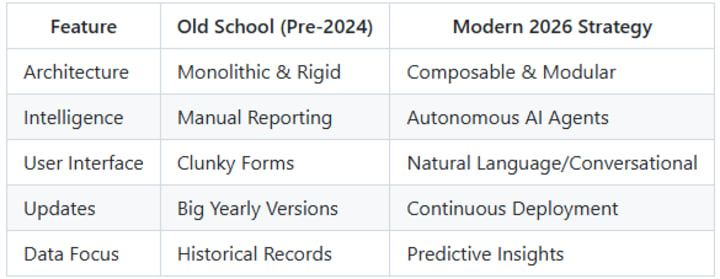
This year, the game has changed. We aren't just talking about cloud vs. on-premise anymore. That debate is so 2020. Now, your erp implementation strategy has to account for agentic AI, real-time ESG reporting, and a workforce that has the attention span of a goldfish. You need a setup that is modular. If one part of the business needs to change, you shouldn't have to rip out the whole spine of the company. This is what we call "Composable ERP." It is basically Lego for grown-ups who like spreadsheets and supply chain logistics.
Tables are a good way to see where you stand. Let's look at how 2026 strategies differ from the old-school way of doing things. It is quite a jump, reckon you'll agree.
The Rise of the AI Copilot
Every vendor from SAP to Oracle is shouting about AI right now. But in 2026, it is actually becoming useful. We are moving past simple chatbots that can't find a purchase order. Modern systems use agentic workflows to handle the "boring" stuff automatically. Imagine a system that sees a late shipment, checks the weather, finds a new carrier, and updates the customer without a human ever touching a keyboard. That is the goal. But wait, this only works if your processes are actually documented. If your workflow is "whatever Sarah decides on Tuesday," AI can't help you.
You have to map your processes before you automate them. It sounds simple, but y'all would be surprised how many companies have no idea how they actually make money. They just sort of... exist. A good 2026 strategy forces you to look in the mirror and decide if your business logic is actually logical. Most of the time, it is just a series of habits dressed up as a strategy. Use the new tech as an excuse to kill off the "that is how we have always done it" mentality. It is proper liberating once you get started.
Training for the TikTok Generation
If you give a 22-year-old a 400-page manual for an ERP system, they are going to quit. No cap. In 2026, training has to be micro-learning. We are talking two-minute videos, interactive walkthroughs, and in-app guidance. It has to be searchable and instant. If they have to leave the application to find out how to do their job, you have already lost. The system should teach the user as they go. It is about reducing the "cognitive load," which is just a fancy way of saying "don't make people think too hard about where the save button is."
I reckon the best companies are even using gamification. Rank the departments on data accuracy. Give out rewards for the fewest support tickets. It sounds a bit dodgy, but it works heaps better than a boring PowerPoint presentation in a windowless conference room. People want to feel like they are winning, even if they are just processing invoices. Make the software the tool that helps them win, not the obstacle that stands in their way. Keep it simple, keep it fast, and for the love of everything, keep it mobile-friendly.
User Acceptance Testing (UAT) Actually Matters
UAT is usually the part of the project where everyone is exhausted and just wants to go home. So, they click "accept" on everything without actually testing the edge cases. This is where the disaster starts. You need your grumpiest, most cynical employees in the UAT sessions. If they can't break it, nobody can. If they say it is rubbish, listen to them. They are the ones who will be using it for eight hours a day. IT people love the features, but the end-users have to live with the reality.
Real talk: if your UAT doesn't result in at least a few heated arguments, you aren't doing it right. You want the friction now, not on go-live morning when the phones start ringing off the hook. Test the weird stuff. What happens if an order is canceled halfway through? What happens if the currency conversion fails? If you don't know the answer during testing, you're fixin' to have a proper bad time later on. It is about being thorough, even when you're knackered and ready for a pint.
"Digital transformation isn't about the software you buy, but the agility you gain. If your ERP doesn't allow you to change your business model in a weekend, you've just bought a very expensive digital paperweight." — Satya Nadella (Paraphrased from 2025 Industry Keynote), Microsoft Events
💡 Brenda Harvey (@b_harvey_tech): "Seeing too many firms skip the 'post-go-live' budget. The day you flip the switch is the start of the project, not the end. Your support costs will peak in month three. Plan for it or perish." — ZDNet Tech Insights
Future Trends: The Road to 2027
Looking ahead to 2027, we are seeing a move toward "Self-Healing ERP." This is wild. Systems are beginning to identify their own data silos and suggesting integrations without human intervention. The market is also pivoting hard toward sustainability. ESG (Environmental, Social, and Governance) tracking is no longer an optional plugin; it is being baked into the core ledger. According to IDC, by 2027, 80% of G2000 companies will use AI-driven resource planning to hit net-zero targets. We are also seeing a massive rise in "Industry Cloud" solutions—ERPs built specifically for niche sectors like biotech or vertical farming, reducing the need for expensive custom coding. The future is hella automated, hella specific, and hella fast.
Measuring ROI Without Fudging the Numbers
The board is going to ask when the system will pay for itself. Most people just make up a number and hope for the best. Don't do that. Focus on "Time to Value." How quickly can you get a new employee up to speed? How much has your order-to-cash cycle shortened? These are real numbers that actually mean something. In 2026, the best setups provide real-time ROI dashboards. You can see the efficiency gains in a line graph. If the line is going down, you have got work to do.
But remember, some benefits are "soft." You can't always put a dollar value on a workforce that isn't ready to throw their laptops out the window. Reduced frustration leads to lower turnover, and hiring is hella expensive. A smooth system is a retention tool. If your tech is brilliant, your best people stay. If it is a dodgy mess, they will head for the hills. Think about the long game, not just the next fiscal quarter. ROI is a marathon, not a sprint, especially with a erp implementation strategy this complex.
The Ghost Town Problem (Post-Go-Live)
The day after go-live is often eerily quiet. Then, the realization sets in. People don't know where the reports are. The integration with the shipping provider is "acting up." This is when most projects fail—not on day one, but in month three. You need a "Hypercare" team that stays on-site (or on-call) for at least 90 days. Do not let your consultants vanish the moment the check clears. You need them around to fix the inevitable weirdness that only surfaces with real-world volume.
Real talk, your internal team is going to be exhausted. They have been working double shifts for months. Give them a break, but make sure there is a clear hand-off. If the knowledge stays in the heads of the external consultants, you are in a proper bind. Document everything. Record the training sessions. Create a "Super User" network within the company so people can help each other. It is about building an internal community that owns the system. You want them to feel like it is *their* tool, not something forced upon them by the suits upstairs.
Mastering the 2026 Go-Live
So, here we are. You have cleaned the data, trained the humans, and survived the UAT arguments. Is there a perfect erp implementation strategy? Probably not. There is always going to be a surprise. A server will go down, or a key stakeholder will decide they want a new feature at the eleventh hour. The goal isn't perfection; it is resilience. It is about having a plan that is flexible enough to survive contact with reality.
Don't let the stress get to you. It's hella hard, but it's also a chance to fundamentally fix how your company works. Take it one step at a time, keep your sense of humor (you'll need it), and listen to your users. If you do that, you might just find yourself in the 25% of projects that actually succeed. And that, my friend, is a proper win. Now, go get 'em, y'all.
About the Creator
Keep reading
More stories from Sherry Walker and writers in 01 and other communities.
Top 10 Mobile App Consultants in Arizona Whose Strategies Changed Product Thinking
For a long time, I believed mobile consultants mostly helped with execution — architecture decisions, technical planning, or scaling issues. Over time, that assumption started breaking down. The consultants who made the biggest impact weren’t just solving technical problems; they were changing how teams thought about products altogether.
By Sherry Walkera day ago in 01
The Strategic Role of a Mobile App Development Company in Digital Transformation
Digital transformation is no longer a buzzword tossed around in boardrooms. It’s a survival strategy. Whether you’re a fast-growing startup or a legacy enterprise, customers expect seamless digital experiences, real-time access, and personalized engagement—often through their smartphones.
By alan michaelabout 22 hours ago in 01
Valentine's Dates Over the Years
Colin grinned as Brooklyn slipped into the living room. “Is it all set?” he asked. The twenty-one year old grinned. She was in her last year of college and Colin knew that Lincoln was proud of her. Although she had been away at college, she’d eagerly helped Colin plan his surprise for Lincoln. “I’m so glad you’re finally doing this,” she said.
By Reb Kreyling7 days ago in Chapters



Comments
There are no comments for this story
Be the first to respond and start the conversation.