
5 Lessons I Learned Navigating the Seattle App Development Market
Why the Emerald City isn't just "Silicon Valley North" - and how I learned to survive the "Amazon Effect" while building digital products.

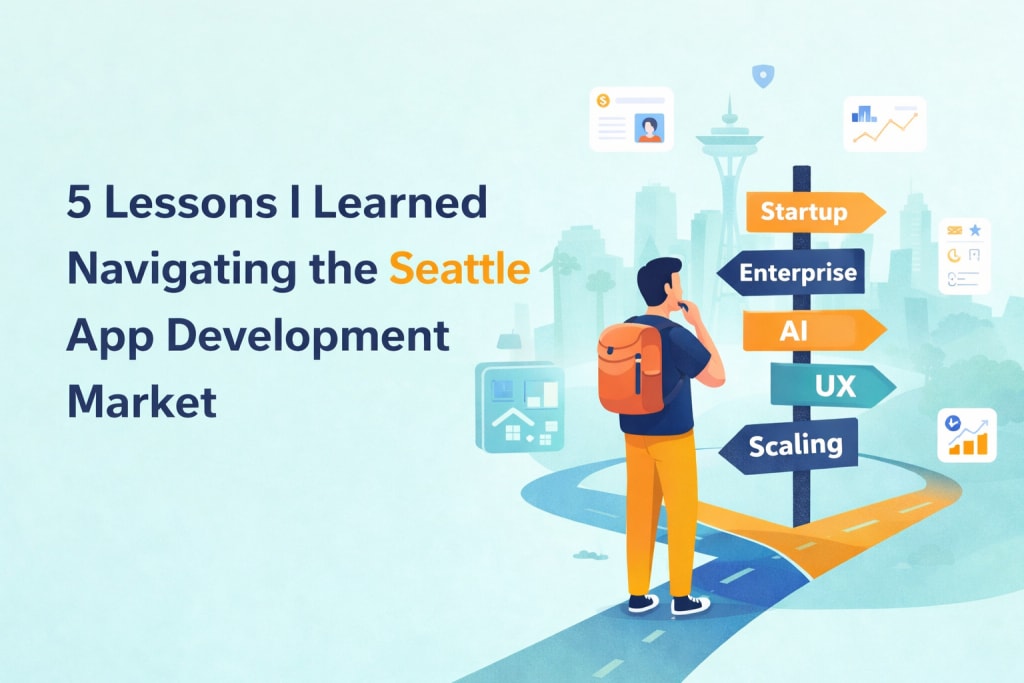
When I first decided to expand my footprint into the Pacific Northwest, I thought I knew what to expect. I assumed Seattle was just "Silicon Valley North"—a rainy extension of the Bay Area’s tech ecosystem. I was wrong.
Stepping into the mobile app development Seattle scene wasn’t just a change of scenery; it was a shift in philosophy. The air here is different, and I don’t just mean the mist off the Puget Sound. The business culture is deeply influenced by the giants that call this region home—Microsoft and Amazon—creating a market that values long-term stability and enterprise-grade architecture over the "move fast and break things" mentality I’ve seen elsewhere.
Over the last few years, navigating this landscape has been a masterclass in adaptation. From talent wars to the sudden explosion of AI integration, here are the five critical lessons I learned while building digital products in the Emerald City.
1. The "Amazon Effect" on Talent is Real (and Expensive)
The first thing that hits you when you try to build a team or find partners in Seattle is the sheer caliber of the workforce—and the price tag that comes with it.
I quickly realized that I wasn't just competing with other agencies; I was competing with the biggest tech companies on the planet. According to a 2025 CBRE report, the Puget Sound area has the third-largest cluster of AI-specialty talent in the U.S., trailing only the Bay Area and New York. This concentration of brainpower is a double-edged sword.
On one hand, the talent pool is incredibly deep. If you need an engineer who understands complex cloud infrastructure or machine learning, they are likely sitting in a coffee shop in Capitol Hill right now.
On the other hand, the costs are steep. Recent data shows that specialized software engineers in Seattle command salaries ranging from $137,000 to over $233,000. When I first started quoting projects, I underestimated this "Amazon Premium." I learned the hard way that you cannot offer "budget" development in a city where the baseline for quality is set by trillion-dollar enterprises.
The Takeaway: If you are entering this market, do not try to compete on price alone. You will lose. Instead, I learned to lean into the quality that this talent pool provides. Clients here expect high rates ($100–$150/hr for local agencies), but they demand exceptional architectural maturity in return.
2. The "MVP" Has a Different Definition Here
In many startup hubs, a Minimum Viable Product (MVP) is often a duct-taped prototype meant to test a hypothesis. In Seattle, I found that "MVP" often translates to "Enterprise-Ready Pilot."
Because the mobile app development Seattle market is heavily skewed toward B2B and enterprise solutions (thanks to the cloud computing dominance of AWS and Azure), the tolerance for buggy software is near zero.
I remember pitching a lean MVP to a mid-sized logistics firm in Bellevue. I proposed a $30,000 budget for a basic build. They looked at me like I was crazy—not because it was too expensive, but because they didn't believe a secure, scalable product could be built for that little.
They were right. Market research from 2025 indicates that a feature-rich business app in this region typically costs between $50,000 and $120,000, with complex AI-driven apps easily pushing past $250,000.
The Takeaway: I stopped selling "cheap and fast." I started selling "scalable and secure." In Seattle, the initial build needs to handle data privacy, compliance, and integration with legacy systems from Day 1. The market here rewards thoroughness over speed.
3. AI is No Longer Optional—It’s the Standard
A few years ago, adding Artificial Intelligence to an app was a nice-to-have differentiator. Today, in a city that is practically the global capital of cloud computing, it is a baseline requirement.
The data supports this shift. The global mobile app market is projected to hit huge numbers by 2026, but the specific growth in Seattle is driven by intelligent apps. With 61.8% of the region's AI talent employed directly by the tech sector, clients here are incredibly savvy. They don't want a chatbot that uses simple scripts; they want generative AI that provides contextual support.
I learned that I couldn't just offer standard mobile app development anymore. I had to pivot my approach at Indi IT Solutions to become AI-first. Whether it was a fitness app needing personalized coaching algorithms or a fintech dashboard requiring predictive analytics, the question from clients shifted from "Can we add AI?" to "How is AI driving the core utility of this app?"
The Takeaway: If your app doesn't learn from its users, it’s already obsolete in this market. I had to upskill my team rapidly to ensure we were fluent in integrating APIs from OpenAI, Google Cloud AI, and Azure Cognitive Services.
4. The "Seattle Freeze" Thaws for Value, Not Hype
You might have heard of the "Seattle Freeze"—the idea that it’s hard to make new friends or break into social circles here. I found a similar phenomenon in the business world, but with a twist.
Seattle business leaders are notoriously skeptical of fluff. In Miami or LA, I found that a flashy pitch deck and high energy could open doors. In Seattle, that same approach often meets a cold shoulder. This is a city of engineers and data scientists. They want to see the architecture. They want to know your API response times. They want to see your security protocols.
I spent the first few months trying to network at high-energy mixers, with little success. I started gaining traction only when I shifted my content and conversation to focus on problem-solving and metrics.
The Takeaway: I stopped trying to "sell" and started trying to "solve." When I approached a potential partner with data showing how a specific mobile architecture reduced server costs by 20%, the "Freeze" melted instantly. The currency of networking here is competence, not charisma.
5. The Hybrid Model is the Only Way to Scale
This was perhaps the hardest lesson to learn, and it ties back to the high cost of talent I mentioned in Lesson 1.
Attempting to build a 100% onshore team in Seattle for every aspect of mobile app development is a financial suicide mission for a growing agency. The margins simply don't work unless you are charging exorbitant rates that alienate mid-market clients.
However, outsourcing everything to an offshore team often leads to a disconnect in quality and communication, which Seattle clients (who are used to high-touch service) will not tolerate.
I found the sweet spot in a hybrid model. I keep the high-level architecture, project management, and UI/UX design strictly local or within high-overlap time zones. This ensures that the client feels heard and the product vision is crystal clear. However, for the heavy lifting of backend coding and testing, we utilize global talent pools.
This isn't just about saving money; it's about speed. With a distributed team, we can effectively have a 24-hour development cycle. The Seattle team scopes and reviews during the day, and the offshore team executes overnight.
The Takeaway: Transparency is key. I never hide the fact that we have a distributed team. Instead, I frame it as a benefit: "You get Seattle-level project management and architecture, with the efficiency and speed of a global workforce." This honesty builds trust, which, as I’ve learned, is the most valuable asset in the Pacific Northwest.
Conclusion
Navigating the mobile app development Seattle market has been one of the most challenging and rewarding experiences of my career. It is a market that demands excellence, rejects hype, and pushes you to be on the cutting edge of technology constantly.
As we look toward 2026, the opportunities here are bounding. With the integration of 5G and the maturation of AI, the apps we are building today are more powerful than the desktop software of a decade ago. But the fundamentals remain the same: understand the local culture, respect the intelligence of your clients, and never stop learning.
If you can make it here, in the shadow of the tech giants, you can build anywhere.
About the Creator
Computer Vision in Retail: Real-Time Intelligence Changing In-Store Decision Making
Retail has always relied on observation—store managers walking aisles, manual audits, historical reports. What has changed is scale and immediacy. Cameras are no longer passive recording devices. Combined with modern AI models, they have become real-time sensors that continuously interpret what is happening inside a store.
By Vitarag Shah5 days ago in 01
No, But Seriously: What’s Going on with Bitcoin?
Bitcoin is acting weird. That’s the simple, unvarnished truth. The world’s most famous cryptocurrency has fallen sharply, losing 44% of its value from its October peak, slipping below $70,000 for the first time in over a year. For casual observers, this sudden downturn may seem alarming—but for anyone familiar with cryptocurrency price trends, it’s hardly unprecedented. Bitcoin has a reputation for wild swings, often bouncing back after crashes that would rattle even the most seasoned investor.
By Story Prism4 days ago in 01
Should We Not Try to Get Too Political?
Here's something you often hear people say, "I try not to get too political." I understand the sentiment and I sympathize with it... while at the same exact time, I completely disagree with the notion. Whether it's referring to social media or wherever, it's kind of unavoidable. You can attempt to sidestep it, not engage, leave the less important things for actual politicians to discuss... you can want it to not take over your life, your conversations, your relationships, and that makes perfect sense.
By Stephen Kramer Avitabile5 days ago in Writers


Comments
There are no comments for this story
Be the first to respond and start the conversation.