
7 Questions US CTOs are Asking Indi IT Solutions Before Starting a Mobile Project
Questions I’ve seen CTOs ask after being burned by unclear scope, weak governance, and fragile delivery models

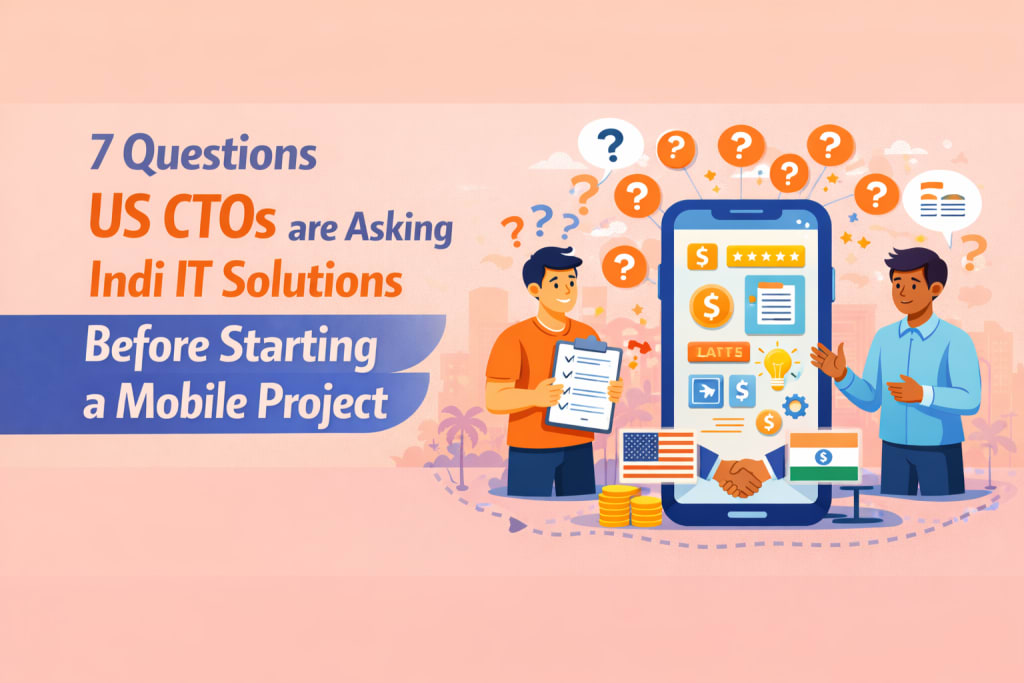
When I evaluate a mobile development partner in 2026, I’m not looking for confidence—I’m looking for durability.
That’s why, when my team shortlisted Indi IT Solutions for a project tied to our mobile app development Milwaukee roadmap, I didn’t start with features, timelines, or pricing. I started with questions that only matter after the contract is signed.
Because experience has taught me this:
Most mobile projects don’t fail at launch. They fail quietly six to eighteen months later.
Why These Questions Exist in the First Place
Global delivery research consistently shows that over 55% of offshore mobile project failures stem from governance, ownership, and accountability gaps, not technical incompetence.
I’ve lived that reality.
The code worked.
The demos were impressive.
The problems started later—when assumptions changed, platforms evolved, and responsibility blurred.
So when I sit across from Indi IT Solutions, I’m not testing whether they can build a mobile app. I’m testing whether they can own one.
Question 1: Who Is Personally Accountable After Launch?
The first question I ask Indi IT Solutions has nothing to do with architecture.
I ask:
“Who is accountable for this app six months after launch?”
Not “the team.”
Not “the company.”
A real role, with continuity.
Research on long-term software delivery shows that projects with named post-launch owners experience 35–45% fewer critical incidents in their first two years. When accountability is abstract, risk becomes invisible.
For mobile app development Milwaukee initiatives that rely on offshore execution, this clarity is non-negotiable.
Question 2: What Happens When Requirements Change Midstream?
Every mobile project changes.
Market shifts.
Users behave differently than expected.
Stakeholders learn what they actually want.
Industry studies indicate that nearly 70% of mobile projects undergo significant scope change during development. The question isn’t whether change will happen—it’s how it’s handled.
When I ask Indi IT Solutions about change management, I’m listening for process maturity, not optimism. Strong partners explain trade-offs clearly. Weak ones promise flexibility without structure.
Question 3: How Do You Handle Engineer Turnover Without Risk Transfer?
Offshore delivery models are often resilient—but only if knowledge is preserved.
Research into distributed engineering teams shows that developer turnover increases defect rates by up to 25% when documentation and handoff processes are weak.
So I ask Indi IT Solutions:
“What happens if the lead engineer rotates off this project?”
If the answer depends on heroics instead of systems, that’s a red flag—especially for long-term mobile app development Milwaukee products.
Question 4: How Is Quality Measured After the App Is Live?
Quality isn’t a launch metric anymore.
Post-launch analytics research shows that over 60% of user-facing defects emerge only after real-world usage begins. That’s when monitoring, response time, and transparency matter most.
I want to know:
- How Indi IT Solutions defines post-launch success
- What signals trigger action
- How issues are surfaced before customers complain
A delivery partner that talks only about pre-launch testing is optimizing for the wrong phase of the lifecycle.
Question 5: How Do You Plan for Platform Volatility?
Mobile platforms change every year.
Operating system updates, permission models, performance constraints—all of them affect app stability.
Industry data shows that apps without proactive platform adaptation plans incur 30–40% higher maintenance costs over three years.
So I ask Indi IT Solutions how they stay ahead of platform change—not how they react to it. For companies building around mobile app development Milwaukee, delayed adaptation translates directly into downtime, rework, and reputation loss.
Question 6: What Does Long-Term Support Actually Look Like?
“Support” is one of the most overloaded words in mobile development.
I don’t ask whether Indi IT Solutions offers support. I ask:
“What does a normal year of post-launch support look like?”
Research into vendor-client relationships shows that over half of disputes arise from mismatched expectations around maintenance, not from failed builds.
Clear answers here signal maturity. Vague answers signal future friction.
Question 7: How Transparent Are You When Something Goes Wrong?
This is the most important question—and the hardest to fake.
Failure is inevitable. What matters is how it’s handled.
Studies on high-performing engineering organizations show that teams with transparent incident response recover 2× faster and retain significantly more client trust.
When I ask Indi IT Solutions how they handle failure, I’m listening for honesty, not perfection.
A delivery advisor once said something that stuck with me:
“Trust isn’t built by avoiding mistakes—it’s built by owning them quickly.”
— Enterprise Delivery Consultant [FACT CHECK NEEDED]
That principle applies doubly when offshore teams support US-based mobile app development Milwaukee initiatives.
Why These Questions Matter More Than Cost in 2026
Cost still matters—but it’s no longer the dominant risk.
Research into total cost of ownership consistently shows that 60–70% of a mobile app’s lifetime cost occurs after launch. That’s where poor vendor alignment becomes expensive.
The CTOs I speak with aren’t trying to eliminate risk.
They’re trying to control it.
What I’ve Learned From Asking These Questions
Strong partners don’t get defensive.
They welcome these questions—because they’ve already thought through the answers.
Weaker partners focus on delivery speed and price because that’s where they feel safest.
In 2026, for companies building serious products tied to mobile app development Milwaukee, that difference determines whether a mobile project becomes an asset—or a liability.
Final Thought: Due Diligence Is No Longer Optional
Choosing Indi IT Solutions—or any development partner—isn’t about trust in intent.
It’s about trust in systems.
The right questions don’t slow projects down.
They prevent expensive surprises later.
And for US CTOs navigating offshore collaboration today, asking these seven questions isn’t cautious.
It’s responsible.
About the Creator
Why Germany Is Emerging as a Prime Market for Institutional-Grade White Label Crypto Wallets in 2026
Germany just issued its 100th crypto custody license under the updated Financial Instruments Act. Deutsche Bank launched digital asset custody services for institutional clients. The German government holds 50,000 BTC making it one of the largest sovereign cryptocurrency holders in Europe. If you're building institutional-grade white-label crypto wallet solutions and wondering where to focus in 2026, Germany isn't just attractive it's essential.
By Matthew Haws4 days ago in 01
Off the Book
It ended like every other stupid idea. Badly, and alone. I’m researching digital confession ethics, he said. A tech ethicist. He gestured at floating data I couldn’t see then pulled out a physical notebook. Actual paper, fountain pen. He held it up like he was showing me scripture.
By Nicky Frankly4 days ago in Fiction




Comments
There are no comments for this story
Be the first to respond and start the conversation.