
AI Voice Agents for Appointment Scheduling in Hospitals
AI-powered voice assistants are revolutionizing hospital appointment scheduling by automating bookings, reducing no-shows, and enhancing patient access 24/7.
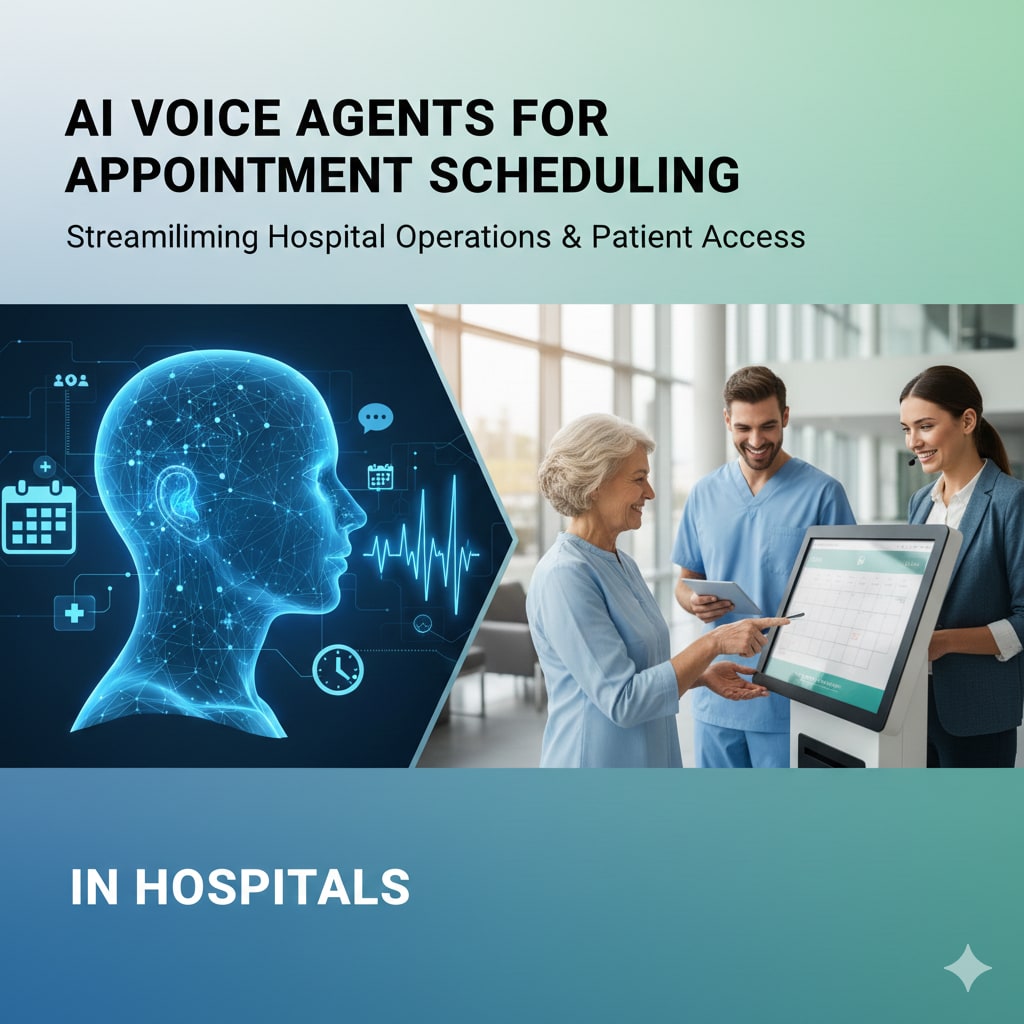
Appointment scheduling is one of the most critical and often most overloaded functions inside hospitals. Between high patient call volumes, rescheduling requests, insurance questions, and last-minute cancellations, front-desk teams are constantly under pressure.
Today, AI voice agents are transforming how hospitals manage this workflow by automating scheduling conversations while maintaining a natural, human-like interaction.
When implemented effectively, AI voice agents for healthcare are not just reducing call center burden they are improving access, lowering no-show rates, and enhancing the overall patient experience.
The Scheduling Challenge in Hospitals
Hospitals handle:
- Thousands of incoming calls daily
- Multi-specialty scheduling complexity
- Physician availability constraints
- Insurance verification requirements
- High no-show and reschedule rates
Manual scheduling creates bottlenecks. Patients often wait on hold, calls get dropped, and staff spend hours managing repetitive tasks instead of supporting clinical workflows.
According to the American Hospital Association, workforce shortages continue to strain administrative and operational teams across the U.S. healthcare system. Appointment coordination is one of the areas most affected.
AI voice agents directly address this gap.
What Are AI Voice Agents in Scheduling?
AI voice agents are conversational AI systems that can answer phone calls and interact with patients using natural language.
Unlike traditional IVR systems that rely on “Press 1, Press 2” menus, modern AI voice agents:
- Understand conversational speech
- Detect patient intent
- Access scheduling systems in real time
- Offer available time slots
- Confirm or modify bookings
- Send automated confirmations
Technology providers such as Nuance Communications (now part of Microsoft) and Google Health have advanced speech recognition and healthcare AI capabilities that power these systems.
How AI Voice Agents Improve Hospital Appointment Scheduling
1. 24/7 Booking Availability
Patients don’t only think about appointments during office hours. AI voice agents allow hospitals to offer:
- After-hours scheduling
- Weekend booking
- Immediate rescheduling
- Instant confirmations
This significantly improves accessibility and reduces call congestion during peak hours.
2. Real-Time Calendar Integration
AI voice agents integrate directly with hospital scheduling software and EHR systems. They can:
- Check physician availability
- Offer alternative dates
- Schedule across departments
- Coordinate follow-up visits
For example:
“Dr. Smith is available Tuesday at 2 PM or Thursday at 11 AM. Which works best for you?”
This conversational approach feels personalized rather than transactional.
3. Intelligent Rescheduling & Cancellation Handling
Last-minute cancellations disrupt hospital operations. AI voice agents can:
- Prompt patients to reschedule immediately
- Offer waitlist opportunities
- Fill canceled slots automatically
- Notify eligible patients of earlier availability
This helps maximize provider utilization and reduce revenue leakage.
4. Reducing No-Show Rates
Missed appointments cost hospitals millions annually.
AI voice agents:
- Send interactive reminders
- Confirm attendance
- Detect hesitation or uncertainty
- Offer easy rescheduling options
Unlike static reminders, conversational AI allows patients to respond naturally, improving confirmation rates.
5. Multilingual Patient Support
Hospitals serve diverse communities. AI voice systems can communicate in multiple languages, improving:
- Health equity
- Scheduling clarity
- Compliance with instructions
- Patient satisfaction
Language accessibility becomes scalable without increasing staff headcount.
Operational Benefits for Hospitals
Hospitals deploying AI voice agents for scheduling report:
- Reduced call center workload
- Shorter average handling time
- Lower operational costs
- Faster patient response times
- Higher booking accuracy
By automating routine scheduling conversations, administrative staff can focus on complex cases, insurance clarifications, and patient support that truly require human attention.
Compliance and Data Security
Healthcare scheduling systems must comply with strict regulatory standards.
Modern AI voice platforms support:
- Encrypted voice communication
- Secure patient data handling
- Role-based access controls
- HIPAA-compliant data processing
Security remains a non-negotiable component of AI implementation in hospital environments.
Human + AI Collaboration
AI voice agents are not replacing scheduling teams. Instead, they act as intelligent assistants.
Routine scheduling → Handled by AI
Complex coordination → Escalated to staff
For example, if a patient expresses confusion, emotional distress, or urgent symptoms, the system can immediately transfer the call to a live representative.
This hybrid model ensures efficiency without sacrificing empathy.
The Future of AI-Powered Scheduling
Over the next few years, AI voice agents will evolve to:
- Predict appointment needs based on patient history
- Automatically schedule follow-ups after discharge
- Coordinate cross-specialty visits
- Detect sentiment during calls
- Personalize scheduling recommendations
With advancements from companies like Amazon Web Services and ongoing AI innovation in healthcare ecosystems, conversational scheduling will become standard infrastructure for hospitals.
Final Thoughts
Appointment scheduling may seem administrative, but it directly shapes patient experience, operational efficiency, and revenue performance.
AI voice agents provide hospitals with a scalable, intelligent solution that improves access, reduces friction, and strengthens engagement from the very first touchpoint.
For healthcare leaders seeking to modernize hospital operations, adopting AI voice agents for healthcare in scheduling workflows is no longer optional it’s a strategic step toward building a more responsive, patient-centered system.
About the Creator
Keep reading
More stories from Lilly Scott and writers in Writers and other communities.
When Amazon Says You’re a Disappointment
Yesterday, for the first Wednesday in months, I didn’t publish a piece on Vocal. Believe me, I wanted to. I had it all written up and ready to go. I was going to share the news that I had officially become a published author.
By Sandy Gillmana day ago in Writers
Social Media Management: Why It Matters in 2026
By 2026, social platforms will no longer just be marketing channels; they will be full-scale business ecosystems where branding, customer service, sales, reputation, and community building intersect. With billions of users spread across constantly evolving networks, companies face more competition, higher audience expectations, and faster content cycles than ever before. Algorithms are smarter, consumers are more selective, and attention spans are shorter, forcing brands to move beyond random posting and toward structured, data-driven strategies. Social media is now a living business environment that reacts in real time to trends, news, and user behavior. For organizations of all sizes, understanding how to position themselves within this space is no longer optional. It’s a strategic necessity tied directly to visibility, credibility, and long-term growth.
By Car Detail Calgary4 days ago in Writers


Comments
There are no comments for this story
Be the first to respond and start the conversation.