
New UK Travel Rules Take Effect: What the Electronic Travel Authorisation Means for Visitors
Government introduces ETA system for eligible countries, while dual nationals face new documentation requirements

Introduction
The United Kingdom has introduced a new Electronic Travel Authorisation (ETA) system for visitors from dozens of countries, including the United States and Australia. The change affects short-term travellers who previously did not need a visa before arrival.
The government says the system is designed to strengthen border security and modernise immigration procedures. However, the rollout has also raised questions, particularly for dual nationals who must now ensure they meet updated documentation requirements before travelling.
Here is what the new system involves and how it may affect travellers.
What Is the Electronic Travel Authorisation?
The Electronic Travel Authorisation is a digital permission required before travelling to the UK for short stays. It applies to visitors who do not normally need a visa for tourism, business visits, or short-term study.
Under the new rules, eligible travellers must apply online before departure. Once approved, the ETA is electronically linked to their passport. Airlines and border authorities can verify the authorisation before boarding and upon arrival.
The system is similar to travel authorisation programmes used in other countries, including the United States’ ESTA scheme and the European Union’s upcoming ETIAS programme.
Why the UK Introduced the ETA
The UK government says the ETA system is intended to improve border management and enhance security checks before travellers arrive. By screening visitors in advance, authorities aim to identify potential risks earlier in the process.
Officials have also stated that the move aligns the UK with other countries that use electronic pre-clearance systems. Since leaving the European Union, the UK has been revising its immigration framework to reflect new border policies.
The Home Office has described the ETA as part of a broader digital transformation strategy within the immigration system.
Who Needs an ETA?
The requirement applies to nationals of countries that previously enjoyed visa-free travel for short visits. This includes citizens of the United States, Australia, Canada, and several other nations.
Travellers from these countries must now apply for an ETA before boarding a flight, ferry, or train to the UK. Without an approved authorisation, they may be denied boarding by their carrier.
It is important to note that the ETA does not replace a visa where one is already required. Visitors from countries that require a visa must still apply through the standard visa process.
How the Application Process Works
Applicants must complete an online form, providing passport details, personal information, and answers to security-related questions. A fee is charged for each application.
Most decisions are expected to be issued within a short period, although authorities recommend applying well in advance of travel. Once granted, the ETA is typically valid for multiple short visits within a specified period, provided the passport remains valid.
Travellers are advised to use the official government website or app to avoid third-party service fees.
What Happens on Arrival?
Even with an approved ETA, visitors must still pass through passport control upon arrival in the UK. The authorisation does not guarantee entry; it allows travel to the border.
Border officers retain the authority to question travellers and determine admissibility under UK immigration law. The ETA functions as a pre-travel clearance rather than automatic entry permission.
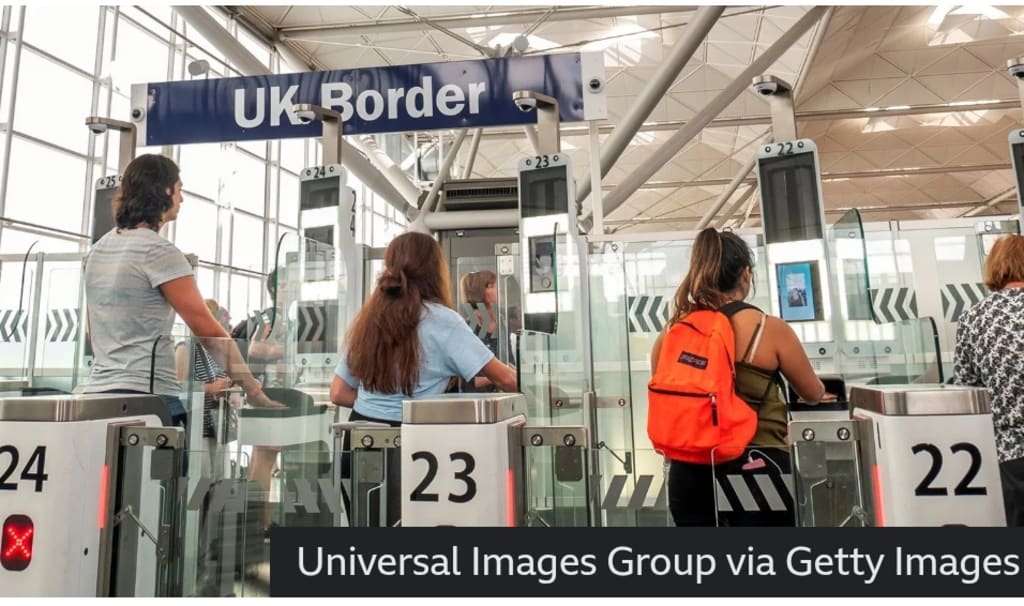
File images from previous years show travellers using electronic passport gates at airports such as Stansted, but manual checks remain in place for certain categories of visitors.
Impact on Dual Nationals
One of the most significant challenges arising from the new system involves dual nationals, particularly those who hold both British citizenship and another nationality.
Under UK law, British citizens are expected to enter the country using a British passport. Dual nationals who previously travelled on a non-UK passport without issue may now face complications.
Some individuals have reported difficulty boarding flights if airline systems do not recognise their British citizenship status. As a result, many dual nationals have rushed to apply for or renew UK passports to avoid travel disruptions.
Concerns Raised by Travellers
Travel industry groups and legal advisers have highlighted concerns about communication and awareness. Some travellers were unaware of the requirement until shortly before departure.
There are also questions about how smoothly airline systems integrate with the new authorisation checks. Carriers are responsible for verifying that passengers have the correct documentation before boarding.
Increased documentation requirements can create confusion, particularly during the early stages of implementation.
Comparison With Other Countries
The UK’s ETA mirrors similar systems in other jurisdictions. The United States requires travellers under its Visa Waiver Program to obtain ESTA approval before arrival. Canada uses an Electronic Travel Authorization for visa-exempt visitors arriving by air.
Such systems are generally designed to enhance pre-screening while maintaining visa-free travel for short visits. The UK’s adoption reflects a broader international trend toward digital border management.
Economic and Tourism Considerations
Tourism contributes significantly to the UK economy. Industry representatives have emphasized the importance of ensuring that new travel rules do not discourage visitors.
While the ETA adds an extra step, government officials argue that the process is straightforward and comparable to systems already familiar to many travellers.
Clear guidance and public awareness campaigns are expected to play a key role in minimising disruption and maintaining visitor confidence.
Practical Advice for Travellers
Visitors planning to travel to the UK should check whether their nationality requires an ETA. Applications should be submitted before booking travel where possible, allowing time for approval.
Travellers should ensure that passport details entered in the application match exactly with the passport used for travel. Any discrepancy could result in delays or denied boarding.
Dual nationals should verify which passport they are required to use and confirm that it is valid for travel.
Government Response
The Home Office has stated that the introduction of the ETA is part of a phased rollout. Authorities have pledged to monitor implementation and address technical or procedural issues as they arise.
Officials have also encouraged travellers to consult official sources for accurate information rather than relying on informal advice or social media posts.
The government maintains that the system balances security needs with the facilitation of legitimate travel.
Broader Policy Context
The ETA is part of the UK’s post-Brexit border framework, which aims to create a more controlled and digitised immigration system. Changes to visa categories, work permits, and student routes have been introduced in recent years.
Electronic authorisation systems represent a shift toward pre-departure checks and data-driven border management. As technology evolves, further adjustments to travel procedures may follow.
For travellers, the key difference is the requirement to secure permission before departure rather than relying solely on passport presentation at arrival.
Conclusion
The new Electronic Travel Authorisation system marks a significant change for visitors to the United Kingdom from visa-exempt countries. While the government presents the policy as a security and modernisation measure, it introduces new steps for travellers who previously did not require advance approval.
For most visitors, the application process is expected to be straightforward. However, dual nationals and those unfamiliar with digital authorisation systems may need to take extra care to ensure compliance.
As with any new travel regulation, awareness and preparation are essential. Checking eligibility, applying in advance, and carrying correct documentation can help avoid delays and ensure a smoother journey to the UK.
About the Creator
Saad
I’m Saad. I’m a passionate writer who loves exploring trending news topics, sharing insights, and keeping readers updated on what’s happening around the world.
Cuba Libre is more than the name of a drink
I once knew a lady who fled Cuba and went to France when the regime came in a long with communism and destroyed the island and while in France had become a dancer. She passed on long ago and it breaks my heart that she passed on without seeing her patria free again. Cuba Libre para Milagros.
By Revista Miko:XCI 8 days ago in Wander
Where Hills Speak and Water Remembers:
When I first saw Nazareth’s skyline rising from the Galilean hills, it felt more like stepping into a long-held memory than just arriving somewhere new. Stone buildings tumbled down the slopes, with minarets and bell towers reaching into the same sky. Still, I was drawn to one place above all: the striking, modern Basilica of the Annunciation.
By Chad Pillai7 days ago in Wander




Comments
There are no comments for this story
Be the first to respond and start the conversation.