
Video Conferencing Market Size and Forecast 2026–2034
AI, Cloud, and Hybrid Work Redefine Global Collaboration

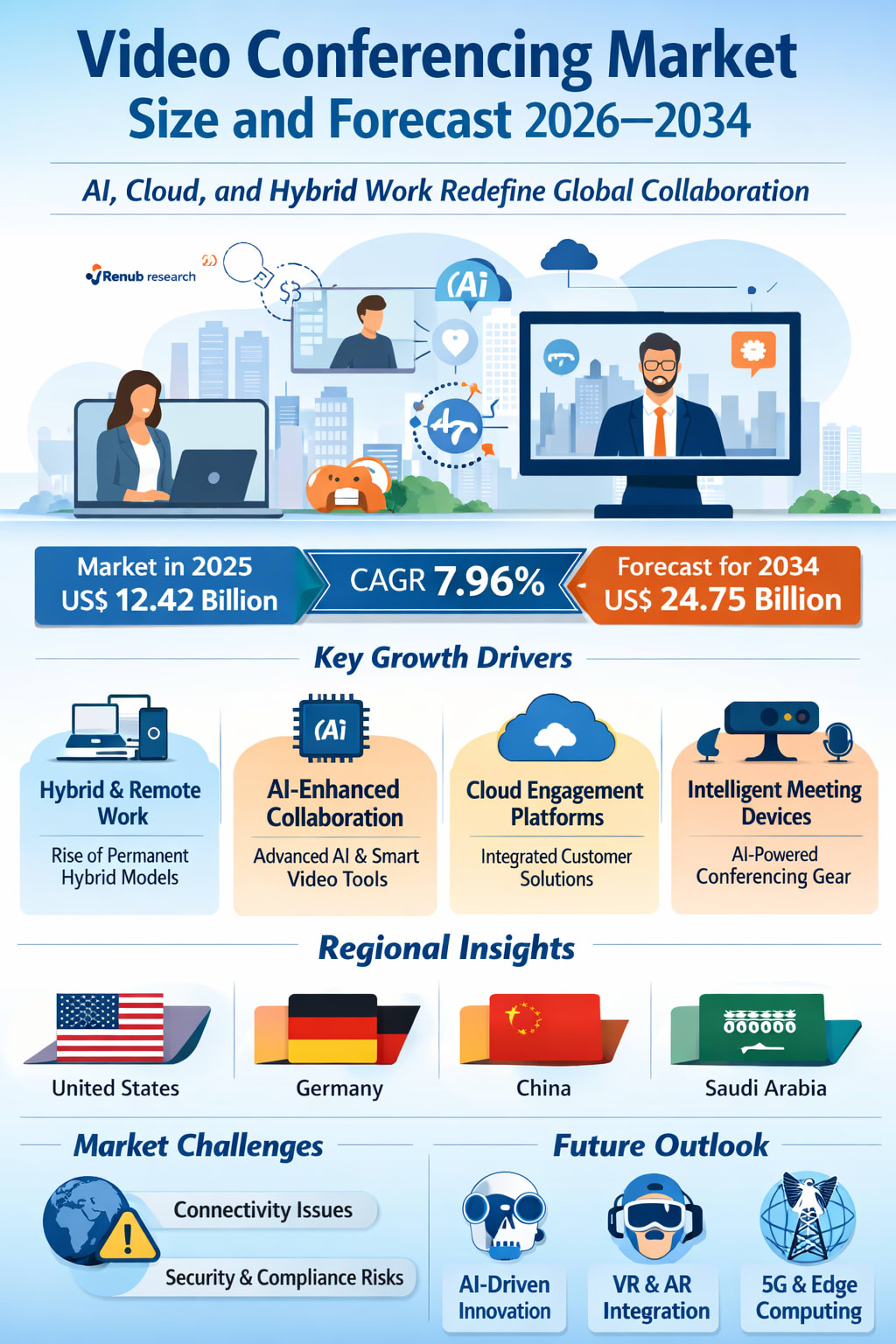
The global Video Conferencing Market is entering a new era of intelligent, cloud-powered collaboration. According to Renub Research, the market is expected to reach US$ 24.75 billion by 2034, rising from US$ 12.42 billion in 2025, expanding at a CAGR of 7.96% from 2026 to 2034.
The growth trajectory reflects a profound shift in how organizations communicate. Remote and hybrid work models have transitioned from temporary responses to permanent strategic frameworks. As enterprises digitize operations and embrace distributed teams, video conferencing has evolved from a simple communication tool into a mission-critical infrastructure for collaboration, engagement, and productivity.
Video Conferencing Industry Overview
Video conferencing is a real-time communication technology that enables individuals and groups to connect through audio and video over internet-based platforms. It integrates hardware components such as cameras, microphones, speakers, and displays with software platforms and cloud connectivity.
Modern systems extend far beyond virtual meetings. They include:
Screen sharing and content collaboration
AI-powered transcription and translation
Virtual whiteboards
Noise suppression and auto-framing
CRM and productivity suite integration
End-to-end encryption and compliance controls
Across enterprises, educational institutions, healthcare providers, and government agencies, video conferencing now underpins daily operations. Its advantages—reduced travel costs, operational flexibility, enhanced productivity, and global connectivity—have made it indispensable in today’s digital-first environment.
Market Dynamics Driving Growth
1. Hybrid and Remote Work Becoming Permanent
The most powerful catalyst for market expansion is the normalization of hybrid work. Organizations increasingly require secure, scalable platforms that allow employees to collaborate seamlessly across geographies.
Cloud-native solutions offer:
On-demand scalability
Continuous feature updates
Lower infrastructure costs
Centralized security management
As digital transformation initiatives accelerate, video conferencing platforms are becoming central hubs for team communication, project management, and customer engagement.
2. Rise of AI-Enhanced Video Creation and Collaboration
Artificial intelligence is redefining the user experience in video conferencing. Companies like Adobe Inc. are integrating generative AI tools such as Firefly to enhance video production and creative workflows.
AI innovations now enable:
Real-time transcription and translation
Automatic speaker tracking
Intelligent background rendering
Sentiment analysis
Smart scheduling assistants
Similarly, Zoom Video Communications, Inc. introduced Zoom Workplace, an AI-powered collaboration ecosystem that enhances productivity and team coordination.
AI not only improves meeting clarity but also supports content creation, training programs, customer support automation, and enterprise storytelling. As businesses demand higher-quality digital experiences, AI integration significantly strengthens adoption.
3. Expansion of Cloud-Based Customer Engagement Platforms
The convergence of communication and customer engagement is reshaping enterprise ecosystems. GoTo Group Inc. introduced GoTo Connect CX, blending video conferencing with multichannel customer experience capabilities.
Organizations increasingly seek unified platforms that combine:
Video meetings
Messaging
Voice communication
Customer service tools
Analytics dashboards
Cloud infrastructure ensures global accessibility and operational flexibility. AI-powered automation improves routing, support efficiency, and user engagement—making video conferencing central to modern omnichannel strategies.
4. Intelligent Hardware and AI-Driven Devices
Hardware innovation is another critical driver. Companies like HP Inc. and Cisco Systems Inc. are introducing AI-enhanced meeting devices equipped with:
Auto-framing cameras
Noise-canceling microphones
Edge-AI processing
Multi-stream video systems
GPU-optimized performance
Additionally, Qualcomm Technologies, Inc. has developed AI-powered conferencing chipsets that improve video clarity while minimizing distractions.
These advancements reduce meeting fatigue and deliver immersive virtual experiences, encouraging broader enterprise adoption.
Market Challenges
Connectivity Limitations
Despite rapid adoption, inconsistent network infrastructure remains a barrier in certain regions. High-definition video requires stable broadband, and latency issues can disrupt communication. Rural areas and emerging economies face bandwidth constraints that affect deployment at scale.
Security and Compliance Risks
Cybersecurity concerns continue to challenge the market. Sensitive corporate discussions make platforms attractive targets for breaches. Organizations must ensure:
End-to-end encryption
Multi-factor authentication
Compliance with GDPR, HIPAA, and regional regulations
AI transparency and responsible data handling
Without strong governance frameworks, privacy risks could slow adoption.
Regional Market Insights
United States
The United States leads global adoption due to advanced digital infrastructure and widespread hybrid work implementation. Enterprises across healthcare, education, and government rely heavily on platforms from companies such as Microsoft Corporation and Amazon Web Services Inc..
Strong broadband penetration and cloud maturity drive consistent demand, though rising cybersecurity expectations require continued innovation.
Germany
Germany’s market reflects its emphasis on Industry 4.0 and GDPR-compliant solutions. Enterprises prioritize secure, locally compliant platforms integrated with manufacturing and industrial ecosystems.
Strict data protection laws can slow adoption of foreign cloud services, but digital infrastructure investments support steady growth.
China
China represents one of the fastest-growing markets, driven by rapid digitalization and government-backed technology initiatives. Domestic providers, including Huawei Technologies Co. Ltd., deliver compliant, AI-enhanced meeting solutions widely used across education and public services.
Expansion of 5G networks further strengthens virtual collaboration capabilities.
Saudi Arabia
Saudi Arabia’s video conferencing market is expanding rapidly under Vision 2030 initiatives. Public and private sectors increasingly adopt digital communication platforms to modernize service delivery.
Sectors such as finance, healthcare, and government are investing heavily in secure and high-quality conferencing infrastructure, making the Kingdom one of the strongest emerging markets in the Middle East.
Recent Industry Developments
April 2025: Avaya Inc. launched Avaya Infinity, integrating AI orchestration with hybrid cloud deployment models.
April 2024: Adobe Inc. introduced Frame.io V4 to streamline collaborative content workflows.
April 2024: Zoom Video Communications, Inc. released Zoom Workplace with advanced AI capabilities.
February 2023: RingCentral, Inc. expanded its partnership with Avaya to accelerate cloud migration.
February 2023: Qualcomm Technologies, Inc. launched AI-enhanced conferencing solutions.
These developments highlight strong investment in AI, cloud flexibility, and secure enterprise-grade platforms.
Market Segmentation
By Component:
Hardware
Software
Services
By Conference Type:
Telepresence System
Integrated System
Desktop System
Service-Based System
By Deployment:
On-Premises
Cloud-Based
By Application:
Corporate Communications
Training & Development
Marketing & Client Engagement
By End Use:
Corporate
Education
Healthcare
Government & Defense
BFSI
Media & Entertainment
By Region:
North America
Europe
Asia Pacific
Latin America
Middle East & Africa
Competitive Landscape
Leading players covered with five viewpoints (Overview, Key Persons, Strategies, SWOT Analysis, Financial Insights) include:
Adobe Inc.
Amazon Web Services Inc.
Avaya Inc.
Cisco Systems Inc.
GoTo Group Inc.
HP Inc.
Huawei Technologies Co. Ltd.
Logitech International S.A.
Microsoft Corporation
Competition is intensifying as companies differentiate through AI integration, security frameworks, hardware innovation, and ecosystem partnerships.
Future Outlook: 2026–2034
The next decade will witness a transition from basic video communication to immersive, intelligent collaboration ecosystems. Emerging trends include:
AI-driven meeting summaries and action tracking
Real-time multilingual collaboration
Integration with virtual and augmented reality
Edge computing for low-latency performance
Sustainable, energy-efficient hardware solutions
As enterprises redefine productivity models, video conferencing platforms will serve as digital headquarters—bridging physical and virtual workplaces.
Final Thoughts
The global Video Conferencing Market is no longer simply about connecting screens—it is about connecting ecosystems. With projected growth to US$ 24.75 billion by 2034, the market reflects a permanent transformation in communication infrastructure.
AI, cloud scalability, intelligent hardware, and omnichannel integration are reshaping collaboration across industries. While connectivity gaps and cybersecurity challenges persist, continued innovation and regulatory alignment will sustain momentum.
About the Creator
Alphabet Inc.: How Data, Advertising, and Innovation Turned Google into a Stock Market Giant
Alphabet Inc., the parent company of Google, represents one of the most powerful business stories in modern history. What began as a simple search engine project has evolved into a global technology empire driven by data, advertising, and innovation. For investors, Alphabet stock offers exposure to the digital economy at its core—where information, attention, and technology intersect.
By Hammad Nawaz6 days ago in Trader
Australia Grid Energy Storage Market to Surge Nearly Tenfold by 2033
In 2024, the Australia grid energy storage market reached a value of USD 366.80 million. Industry projections indicate the market will grow exponentially to USD 3,941.14 million by 2033, representing a robust compound annual growth rate (CAGR) of 26.80% between 2025 and 2033. This strong growth outlook reflects accelerating adoption of grid-scale battery systems, policy engagement at federal and state levels, and the pressing need to manage renewable energy intermittency while reinforcing grid stability.
By Rashi Sharma7 days ago in Trader




Comments
There are no comments for this story
Be the first to respond and start the conversation.