
United States Mobile Virtual Network Operator (MVNO) Market Size and Forecast 2025–2033
Affordable Connectivity, Smarter Plans, and the Rise of Virtual Telecom in America

Introduction: A Quiet Revolution in the U.S. Telecom Market
The United States telecom industry is undergoing a subtle yet powerful transformation. While major mobile network operators (MNOs) such as Verizon, AT&T, and T-Mobile continue to dominate infrastructure ownership, a fast-growing segment is reshaping how millions of Americans access mobile services: Mobile Virtual Network Operators (MVNOs). These providers do not own network infrastructure but instead lease capacity from established carriers, allowing them to focus on pricing innovation, customer experience, and niche market strategies.
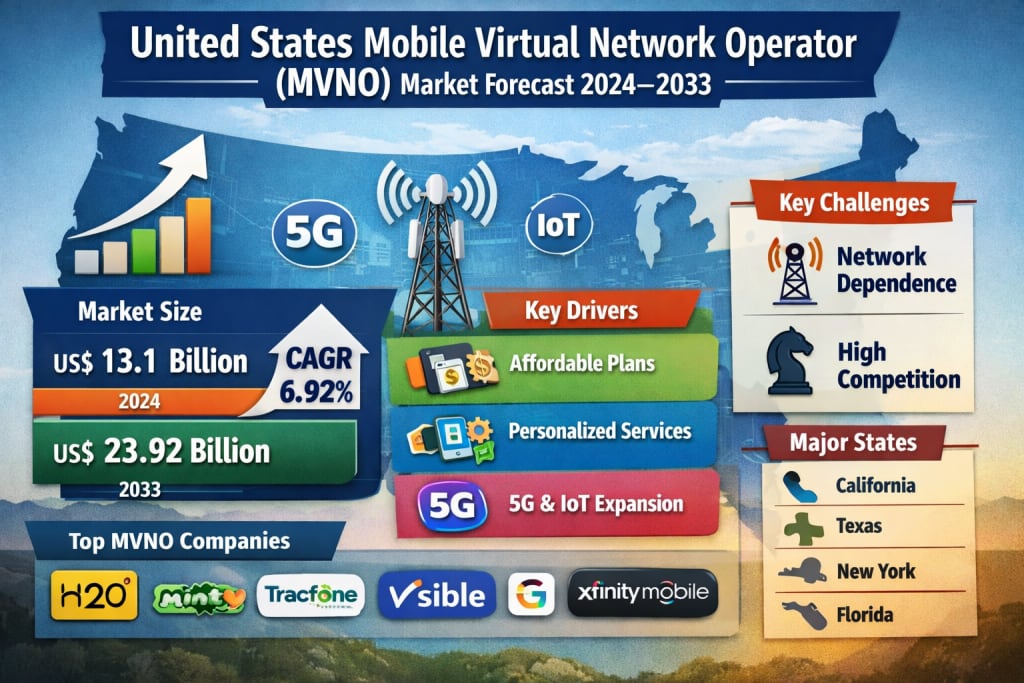
According to Renub Research, the United States Mobile Virtual Network Operator (MVNO) Market is expected to grow from US$ 13.1 billion in 2024 to US$ 23.92 billion by 2033, registering a compound annual growth rate (CAGR) of 6.92% from 2025 to 2033. This impressive expansion reflects deeper changes in consumer behavior, enterprise connectivity needs, and the economics of mobile services in a 5G-driven digital economy.
As Americans increasingly rely on smartphones for work, entertainment, payments, and communication, the demand for affordable, flexible, and data-centric mobile plans continues to rise. MVNOs are stepping into this gap, offering cost-effective alternatives to traditional carriers while leveraging the same high-quality networks.
Understanding the MVNO Model
Mobile Virtual Network Operators operate by purchasing wholesale network access from major carriers and reselling it to end users under their own brand. Unlike traditional MNOs, MVNOs do not invest billions in spectrum licenses, towers, or core network infrastructure. Instead, they focus on marketing, customer service, pricing models, and tailored offerings.
There are several operational models within the MVNO ecosystem. Some function primarily as resellers, handling branding and customer acquisition while relying heavily on host networks for technical operations. Others act as service providers, managing more elements of the customer experience. The most advanced players operate as full MVNOs, controlling core network components such as billing systems, SIM provisioning, and customer management platforms, while still leasing radio access from MNOs.
This flexible structure allows MVNOs to operate with lower overhead costs and pass those savings on to consumers. It also enables them to experiment with innovative pricing strategies, niche targeting, and digital-first service models.
Market Outlook: Strong Growth Through 2033
The growth outlook for the U.S. MVNO market is strongly positive. Renub Research projects the market to reach US$ 23.92 billion by 2033, up from US$ 13.1 billion in 2024. A CAGR of 6.92% over the forecast period underscores the increasing acceptance of virtual operators among both consumers and enterprises.
Several macro trends are supporting this expansion. The continued rollout of 5G networks by major carriers is improving network performance and capacity, which indirectly benefits MVNOs that rely on these infrastructures. At the same time, rising competition in the telecom sector is pushing consumers to seek better value-for-money plans, an area where MVNOs traditionally excel.
Additionally, the growth of digital services, remote work, online education, streaming platforms, and cloud-based applications is driving higher data consumption. This creates fertile ground for MVNOs offering flexible, data-centric, and contract-free plans.
Key Drivers of the U.S. MVNO Market
1. Economical Alternatives for Cost-Conscious Consumers
One of the strongest drivers behind MVNO adoption in the United States is affordability. MVNOs typically offer significantly lower-priced plans compared to major carriers, making them especially attractive to students, retirees, budget-conscious families, and low-income users. By avoiding the massive capital expenditures associated with network infrastructure, MVNOs can operate leaner business models and transfer those cost advantages to customers.
The availability of no-contract plans, prepaid options, and customizable bundles further enhances their appeal. In an economic environment where households are increasingly mindful of monthly expenses, these flexible and affordable mobile solutions are gaining strong traction.
2. Rising Demand for Personalized Mobile Plans
Modern consumers no longer want one-size-fits-all mobile plans. Usage patterns vary widely—some users prioritize data, others focus on international calling, while many seek family or business-oriented packages. MVNOs have been particularly successful in addressing this demand for personalization.
From pay-as-you-go and data-only plans to international roaming and migrant-focused packages, MVNOs are carving out specialized niches. This ability to tailor offerings improves customer satisfaction, strengthens brand loyalty, and helps virtual operators compete effectively against much larger incumbents.
3. Technological Advancements: 5G and IoT
The expansion of 5G networks in the United States is opening new opportunities for MVNOs. Faster speeds, lower latency, and improved network reliability allow virtual operators to offer high-quality services comparable to those of major carriers. This is especially important for attracting tech-savvy consumers and enterprise customers.
Moreover, the growing adoption of Internet of Things (IoT) solutions and machine-to-machine (M2M) communication is creating new market segments. MVNOs that specialize in M2M and connected device services are well-positioned to benefit from the increasing number of smart devices, connected vehicles, and industrial IoT applications.
Challenges Facing the U.S. MVNO Market
1. Dependence on Host Network Operators
While the MVNO model reduces capital requirements, it also creates a strong dependence on host network operators such as Verizon, AT&T, and T-Mobile. MVNOs have limited control over network quality, coverage, data speeds, and pricing structures. Any changes in wholesale agreements, such as increased fees or usage restrictions, can directly impact profitability and service competitiveness.
This dependence makes long-term strategic planning more complex and can limit an MVNO’s ability to differentiate purely on network performance.
2. Limited Differentiation in a Crowded Market
The U.S. MVNO market is highly competitive, with many providers offering similar voice, text, and data services at comparable prices. Since most rely on the same underlying networks, meaningful product differentiation is challenging. As a result, many MVNOs compete primarily on price, customer service, or niche targeting.
While these strategies can be effective in the short term, they are relatively easy for competitors to replicate. This limits the potential for strong brand loyalty and can put pressure on margins over time.
State-Level Market Overview
California
California represents one of the most dynamic MVNO markets in the United States. The state’s tech-savvy population, diverse demographics, and large immigrant communities create strong demand for flexible and affordable mobile services. MVNOs offering bilingual support, international calling, and digital-first services perform particularly well in major cities such as Los Angeles, San Francisco, and San Diego. However, intense competition and regulatory considerations also shape the market landscape.
Texas
Texas features a large and diverse customer base, spanning both urban and rural regions. MVNOs in the state focus on affordable, flexible plans tailored to different demographic groups, including students, retirees, and migrant communities. The growing demand for data-centric services and the expansion of 5G networks are creating new growth opportunities, although price sensitivity and competitive pressures remain significant challenges.
New York
New York’s MVNO market is characterized by high demand density and intense competition. The state’s large urban population drives strong demand for mobile services, encouraging MVNOs to innovate in pricing, digital customer experiences, and customized plans. Regulatory oversight aimed at ensuring fair competition and consumer protection also plays an important role in shaping the market.
Market Segmentation
By Type
Discount
Telecom
Retail
Migrant
Business
Roaming
M2M
By Operational Model
Reseller
Service Provider
Full MVNO
By End Use
Consumer
Enterprise
By States
California
Texas
New York
Florida
Illinois
Pennsylvania
Ohio
Georgia
Washington
New Jersey
Rest of United States
Competitive Landscape and Key Companies
The U.S. MVNO market features a mix of independent brands and sub-brands backed by major telecom and technology companies. Leading players covered in the market include:
H2O Wireless (Locus Telecommunications, LLC)
Mint Mobile, LLC (T-Mobile US, Inc.)
RedPocket Mobile
TracFone Wireless, Inc. (Verizon Communications Inc.)
Visible (Verizon Communications)
Cricket Wireless LLC
Google Fi Wireless (Google LLC, a subsidiary of Alphabet Inc.)
Tello, LLC
UVNV, LLC
Xfinity Mobile (Comcast Corporation)
These companies compete on pricing, data offerings, customer experience, digital platforms, and niche market focus. Many are also leveraging strong brand ecosystems, such as Google and Comcast, to cross-sell services and build long-term customer relationships.
The Road Ahead: What to Expect
Looking ahead, the U.S. MVNO market is expected to benefit from continued 5G expansion, rising data consumption, and growing demand for flexible, affordable mobile services. Enterprise adoption, particularly in IoT and M2M applications, is likely to become an increasingly important growth engine.
At the same time, competition will remain intense. Success will depend on an MVNO’s ability to innovate in service design, build strong digital customer experiences, and create clear value propositions beyond just low prices.
Final Thoughts
The United States Mobile Virtual Network Operator (MVNO) market is no longer a niche corner of the telecom industry—it is becoming a central pillar of the country’s digital connectivity ecosystem. With the market projected to grow from US$ 13.1 billion in 2024 to US$ 23.92 billion by 2033 at a CAGR of 6.92%, MVNOs are set to play an increasingly important role in shaping how Americans connect, communicate, and consume digital services.
Driven by affordability, personalization, and technological progress, MVNOs are redefining value in the mobile services market. While challenges such as network dependence and intense competition persist, the long-term outlook remains strong. For consumers and businesses alike, the rise of MVNOs signals a future of more choice, greater flexibility, and smarter connectivity in the U.S. telecom landscape.
About the Creator
North America Gluten-Free Food Market Trends & Summary (2025–2033)
Introduction The North America gluten-free food market is undergoing a strong transformation, driven by changing consumer lifestyles, rising health awareness, and the growing prevalence of gluten-related disorders. What was once a niche category catering mainly to people with celiac disease has evolved into a mainstream food segment embraced by health-conscious consumers across the United States, Canada, and Mexico.
By Sakshi Sharma5 days ago in Trader



Comments
There are no comments for this story
Be the first to respond and start the conversation.