
Stock Trading - Entry 48
A decade of real estate investing lessons and the REITs I invest in

I am sure the book "Rich Dad, Poor Dad" has made it onto your reading list at some point and that marked the start of my exploration of investing in real estate. This article outlines my exploration into real estate acquisitions and why I have, in 2025, settled on REITs. This article is not financial advice; it gets into my own thoughts on society, building wealth, and getting roofs over people's heads.
Back in 2012, my father and I went to a real estate conference. I immediately grasped the concept and its potential. We took some follow-up courses and things made sense. This was reinforced by other real estate seminars I also attended, which included other creative financing solutions, different market segments (e.g. cottages), and projects in other countries.
What's more, I got good at playing Cashflow 101 (and ok with Cash Flow 102). Strangely, it was playing Pay Day with two really smart (and Greek) young primary schoolers that rounded out my education. The lesson: selectively use wealth to stimulate enjoyment in life. See, whose two children quickly learned to enjoy what you spend on to the max while not aiming to spend tons in the first place. It was kinda cute when I asked things like 'who wants to spend $X and go on a trip to some place?' and they pretended like they weren't even there, but when one of them was selected, they lit up and put on a mini show of how much they enjoyed the experience/object, paid, and the game went on. (Their parents were impressed at their kids already knowing this - and rightfully so IMO.)
The brakes were put on gently at other conferences in terms of people simply not wanting to take a risk on a property, even though the stars aligned. So, I took a moment of pause just to see what my enthusiasm could have been missing. What caught me were two concepts. One was the anecdotal fact that only half of single-family homes in a rent-to-own situation typically transfer from the investor to the homeowners in the end. That means one can expect to become a landlord as opposed to a home-owning-enabler very quickly. (Remember the lesson I was taught earlier? Later on, I read a more spiritually-refined version of it that went, "Use money to love people. Don't love money and use people.")
Did I want to become a full-on landlord? No. First up, it is work. Period. Can't convince me otherwise, sorry. Too many others have learned lessons, mostly good, that they imparted to me. The other thing, though, is the macro-level. Did I need to become a landlord to become wealthy? No. In fact, my social justice fire flared up at the thought. The world would not be a better place by rewinding things a few hundred years to having landlords and serfs. Shitty social model and economy to aim for in today's world IMO.
Some real estate investors, however, asked themselves "why stop with a few properties when the money from other investors can be brought in to buy even more properties?" Enter real estate investment trusts (REITs). Admittedly, my first few exposures to REITS in Canada were collapses due to it being more of a scheme. Many real estate investors won't get into real estate unless they are on the deed in some way, shape, or form as a result (including liens).
Things have changed over the past decade in Canada when it comes to REITs. More stringent rules apply with auditing, registration, etc. on the side of the company and then many tax advantages for investors (e.g. using TFSAs and RRSPs). Right away, I knew I needed to know my own sell-out lines for REITs (see entry 1 to find out how and why to develop sell-out lines). For me it was the fewer residential properties the better. Also, I had to be comfortable with the area in which the properties are located. If properties are diversified across the country, good. If they were mostly in one area, then I would do some research to see how the property market was doing in that sector and make my decision accordingly.
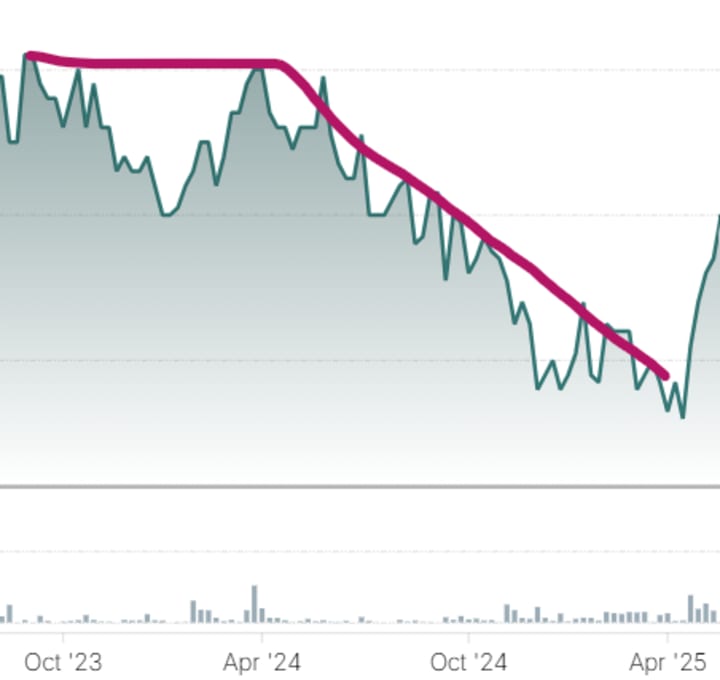
If you really want to know how simple it is to do property market analysis, just watch the headlines news or do a simple Internet search. For example, take Global Education Communities (GEC). All student housing. That might be fine, but not when the federal government reduces your customer base by capping foreign students (who need those living spaces). As you can see in GEC's stock price, it tumbled hard after the academic term during which each announcement was made and it took almost a year for the stock price to bounce back. But the caps are still in effect from what I gather (as of the date of publishing this article)....
Finally, investing means I want a piece of the pie, so that means dividends - and not paltry ones. Here are the ones I got into with the corresponding dividend's (annual) yield on cost:
- NXR. UN (over 8%)
- NET.UN (over 6%)
- DIR.UN (over 5%)
It should be noted that I have since sold DIR.UN due to it reaching my selling point that far exceeded the corresponding yield on cost (see the beginning of entry 43 to find out why). Also, this list excludes mortgage financing companies in which I own shares.
Other REITs I looked at but have not bought to-date (as of publishing this article) were:
- GEC (see above)
- APR.UN (the North American auto sector is too volatile for me to get a read on land use in that sector)
- BTB.UN (I couldn't buy it at a deal)
- KMP.UN (mostly residential, the Halifax property market is so-so, and the business-speak they use is telling they could be doing better but aren't)
- MCAN (I couldn't buy it at a deal)
- GDC (the Calgary property market is so-so and you need to know where in the city to build what - and I know too little about the latter)
- OLY (way too expensive for me, but I have heard this company really knows how to take RRSP money and make it grow for those investing into specific real estate development projects)
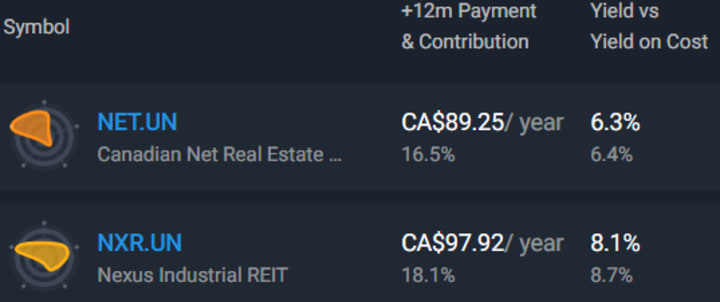
And so, with a little over 400 shares combined in two REITS, here's the passive income being generated in my portfolio, according to simplywall.st, as at the date of publishing this article.
To find out what I do or don't invest in next, subscribe for free below to become notified right when I publish those articles. Alternatively, you can bookmark this page that contains a list of all my entries in my stock and blockchain trading journey I publish on Vocal Media.
About the Creator
Richard Soulliere
Bursting with ideas, honing them to peek your interest.
Enjoyes blending non-fiction into whatever I am writing.
Keep reading
More stories from Richard Soulliere and writers in Trader and other communities.
Stock Trading - Entry 46
This is kind of a snapshot before I start diving into the long-awaited analysis at the two-year mark. Yup, it has almost been that amount of time since I opened a trading account and setup various funds. To highlight certain flavours, this recap is organized into three sections; indicators, specific analyses, and external impacts. (I am not dispensing financial advice here or in any of my articles mentioned below.)
By Richard Soulliere6 months ago in Trader
Bitcoin Stands Alone as Liquidity Dries Up
Bitcoin suffered a sharp and unusually persistent sell-off between the night of the 29th and the morning of the 30th, falling from approximately $87,000 to $81,000 in less than twelve hours, a decline of nearly 7 percent. While risk assets across the broader crypto market weakened in tandem, what stood out was not the magnitude of the drop itself but Bitcoin’s inability to recover alongside traditional markets. Equities and commodities attempted modest rebounds after the initial shock, yet Bitcoin remained pinned near the lows. This divergence offers a clearer window into the current state of market liquidity than any single headline catalyst.
By crypto geniea day ago in Trader
Asphalt Market Size, Share, Growth by 2034
📌 Asphalt Market Overview The Asphalt Market refers to the global industry involved in producing, supplying, and selling asphalt — a petroleum-derived material widely used in road paving, roofing, waterproofing, and other construction applications. Asphalt is a preferred surface material due to its durability, cost-effectiveness, ease of maintenance, and rapid deployability compared with alternatives like concrete. It plays a central role in transportation infrastructure, residential and commercial construction, and industrial projects. Growth is largely driven by infrastructure spending, urbanization, and the need to repair and upgrade aging road networks worldwide.
By James Smitha day ago in Trader


Comments
There are no comments for this story
Be the first to respond and start the conversation.