
Security Analytics Market Size and Forecast 2026–2034
AI-Driven Threat Intelligence and Real-Time Cyber Defense to Shape the Next Decade of Growth

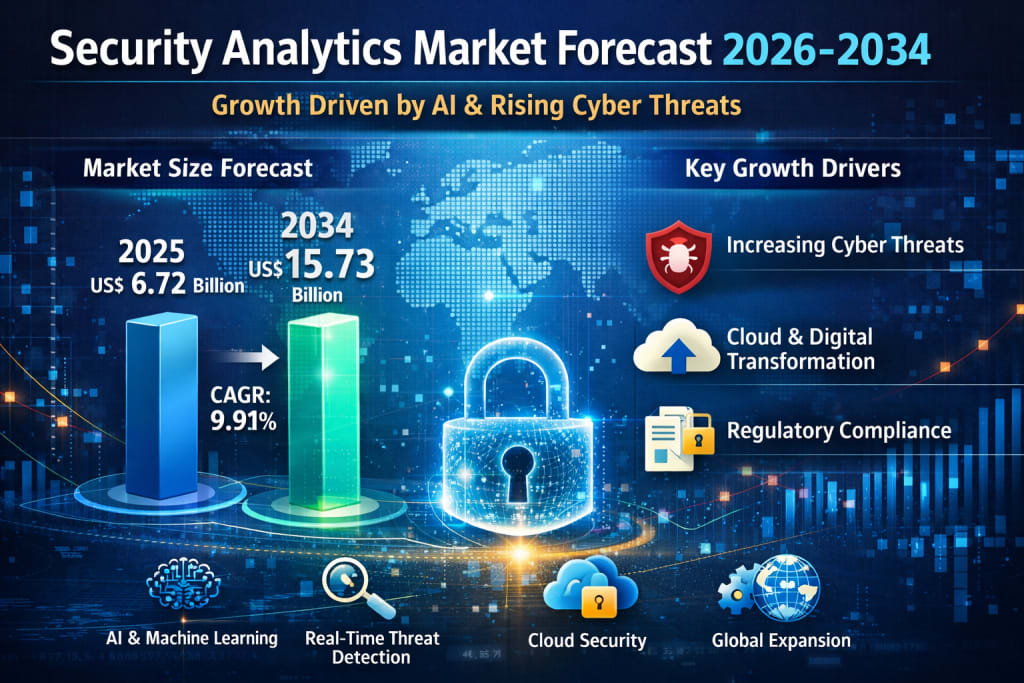
The global Security Analytics Market is entering a transformative decade, fueled by escalating cyber threats and the accelerating pace of digital transformation. According to Renub Research, the Security Analytics Market is expected to reach US$ 15.73 billion by 2034, up from US$ 6.72 billion in 2025, growing at a CAGR of 9.91% from 2026 to 2034.
This remarkable expansion underscores the increasing importance of advanced, AI-driven threat detection systems in safeguarding enterprise data, cloud infrastructures, and digital ecosystems worldwide. As organizations shift from reactive cybersecurity models to predictive and intelligence-driven defense strategies, security analytics has become the backbone of modern cyber resilience.
Security Analytics Industry Overview
Security analytics represents a critical evolution in cybersecurity. Unlike traditional systems that rely heavily on signature-based detection and manual rule-setting, security analytics platforms leverage artificial intelligence (AI), machine learning (ML), behavioral analytics, and big data processing to detect anomalies and prevent breaches in real time.
These platforms aggregate and analyze massive volumes of data from:
Network traffic
Endpoints
Cloud environments
Applications
IoT devices
User behavior logs
By correlating disparate data streams, security analytics solutions provide actionable insights that help organizations detect ransomware, phishing campaigns, insider threats, advanced persistent threats (APTs), and zero-day exploits before they cause substantial damage.
The market encompasses several solution categories, including:
Security Information and Event Management (SIEM)
User and Entity Behavior Analytics (UEBA)
Network Traffic Analysis
Endpoint Security Analytics
Threat Intelligence Platforms
Predictive Risk Modeling
As cyberattacks grow more sophisticated, enterprises across finance, healthcare, retail, government, telecom, and manufacturing are investing heavily in analytics platforms to enhance visibility and accelerate incident response.
Growth Drivers Fueling Market Expansion
1. Rising Frequency and Sophistication of Cyber Threats
Cybercrime is becoming more organized, automated, and financially motivated. Modern attackers employ AI-powered malware, polymorphic ransomware, and social engineering techniques that easily bypass conventional firewalls and antivirus systems.
Organizations now recognize that perimeter-based security alone is insufficient. Security analytics tools help detect behavioral anomalies and suspicious activities across networks, enabling proactive intervention.
The financial consequences of breaches—ranging from regulatory penalties to reputational damage—have intensified investment in predictive cybersecurity tools. As a result, demand for AI-driven analytics platforms continues to surge globally.
2. Digital Transformation and Cloud Adoption
The global shift toward cloud computing, SaaS applications, remote work, and IoT ecosystems has expanded enterprise attack surfaces dramatically.
Hybrid and multi-cloud environments introduce complexity that traditional monitoring systems cannot adequately manage. Security analytics provides centralized visibility across on-premises and cloud infrastructures, ensuring consistent monitoring and threat detection.
Remote work has further reinforced the need for advanced behavioral analytics. Identifying unusual login patterns, unauthorized access attempts, or suspicious data transfers is now critical for enterprise security strategies.
The ongoing digital transformation wave across industries is therefore a major catalyst for market growth.
3. Regulatory Compliance and Data Privacy Mandates
Compliance requirements such as GDPR, HIPAA, PCI DSS, and region-specific data protection regulations demand real-time monitoring, reporting, and incident response capabilities.
Security analytics platforms enable automated log monitoring, audit trail generation, policy enforcement, and vulnerability assessment—helping organizations remain compliant while strengthening security posture.
As governments tighten cybersecurity regulations worldwide, compliance-driven adoption continues to push market expansion forward.
Key Challenges in the Security Analytics Market
1. Shortage of Skilled Cybersecurity Professionals
Despite rising demand, the cybersecurity talent gap remains a critical obstacle. Security analytics systems generate extensive data that requires skilled analysts to interpret and act upon.
Organizations often struggle to recruit professionals with expertise in threat intelligence, AI, data science, and cybersecurity operations. While automation reduces manual workload, human oversight remains indispensable.
The talent shortage may slow deployment and limit full utilization of advanced analytics capabilities.
2. Integration Complexity and High Costs
Implementing security analytics across hybrid IT infrastructures can be technically challenging and expensive. Enterprises must integrate data from legacy systems, cloud platforms, and third-party tools.
Licensing fees, infrastructure upgrades, customization, and ongoing maintenance increase total cost of ownership—posing adoption barriers for small and medium enterprises (SMEs).
Ensuring interoperability with existing security tools such as firewalls and endpoint protection systems further complicates deployments.
Regional Market Insights
United States Security Analytics Market
The United States represents one of the most mature and technologically advanced markets for security analytics. High digital penetration, cloud adoption, and a strong regulatory framework drive substantial investment.
According to the Federal Bureau of Investigation’s 2023 Internet Crime Report, the Internet Crime Complaint Center received:
21,489 Business Email Compromise (BEC) complaints
2,825 ransomware complaints
14,190 government impersonation complaints
37,560 tech and customer support impersonation complaints
These alarming statistics emphasize the urgent need for sophisticated analytics solutions.
Major technology leaders such as Cisco Systems Inc, International Business Machines Corporation, Palo Alto Networks, Inc, and Fortinet, Inc. play a pivotal role in advancing AI-powered threat detection and integrated security platforms.
Enterprises across healthcare, BFSI, telecom, and government sectors increasingly prioritize analytics-driven cybersecurity strategies to protect sensitive information.
United Kingdom Security Analytics Market
The United Kingdom is witnessing steady growth driven by digital innovation and regulatory compliance mandates. With strong financial and public sector institutions, the UK market relies heavily on real-time threat intelligence.
GDPR enforcement and sector-specific cybersecurity guidelines are pushing enterprises to adopt SIEM and UEBA platforms. As hybrid work and cloud transformation continue, security analytics remains a cornerstone of enterprise risk management in the region.
India Security Analytics Market
India’s rapidly expanding digital economy—spanning fintech, e-commerce, digital payments, and government digitalization—has intensified cybersecurity needs.
Growing investments in AI and ML-based security systems, along with increased cyber awareness among enterprises, are accelerating adoption. Although cost sensitivity and talent shortages present challenges, India’s market is poised for robust long-term growth.
With rising cyber incidents targeting financial institutions and digital platforms, advanced analytics solutions are becoming essential components of enterprise IT strategies.
United Arab Emirates Security Analytics Market
The UAE is emerging as a cybersecurity innovation hub within the Middle East. Government-led smart city initiatives, cloud-first strategies, and digital infrastructure investments have expanded cybersecurity requirements.
Security analytics platforms help UAE enterprises and public agencies achieve proactive monitoring, enhanced visibility, and automated response capabilities—supporting national cybersecurity frameworks and digital transformation agendas.
Recent Industry Developments
The security analytics landscape is evolving rapidly, with major vendors launching AI-driven innovations and strategic expansions:
June 2025: Fortinet introduced an AI-powered office security suite protecting email, browsers, and collaboration tools.
May 2025: Palo Alto Networks reported a 34% ARR increase in next-generation security.
May 2025: KDDI and NEC formed a combined cybersecurity venture targeting infrastructure and supply-chain clients.
April 2025: Aurascape secured USD 50 million to secure AI application pipelines.
August 2024: Fortinet acquired Next DLP to strengthen enterprise data loss prevention capabilities.
April 2024: Cisco launched Hypershield, embedding security directly into AI-driven data centers using eBPF technology.
These developments highlight a strategic shift toward AI-native, integrated, and cloud-centric cybersecurity architectures.
Market Segmentation
By Offering
Solutions
Services
By Application
Web Security Analytics
Network Security Analytics
Endpoint Security Analytics
Security Analytics Platforms
Others
By Organization Size
Large Enterprises
SMEs
By Industry Vertical
BFSI
Telecom & IT
Retail
Healthcare
Government & Defense
Manufacturing
Others
By Geography
North America, Europe, Asia Pacific, Latin America, and Middle East & Africa, including key markets such as the United States, Canada, United Kingdom, Germany, France, India, China, Japan, Australia, Brazil, Mexico, Saudi Arabia, South Africa, and the United Arab Emirates.
Competitive Landscape
Key players shaping the global market include:
Cisco Systems Inc
International Business Machines Corporation
Juniper Networks, Inc.
Palo Alto Networks, Inc
Fortinet, Inc.
Hewlett Packard Enterprise Co
Splunk Inc.
LogRhythm Inc.
Each company is evaluated from five perspectives: Overview, Key Persons, Recent Developments, SWOT Analysis, and Financial Insights.
Strategic mergers, AI innovation, and platform consolidation remain central competitive strategies as vendors race to offer unified security ecosystems.
Final Thoughts
The Security Analytics Market is no longer a niche cybersecurity segment—it is a foundational pillar of enterprise resilience in the digital era. With the market projected to grow from US$ 6.72 billion in 2025 to US$ 15.73 billion by 2034, the sector reflects a broader shift toward predictive, AI-driven cybersecurity frameworks.
Rising cybercrime, regulatory pressures, cloud expansion, and digital transformation will continue to accelerate adoption. Although challenges such as skill shortages and integration complexity persist, innovation in automation and AI is steadily closing capability gaps.
About the Creator
Philippines Edible Cutlery Market 2026: Plastic Reduction Push, Sustainable Dining and Eco-Foodservice Adoption
Philippines Edible Cutlery Market Overview The Philippines edible cutlery market is gaining momentum as sustainability initiatives and consumer environmental awareness reshape food consumption habits across the country. Edible cutlery — including spoons, forks and sporks made from grain-based or plant-derived materials — provides a biodegradable alternative to single-use plastic utensils while offering functional and experiential dining benefits. As regulatory pressure against plastic waste intensifies and food delivery ecosystems expand, edible cutlery is emerging as a practical solution aligned with zero-waste dining trends.
By Manisha Dixit3 days ago in Trader
Low Voltage Switchgear Market Overview, Size, Share & Forecast
Low Voltage Switchgear Market Overview Low voltage switchgear refers to assembly or combination of electrical disconnect switches, circuit breakers, fuses, relays, and protection devices designed to control and protect electrical systems operating at voltages up to 1,000 V. These systems serve as a critical interface between power sources and end-equipment, ensuring safety, reliability, and efficient distribution of electricity across applications such as industrial plants, commercial buildings, residential complexes, transportation systems, renewable energy installations, and utility networks.
By James Smith4 days ago in Trader
Echoes
I stepped carefully around the corner, the familiar sights and sounds hitting me like a brick to the face. My eyes watered. I could practically see us, all of us, back then, clustered around the outdoor tables in front of the pizza shop, the bar, the coffee shop. I could smell the various stalls from the events we’d been to on this street. I could taste the churros and nachos.
By Phoenixica247 days ago in Fiction




Comments
There are no comments for this story
Be the first to respond and start the conversation.