
North America Non-Lethal Weapons Market Trends & Summary
From Crowd Control to Smart Policing: Why Non-Lethal Weapons Are Reshaping Public Safety in North America

Introduction: A Market Built on the Need for De-escalation
The conversation around public safety in North America has changed dramatically over the past decade. Governments, law enforcement agencies, and military forces are increasingly under pressure to balance operational effectiveness with accountability, transparency, and respect for human rights. In this evolving landscape, non-lethal weapons have emerged as a critical tool—designed not to replace traditional weapons entirely, but to offer safer alternatives in situations where the use of lethal force is either inappropriate or legally restricted.
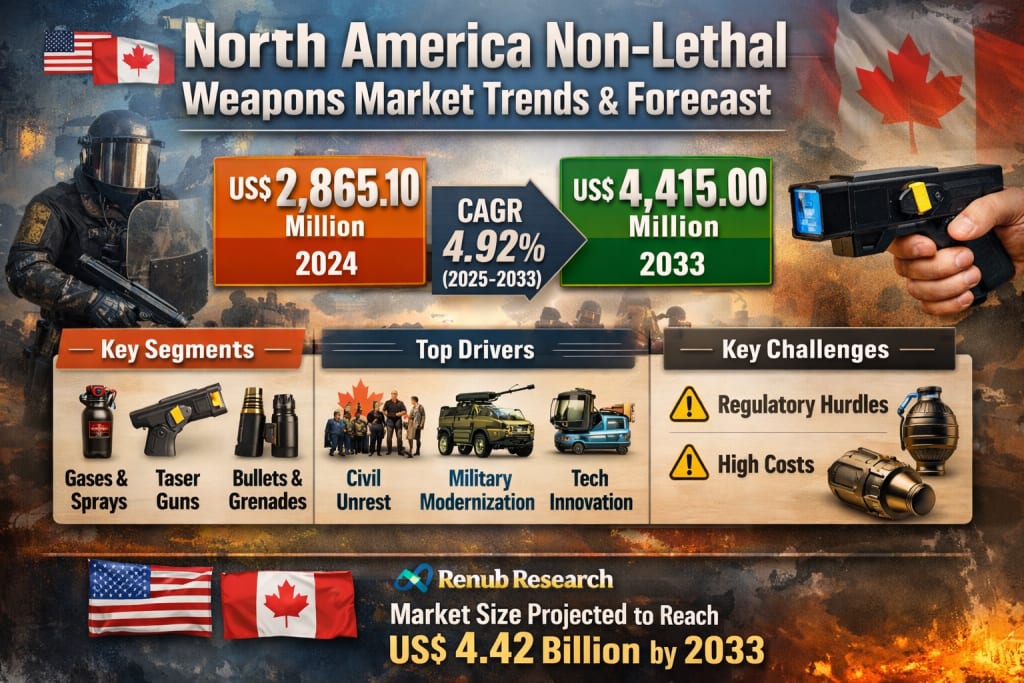
According to Renub Research, the North America Non-Lethal Weapons Market is expected to grow from US$ 2,865.10 million in 2024 to US$ 4,415.00 million by 2033, registering a CAGR of 4.92% from 2025 to 2033. This steady expansion reflects not only rising demand from military and law enforcement agencies, but also deeper structural changes in how security, crowd control, and public order are managed across the region.
Driven by significant defense spending, continuous technological advancements, and increasing deployment by police and armed forces, North America currently holds a dominant share of the global non-lethal weapons market. The United States leads in innovation and procurement, while Canada is steadily expanding the adoption of less-lethal tools as part of modern, community-oriented policing strategies.
Understanding Non-Lethal Weapons: Purpose and Scope
Non-lethal weapons—also commonly referred to as less-lethal weapons—are designed to incapacitate, deter, or control individuals without causing permanent injury or death. They are particularly valuable in scenarios such as crowd control, riot management, border security, peacekeeping missions, and sensitive law enforcement operations where minimizing casualties is a priority.
Key product categories in this market include gases and sprays (such as pepper spray and tear gas), grenades, rubber or kinetic bullets, Taser guns, and other specialized devices. From a technology perspective, these weapons span chemical, electroshock, mechanical and kinetic, and acoustic/light-based systems, reflecting the diversity of approaches used to manage threats without resorting to lethal force.
The primary end users are law enforcement agencies, military forces, and other security organizations, including border security and private security firms. As urbanization increases and public gatherings become more frequent, the role of non-lethal weapons in maintaining order while preserving public trust has become more prominent than ever.
Market Overview: Why North America Leads
North America’s leadership in the non-lethal weapons market is closely tied to its strong defense budgets, advanced industrial base, and robust research and development ecosystem. The United States, in particular, plays a central role in shaping both the regional and global market through continuous investment in innovation and procurement.
Major defense and security companies such as Axon Enterprise, Raytheon Technologies, General Dynamics, Combined Systems, Textron, Moog, and Byrna Technologies are actively developing next-generation non-lethal solutions. These range from improved conducted energy weapons (like Tasers) to advanced crowd-control munitions and emerging directed-energy and acoustic systems.
Canada, while smaller in market size, is also witnessing consistent growth, especially as non-lethal tools are increasingly integrated into community policing frameworks. The emphasis on de-escalation, officer safety, and public accountability is pushing agencies to modernize their equipment and training programs.
Overall, the region’s market growth is supported by a combination of government contracts, public safety initiatives, and technological innovation, making North America a global hub for non-lethal weapon development and deployment.
Key Growth Drivers
1. Rising Incidents of Civil Unrest and Protests
In recent years, North America has seen a noticeable increase in public demonstrations, protests, and civil unrest, often linked to political, social, and economic issues. These situations place law enforcement agencies in challenging positions, where they must restore order without escalating violence or causing unnecessary harm.
Non-lethal weapons such as pepper spray, tear gas, rubber bullets, and Tasers provide authorities with a broader set of response options. They allow officers to disperse crowds, subdue aggressive individuals, and manage volatile situations while reducing the risk of fatal outcomes. As public and legal expectations increasingly favor restraint and proportionality, the demand for non-lethal alternatives continues to rise—making civil unrest a significant driver of market growth.
2. Modernization of Military and Law Enforcement Agencies
Across the United States and Canada, federal, state, and local governments are investing heavily in modernizing their security forces. This includes upgrading equipment, improving training, and adopting technologies that align with contemporary standards of human rights and operational efficiency.
Non-lethal weapons are becoming a core part of this modernization effort. They are now routinely integrated into counterterrorism operations, border security missions, and riot control strategies, where lethal force may be unnecessary or counterproductive. Stable government budgets and long-term public safety programs are sustaining demand for these systems, positioning non-lethal weapons as essential components of modern security doctrines.
3. Technological Advancements
Technology is one of the most powerful forces shaping the future of the non-lethal weapons market. Innovations in smart systems, directed energy weapons, acoustic deterrents, and data-enabled targeting are expanding both the capabilities and the applications of less-lethal tools.
Manufacturers are increasingly incorporating artificial intelligence, improved sensors, and remote operation features to enhance accuracy, safety, and operational flexibility. Government-backed R&D initiatives and partnerships with major defense contractors are accelerating the pace of innovation, giving North American companies a strong competitive edge in the global market.
This thriving innovation ecosystem not only improves performance in real-world scenarios but also helps address concerns around misuse by enabling better monitoring, control, and accountability.
Challenges Facing the Market
1. Regulatory and Legal Constraints
Despite their “non-lethal” label, these weapons are still subject to strict legal and ethical scrutiny. Both domestic laws and international human rights frameworks regulate how and when they can be used, particularly in civilian contexts.
Incidents involving misuse or excessive force—such as improper deployment of chemical agents or conducted energy weapons—can lead to lawsuits, internal investigations, and public backlash. As a result, agencies often adopt cautious, highly regulated implementation strategies, which can slow procurement and deployment. Increasing demands for transparency, reporting, and accountability further complicate the regulatory environment, acting as a restraint on faster market expansion.
2. High Costs and Budget Limitations
Advanced non-lethal weapon systems—especially those based on directed energy, AI, or remote operation technologies—can be expensive to develop, procure, and maintain. Beyond the equipment itself, agencies must also invest in training, infrastructure, and long-term maintenance.
For smaller police departments and local governments with limited budgets, these costs can be prohibitive. As a result, adoption is often concentrated in larger, better-funded agencies. Lengthy and complex procurement processes also slow down market penetration, limiting the pace at which new technologies can be rolled out across the region.
Country-Level Insights
United States: The Regional Powerhouse
The United States Non-Lethal Weapons Market is driven by the growing emphasis on reducing civilian casualties and improving officer safety. Law enforcement and military agencies are increasingly deploying Tasers, rubber bullets, pepper spray, and acoustic devices to handle crowd control, de-escalation, and high-risk encounters.
Government support plays a crucial role. The U.S. Department of Defense allocated around US$ 486 million in FY2024 for research and acquisition of non-lethal weapons. According to the Joint Non-Lethal Weapons Directorate (JNLWD), more than 75,000 military personnel received specialized training, and training programs involving non-lethal weapons increased by 45% between 2021 and 2023. These figures highlight the strategic importance of less-lethal capabilities within U.S. defense planning.
At the same time, the market faces challenges such as strict regulatory oversight, ethical debates, and high costs, particularly for smaller departments. Even so, demand continues to grow as public safety strategies increasingly prioritize responsible and proportionate use of force.
Canada: Steady and Community-Focused Growth
In Canada, the non-lethal weapons market is evolving in line with broader public safety and human rights trends. Law enforcement agencies are adopting tools like pepper spray, Tasers, and rubber bullets to manage public disturbances and protests while minimizing the risk of fatalities.
Technological progress in acoustic and directed energy systems is also contributing to market diversification. However, adoption rates vary across provinces due to budget constraints, regulatory scrutiny, and ethical considerations. Despite these challenges, the overall outlook remains positive, with gradual growth expected as agencies seek to improve both operational effectiveness and public trust.
Recent Market Developments
The North American market continues to see active product innovation and launches:
Byrna Technologies announced in August 2023 the release of a non-lethal weapon based on a conventional handgun capable of firing pepper projectiles. The company has also developed a non-lethal shotgun shell compatible with standard shotguns.
In March 2023, U.S.-based Guard Dog Security introduced the Fireball, a launcher that can shoot non-lethal pepper balls up to 60 feet.
Additionally, Byrna Technologies reported in November 2024 that it had sold over 500,000 Byrna SD personal security devices, highlighting growing interest in less-lethal options not only among institutions but also in the personal security segment.
These developments underline the market’s shift toward more accessible, versatile, and technologically advanced non-lethal solutions.
Market Segmentation Snapshot
By Product Type:
Gases and Sprays
Grenades
Bullets
Taser Guns
Others
By Technology:
Chemical
Electroshock
Mechanical and Kinetic
Acoustic/Light
Others
By End Use:
Law Enforcement
Military
Others
By Country:
United States
Canada
Key Companies Covered
Byrna Technologies Inc.
General Dynamics Corporation
Moog Inc.
Raytheon Technologies Corporation
Rheinmetall AG
Textron Inc.
Combined Systems Inc.
Each of these players is analyzed from four viewpoints: Overview, Key Persons, Recent Developments & Strategies, and Financial Insights, reflecting the competitive and innovation-driven nature of the market.
Final Thoughts: A Market Balancing Safety, Technology, and Accountability
The North America Non-Lethal Weapons Market stands at the intersection of security needs, technological progress, and social responsibility. With the market projected by Renub Research to grow from US$ 2.87 billion in 2024 to US$ 4.42 billion by 2033, the trajectory is clear: non-lethal weapons are becoming an increasingly important part of modern defense and law enforcement strategies.
While challenges related to regulation, ethics, and cost remain significant, the long-term drivers—urbanization, civil unrest, modernization programs, and technological innovation—continue to support steady growth. More importantly, the broader shift toward de-escalation, proportional response, and humane enforcement ensures that non-lethal weapons will remain central to the future of public safety in North America.
In an era where trust, transparency, and accountability matter as much as operational effectiveness, the non-lethal weapons market is not just expanding—it is redefining how security is delivered across the region.
About the Creator
DC Tax Filing 2026: Simple Hacks to Get Your Maximum Refund Fast
DC Tax Filing 2026 can feel complicated, but with the right approach, it doesn’t have to be. Many residents miss simple opportunities that could increase their refund. Knowing these practical tips helps you file accurately, avoid mistakes, and get your money faster. They will show easy-to-follow strategies for DC Tax Filing 2026 that anyone can use. From tracking deductions to filing smartly, these steps make your refund bigger and the process smoother.
By hamza mirza5 days ago in Trader
Stanislav Kondrashov on Market Movement: Novo Nordisk Recovers, Semiconductor Strength Grows
Recent shifts in the global financial landscape have drawn attention to a handful of key developments. Among them: the rebound of Danish pharmaceutical company Novo Nordisk and the continued strength in semiconductor stocks. These trends, according to Stanislav Kondrashov, founder of TELF AG and long-time market observer, are less about hype and more about repositioning in response to changing fundamentals.
By Stanislav Kondrashov7 days ago in Trader



Comments
There are no comments for this story
Be the first to respond and start the conversation.