
Middle East Cinema Market Size and Forecast 2026–2034
Multiplex Expansion, Premium Formats, and Youth-Driven Demand Power a New Era of Entertainment Growth

Introduction: A New Chapter for Cinema in the Middle East
The Middle East cinema market is entering a transformative phase, driven by rapid urbanization, a youthful population, rising disposable incomes, and strong government backing for the entertainment sector. Once characterized by limited access and conservative exhibition landscapes, the region’s cinema industry has evolved into a dynamic, fast-growing entertainment ecosystem featuring world-class multiplexes, premium viewing formats, and a diverse mix of international and regional content.
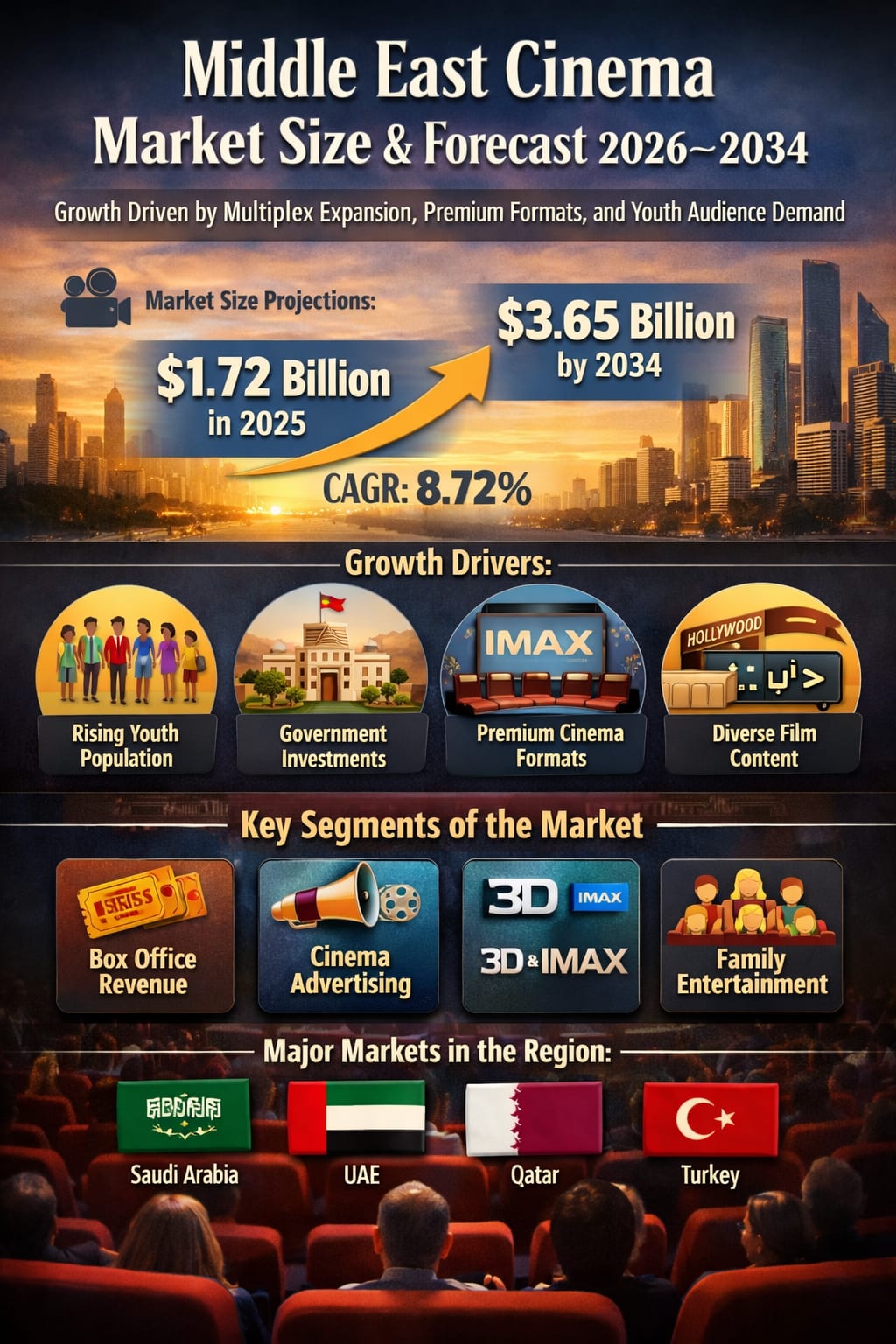
According to industry estimates, the Middle East cinema market is expected to grow from US$ 1,720.33 million in 2025 to US$ 3,650.87 million by 2034, registering a compound annual growth rate (CAGR) of 8.72% during 2026–2034. This impressive growth trajectory is being fueled by the rapid expansion of multiplexes, rising popularity of premium cinema experiences, increasing film content diversity, and sustained government initiatives aimed at strengthening the entertainment and cultural sectors.
Cinema in the Middle East is no longer just about watching movies—it has become a social, cultural, and lifestyle experience, often integrated into large shopping malls and mixed-use developments. As the region continues to open up culturally and economically, cinema is emerging as a key pillar of the broader entertainment economy.
Middle East Cinema Industry Outlook
Cinema is a powerful medium of visual storytelling that blends motion pictures, sound, and narrative to entertain, educate, and inspire audiences. Globally, it is both an art form and a social experience—and in the Middle East, it has increasingly become a symbol of cultural modernization and lifestyle transformation.
Historically, parts of the region had limited access to cinemas. However, over the past decade, the landscape has changed dramatically. Today, modern multiplexes, luxury theaters, international film festivals, and growing local film production are reshaping the industry. A young, tech-savvy population, combined with increasing disposable incomes and urban lifestyles, has significantly boosted cinema attendance.
Foreign films—particularly Hollywood blockbusters—continue to dominate box office revenues, but regional and Arabic-language films are steadily gaining acceptance and cultural relevance. For many consumers, going to the cinema is no longer just about watching a movie; it is a complete social outing that often includes shopping and dining. This shift has positioned cinema as a vital component of the Middle East’s evolving entertainment and lifestyle ecosystem.
Key Growth Drivers of the Middle East Cinema Market
1. Growing Youth Population and Urban Lifestyle
One of the strongest drivers of cinema market growth in the Middle East is the region’s young and rapidly urbanizing population. A significant proportion of the population is under the age of 35, creating a large and enthusiastic audience base for modern entertainment experiences. Urban lifestyles encourage out-of-home leisure activities, and cinemas have become popular social spaces for families, friends, and couples.
Large shopping malls and mixed-use developments have made cinemas more accessible than ever. Young audiences are especially drawn to international content, premium formats, and immersive technologies. With cities expanding and disposable incomes rising, youth-driven demand for cinema experiences remains a fundamental pillar of long-term market growth. The presence of a massive, digitally connected young population across the broader MENA region further reinforces this trend.
2. Government Support and Entertainment Investments
Government initiatives aimed at economic diversification and cultural development are playing a crucial role in shaping the cinema industry. Several Middle Eastern countries have included entertainment and media as strategic pillars of their national development plans. These initiatives encourage private sector participation, attract international cinema operators, and support the growth of local film production and exhibition.
The cinema industry is increasingly being recognized not only as a commercial sector but also as a cultural asset that enhances quality of life and global cultural integration. Favorable regulatory environments, investment incentives, and large-scale entertainment projects are creating a strong foundation for sustained market expansion across exhibition, production, and associated services.
3. Rising Demand for Premium and Immersive Experiences
Consumer preferences are shifting toward high-quality, immersive entertainment experiences. Formats such as IMAX, 4DX, VIP lounges, luxury recliners, and dine-in cinemas are gaining strong traction across major cities. Rising disposable incomes—especially in metropolitan areas—are enabling consumers to pay higher ticket prices for superior comfort, sound, and visual quality.
Cinema operators are increasingly differentiating themselves through advanced technology, personalized services, and premium food and beverage offerings. These enhancements not only improve customer satisfaction but also significantly increase revenue per screen. As entertainment becomes more lifestyle-oriented, premium cinema formats are expected to remain a major driver of value growth in the Middle East cinema market.
Challenges Facing the Middle East Cinema Market
1. Competition from Digital Streaming Platforms
The rapid rise of digital streaming platforms poses a significant challenge to traditional cinema exhibition. Consumers now have easy access to a wide range of on-demand content at home, often at lower costs and with greater convenience. Streaming platforms are also investing heavily in exclusive content, including regional and Arabic-language productions, which can divert audiences away from theaters.
Younger viewers, in particular, may be less inclined to visit cinemas for non-blockbuster films. To remain competitive, cinema operators must continue to emphasize the unique value of the theatrical experience—large screens, immersive sound, social engagement, and exclusive or early-access content that cannot be replicated at home.
2. High Capital and Operational Costs
Establishing and operating modern multiplexes involves substantial capital investment in real estate, projection systems, sound technology, seating, and interior design. Premium formats further increase costs due to specialized equipment and licensing requirements. In addition, operators face ongoing expenses related to staffing, maintenance, utilities, and content licensing.
In smaller cities or emerging markets, it may take time to achieve optimal occupancy rates, which can put pressure on profitability. Economic fluctuations and inflationary trends may also affect consumer spending on discretionary entertainment, adding another layer of risk for operators.
Market Overview by Key Segments
Middle East Box Office Cinema Market
The Middle East box office market has shown robust growth, supported by expanding cinema infrastructure, a rising number of screens, and increasing consumer spending on entertainment. Major cities act as box office hubs, driven by regular releases of international blockbusters and a growing slate of regional productions.
Hollywood films—particularly in action, adventure, and animation genres—continue to dominate revenues, while Arabic-language films are gradually increasing their market share due to improved production quality and cultural resonance. Holiday seasons and festival periods contribute significantly to annual box office collections. With continued demographic growth and cultural openness, the box office segment is expected to remain a core revenue generator.
Middle East Cinema Advertising Market
Cinema advertising is emerging as an attractive medium for brands seeking high-impact engagement with a captive audience. On-screen ads, lobby displays, digital signage, and event-based promotions offer premium visibility in a low-distraction environment. Luxury brands, automotive companies, telecom operators, and consumer goods firms are among the leading advertisers in this space.
As cinema attendance rises, advertisers are allocating larger budgets to this channel, particularly in high-income urban markets. The integration of data analytics and targeted advertising solutions is further improving campaign effectiveness, while cross-platform integration with social and mobile media is enhancing brand recall.
Middle East 3D Cinema Market
The 3D cinema segment continues to grow steadily, driven by demand for immersive experiences, especially for big-budget animation, science fiction, fantasy, and action films. The region’s theaters have invested heavily in modern 3D projection and sound technologies to meet audience expectations.
Although 3D tickets are priced higher than standard screenings, consumers often perceive them as premium, event-based experiences. Families and young audiences remain the core target groups, and the widespread availability of 3D screens in both large and mid-sized multiplexes ensures broad market reach.
Middle East Family Cinema Market
Family audiences represent a crucial segment of the Middle East cinema market, reflecting the region’s strong cultural emphasis on family-oriented entertainment. Cinemas provide a safe, comfortable, and climate-controlled environment suitable for all age groups. Animated films, action movies, and dubbed or subtitled content perform particularly well with family audiences.
Operators often offer family-friendly seating, special promotions, and bundled food packages to enhance appeal. Weekends and holiday periods generate peak demand, and family visits also contribute significantly to food and beverage sales, boosting overall revenue per customer.
Middle East Standard Cinema Market
Standard cinemas remain the backbone of the region’s exhibition market, accounting for the largest share of screens and overall attendance. With more affordable ticket prices, they cater to students, families, and budget-conscious viewers. These theaters primarily screen mainstream international and regional films and maintain high occupancy across multiple showtimes.
While premium formats are growing, standard cinemas continue to play a vital role in mass-market penetration and volume-driven revenue generation, especially in secondary cities and community hubs.
Country-Level Market Insights
Saudi Arabia
Saudi Arabia is one of the fastest-growing cinema markets in the region, supported by strong government initiatives, a young population, and rapid infrastructure development. Since the reopening and expansion of cinemas, multiplexes have spread across major cities and new urban developments. Demand for Hollywood blockbusters remains strong, alongside growing interest in Arabic and domestic productions. Premium formats are also gaining traction, positioning cinema as a key lifestyle and social activity.
United Arab Emirates (UAE)
The UAE hosts a mature, highly competitive cinema market with advanced technology adoption and diverse content offerings. Cinemas are widely available in malls and entertainment complexes, particularly in Dubai and Abu Dhabi. The multicultural population drives demand for content in multiple languages, while luxury formats such as IMAX, recliners, and dine-in theaters are well established. High per-capita entertainment spending supports strong box office and F&B revenues.
Qatar
Qatar’s cinema market is smaller in size but strongly premium-oriented, reflecting the country’s high per-capita income levels. Cinemas are concentrated in upscale malls and mixed-use developments and feature modern technology and high-end seating. While foreign films dominate, Arabic content maintains steady demand. Despite a smaller population base, high average spending per customer makes Qatar an attractive market.
Turkey
Turkey represents one of the largest and most mature cinema markets in the broader region, with a strong local film industry. Turkish-language films often outperform foreign titles at the domestic box office. Cinemas are widely available across major and secondary cities, and ticket prices remain relatively affordable, encouraging frequent посещения. Cultural affinity for storytelling and cinema as a social activity supports long-term market stability.
Market Segmentation
By Revenue:
Box Office
Cinema Advertising
Cinema Food and Drinks
By Cinema Format:
2D
3D
4D
IMAX
By Seating Format:
VIP / Premium
Standard
By End User:
Alone
Spouse (Couple)
Family
Friends
By Country:
Saudi Arabia
United Arab Emirates
Qatar
Bahrain
Kuwait
Oman
Rest of Middle East
Competitive Landscape
Key players in the Middle East cinema market include:
AMC, IMAX, Cinépolis, VOX Cinemas, Empire Cinemas, Cinema City, Al Shaab Cinema
These companies are analyzed across five key dimensions:
Overview
Key Persons
Recent Developments & Strategies
Product Portfolio
Financial Insights
Competition is increasingly centered around screen expansion, premium format deployment, partnerships with content providers, and enhancement of in-theater experiences.
Final Thoughts
The Middle East cinema market is on a strong growth trajectory, supported by demographic advantages, government backing, rising consumer spending, and continuous innovation in exhibition formats. While challenges such as streaming competition and high operational costs remain, the unique social and immersive nature of the cinema experience continues to set theaters apart.
With the market projected to more than double in value by 2034, cinema is set to remain a vital pillar of the region’s entertainment economy—blending culture, technology, and lifestyle into a compelling growth story for years to come.
About the Creator
Dividend Investing Guide: Building Passive Income Through Stocks
Dividend investing is a popular strategy among investors who want to generate steady income while still benefiting from long-term capital growth. Instead of relying solely on rising stock prices, dividend investors earn regular cash payments from the companies they own. Over time, this approach can create a reliable income stream and support long-term wealth creation.
By Hammad Nawaz5 days ago in Trader
Laundry Detergent Market: Innovation, Sustainability, and the Future of Fabric Care
Laundry Detergent Market Overview Laundry detergents are cleaning agents specifically formulated to remove dirt, stains, and odors from fabrics. They are available in various formats including powder, liquid, gel, pods, and sheets. Each format caters to specific consumer preferences and washing machine technologies.
By James Smith3 days ago in Trader




Comments
There are no comments for this story
Be the first to respond and start the conversation.