
HVAC Equipment Market Size, Growth & Forecast 2025–2033 | Renub Research
Smart, Sustainable, and Scalable: How HVAC Equipment Is Powering the Next Decade of Global Infrastructure

Global HVAC Equipment Market Outlook
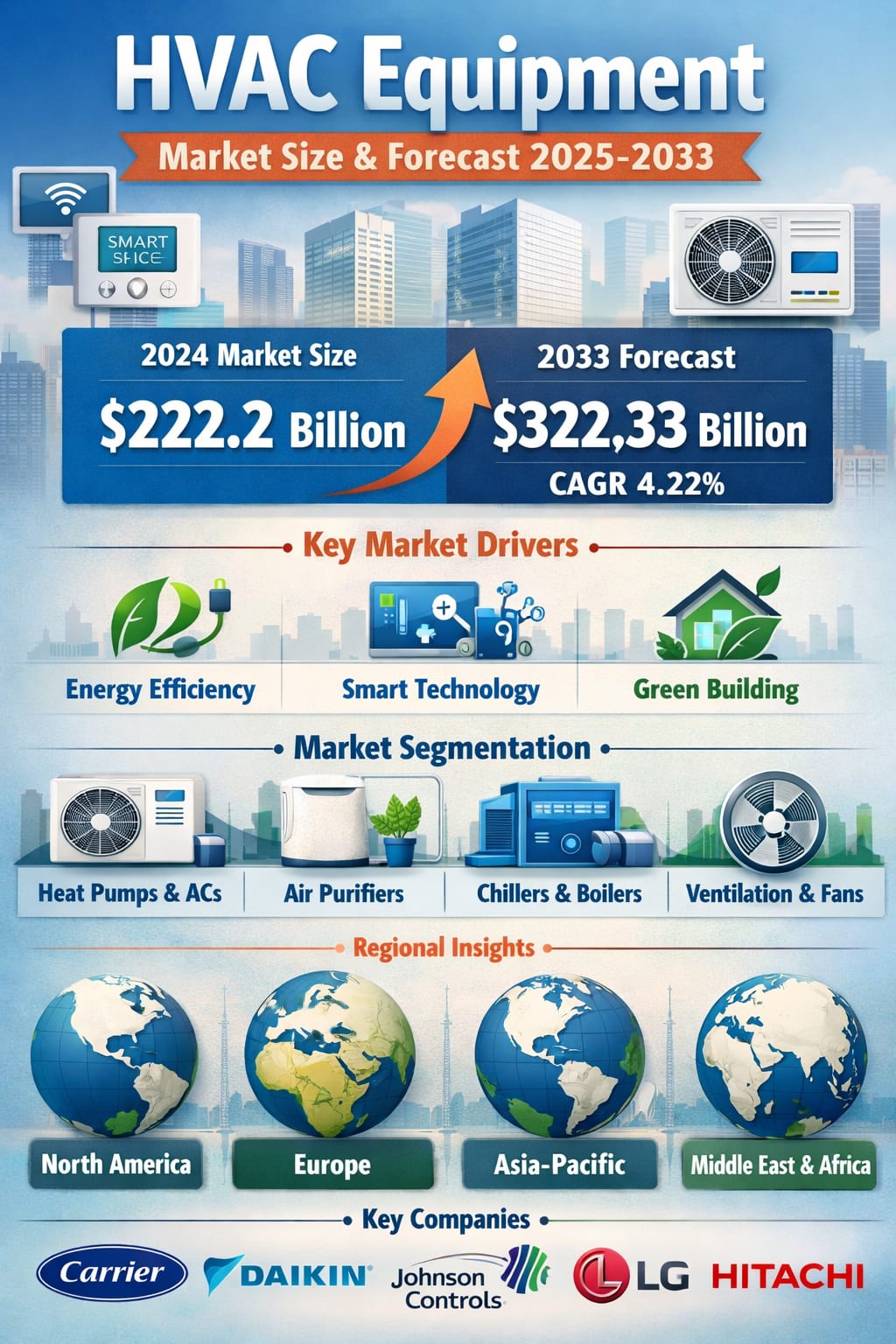
The global HVAC (Heating, Ventilation, and Air Conditioning) equipment market is entering a decisive decade shaped by sustainability goals, urban expansion, and rapid technological innovation. According to Renub Research, the HVAC Equipment Market was valued at US$ 222.2 billion in 2024 and is projected to reach US$ 322.33 billion by 2033, growing at a CAGR of 4.22% from 2025 to 2033.
This steady growth reflects the rising importance of climate control, energy efficiency, and indoor air quality across residential, commercial, and industrial environments. HVAC systems are no longer viewed as optional building components—they are now critical infrastructure supporting health, productivity, and environmental performance.
A combination of stricter energy efficiency regulations, growing awareness of environmental sustainability, and breakthroughs in smart and connected technologies is reshaping the industry. At the same time, urbanization in emerging economies and the rapid expansion of green building initiatives are creating strong long-term demand for advanced HVAC solutions worldwide.
Understanding the HVAC Equipment Industry
HVAC equipment includes a broad range of systems designed to regulate temperature, humidity, and air quality in indoor environments. These systems play a central role in creating comfortable, healthy, and productive spaces in homes, offices, factories, hospitals, shopping centers, and data centers.
The market covers equipment such as heat pumps, air conditioners, boilers, air purifiers, chillers, air handling units, unitary heaters, ventilation fans, and dehumidifiers, among others. Each category serves specific climate, building, and operational needs, making HVAC a highly diversified and application-driven industry.
As climate patterns become more extreme and urban populations continue to rise, the importance of reliable and energy-efficient HVAC systems is increasing. The industry is also being transformed by automation, IoT integration, and smart control systems, which allow users to monitor and optimize performance in real time while reducing energy consumption and operating costs.
Urbanization and Demographic Pressure: A Structural Growth Driver
Global urbanization is one of the strongest long-term drivers of HVAC demand. By 2050, around 68% of the world’s population is expected to live in urban areas, significantly increasing the need for residential buildings, offices, hospitals, schools, and commercial spaces.
At the same time, the global population is projected to keep growing—from 7.6 billion today to 8.6 billion by 2030, 9.8 billion by 2050, and 11.2 billion by 2100. Each year, roughly 83 million people are added to the global population, creating sustained pressure on housing and infrastructure.
In dense urban environments, proper ventilation and climate control are essential to maintain indoor air quality, manage heat stress, and reduce the spread of pollutants, odors, and airborne contaminants. HVAC systems help regulate temperature, control humidity, and reduce the risk of mold and microbial growth—making them indispensable in modern city life.
Energy Efficiency and Sustainability at the Core of Market Expansion
Buildings are among the world’s largest energy consumers. In the European Union alone, buildings account for over 40% of energy consumption and 36% of greenhouse gas emissions, much of which is linked to heating, cooling, and ventilation systems.
This reality has pushed governments and regulators to introduce stricter energy efficiency standards and emissions reduction targets. As a result, demand is rising for high-efficiency HVAC systems that use less energy while delivering better performance.
Manufacturers are responding with innovations such as variable-speed compressors, smart thermostatic controls, and energy-optimized system designs. For example, Carrier’s Infinity 20 air conditioner with Greenspeed intelligence operates at multiple speeds to match real-time demand, improving comfort while significantly reducing energy use.
These advancements not only lower operating costs for end users but also align HVAC investments with broader climate and sustainability goals—making energy efficiency a central pillar of market growth.
Rising Demand for Better Indoor Air Quality
The importance of indoor air quality has surged in recent years, especially following global health challenges that highlighted the risks of poor ventilation in enclosed spaces. Today, both consumers and businesses prioritize HVAC systems that can filter pollutants, reduce airborne pathogens, and improve overall air cleanliness.
Modern HVAC equipment increasingly integrates advanced filtration and air purification technologies. For instance, LG’s Plasmaster Ionizer++ technology is designed to eliminate up to 99.9% of certain bacteria in controlled environments, demonstrating how air quality has become a key performance metric alongside temperature control.
As awareness grows, demand for air purifiers, high-efficiency filters, and ventilation systems is rising across homes, offices, healthcare facilities, and public buildings—adding another strong growth layer to the HVAC equipment market.
Technology Transformations: IoT, Smart Systems, and Connected Comfort
One of the most significant shifts in the HVAC industry is the integration of Internet of Things (IoT) and smart technologies. Modern systems can now be monitored, controlled, and optimized remotely through smartphones, tablets, and building management platforms.
Smart thermostats, sensors, and connected control systems allow users to adjust temperature settings, schedule operations, track energy usage, and receive maintenance alerts in real time. This not only enhances comfort and convenience but also improves energy efficiency and reduces unnecessary operating costs.
A notable example is Resideo’s Honeywell Home T10+ Smart Thermostat Kits, which use advanced connectivity to manage multiple indoor air quality devices simultaneously, simplifying setup and customization while improving overall system performance.
As digitalization continues to spread across the built environment, smart and connected HVAC systems are expected to become the industry standard rather than the exception.
Challenges: Energy Use, Efficiency, and Lifecycle Costs
Despite strong growth prospects, the HVAC equipment market faces several structural challenges. Energy consumption remains a major concern, as HVAC systems are among the most energy-intensive components of buildings. Balancing high performance with low energy use is especially difficult in older buildings that were not designed for modern, efficient systems.
Retrofitting such structures can be costly and technically complex. While advanced technologies like variable-speed systems and smart controls offer solutions, their adoption often requires higher upfront investment, which can slow penetration in cost-sensitive markets.
Another key challenge is maintenance and lifecycle cost. HVAC systems require regular inspections, part replacements, and skilled technicians. Poor maintenance can lead to higher energy consumption, unexpected breakdowns, reduced system lifespan, and increased operating expenses.
In commercial and industrial settings, HVAC failures can disrupt operations, reduce productivity, and compromise comfort or safety. Although predictive maintenance and proactive service models are gaining traction, they also require sustained investment and long-term planning from building owners and operators.
Regional Outlook: Where Growth Is Taking Shape
Asia-Pacific: The Fastest-Growing Market
Asia-Pacific leads global HVAC equipment growth, driven by rapid urbanization, large-scale construction activity, and rising living standards. Countries such as China, India, and Southeast Asian nations are witnessing massive investments in residential, commercial, and industrial infrastructure, all of which require modern HVAC systems.
North America: Focus on Efficiency and Upgrades
In the United States and Canada, market growth is supported by government incentives, technological innovation, and strong demand for energy-efficient upgrades. The region is characterized by a mature but evolving market, where smart HVAC systems, building automation, and sustainability initiatives are shaping future demand.
Europe: Regulation-Driven Transformation
Europe’s HVAC market is heavily influenced by strict energy efficiency and climate regulations. Countries like Germany are accelerating the adoption of renewable-based heating solutions such as heat pumps and solar-assisted systems, supported by subsidies and long-term decarbonization goals.
Middle East & Africa: Climate and Infrastructure Push
In regions such as the UAE and Saudi Arabia, extreme climate conditions, rapid urban development, and mega infrastructure projects are fueling strong demand for advanced HVAC systems, particularly energy-efficient and smart solutions suited for large-scale commercial and residential projects.
Country Spotlights
United States HVAC Equipment Market
The U.S. market is expanding steadily due to rising demand for energy-efficient systems, smart building integration, and sustainable construction. Air conditioners, heat pumps, air purifiers, and advanced control systems are widely adopted across residential, commercial, and industrial sectors. Innovation, strategic partnerships, and digitalization continue to shape competitive dynamics.
Germany HVAC Equipment Market
Germany’s HVAC market is driven by its commitment to carbon neutrality by 2050. Heat pumps, renewable energy integration, and smart building technologies are gaining strong momentum, supported by government incentives. While high upfront costs and skills shortages pose challenges, long-term growth remains aligned with national energy and environmental goals.
China HVAC Equipment Market
China represents one of the world’s largest and fastest-growing HVAC markets, fueled by urbanization, construction activity, and green building policies. The government’s “Clean Heating Plan” aims to convert a large share of northern households from coal-based heating to cleaner alternatives, supporting both air quality improvement and carbon neutrality goals by 2060.
United Arab Emirates HVAC Equipment Market
The UAE’s HVAC market is growing rapidly due to harsh climate conditions, smart city projects, and sustainability-focused infrastructure development. Technologies such as VRF systems and IoT-enabled HVAC solutions are gaining popularity, supported by government policies promoting green buildings and energy efficiency.
Recent Industry Development
In November 2023, Midea Group announced an investment of USD 105 million to open its third industrial complex in Egypt’s Sadat City industrial zone. This brought the company’s total investment in Egypt to USD 247 million, creating around 3,900 new jobs and strengthening its global export capabilities—highlighting the industry’s continued expansion and localization strategies.
Market Segmentation
By Equipment
Heat Pump
Air Conditioning
Boilers
Air Purifier
Chillers
Air Handling Units
Unitary Heaters
Ventilation Fans
Dehumidifier
Others
By End Use
Residential
Commercial
Industrial
By Region
North America: United States, Canada
Europe: France, Germany, Italy, Spain, United Kingdom, Belgium, Netherlands, Turkey
Asia Pacific: China, Japan, India, Australia, South Korea, Thailand, Malaysia, Indonesia, New Zealand
Latin America: Brazil, Mexico, Argentina
Middle East & Africa: South Africa, Saudi Arabia, United Arab Emirates
Key Companies Covered
Carrier Corporation
Daikin Industries, Ltd.
Fujitsu
Haier Group
Havells India Ltd.
Hitachi Ltd.
Johnson Controls
LG Electronics
(Each profiled with overview, key persons, recent developments & strategies, and revenue analysis.)
Final Thoughts
The global HVAC equipment market is entering a phase of steady, sustainability-driven growth. With the market expected to rise from US$ 222.2 billion in 2024 to US$ 322.33 billion by 2033, the industry is being reshaped by energy efficiency regulations, smart technologies, urbanization, and rising expectations for indoor comfort and air quality.
While challenges related to energy consumption, maintenance costs, and system upgrades remain, ongoing innovation and policy support are creating a strong foundation for long-term expansion. As buildings become smarter, greener, and more connected, HVAC equipment will remain at the heart of the world’s transition toward more efficient, healthy, and sustainable indoor environments.
About the Creator
Philippines Retail Market 2026: Set for Rapid Expansion on Digital, Urban & Consumer Trends
Philippines Retail Market Overview The Philippines retail market is experiencing significant expansion as rising consumer spending, omnichannel retailing, and modern retail innovations reshape how Filipinos shop. According to the latest IMARC Group report, the market size reached USD 648.2 billion in 2025 and is expected to grow to USD 1,223.1 billion by 2034, exhibiting a compound annual growth rate (CAGR) of 7.31% during 2026–2034 — reflecting robust demand across product segments and distribution channels.
By Manisha Dixit2 days ago in Trader
Philippines Vending Machine Market 2026: Grows on Urban Convenience & Digital Payments
Philippines Vending Machine Market Overview The Philippines vending machine market size is steadily expanding as urban lifestyles, digital payment adoption, and changing consumer expectations drive demand for automated retail solutions. According to the latest IMARC Group analysis, the market was valued at USD 466.28 million in 2025 and is projected to reach USD 658.90 million by 2034, reflecting a compound annual growth rate (CAGR) of 3.92% during 2026–2034.
By Manisha Dixit2 days ago in Trader
The Cave Part 6
If you have ever heard a tale about yourself that you cannot remember and doubtless think is made up, you will know how I felt when Tharkin related all that the eagle had seen of me before my memories were scattered. Of far distances and traveling companions that I did not recall, camping out under the stars and making our way to the mountains with deliberate purpose. The great bird had lost contact with my party once we entered the forests, and the seven other members were not seen again by him or his brethren since.
By Jamye Sharp4 days ago in Chapters



Comments
There are no comments for this story
Be the first to respond and start the conversation.