
Global Printed Circuit Board Market Size and Forecast 2025–2033
How 5G, Electric Vehicles, and Smart Devices Are Reshaping the Backbone of Modern Electronics

Introduction: The Invisible Backbone of the Digital World
Behind every smartphone, electric vehicle, medical scanner, and industrial robot lies a critical but often overlooked component: the printed circuit board (PCB). While consumers focus on sleek screens and powerful processors, PCBs quietly perform the essential task of connecting and supporting all electronic components in a compact, reliable, and scalable way.
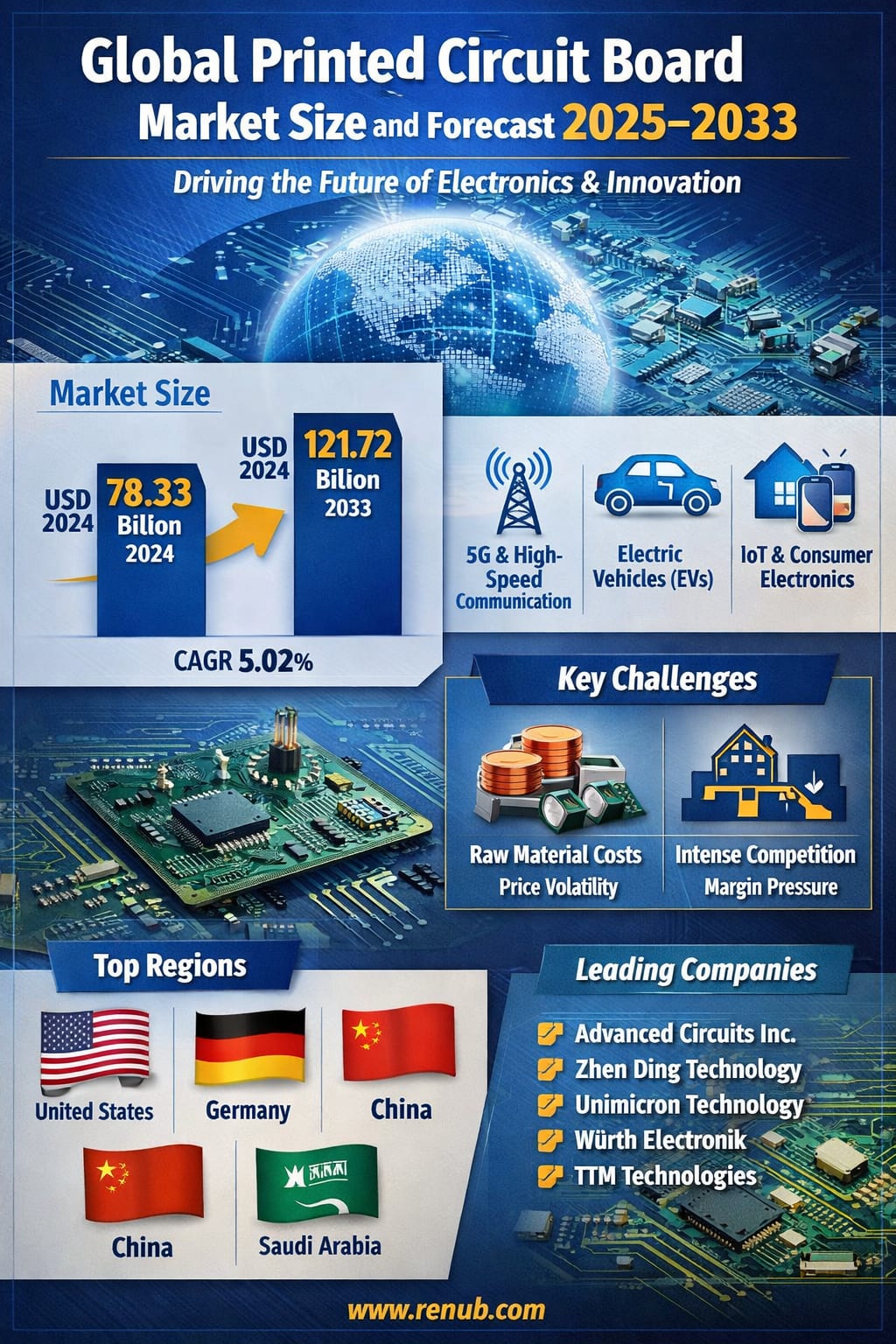
The Global Printed Circuit Board (PCB) Market was valued at USD 78.33 billion in 2024 and is projected to reach USD 121.72 billion by 2033, growing at a compound annual growth rate (CAGR) of 5.02% over the forecast period. This steady expansion reflects the unstoppable growth of electronics across industries such as consumer devices, automotive, healthcare, telecommunications, and industrial automation.
From 5G base stations and electric vehicles to wearable medical devices and smart factories, PCBs are no longer simple support components—they are strategic enablers of technological progress. As devices become smaller, faster, and more complex, the role of advanced PCB technologies such as HDI (High-Density Interconnect), rigid-flex, and multilayer boards continues to expand.
Global Printed Circuit Board Market Outlook
A printed circuit board is a flat board that mechanically supports and electrically connects electronic components using conductive tracks, pads, and other features etched from copper sheets laminated onto a non-conductive substrate. In simple terms, PCBs are the foundation on which modern electronics are built.
PCBs are used across virtually every industry: consumer electronics, automotive, aerospace, telecommunications, industrial machinery, and medical equipment. Their reliability, scalability, and design flexibility make them indispensable for producing compact, high-performance, and cost-effective electronic systems.
The evolution of electronics toward miniaturization, higher speeds, and greater functionality has dramatically increased the complexity of PCB design and manufacturing. Single-layer boards are increasingly giving way to multilayer, HDI, and rigid-flex PCBs that can support dense component placement, high-speed signal transmission, and strict thermal management requirements.
With the rise of IoT devices, 5G infrastructure, electric vehicles, and smart industrial systems, the PCB market has become one of the most dynamic and strategically important segments of the global electronics value chain.
Key Drivers of Growth in the Global PCB Market
1. Emergence of 5G and High-Speed Communication
The global rollout of 5G networks is one of the strongest growth engines for the PCB market. 5G technology demands high-frequency, high-speed, and highly reliable circuit boards capable of handling massive data flows with minimal signal loss.
Telecom infrastructure such as base stations, small cells, routers, and data centers requires advanced multilayer and high-frequency PCBs with superior signal integrity and thermal performance. As countries continue to invest in digital infrastructure and network upgrades, PCB manufacturers are seeing strong demand for technologically sophisticated boards that can meet next-generation communication standards.
2. Electrification of Vehicles and the Rise of EVs
The automotive industry is undergoing a historic transformation driven by electric vehicles (EVs), hybrid systems, and advanced driver assistance systems (ADAS). Modern vehicles now contain dozens, and sometimes hundreds, of PCBs used in battery management systems, power electronics, infotainment, safety systems, and vehicle connectivity modules.
EVs, in particular, require high-reliability, heat-resistant, and high-density PCBs to manage power distribution and control systems. As governments push for cleaner transportation and automakers increase investments in electrification and autonomous driving technologies, the automotive segment is becoming one of the fastest-growing end-use markets for PCBs.
3. Growth of IoT, Wearables, and Consumer Electronics
The explosion of IoT devices, wearables, and smart home products is driving demand for compact and highly integrated PCB solutions. Devices such as smartwatches, fitness trackers, wireless earbuds, smart speakers, and home automation systems rely heavily on HDI and rigid-flex PCBs to pack more functionality into smaller form factors.
Shorter product life cycles, constant innovation, and rising consumer expectations for performance and design continue to push PCB manufacturers toward more advanced and miniaturized board technologies. This trend is especially strong in Asia-Pacific, where most global consumer electronics manufacturing is concentrated.
Challenges Facing the Global PCB Market
1. Volatility in Raw Material Prices
PCB manufacturing depends heavily on materials such as copper, epoxy resins, and specialty laminates. Price fluctuations caused by supply chain disruptions, geopolitical tensions, or trade restrictions can significantly impact production costs and profit margins.
When raw material prices rise sharply, manufacturers must either absorb the cost increases or pass them on to customers—both of which can strain business relationships and competitiveness. Longer lead times for key materials also force companies to maintain higher inventories, increasing working capital requirements.
2. Intense Competition and Margin Pressure
The global PCB industry is highly competitive, particularly in Asia, where large-scale manufacturers benefit from cost advantages and economies of scale. Companies in China, Taiwan, and South Korea dominate high-volume production, often operating on thin margins.
To stay competitive, manufacturers must invest in automation, advanced manufacturing processes, and high-value PCB technologies such as HDI and rigid-flex boards. However, these investments require significant capital, making it difficult for smaller players to keep pace and maintain profitability in a price-sensitive market.
End-Use Segment Insights
PCB in Consumer Electronics
Consumer electronics remain the largest demand driver for PCBs, fueled by the massive global market for smartphones, laptops, tablets, televisions, and connected home appliances. Modern devices require compact, multifunctional, and high-performance PCBs to support advanced features while maintaining slim and lightweight designs.
Emerging product categories such as foldable phones, AR/VR devices, and wearable electronics are further increasing the need for innovative PCB designs. Rapid product refresh cycles and growing demand in emerging markets continue to make consumer electronics one of the most dynamic segments of the PCB industry.
PCB in Industrial and Automation Equipment
Industrial automation is accelerating worldwide as manufacturers adopt Industry 4.0, smart factories, and IoT-enabled machinery. This shift is boosting demand for rugged, high-reliability PCBs used in robotics, control systems, power supplies, and industrial sensors.
These applications often require boards that can operate in harsh environments, withstand high temperatures, and deliver long-term reliability. As industries seek greater efficiency, connectivity, and automation, the industrial PCB segment is expected to provide stable, long-term growth opportunities.
PCB in Medical Devices
Healthcare electronics represent a fast-growing and high-value segment of the PCB market. Devices such as portable diagnostic tools, patient monitoring systems, imaging equipment, and wearable medical devices rely on highly reliable, miniaturized PCB solutions.
Rigid-flex and HDI PCBs are increasingly used in medical applications where space constraints, reliability, and performance are critical. Aging populations, expanding healthcare infrastructure, and the digital transformation of healthcare systems are driving sustained demand for advanced medical electronics worldwide.
Regional Market Perspectives
United States Printed Circuit Board Market
The U.S. PCB market is primarily focused on high-end, low-to-medium volume production for sectors such as aerospace, defense, medical devices, and industrial equipment. While much of mass PCB manufacturing has moved offshore, American companies specialize in high-complexity, high-value boards.
Government initiatives such as the CHIPS Act and rising concerns about supply chain security are encouraging reshoring of critical electronics manufacturing, including PCB production. In June 2024, AdvancedPCB was launched as a future-ready PCB manufacturer through the integration of Advanced Printed Circuit Technology (APCT), Advanced Circuits, Inc. (ACI), and San Diego PCB Design (SDPCB), highlighting renewed investment and consolidation in the U.S. market.
Germany Printed Circuit Board Market
Germany’s PCB market is closely tied to its strengths in automotive engineering, industrial automation, and precision medical equipment. The country emphasizes high-quality, high-reliability, and technologically advanced PCBs, often produced in lower volumes but with high value-added complexity.
Growth is particularly strong in electric vehicles, smart factory systems, and renewable energy applications. In April 2024, Thales Group increased its circuit board production at its Industrial Competence Center to meet rising demand from Germany and European rail networks, underlining the strategic importance of PCBs in modern infrastructure development.
China Printed Circuit Board Market
China dominates global PCB production, accounting for more than half of worldwide output. The country benefits from massive manufacturing scale, integrated supply chains, and strong cost competitiveness. Major production hubs such as Shenzhen and Suzhou serve global markets in consumer electronics, telecommunications, automotive, and lighting.
As China pushes forward with 5G, AI, and electric vehicles, demand for advanced PCBs such as HDI and flexible boards is rising rapidly. In October 2024, WUS Printed Circuit announced a CNY 4.3 billion investment to expand production capacity in response to growing computing demand, reflecting continued confidence in long-term market growth.
Saudi Arabia Printed Circuit Board Market
Saudi Arabia’s PCB market is still in its early stages but is gaining momentum under the country’s Vision 2030 economic diversification strategy. Investments in smart cities, renewable energy, defense, and digital infrastructure are creating new demand for electronic systems and, in turn, PCBs.
While most PCBs are currently imported, government incentives and foreign partnerships aim to gradually build local manufacturing capabilities. In September 2024, Chinese technology company Meituan expanded into the Saudi market with its KeeTa platform, signaling broader growth in digital services and supporting infrastructure that will indirectly boost electronics and PCB demand.
Market Segmentation Overview
By Type:
Single-Sided
Double-Sided
Multi-Layer
HDI
Substrate
By Structure:
Rigid
Flexible
Rigid-Flex
By End Use:
Industrial Electronics
Healthcare
Aerospace and Defense
Automotive
IT and Telecom
Consumer Electronics
Others
By Region:
North America, Europe, Asia Pacific, Latin America, Middle East & Africa, including major markets such as the United States, Germany, China, India, Japan, Brazil, and Saudi Arabia.
Competitive Landscape and Key Players
The global PCB market features a mix of large multinational manufacturers and specialized regional players. Competition is based on technology capability, manufacturing scale, quality, reliability, and customer service.
Key players include:
Advanced Circuits Inc.
Zhen Ding Technology Holding Limited
Unimicron Technology Corporation
Würth Elektronik GmbH & Co. KG
Becker & Müller Circuit Printing GmbH
Jabil Inc.
Murrietta Circuits
Nippon Mektron Ltd.
Sumitomo Corporation
TTM Technologies Inc.
These companies are continuously investing in advanced manufacturing technologies, capacity expansion, and high-value PCB solutions to stay competitive in a rapidly evolving market.
Final Thoughts: A Market Built for the Future
The global printed circuit board market is no longer just a behind-the-scenes industry—it is a strategic pillar of the digital economy. With the market expected to grow from USD 78.33 billion in 2024 to USD 121.72 billion by 2033, PCBs will continue to play a central role in shaping the future of electronics.
Driven by 5G, electric vehicles, industrial automation, and healthcare digitization, the industry is moving steadily toward higher complexity, higher performance, and higher value-added solutions. While challenges such as cost pressures and intense competition remain, companies that invest in innovation, quality, and advanced manufacturing capabilities are well positioned to thrive.
About the Creator
United States Smart Pills Market Size and Forecast 2025–2033
United States Smart Pills Market: A New Era of Ingestible Technology The United States Smart Pills Market is entering a phase of rapid transformation, driven by the convergence of healthcare, digital technology, and advanced medical devices. According to industry estimates, the market is expected to reach US$ 4.13 billion by 2033, growing from US$ 1.53 billion in 2024, at a robust CAGR of 11.66% from 2025 to 2033. This impressive growth reflects a broader shift in modern healthcare toward minimally invasive diagnostics, real-time patient monitoring, and data-driven treatment strategies.
By Sakshi Sharma4 days ago in Trader



Comments
There are no comments for this story
Be the first to respond and start the conversation.