
Global Beef Market Trends & Summary (2025–2033)
Rising Protein Demand, Premiumization, and Expanding Foodservice Channels Reshape the Global Beef Industry

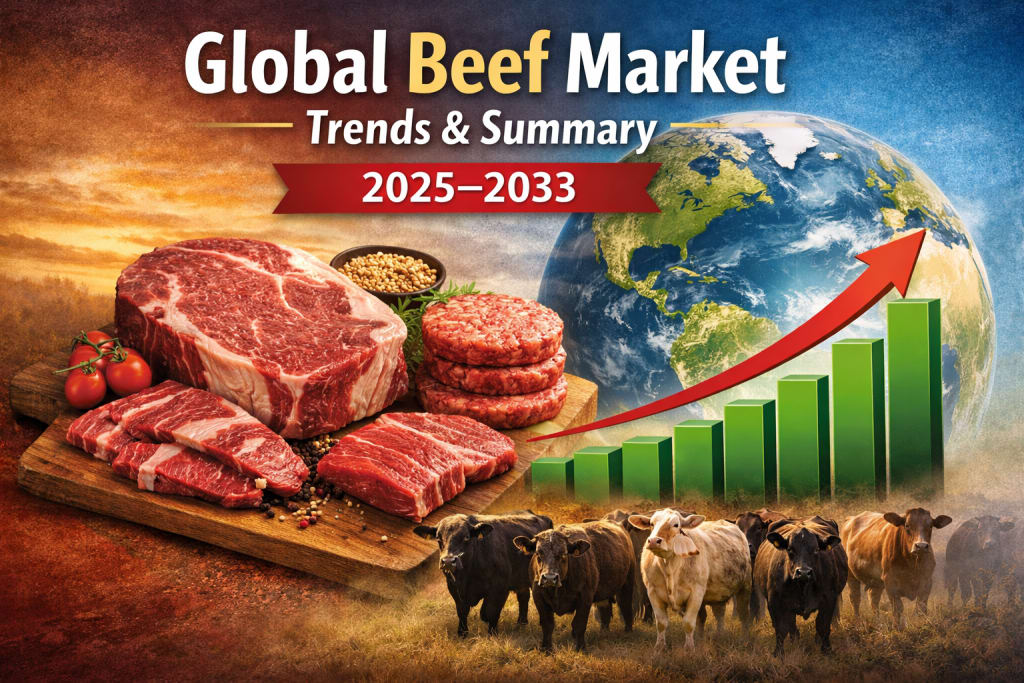
Global Beef Market Outlook: A Growing Industry with Strong Fundamentals
The global beef market continues to hold a critical position in the world’s food and agriculture ecosystem, supported by steady demand, evolving consumer preferences, and continuous improvements in production and distribution. According to Renub Research, the Beef Market is expected to reach US$ 749.90 billion by 2033, rising from US$ 520.53 billion in 2024, growing at a compound annual growth rate (CAGR) of 4.14% from 2025 to 2033.
This expansion is being fueled by multiple converging factors: rising global demand for protein-rich diets, growing consumer interest in premium and high-quality meat products, technological advancements in cattle farming and meat processing, and expanding consumption in emerging economies and the global foodservice sector.
Beef remains one of the most widely consumed animal proteins worldwide, valued for its taste, texture, and nutritional profile. It is a rich source of high-quality protein, iron, zinc, and B vitamins, making it an important component of many diets. From everyday meals such as burgers and curries to premium steaks served in fine-dining restaurants, beef plays a versatile role across cultures and cuisines.
At the same time, the industry is undergoing a structural transformation. Consumers are more informed, more selective, and more conscious about quality, safety, sustainability, and animal welfare. These changing expectations are reshaping how beef is produced, marketed, and sold across global markets.
Beef Industry Overview: From Farm to Fork
The beef industry covers a wide value chain, starting from cattle breeding and farming, moving through slaughtering and processing, and finally reaching distribution via retail, wholesale, and foodservice channels. Each stage has seen modernization over the past decade, driven by improvements in genetics, feed efficiency, animal health management, cold chain logistics, and digital traceability systems.
In many countries, beef production has become more data-driven and technology-enabled, helping farmers increase yields while improving quality and consistency. Advanced breeding techniques, better feed formulations, and disease management practices have all contributed to more efficient and reliable supply.
On the consumer side, demand patterns are shifting. While volume consumption continues to rise in developing economies, mature markets are increasingly focused on premium cuts, branded beef, and certified products such as grass-fed, organic, or antibiotic-free beef. This dual trend—volume growth in emerging markets and value growth in developed markets—is one of the defining features of the global beef industry today.
Key Growth Drivers Shaping the Beef Market
1. Rising Demand for Natural, Premium, and Antibiotic-Free Beef
One of the strongest trends in the beef market is the growing consumer preference for high-quality, natural, and responsibly produced meat. In countries like the United States, demand for branded and premium beef categories—such as USDA Choice, USDA Prime, USDA Natural, and Certified Angus Beef (CAB)—has increased significantly, supported by higher disposable incomes and a broader premiumization trend in food consumption.
Consumers are becoming more aware of the potential health impacts of antibiotics and growth hormones used in livestock production. This has accelerated demand for antibiotic-free, grass-fed, and organic beef products. Foodservice brands and retailers are also responding by expanding their premium and “clean-label” beef offerings.
For example, Certified Angus Beef has reported consistent growth in foodservice sales, reflecting how restaurants are using premium beef as a way to differentiate their menus and justify higher price points. Similarly, producers like Raise American have introduced 100% grass-fed organic beef products to cater to flexitarian and health-conscious consumers.
This shift toward quality over quantity is helping the beef market grow not just in volume, but also in overall value.
2. Expansion of Distribution Channels and E-Commerce
The global meat distribution network is expanding rapidly, and this is playing a crucial role in supporting market growth. Supermarkets, hypermarkets, specialty meat shops, wholesalers, and online platforms are all contributing to wider availability and better accessibility of beef products.
The foodservice sector—including restaurants, hotels, cafes, and fast-food chains—remains a major driver of demand. As urban lifestyles become busier and eating out becomes more common, demand for beef-based dishes continues to rise, especially in quick-service and casual dining formats.
At the same time, e-commerce and online grocery platforms are transforming how consumers buy meat. Online channels offer convenience, a wider selection of cuts, attractive promotions, and home delivery—features that have become increasingly popular since the pandemic. Many consumers now feel comfortable ordering fresh and chilled beef online, especially when platforms provide quality certifications, traceability, and cold-chain assurance.
Supermarkets and hypermarkets still dominate in terms of volume sales, thanks to their wide product range, competitive pricing, and consumer trust. However, online retail is emerging as one of the fastest-growing channels, adding a new layer of momentum to the global beef market.
3. Rising Global Demand for Protein-Rich Diets
Perhaps the most powerful long-term driver of the beef market is the global shift toward protein-rich diets, especially in emerging economies. As countries such as China, India, Brazil, and Southeast Asian nations continue to urbanize and grow economically, millions of consumers are moving into the middle class and upgrading their diets.
Western-style eating patterns, which include higher consumption of animal protein, are becoming more common. Beef, in particular, is often seen as a premium and aspirational protein, associated with better nutrition, status, and modern lifestyles.
Rising disposable incomes mean that more consumers can afford beef on a regular basis rather than as an occasional luxury. This trend is significantly expanding the consumer base in large, high-population markets, making emerging economies a central pillar of future growth for the global beef industry.
Challenges Facing the Global Beef Market
1. Animal Welfare and Sustainability Concerns
Despite strong demand, the beef industry faces increasing scrutiny over animal welfare, environmental impact, and ethical farming practices. Advocacy groups and conscious consumers are raising concerns about overcrowding, inhumane slaughter practices, and the carbon footprint of cattle farming.
These concerns are pushing governments and industry bodies to introduce stricter regulations and higher welfare standards. While this is positive from an ethical and sustainability perspective, it can also increase production costs for farmers and processors, potentially squeezing profit margins.
At the same time, it is also creating new market segments, such as certified humane, grass-fed, and sustainably produced beef, which can command premium prices and help offset higher costs.
2. Supply Chain Disruptions and Operational Risks
The beef market is also vulnerable to supply chain disruptions, caused by factors such as disease outbreaks, labor shortages, transportation bottlenecks, and geopolitical tensions. The COVID-19 pandemic exposed several weaknesses in global meat supply chains, including temporary plant closures, logistics delays, and labor constraints.
Such disruptions can lead to price volatility, product shortages, and reduced availability, affecting both producers and consumers. Building more resilient, flexible, and diversified supply chains has become a strategic priority for major players in the beef industry.
Regional Insights: How the Market Varies Across the World
North America: A Mature Yet Powerful Market
North America, especially the United States, remains one of the largest producers and consumers of beef globally. The region is characterized by high per capita consumption, strong foodservice demand, and a well-developed retail infrastructure. Premiumization is a major trend here, with strong growth in branded, organic, and specialty beef products.
Europe: Strong Demand, Tight Regulations
Europe shows steady demand for beef, but growth is moderated by strict regulations, high production costs, and increasing environmental concerns. Countries like Germany, France, and the United Kingdom have significant consumption, with a growing focus on sustainability, traceability, and animal welfare-certified products.
Asia-Pacific: The Fastest-Growing Opportunity
The Asia-Pacific region, led by China, Japan, South Korea, and emerging Southeast Asian markets, represents the most dynamic growth opportunity. Rising incomes, urbanization, and changing diets are driving rapid increases in beef consumption. In China, domestic production struggles to keep pace with demand, leading to rising imports from countries such as Brazil, Argentina, and Australia.
Latin America: A Global Export Powerhouse
Brazil, Argentina, and Mexico play a crucial role in the global beef trade, especially as major exporters. The region benefits from large cattle herds, competitive production costs, and strong export demand, particularly from Asia and the Middle East.
Middle East & Africa: Growing, Niche-Driven Demand
In the Middle East and Africa, demand is supported by population growth, rising incomes, and religiously compliant meat segments such as Halal beef. Countries like Saudi Arabia, the UAE, and South Africa are important regional markets, with a mix of local production and imports.
Market Segmentation Snapshot
By Cut:
Brisket
Shank
Loin
Others
By Slaughter Method:
Halal
Kosher
Others
By Distribution Channel:
Supermarkets and Hypermarkets
Retail Stores
Wholesalers
E-Commerce
Others
By Geography:
North America: United States, Canada
Europe: France, Germany, Italy, Spain, United Kingdom, Belgium, Netherlands, Turkey
Asia-Pacific: China, Japan, India, South Korea, Thailand, Malaysia, Indonesia, Australia, New Zealand
Latin America: Brazil, Mexico, Argentina
Middle East & Africa: South Africa, Saudi Arabia, UAE
Competitive Landscape: Key Players Shaping the Industry
The global beef market is highly competitive, with several large multinational players operating across production, processing, and distribution. Key companies include:
JBS S.A.
Tyson Foods
Pilgrim’s Pride Corporation
Danish Crown Group
Vion Food Group
WH Group
Hormel Foods Corporation
Muyuan Foods
These companies compete on scale, efficiency, brand strength, product quality, and geographic reach. Strategic priorities across the industry include capacity expansion, product innovation, sustainability initiatives, and strengthening supply chain resilience.
Final Thoughts: A Market Built on Both Scale and Value
The global beef market is entering a phase of balanced, sustainable growth. With Renub Research projecting the market to rise from US$ 520.53 billion in 2024 to US$ 749.90 billion by 2033, at a CAGR of 4.14%, the long-term outlook remains solid.
What makes this growth particularly interesting is its dual nature: expanding consumption in emerging economies on one hand, and rising demand for premium, high-quality, and responsibly produced beef in developed markets on the other.
While challenges related to animal welfare, sustainability, and supply chain stability cannot be ignored, they are also driving innovation and higher standards across the industry. Companies that can successfully balance efficiency, quality, transparency, and ethical practices will be best positioned to lead in the next decade.
About the Creator
Sakshi Sharma
Content Writer with 7+ years of experience crafting SEO-driven blogs, web copy & research reports. Skilled in creating engaging, audience-focused content across diverse industries.
Keep reading
More stories from Sakshi Sharma and writers in Trader and other communities.
Europe Air Conditioner (AC) Market Trends & Outlook 2025–2033
Introduction: Cooling Becomes a Necessity, Not a Luxury The Europe Air Conditioner (AC) Market is undergoing a significant transformation, driven by shifting climate patterns, rapid urbanization, and the growing emphasis on energy efficiency and sustainability. Once considered a non-essential appliance in many European countries, air conditioning is now increasingly viewed as a necessity—particularly as heatwaves become more frequent and intense across the continent.
By Sakshi Sharmaabout 22 hours ago in Trader
United States Wine Market is Expected to Grow USD 119.6 Billion by 2034 | CAGR 4.59%
Overview United States Wine Market The United States wine market encompasses domestic production, imports, distribution, and consumption of all wine types, including red, white, rosé, and sparkling wines. Wine holds a prominent position in the country’s beverage landscape, from casual social occasions to premium dining experiences. California remains the country’s largest wine-producing region, accounting for the vast majority of domestic output, while imports from Europe, South America, and Oceania provide variety and choice on retail shelves.
By Ashutosh Srivastavaa day ago in Trader
Asia Stocks Pull Back From Record Highs on AI Disruption Fears; KOSPI Slips Nearly 4%
Asian equity markets retreated sharply today as growing concerns around artificial intelligence (AI) disruption, global rate uncertainty, and sector-specific volatility triggered a broad selloff across the region. After touching record highs in recent sessions, major Asian indices witnessed profit-booking and increased risk aversion, signaling that investors may be reassessing the sustainability of the recent rally.
By Hammad Nawaz2 days ago in Trader
from death into life
Young Aldin of Wiloh had never contemplated death. It was almost strange — so many around him had the tendency to obsess over it, to clamor and claw almost desperately at their own perceptions of the end to know death as much as they could: when it would come, why it would come, where it would take them when it did.
By angela hepworth3 days ago in Fiction




Comments
There are no comments for this story
Be the first to respond and start the conversation.