
France Convenience Store Market Size and Forecast 2026–2034
Urban Lifestyles, Digital Payments, and Ready-to-Eat Demand Reshape France’s Neighborhood Retail Landscape

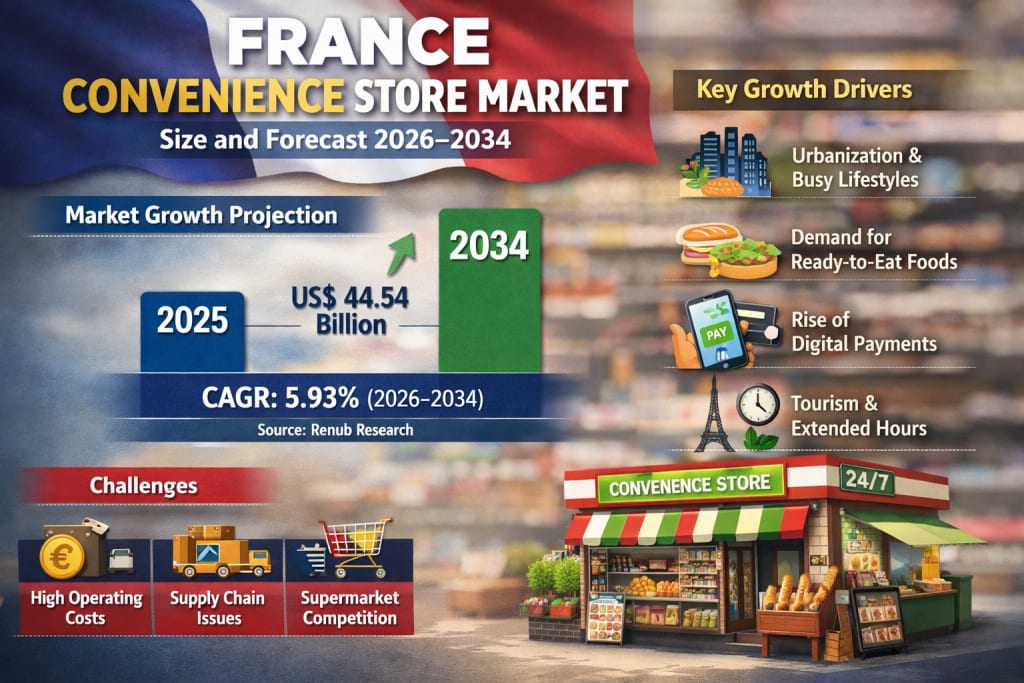
France Convenience Store Market Overview
The France Convenience Store Market is entering a decisive phase of transformation, supported by urbanization, evolving consumer behavior, and a strong shift toward fast, flexible retail formats. According to Renub Research, the market is expected to expand from US$ 26.52 billion in 2025 to US$ 44.54 billion by 2034, registering a CAGR of 5.93% during the forecast period 2026–2034.
Convenience stores in France are no longer viewed as simple stop-gap retailers. Instead, they are becoming essential neighborhood hubs that blend speed, accessibility, fresh food offerings, and digital payment integration. Rising tourism, extended operating hours, and increasing acceptance of cashless payments continue to enhance their appeal across both metropolitan and secondary cities.
As French consumers seek efficiency without compromising quality, convenience stores are evolving to reflect national culinary preferences, sustainability expectations, and modern shopping habits.
Outlook of the Convenience Store Market in France
Convenience stores are compact retail outlets strategically located to provide quick access to everyday essentials. These stores typically stock packaged food, beverages, snacks, bakery items, household goods, personal care products, and ready-to-consume meals. Their defining strengths lie in speed, proximity, and flexible hours, often operating late into the evening.
In France, convenience stores are increasingly found in city centers, residential neighborhoods, transit stations, and tourist zones. Changing lifestyles, dense urban populations, and time-constrained consumers have accelerated their popularity. Professionals, students, and commuters value the ability to make frequent, small purchases without visiting large hypermarkets.
Modern French convenience stores emphasize fresh bakery items, organic snacks, regional specialties, and locally sourced products, aligning closely with national food culture. As urbanization intensifies and consumer schedules grow busier, these outlets are becoming an indispensable part of daily life throughout France.
Growth Drivers of the France Convenience Store Market
Urbanization and the Shift Toward Faster Shopping Habits
With more than 82% of France’s population living in urban areas, cities such as Paris, Lyon, and Marseille are experiencing sustained population density growth. Traditional weekly supermarket trips are increasingly impractical for urban residents, encouraging frequent, short visits to nearby stores.
Single-person households and dual-income families further amplify demand for on-the-go meals, quick essentials, and flexible shopping hours. Convenience stores meet this demand by offering easily accessible locations and extended operating times, making them a preferred option for time-pressed consumers.
Rising Demand for Fresh, Local, and Ready-to-Eat Foods
French consumers increasingly seek high-quality yet convenient food options. As a result, convenience stores are expanding their offerings of freshly baked pastries, sandwiches, salads, fruit portions, organic snacks, and regional specialties.
This trend aligns strongly with France’s culinary heritage, which prioritizes freshness and authenticity. Many stores collaborate with local suppliers and artisans to differentiate themselves from mass-market supermarkets. Sustainability considerations, such as eco-friendly packaging and minimally processed foods, are also shaping product portfolios.
In July 2025, bakery supplier Delice de France entered the chilled ready-to-eat category with its modular “Delice to Go” concept, highlighting how premium grab-and-go offerings are redefining convenience retail across France.
Digital Payments, Technology Adoption, and Omnichannel Retail
Digitalization is a major force transforming France’s convenience store landscape. Contactless payments, mobile wallets, and self-checkout systems have significantly reduced transaction times and improved customer experience.
France leads Europe in digital payment adoption, with 71% of retailers now preferring cashless transactions. Click-and-collect services, loyalty apps, and partnerships with third-party delivery platforms allow convenience stores to blend physical accessibility with online convenience.
As French consumers increasingly embrace technology, tech-enabled convenience stores are well positioned to capture long-term growth.
Challenges in the France Convenience Store Market
High Operating Costs and Intense Competition
Operating convenience stores in France is capital-intensive. High urban rents, rising labor costs, and limited retail space place pressure on margins. Unlike hypermarkets, convenience stores lack economies of scale, making price competition difficult.
Competition has intensified as large supermarket chains introduce urban micro-store formats, directly targeting the same customer base. Additionally, strict regulations surrounding labor hours, food handling, and promotions add complexity to daily operations.
Maintaining profitability while offering diverse, affordable products remains a critical challenge.
Supply Chain Complexity and Fresh Food Management
Fresh food is a major draw for French consumers but presents logistical hurdles. Limited storage space requires frequent restocking, increasing transportation and distribution costs, especially in dense city centers.
Perishable goods such as produce, dairy, and ready meals demand precise inventory control to minimize waste. Weather disruptions, supplier inconsistencies, and transportation delays further complicate operations. Achieving freshness without excess spoilage remains a key operational concern.
France Convenience Store Market by Product Category
Raw Food Segment
The raw food segment is gaining traction as health-conscious consumers seek natural, minimally processed ingredients. Fruits, vegetables, herbs, and basic cooking essentials support the growing “quick-cooking” trend among urban households.
Partnerships with local farmers and efficient cold storage systems enable stores to deliver freshness despite limited space, reinforcing consumer trust.
Frozen Food Segment
Frozen foods represent a strong growth area due to longer shelf life and reduced waste. Frozen vegetables, ready meals, desserts, and bakery items are popular among consumers seeking convenience without compromising taste.
Advances in freezing technology have enhanced quality perception, making frozen foods an increasingly attractive option in French convenience stores.
Meat and Poultry Products
Packaged meat and poultry products cater to small households and busy consumers. Deli meats, marinated cuts, and ready-to-cook portions are sourced from reliable suppliers and stored under strict quality controls.
Although perishable, this segment performs well due to consistent demand and the preference for smaller portion sizes.
Cereal-Based Products
Cereal-based items such as bread, pastries, snack bars, and biscuits remain staples. France’s rich bakery tradition supports strong demand for fresh baguettes, croissants, and viennoiseries, often supplied through partnerships with local bakeries.
Regional Insights: Key City Markets
Paris Convenience Store Market
Paris represents the most competitive convenience store market in France. High population density, tourism, and extended operating hours drive continuous foot traffic. Shoppers prioritize quality, freshness, and organic options, pushing stores to elevate product standards.
Marseille Convenience Store Market
Marseille’s multicultural population and Mediterranean lifestyle shape product offerings. Stores cater to diverse tastes with regional and international cuisines. Proximity to beaches, ports, and tourist areas boosts seasonal demand.
Strasbourg Convenience Store Market
Strasbourg benefits from its administrative importance and cross-border workforce. Demand is driven by students, professionals, and tourists seeking bakery items, Alsatian specialties, and eco-friendly products.
Market Segmentation
By Type:
Raw Food, Canned Food, Frozen Food, Ready-to-Eat, Ready-to-Cook, Others
By Product:
Meat/Poultry Products, Cereal-Based Products, Vegetable-Based Products, Others
By Distribution Channel:
Supermarkets & Hypermarkets, Convenience Stores, Specialty Stores, Others
By City:
Paris, Lyon, Marseille, Toulouse, Bordeaux, Lille, Nantes, Strasbourg, Nice, Montpellier, Rest of France
Competitive Landscape
Key companies operating in the France convenience and packaged food ecosystem include:
Ajinomoto Co., Inc.
Amy's Kitchen, Inc.
Cargill, Incorporated
Conagra Brands, Inc.
General Mills, Inc.
McCain Foods Limited
MTR Foods Pvt. Ltd.
Nestlé SA
Tyson Foods Inc.
Each company has been evaluated across five viewpoints: overview, key leadership, recent developments, SWOT analysis, and revenue performance.
Final Thoughts
The France Convenience Store Market is evolving into a sophisticated, consumer-centric retail ecosystem. With strong growth projected through 2034, driven by urban lifestyles, digital payments, and demand for high-quality ready-to-eat foods, convenience stores are redefining neighborhood retail in France.
Despite challenges related to operating costs and supply chain complexity, innovation, localization, and technology adoption will remain critical success factors. As consumer expectations continue to shift toward speed, quality, and sustainability, convenience stores are poised to play an increasingly strategic role in France’s retail future.
About the Creator
Sakshi Sharma
Content Writer with 7+ years of experience crafting SEO-driven blogs, web copy & research reports. Skilled in creating engaging, audience-focused content across diverse industries.
Keep reading
More stories from Sakshi Sharma and writers in Trader and other communities.
Europe Insurance Third Party Administrators Market Size & Forecast (2026–2034)
Introduction The Europe Insurance Third Party Administrators (TPA) Market is undergoing a significant transformation as insurers increasingly turn to outsourcing to improve efficiency, reduce costs, and manage growing operational complexity. According to Renub Research, the market is projected to grow from US$ 156.09 billion in 2025 to US$ 242.56 billion by 2034, registering a compound annual growth rate (CAGR) of 5.02% from 2026 to 2034.
By Sakshi Sharmaabout 17 hours ago in Trader
Ceramics Market: Trends, Innovations, and Industry Growth
Overview The ceramics market is a dynamic and expansive sector that spans a wide range of applications, from traditional pottery and tiles to cutting-edge industrial ceramics used in electronics, aerospace, and medical devices. Ceramics are prized for their durability, heat resistance, and insulating properties, making them essential in various high-tech and manufacturing applications. The market is being influenced by technological advancements, growing demand for eco-friendly products, and innovations in smart ceramics. This industry is experiencing significant growth, particularly in emerging markets, driven by infrastructure development and rising consumer interest in ceramic products for both functional and aesthetic purposes.
By James Smith3 days ago in Trader
Australia Payments Market: USD 1.34 Trillion by 2033—A Cashless Future in Motion
The Australia payments market is undergoing a profound shift as digital transaction technologies replace traditional cash and reshape how businesses and consumers exchange value. According to IMARC Group’s latest analysis, the market reached USD 806.4 billion in 2024 and is projected to grow to USD 1,341.7 billion by 2033, exhibiting a CAGR of 5.3% over 2025–2033.
By Rashi Sharmaabout 19 hours ago in Trader


Comments
There are no comments for this story
Be the first to respond and start the conversation.