
Could the Iran War Close the Strait of Hormuz?
The Oil Price Shock No One Is Ready For

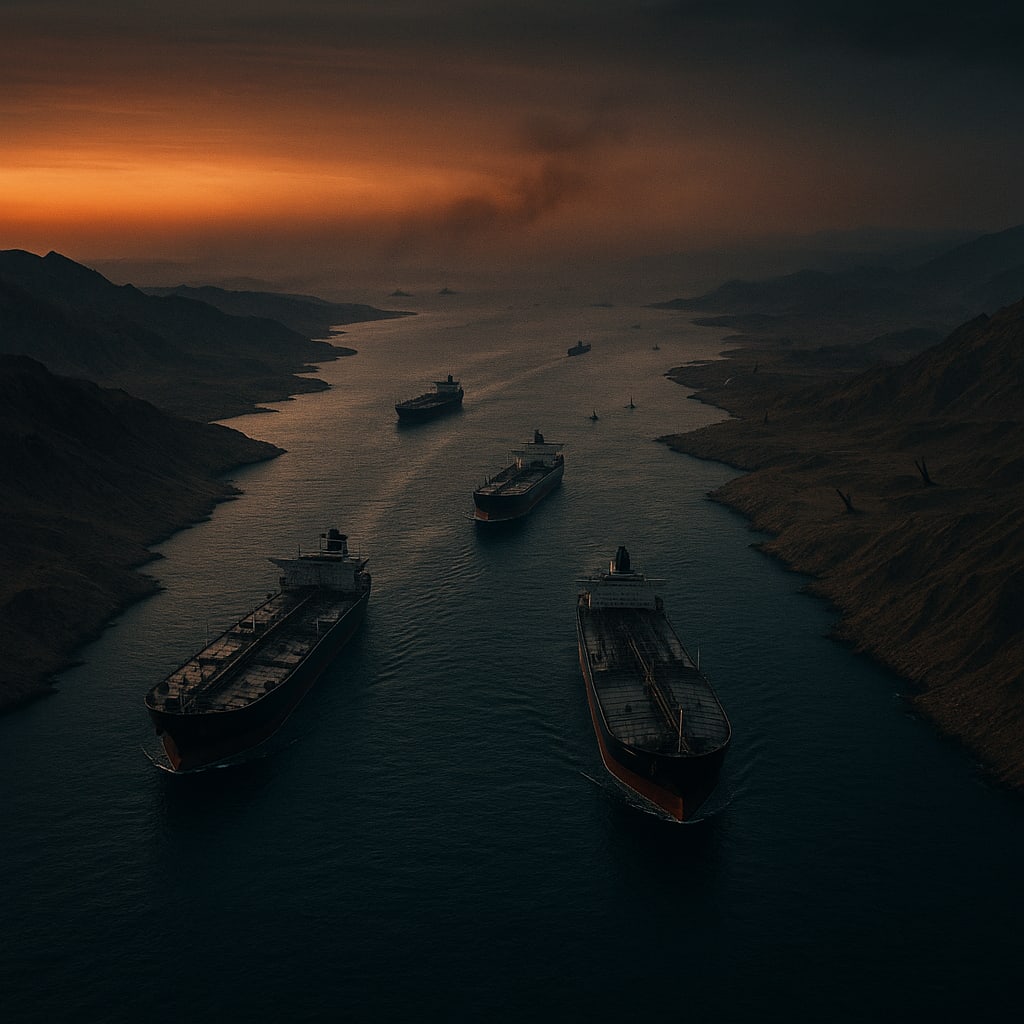
The narrow stretch of water that decides how much your life costs
The first time I saw the Strait of Hormuz on a map, I had to zoom in three times.
This tiny blue throat at the mouth of the Persian Gulf, a place I’d never seen, was quietly deciding the price of gas at the station down my street, the cost of heating my apartment, even the number on my grocery receipt.
All that power, in a strip of water barely wider than a long commute.
Now imagine that same narrow passage with missiles overhead, tankers on fire, GPS jammed, insurance canceled, and a war between Iran and its enemies playing out in real time.
Everyone keeps asking: Could Iran actually close the Strait of Hormuz?
The scarier question is the one you feel in your stomach: If that happens, what does it do to everything else in our lives?
Because this isn’t just about oil.
It’s about rent, food, jobs, elections, and the quiet, creeping panic of watching prices jump while your income stays the same.
And most people, from what I can tell, are not ready for that kind of shock.
The day I realized “geopolitics” was sitting in my gas tank
I still remember standing at a pump in 2008, watching the numbers jump like they were trying to make me sweat.
I was in college, broke and driving a car that rattled if you looked at it wrong. Gas had just blown past $4 a gallon in my town. I’d always heard older people talk about the “oil crisis” of the 1970s, but it felt like a history lesson, not a warning.
That summer, it stopped feeling like history.
News anchors were saying phrases I’d never really paid attention to: global oil supply… chokepoints… Middle East tensions… Iran… Strait of Hormuz.
I thought it was background noise.
Then my grocery bill went up.
Then my bus pass price went up.
Then the diner where I worked part-time cut my hours because fewer people were going out to eat.
All because a bunch of people I would never meet were arguing over oil on the other side of the world.
That was the first time I really understood that “energy security” isn’t some dry policy phrase. It’s whether your paycheck stretches to the end of the month. It’s whether your landlord raises rent next year “because everything is more expensive.”
And now, every time Iran hits the headlines and tensions flare near the Strait of Hormuz, I feel that same old flutter of dread.
Because I know how fragile this setup really is.
What the Strait of Hormuz actually is (and why it owns your wallet)
Picture a highway where one lane carries a fifth of the world’s oil.
Now squeeze that highway until it’s only about 21 miles across at its narrowest.
On one side: Iran.
On the other: Oman and the UAE.
In the middle: some of the most valuable ships on Earth.
That’s the Strait of Hormuz.
Every day, about 17–20 million barrels of oil and a huge amount of liquefied natural gas pass through that narrow space. Countries like Saudi Arabia, Iraq, Kuwait, Qatar, and the UAE pump oil out of the ground, load it onto tankers in the Persian Gulf, and those ships have one way out: the Strait.
If you’ve ever wondered how connected we are, here’s your answer:
When a tanker passes through Hormuz, it’s not just heading to China or Europe. It’s feeding the global oil pool that sets the “benchmark” price for everyone: the gas station near you, the airline ticket you buy, the plastic wrap around your groceries.
And that’s what makes talk of an “Iran war” so dangerous.
When people say “closing the Strait of Hormuz,” they’re not talking about a door gently shutting. They’re talking about missiles, naval mines, drone swarms, fast attack boats, and cyber warfare all converging on one point where the global economy is most vulnerable.
If that sounds overdramatic, it’s because we’ve been lucky for a long time.
Could Iran actually close the Strait of Hormuz—or is it bluffing?
Here’s the uncomfortable truth: Iran doesn’t have to fully close the Strait to cause chaos.
It just has to make it unsafe enough that shipping companies, insurance firms, and captains decide it’s not worth the risk.
Iran has spent decades preparing for exactly this kind of leverage.
Not to win a conventional naval war—that’s not realistic—but to make any conflict around Hormuz so costly and messy that everyone else thinks twice.
They’ve built:
Land-based anti-ship missiles along their coastline
Fast attack boats that can swarm larger ships
Naval mines that are cheap, hard to detect, and terrifyingly effective
Drones and small submarines that complicate any attempt to keep the Strait “open”
The U.S. and its allies have carrier strike groups, advanced jets, submarines, and surveillance.
On paper, the U.S. Navy could fight its way through.
But here’s how the real world works:
If even a few tankers get attacked—especially if one actually sinks and spills oil—insurance costs skyrocket. Some shipping companies will immediately stop sending their vessels through. Others will demand higher rates.
The Strait doesn’t have to be sealed off like a door.
It just has to look like a haunted house that no sane captain wants to sail through.
And each day that happens, millions of barrels of oil are delayed, rerouted, or held back.
The oil market doesn’t wait patiently for facts. It reacts to fear.
Oil markets run on fear, not just supply
People imagine oil prices are about barrels in barrels out; numbers on spreadsheets; “fundamentals.”
Sometimes they are.
But in a crisis, oil prices are about fear.
Fear that tankers will get hit tomorrow
Fear that insurance will vanish overnight
Fear that a regional conflict will spread
Fear that the Strait of Hormuz will go from risky to impossible
Traders don’t wait for proof that 5 million barrels per day are offline. They see missiles flying and move money like the world is ending.
History is full of reminders:
The 1973 oil embargo sent prices skyrocketing and reshaped entire economies.
The Iran–Iraq “Tanker War” in the 1980s drove up insurance and risk premiums.
The 1990 invasion of Kuwait and the Gulf War sent oil prices violently higher.
Even minor attacks on tankers around Hormuz in recent years caused noticeable price spikes—without any true closure.
Now imagine a full-scale war with Iran where the Strait is the frontline.
Oil could easily jump from, say, $80 a barrel to $150 or more in weeks.
It doesn’t even take a total shutdown—just a period where enough ships are hit or threatened that the supply chain starts to buckle.
And here’s the part most people miss: the pain doesn’t stay at the pump.
How a war in Iran quietly shows up in your rent, your food, your job
When oil prices spike, it feels very personal at the gas station.
But oil is everywhere. It’s in the cost of:
Transporting food, clothes, and medicine
Running factories and warehouses
Flying planes and driving trucks
Heating buildings in colder regions
Producing plastics, packaging, pesticides, fertilizers
If the Strait of Hormuz war sends oil into a super-spike, a few things start happening pretty fast:
Your grocery bill climbs
Trucking companies pay more for diesel. That gets baked into the price of everything they haul: milk, bread, produce, meat. You feel it one cart at a time.
Your landlord “adjusts for inflation”
If you rent, that phrase is probably already in your nightmares. Higher energy costs ripple into construction materials, maintenance, and utilities. Even if your landlord is just using it as an excuse, the excuse exists.
Your employer starts cutting corners
Small businesses that operate on thin margins get hammered when shipping costs spike. Layoffs, fewer hours, hiring freezes—it all usually shows up within months of a big, sustained price shock.
Interest rates become a tug-of-war
Central banks hate inflation. If oil shock inflation takes off, they may keep interest rates higher for longer or hike again. That can crush borrowers, home buyers, and anyone already struggling with debt.
Political tension goes off the charts
People already furious at the cost of living suddenly have another 20–40% added on top. Governments scramble, blame each other, and you get chaos: protests, election upsets, policy lurches.
All from a war in a place most people couldn’t find on a map five minutes ago.
That’s the thread that runs from a missile launcher on an Iranian shoreline to how many eggs you put in your cart.
Why almost no one is emotionally prepared for an energy shock
If you’re under 40, you’ve never really lived through a true oil shock in the way older generations did.
You may have experienced “high gas prices” or “annoying inflation.” But a full, global energy crisis triggered by a war at a chokepoint like Hormuz? That’s different.
We built our modern lives on an assumption that oil flows will basically… keep flowing. There might be bumps, but the system holds.
Most of us don’t have a mental model for what happens when that assumption cracks.
We expect:
Groceries to be affordable-ish
Commutes to be predictable
Flights to be expensive sometimes, not luxuries
Heat and electricity to be reliable and relatively cheap
The danger isn’t just that a war with Iran could close or choke the Strait of Hormuz. The danger is how hollowed-out and exposed our lifestyles are after years of barely thinking about where energy comes from.
Governments talk about “energy transition” like it’s a smooth curve on a PowerPoint slide.
In reality, it’s a messy, vulnerable in-between, where we’re still utterly dependent on oil… while pretending we’re not.
Nothing reveals that lie faster than a crisis at the world’s most important oil chokepoint.
The uncomfortable nuance: Iran doesn’t want total chaos either
Here’s where it gets complicated.
Iran knows it holds a loaded gun in the form of the Strait of Hormuz. But it also lives in the same house it threatens to set on fire.
Iran needs oil exports too.
It needs trade partners.
It needs some version of global stability to survive, even if it’s the hostile, sanctions-heavy version it has now.
So if a war breaks out, Iran’s likely play isn’t “permanent closure.”
It’s controlled chaos:
Attacks, threats, and disruptions that send prices higher
Enough danger to scare the world, but not enough to unify it against Iran completely
Short, sharp shock periods, then pauses, then new rounds of escalation
That kind of on-again off-again disruption is almost worse than a one-time crisis. Markets hate uncertainty more than they hate bad news.
In that scenario, oil prices could whipsaw violently: up $20, down $10, up $30 again. Businesses can’t plan. Governments can’t budget. Ordinary people are just trying to make it to next month without losing their grip.
And yet in every debate, in every panel, in every TV segment, the question is framed like a yes/no:
“Can Iran close the Strait of Hormuz?”
The real question is:
“How much chaos is enough to break the system that runs your life?”
What “being ready” actually looks like when you’re not in charge of anything
Most of us don’t direct armies or move oil tankers. We don’t set rates or negotiate with Iran.
We’re just trying to survive the fall-out.
So what does “being ready” look like if a war in Iran starts choking the Strait of Hormuz and the oil price shock hits?
It’s not about building a bunker or hoarding gasoline in your garage.
It’s more boring and more honest:
Knowing where your money leaks when energy prices climb
That could mean long commutes, subscriptions you don’t use, a house that bleeds heat. Energy shocks expose every inefficiency.
Having some buffer, even a small one
A month or two of basic expenses stashed away isn’t a luxury; it’s a shock absorber. If that sounds impossible, remember: The people most hurt in every crisis are the ones with zero cushion.
Paying attention to energy, not just politics
We obsess over elections, scandals, and culture wars while ignoring the pipes, cables, and tankers that keep everything running. Those “boring” stories might matter more than the shouting matches.
Recognizing how fragile “normal” actually is
This isn’t about living in fear. It’s about dropping the illusion that life will always look like it does now. When you stop assuming permanence, you start making different choices.
Because if an Iran war sends oil prices through the roof, the people who cope best won’t be those who predicted the exact date of the conflict.
They’ll be the ones who already understood that this system was built on a knife edge.
The thing about chokepoints
The more I read about Hormuz, the more I realized something that genuinely unnerved me.
The Strait isn’t just a geographic chokepoint. It’s a metaphor for how we live.
We’ve created global systems where everything—energy, food, supply chains, finance—funnels through these narrow, fragile points.
One strait
One semiconductor factory
One rare earth supplier
One pipeline
One “just in time” shipping route
We run our lives through them, then act shocked when one of them becomes a battlefield.
Could a war with Iran close the Strait of Hormuz? Maybe completely, maybe partially, maybe off and on in agonizing bursts.
Will that send oil prices soaring in ways that most people and governments are not prepared for? Almost certainly.
But beneath all the headlines and scary hypotheticals is a quieter realization:
We’ve built a world where a handful of miles of seawater can decide whether you can afford eggs, rent, and a tank of gas in the same week.
If that doesn’t make you pause, I’m not sure what will.
Because the real story isn’t just whether Iran pulls the trigger.
It’s that we handed anyone that kind of power in the first place—and called it progress.
About the Creator
abualyaanart
I write thoughtful, experience-driven stories about technology, digital life, and how modern tools quietly shape the way we think, work, and live.
I believe good technology should support life
Abualyaanart
Keep reading
More stories from abualyaanart and writers in Trader and other communities.
Australia Cigarette Market Remains Resilient Amid Regulation and Illicit Trade Pressures
In 2025, the Australia cigarette market was valued at around USD 23.31 billion and is projected to reach approximately USD 27.47 billion by 2034, expanding at a compound annual growth rate (CAGR) of 1.84% from 2026 to 2034. This measured growth comes against a backdrop of one of the world’s most stringent tobacco regulatory environments — marked by plain packaging, extensive advertising curbs, and rising excise taxes — yet consumer demand has shown resilience. As the industry evolves, shifts in consumer preferences, retail strategies, and broader socio-economic forces are reshaping the landscape.
By Rashi Sharma7 days ago in Trader
Mexico 5G Infrastructure Market Size, Share, Industry Trends & Forecast 2026–2034
Market Overview The Mexico 5G infrastructure market is becoming a critical pillar in the country’s digital transformation. Telecommunication companies, infrastructure providers, and government agencies are increasingly investing in next‑generation network technologies to deliver faster connectivity, lower latency, and greater network capacity. As businesses and consumers rely more on digital platforms, the demand for advanced communication infrastructure is expanding rapidly across Mexico.
By Jackson Watson2 days ago in Trader
REEEEEEEEE!
I'm on a low road right now. There are a literal million things to do and not one of them worth my time. I would rather sit in place and burn but the orbit takes me on its inevitable route 'round the center; and I a center in my own right, around which others orbit, and so on and so forth, ad infinitum, ad nauseum.
By C. Rommial Butlera day ago in Poets



Comments
There are no comments for this story
Be the first to respond and start the conversation.