
Children’s Wear Market Size and Forecast 2026–2034
Global Industry Set for Steady Expansion Amid Fashion, Sustainability, and Digital Retail Boom

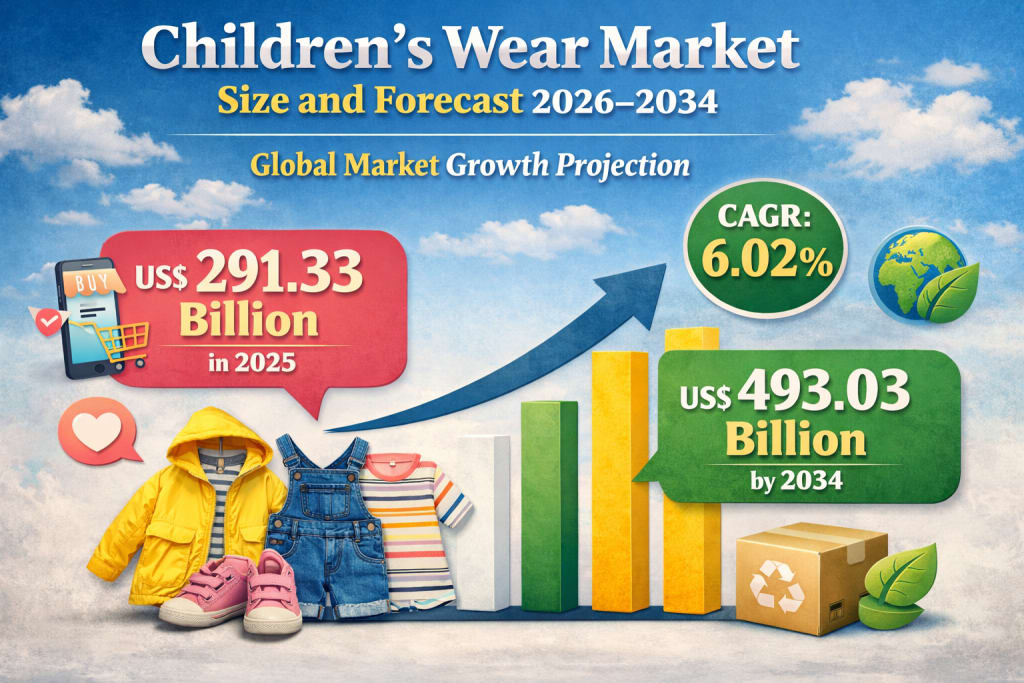
The global Children’s Wear Market is entering a new phase of structured and sustainable growth. According to Renub Research, the market is projected to expand from US$ 291.33 billion in 2025 to US$ 493.03 billion by 2034, growing at a CAGR of 6.02% from 2026 to 2034.
This steady expansion reflects changing consumer behavior, increasing disposable incomes, social media influence, technological advancements in textiles, and a growing preference for eco-conscious apparel. The industry is no longer limited to basic clothing needs; it has transformed into a fashion-forward, innovation-driven, and digitally empowered segment of the global apparel ecosystem.
Children’s Wear Industry Overview
The children’s wear industry encompasses clothing for infants, toddlers, preschoolers, and grade-school children. It includes casual wear, formal attire, school uniforms, sportswear, festive collections, and seasonal garments.
Unlike adult apparel, children’s wear purchasing decisions are influenced by a combination of parental preferences and children’s own style awareness. Today’s parents seek a balance between comfort, durability, safety, affordability, and style. Meanwhile, children are becoming increasingly fashion-conscious, influenced by cartoons, celebrities, social media trends, and peer culture.
Focus on Comfort and Fabric Innovation
Comfort remains a dominant purchasing factor, particularly for infants and toddlers. Breathable, hypoallergenic, and skin-friendly materials such as cotton and organic blends are highly preferred. The industry has also seen growing adoption of:
Organic cotton
Recycled polyester
Bamboo fabrics
Chemical-free dyes
Safety regulations regarding fasteners, drawstrings, and fabric treatments are becoming more stringent across major markets. This pushes manufacturers to invest in compliance and product innovation.
Sustainability as a Strategic Priority
Environmental consciousness is shaping buying patterns. Parents are increasingly selecting brands that adopt ethical sourcing, eco-friendly fabrics, and recyclable packaging. Sustainability is no longer a niche segment—it is becoming mainstream, particularly in developed markets.
Key Growth Drivers in the Children’s Wear Market
1. Rising Disposable Income and Expanding Middle Class
Increasing household incomes across emerging economies are fueling spending on branded and premium children’s clothing. Regions such as Asia-Pacific, the Middle East, and Latin America are witnessing strong growth due to urbanization and rising middle-class populations.
Dual-income households in urban areas are allocating higher budgets toward children’s fashion, viewing it as an extension of lifestyle and social positioning. Parents are more willing to invest in quality, durable, and branded apparel.
2. Influence of Fashion Trends and Social Media
Fashion cycles in children’s wear are accelerating due to social media exposure. Mini-me collections—where children’s outfits replicate adult fashion trends—have become highly popular.
Character-themed apparel inspired by films, cartoons, and entertainment franchises drives strong seasonal demand. Celebrity endorsements and influencer marketing amplify brand awareness and purchase intent.
Children themselves are playing a stronger role in decision-making. Fashion has become a medium of self-expression, even at early ages.
3. Rapid Growth of E-Commerce and Omnichannel Retail
Digital transformation is reshaping the retail landscape. E-commerce platforms provide:
Wide assortment options
Competitive pricing
Easy returns
Size guides
Customer reviews
Omnichannel strategies allow parents to browse online and purchase offline, or vice versa. Mobile shopping, social commerce, and personalized recommendations are enhancing convenience and driving repeat purchases.
E-commerce has also expanded access to international brands in emerging markets, accelerating global integration of fashion trends.
Challenges Facing the Children’s Wear Industry
Rapid Fashion Cycles and Inventory Complexity
Children’s wear involves multiple SKUs across sizes, age groups, and seasonal collections. Managing inventory efficiently remains a major challenge. Overstocking leads to discounting pressures, while stockouts result in lost sales.
Since children outgrow clothes quickly, turnover cycles are shorter than in adult apparel. Retailers must rely on advanced analytics and agile supply chain systems to remain competitive.
Price Sensitivity and Competitive Intensity
Despite rising incomes, children’s wear remains price-sensitive. Parents often prioritize value for money due to the frequent replacement cycle. The market faces competition from:
Fast fashion brands
Private labels
Local manufacturers
Global apparel giants
Online marketplaces have increased price transparency, intensifying competition. Companies must balance affordability with innovation and brand differentiation.
Regional Insights
United States Children’s Wear Market
The United States represents a mature yet innovation-driven children’s wear market. Strong consumer spending, dual-income households, and high digital adoption support steady demand.
E-commerce and omnichannel retail are highly developed, while sustainability and organic fabrics are gaining prominence. Fashion-forward collections, character collaborations, and branded apparel remain key demand drivers.
Although inventory management and pricing pressure persist, technological adoption and brand innovation continue to sustain growth.
United Kingdom Children’s Wear Market
The United Kingdom children’s wear market is characterized by fashion consciousness and strong regulatory compliance standards. Parents emphasize durability, comfort, and ethical sourcing.
School uniforms represent a significant segment in the UK market. Meanwhile, e-commerce adoption is high, supporting convenient purchasing patterns.
Sustainability initiatives and eco-friendly materials are gaining traction, positioning the UK as a leader in responsible apparel consumption.
India Children’s Wear Market
As you are based in India, this segment may be particularly relevant. The India children’s wear market is among the fastest-growing globally, driven by:
A large young population
Rising disposable income
Urbanization
Expanding e-commerce penetration
Parents increasingly prefer branded and fashionable clothing while maintaining sensitivity to price. The market presents strong opportunities across value, mid-range, and premium segments.
Festive wear and occasion-based apparel contribute significantly to sales, alongside school uniforms and casual wear.
United Arab Emirates Children’s Wear Market
The UAE market benefits from high disposable income, urbanization, and a cosmopolitan population. International brands enjoy strong visibility, while premium and luxury children’s wear segments are expanding.
E-commerce growth and retail infrastructure investments further support expansion. Sustainability trends are gradually influencing consumer preferences.
Recent Developments in the Children’s Wear Market
The industry continues to witness innovation and brand expansion:
July 2025: FreshFeet launched children’s footwear with Dual Fit Tech, addressing growing foot size challenges and promoting sustainability.
April 2025: Rag & Bon introduced the Miramar kidswear line featuring hyper-realistic denim-style sweatpants designed for comfort and play.
March 2025: Vogue Williams launched the Gen kidswear brand through major online retail platforms, offering durable and unisex designs.
March 2025: Reebok unveiled a Sesame Street-inspired sneaker collection featuring vibrant character themes and playful design elements, priced between USD 50–60.
These developments highlight the industry’s focus on innovation, comfort, and brand storytelling.
Market Segmentation
By Product Category
Apparel
Footwear
Others
By Consumer Group
Infant (0–12 months)
Toddler (1–3 years)
Preschool (3–5 years)
Gradeschooler (5–12 years)
By Distribution Channel
Offline
Online
By Region
North America: United States, Canada
Europe: France, Germany, Italy, Spain, United Kingdom, Belgium, Netherlands, Turkey
Asia-Pacific: China, Japan, India, Australia, South Korea, Thailand, Malaysia, Indonesia, New Zealand
Latin America: Brazil, Mexico, Argentina
Middle East & Africa: South Africa, Saudi Arabia, United Arab Emirates
Competitive Landscape
Leading companies operating in the global children’s wear market include:
Adidas AG
Benetton Group Srl
Carter’s, Inc.
Cotton On Clothing Pty Ltd
DIESEL USA Inc.
Dolce & Gabbana S.r.l.
Kimberly-Clark Corporation
Levi Strauss & Co.
NIKE, Inc.
Gap Inc.
Renub Research evaluates companies across five viewpoints:
Overview, Key Persons, Recent Developments, SWOT Analysis, and Financial Insights.
Final Thoughts
The global children’s wear market is poised for consistent and resilient expansion, reaching nearly half a trillion dollars by 2034. Fashion evolution, sustainability initiatives, rising middle-class income, and digital retail transformation are redefining the industry.
Despite challenges related to inventory complexity and price sensitivity, brands that embrace innovation, sustainability, and omnichannel engagement will remain competitive. Emerging markets like India offer high-growth opportunities, while mature markets focus on premiumization and eco-conscious offerings.
As consumer expectations continue to evolve, the children’s wear industry will remain one of the most dynamic and adaptive segments within the global apparel market—balancing comfort, creativity, technology, and responsible growth.
About the Creator
Sakshi Sharma
Content Writer with 7+ years of experience crafting SEO-driven blogs, web copy & research reports. Skilled in creating engaging, audience-focused content across diverse industries.
Keep reading
More stories from Sakshi Sharma and writers in Trader and other communities.
United States Proton Therapy Market Size & Forecast 2026–2034
Introduction The United States proton therapy market is entering a decisive phase of growth, driven by the rising burden of cancer, the increasing adoption of precision oncology, and rapid technological advancements in radiation therapy systems. As healthcare providers and patients alike seek treatments that are not only effective but also safer and more targeted, proton therapy is emerging as one of the most promising solutions in modern cancer care.
By Sakshi Sharmaabout 14 hours ago in Trader
Australia Wearable Injectors Market 2026: Home-Based Therapy Growth, Biologics Expansion and Smart Drug Delivery Innovation
Australia Wearable Injectors Market Overview Australia’s wearable injectors market is emerging as a rapidly growing segment within the medical device and drug delivery landscape, driven by increasing adoption of patient-centric healthcare solutions and expanding use of biologic therapies. Wearable injectors are compact devices attached to the body that enable controlled subcutaneous delivery of large-volume medications over extended periods, allowing patients to self-administer treatment outside clinical settings. As healthcare systems emphasise convenience, treatment adherence and remote care models, wearable injectors are becoming critical tools supporting chronic disease management across Australia.
By Amyra Singha day ago in Trader
Point of Sale Terminal Market Size & Forecast 2026–2034
Introduction The global Point of Sale (POS) terminal market is undergoing a powerful transformation, driven by the rapid shift toward digital payments, the expansion of modern retail and hospitality, and the growing need for faster, safer, and more integrated transaction systems. What was once a simple cash register has evolved into a sophisticated business management platform that connects payments, inventory, customer data, and analytics into one seamless ecosystem.
By shibansh kumar4 days ago in Trader
Veil of Subconscious Awakening
Images slide behind my eyelids like film cadres, bursting with meanings. In one moment, I’m speeding down the highway, making the speedometer swing wildly like a frantic pendulum. The next moment, I’m plunging from a falling plane, slowly crashing earthward. At home, I meet black cat’s green, googly eyes staring at me from the cavernous hollowness of the kitchen. When I turn for a moment, it disappears, and all I can see is a pair of blue suede shoes set up against the wall. I pick them up and put them on. When I glimpse at them again, they’ve become black as night, making me blink and flinch.
By Moon Desert5 days ago in Fiction




Comments
There are no comments for this story
Be the first to respond and start the conversation.