
Business Software and Services Market Size and Forecast 2025–2033
How Cloud, AI, and Automation Are Reshaping the Digital Backbone of Global Enterprises

Business Software and Services Market: A Digital Engine for the Global Economy
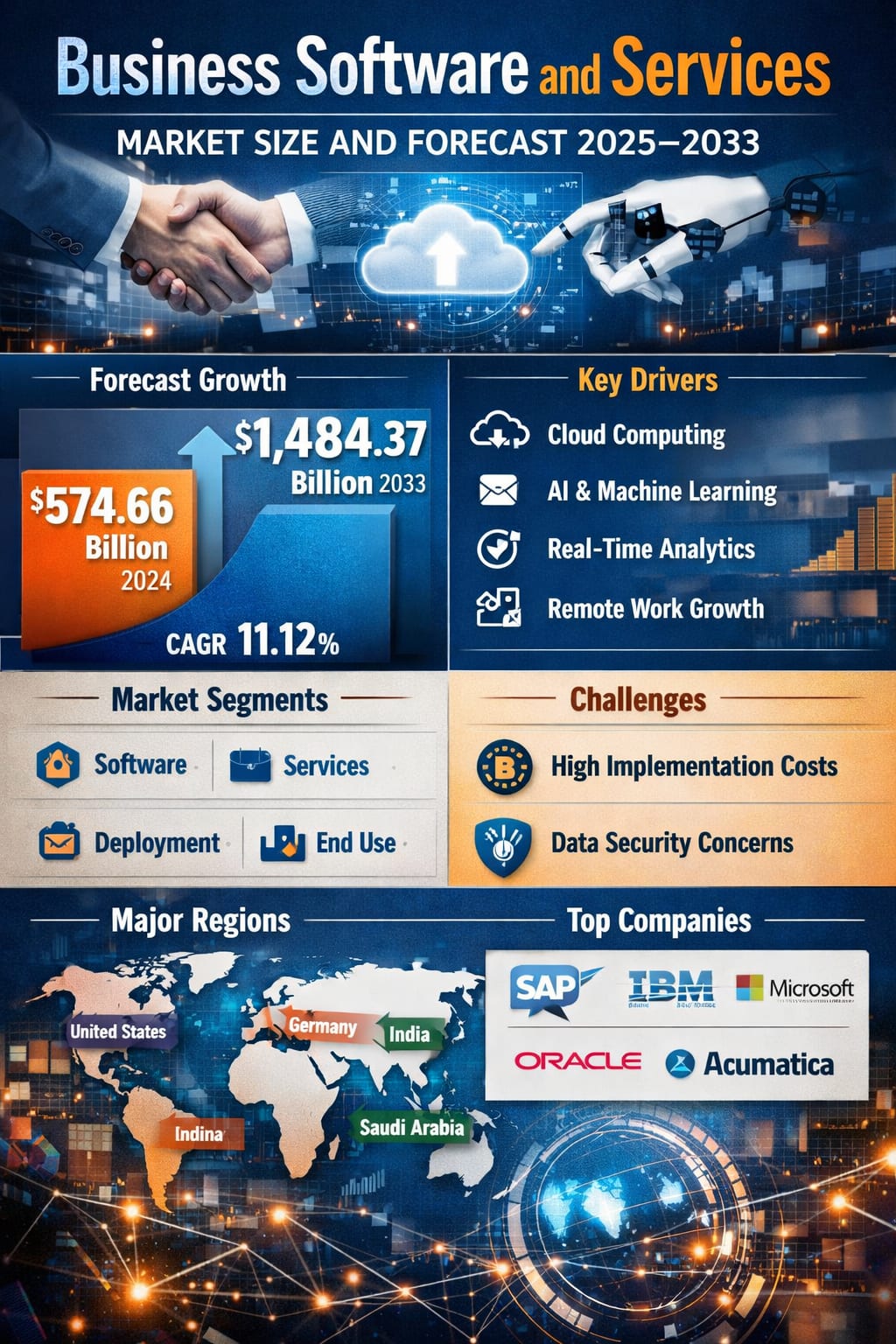
The global business software and services market is entering a decisive decade, driven by rapid digitalization, cloud adoption, and the deep integration of artificial intelligence across enterprise operations. According to Renub Research, the Business Software and Services Market is expected to reach US$ 1,484.37 billion by 2033, up from US$ 574.66 billion in 2024, expanding at a robust CAGR of 11.12% from 2025 to 2033. This remarkable growth trajectory reflects how essential software and digital services have become to nearly every industry, from banking and manufacturing to healthcare and government.
Business software and services encompass a broad range of solutions designed to help organizations manage, automate, and optimize their operations. This includes enterprise resource planning (ERP), customer relationship management (CRM), accounting, human resources, supply chain management, project management, and advanced analytics platforms. Alongside software products, the services segment covers consulting, implementation, system integration, support, and managed services. Together, these offerings form the digital backbone that supports modern enterprises in an increasingly competitive and data-driven world.
What makes this market especially dynamic is the shift toward cloud-based delivery models and Software-as-a-Service (SaaS). These models have dramatically lowered entry barriers, improved scalability, and enabled businesses of all sizes to access sophisticated tools that were once limited to large enterprises. At the same time, emerging technologies such as artificial intelligence (AI), machine learning (ML), and robotic process automation (RPA) are transforming software from passive systems of record into intelligent systems of action.
Industry Overview: From Support Tools to Strategic Assets
Traditionally, business software was viewed primarily as a support function—necessary, but rarely strategic. That perception has changed completely. Today, software platforms are central to how organizations design strategies, engage customers, manage supply chains, and make real-time decisions.
Modern enterprises rely on integrated software ecosystems that connect finance, sales, human resources, operations, and customer data into unified platforms. This integration not only improves efficiency but also enhances visibility across the organization. Executives can track performance in real time, managers can optimize workflows, and frontline teams can respond faster to customer needs.
Cloud computing has played a pivotal role in this transformation. By moving infrastructure and applications to the cloud, companies gain flexibility, reduce capital expenditure, and accelerate deployment cycles. SaaS solutions, in particular, have become the preferred model for many organizations because they offer predictable costs, continuous updates, and easier scalability.
At the same time, services such as consulting, managed services, and technical support have become increasingly important. As software environments grow more complex, businesses need expert partners to help them implement, customize, secure, and optimize their digital systems. This is why the services segment continues to grow alongside software sales, creating a more holistic and resilient market ecosystem.
Key Growth Drivers Shaping the Market
1. Accelerating Digital Transformation Across Industries
One of the strongest forces behind the expansion of the business software and services market is the widespread adoption of digital transformation initiatives. Organizations across sectors are rethinking their operating models to stay competitive in a fast-changing digital economy. This involves adopting cloud platforms, integrating AI-driven tools, and using advanced analytics to guide decision-making.
Digital transformation is no longer optional—it is a strategic necessity. Companies are investing heavily in software that improves collaboration, automates processes, and delivers real-time insights. These investments help organizations adapt to changing customer expectations, regulatory environments, and competitive pressures. As a result, demand for comprehensive business software platforms and related services continues to rise globally.
2. Growing Need for Real-Time Data Analytics and Transparency
In today’s business environment, speed and accuracy of information are critical. Organizations increasingly depend on real-time data analytics to monitor performance, understand customer behavior, and identify risks and opportunities as they emerge. Business software platforms now integrate advanced reporting, visualization, and predictive analytics tools that turn raw data into actionable insights.
Beyond internal decision-making, transparency has become essential for building trust with investors, customers, and regulators. Software solutions that support compliance, auditing, and data governance are therefore in high demand. This push for greater visibility and accountability is driving sustained investment in enterprise software and analytics services, reinforcing long-term market growth.
3. Continuous Innovation and Customization of Software Solutions
Another major growth driver is the ongoing innovation and customization of software to meet diverse industry and enterprise needs. Businesses no longer want one-size-fits-all solutions. They are looking for flexible, modular platforms that can be tailored to specific workflows, regulatory requirements, and growth strategies.
Vendors are responding by developing highly configurable software enriched with automation and AI capabilities. For example, in October 2024, Stem Inc., a leader in AI-driven renewable energy software and services, launched new strategy-based services alongside software designed to support scalable growth and improved profitability. Such innovations highlight how customized, intelligent software solutions can deliver measurable business value while opening new revenue streams for providers.
Challenges Facing the Business Software and Services Market
High Implementation Costs
Despite its strong growth prospects, the market faces notable challenges—one of the most significant being high implementation costs. Deploying enterprise software often requires substantial upfront investment in licenses, customization, system integration, and infrastructure upgrades. For small and medium-sized enterprises (SMEs), these costs can be a major barrier to adoption.
In addition, organizations must factor in ongoing expenses related to maintenance, support, and employee training. Complex implementations can also lead to project delays and budget overruns, reducing the overall return on investment. While cloud and SaaS models have helped lower some of these barriers, cost remains a critical consideration for many potential adopters.
Data Security and Privacy Concerns
As businesses increasingly rely on digital and cloud-based systems, data security and privacy have become top priorities. Protecting sensitive corporate and customer data from cyberattacks, breaches, and unauthorized access is a constant challenge. Compliance with regulations such as GDPR and CCPA adds another layer of complexity, requiring robust security architectures and governance frameworks.
Any vulnerability in software systems can lead to financial losses, reputational damage, and legal consequences. As a result, both software vendors and end users must invest continuously in cybersecurity technologies and best practices. While this strengthens the overall ecosystem, it can also slow adoption and increase operational costs.
Regional Market Insights
United States: Innovation at Scale
The United States remains one of the most dynamic and competitive markets for business software and services. Rapid adoption of cloud computing, AI, and automation is driving demand across industries. Companies are increasingly turning to managed services, consulting, and technical support to help them deploy and optimize complex software environments.
Real-time data analytics plays a central role in enabling informed decision-making and operational agility. With many of the world’s leading technology companies headquartered in the U.S., the market benefits from continuous innovation and strong investment in next-generation digital solutions.
Germany: Engineering Efficiency Meets Digital Transformation
Germany’s business software and services market is expanding steadily, supported by the country’s strong industrial base and growing commitment to digital transformation. Companies are adopting cloud platforms, AI, and automation to enhance productivity and improve decision-making.
There is also rising demand for consulting and managed services, as organizations seek expert guidance to modernize legacy systems and integrate new technologies. Real-time analytics and data-driven operations are becoming increasingly important, especially in manufacturing and engineering-driven sectors. Overall, the German market reflects a clear shift toward intelligent, scalable, and flexible software ecosystems.
India: A High-Growth Digital Powerhouse
India represents one of the fastest-growing markets for business software and services, fueled by widespread digitalization, a strong IT services sector, and supportive government initiatives. The adoption of cloud computing and AI is accelerating across industries such as banking, manufacturing, healthcare, and telecommunications.
A large pool of skilled professionals and a vibrant startup ecosystem further strengthen the market. However, challenges such as talent shortages in specialized areas and data security concerns remain. Even so, the long-term outlook is highly positive, as Indian enterprises continue to modernize operations and invest in advanced digital platforms to boost efficiency and competitiveness.
Saudi Arabia: Vision 2030 and the Digital Future
Saudi Arabia’s business software and services market is gaining strong momentum under the Vision 2030 initiative, which emphasizes economic diversification and digital transformation. The government is investing heavily in digital infrastructure, including smart cities and advanced connectivity such as 5G networks.
Sectors like AI, cloud computing, and cybersecurity are receiving significant attention, and both public and private organizations are accelerating technology adoption. The growth of SMEs is also driving demand for scalable and cost-effective software solutions. Together, these trends are positioning Saudi Arabia as an emerging regional hub for technology and innovation.
Recent Developments in the Market
The competitive landscape continues to evolve through strategic acquisitions and product innovations:
January 2025: IBM announced plans to acquire Applications Software Technology LLC, an Oracle consulting firm. This move is expected to strengthen IBM’s Oracle solutions portfolio and help public sector clients in North America, the UK, and Ireland address challenges such as legacy system migration, skill shortages, and strict security and compliance requirements in cloud transformations.
October 2024: Acumatica, Inc. launched its new Professional Services Edition, aimed at helping small and mid-sized professional services businesses improve productivity and drive growth. Tailored for sectors such as architecture, engineering, and IT services, this solution expands Acumatica’s industry-specific offerings and highlights the growing importance of vertical-focused software platforms.
Market Segmentation Snapshot
By Software:
Finance
Sales & Marketing
Human Resource
Supply Chain
Others
By Service:
Consulting
Managed Services
Support & Maintenance
By Deployment:
Cloud
On-premise
By Enterprise:
Large Enterprises
Small & Medium Enterprises
By End Use:
Aerospace & Defense
BFSI
Government
Healthcare
IT & Telecom
Manufacturing
Retail
Transportation
Others
By Geography (25 Viewpoints):
North America (United States, Canada), Europe (France, Germany, Italy, Spain, UK, Belgium, Netherlands, Turkey), Asia Pacific (China, Japan, India, Australia, South Korea, Thailand, Malaysia, Indonesia, New Zealand), Latin America (Brazil, Mexico, Argentina), Middle East & Africa (South Africa, UAE, Saudi Arabia).
Competitive Landscape: Key Players
The market features a mix of global technology giants and specialized enterprise software providers. Key players include:
Acumatica, Inc.
SAP SE
Deltek, Inc.
IBM Corporation
Infor
Microsoft
Epicor Software Corporation
NetSuite Inc.
Oracle
MicroStrategy Incorporated
These companies are analyzed across five dimensions: company overview, key persons, recent developments and strategies, SWOT analysis, and sales analysis—highlighting the depth and competitiveness of the global market.
Final Thoughts: Software as the Strategy Layer of Business
The business software and services market is no longer just about tools—it is about building the digital foundation of modern enterprises. With the market projected to grow from US$ 574.66 billion in 2024 to US$ 1,484.37 billion by 2033, the scale of opportunity is enormous. Cloud computing, AI, automation, and real-time analytics are transforming how organizations operate, compete, and innovate.
While challenges such as high implementation costs and data security concerns remain, the overall direction is clear: software and digital services are becoming strategic assets rather than operational expenses. Companies that invest wisely in flexible, secure, and intelligent platforms will be better positioned to navigate uncertainty, seize new opportunities, and thrive in the digital economy of the next decade.
About the Creator
Sakshi Sharma
Content Writer with 7+ years of experience crafting SEO-driven blogs, web copy & research reports. Skilled in creating engaging, audience-focused content across diverse industries.
Keep reading
More stories from Sakshi Sharma and writers in Trader and other communities.
Beauty Salon Market Size and Forecast 2025–2033
Beauty Salon Market: A Global Industry in Transformation The global beauty salon market is undergoing a remarkable transformation, driven by changing lifestyles, rising disposable incomes, and an ever-growing emphasis on personal appearance and self-care. According to Renub Research, the Beauty Salon Market is expected to reach US$ 352.05 billion by 2033, up from US$ 176.7 billion in 2024, expanding at a compound annual growth rate (CAGR) of 7.96% from 2025 to 2033. This strong growth trajectory highlights how grooming and wellness services have evolved from occasional luxuries into routine lifestyle necessities for millions of consumers worldwide.
By Sakshi Sharmaabout 8 hours ago in Trader
MSFT Stock: Microsoft’s Market Performance and Global Insights
MSFT Stock, representing Microsoft Corporation, is one of the most influential technology stocks in global financial markets. Microsoft has evolved from a software company into a technology powerhouse, with business lines spanning Windows, Office, cloud computing through Azure, AI technologies, and gaming with Xbox. This diversification has made MSFT Stock a favorite for both retail and institutional investors seeking long-term growth and stability.
By Hammad Nawaz6 days ago in Trader
XRP Price Structure, Legal Impact, and Long-Term Investment Perspective
Introduction XRP has remained one of the most debated cryptocurrencies in the market, largely because of its strong focus on real-world financial use cases and ongoing regulatory discussions. Unlike many crypto assets built primarily for decentralized applications or speculation, XRP targets the global payments and remittance sector. From an investment point of view, XRP behaves differently compared to most large-cap cryptocurrencies, as its price trend is often influenced by legal developments and institutional adoption rather than pure market hype.
By Hammad Nawaz3 days ago in Trader




Comments
There are no comments for this story
Be the first to respond and start the conversation.