
Bitcoin (BTC): A Comprehensive 2025 Overview
Bitcoin (BTC): A Comprehensive 2025 Overview

Bitcoin (BTC): A Comprehensive 2025 Overview
Bitcoin, the world’s first and most recognized cryptocurrency, has continued to shape global finance since its creation in 2009. What began as a niche experiment in peer-to-peer money has transformed into a trillion-dollar asset class, attracting institutional investors, policymakers, and everyday people alike. In 2025, Bitcoin is no longer just a curiosity; it’s a central talking point in debates about the future of money, financial sovereignty, and global economics.
This article explores Bitcoin’s origins, technology, investment case, recent price movements, and its possible future trajectory.
---
1. Origins and Technology
Bitcoin was introduced in 2009 by the pseudonymous figure Satoshi Nakamoto, whose white paper, “Bitcoin: A Peer-to-Peer Electronic Cash System”, laid out a radical new way to transfer value without trusted intermediaries. Instead of banks validating and recording transactions, Bitcoin relies on blockchain technology: a decentralized, immutable ledger maintained by thousands of nodes across the globe.
The blockchain ensures transparency and prevents double-spending. Transactions are grouped into blocks, verified by miners using Proof of Work (PoW), and then added to the chain. Mining requires significant computational power but secures the network by making it prohibitively expensive for bad actors to alter the system.
One of Bitcoin’s defining features is its fixed supply. Only 21 million bitcoins will ever exist, making it scarce in a way fiat currencies, which central banks can print endlessly, are not. This scarcity underpins Bitcoin’s nickname: “digital gold.”
---
2. Bitcoin as Digital Gold
Initially, Bitcoin was pitched as “electronic cash,” but over time its primary use case shifted. With high transaction fees and slow processing times compared to payment processors like Visa, it became less practical as everyday currency. Instead, Bitcoin evolved into a store of value and hedge against inflation.
Investors increasingly view it like gold: a non-sovereign, scarce asset that cannot be debased by governments. The narrative gained traction during periods of loose monetary policy and rising inflation, especially in the early 2020s when global central banks printed trillions in response to economic crises.
In 2025, Bitcoin remains the largest cryptocurrency by market capitalization, with institutional adoption strengthening its legitimacy. Companies such as Tesla, MicroStrategy, and Fidelity continue to hold Bitcoin on their balance sheets, while major banks offer BTC trading and custody services.
---
3. Market Performance in 2025
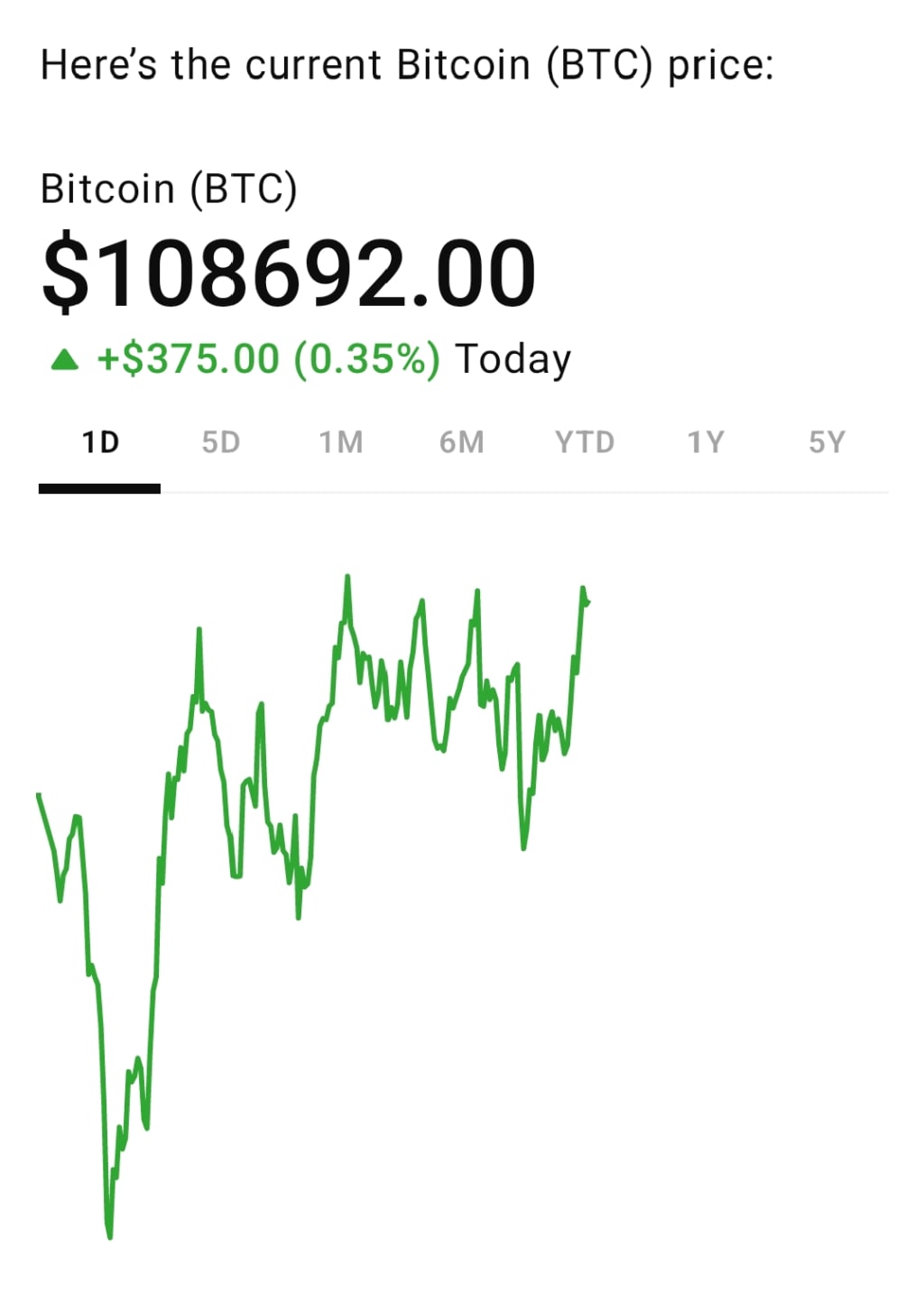
As of late August 2025, Bitcoin trades around $108,000 per coin, down from its mid-August record high near $124,000. The volatility highlights both its potential for outsized gains and the risks investors face.
Resistance and Support: Bitcoin has strong support near the $107,000–111,000 range, while resistance lies around $113,000–124,000.
Macro Factors: Interest rate expectations, global economic growth, and regulatory developments heavily influence price. Optimism about U.S. rate cuts fueled recent rallies, while cautious sentiment has triggered pullbacks.
Investor Behavior: Institutional demand has stabilized price swings compared to earlier years, but retail traders still contribute to sharp intraday moves.
Despite short-term fluctuations, Bitcoin is up massively from just five years ago, when it hovered around $10,000 in 2020. That growth demonstrates its long-term potential — though skeptics warn of bubbles and unsustainable valuations.
---
4. Bitcoin’s Role in the Global Economy
Beyond price speculation, Bitcoin plays an increasingly important role in the global economy:
Hedge Against Inflation: In countries with high inflation or currency crises (e.g., Argentina, Turkey, Nigeria), Bitcoin serves as a lifeline for preserving wealth.
Financial Inclusion: Millions of unbanked individuals use Bitcoin as an alternative to inaccessible or unstable banking systems.
Cross-Border Payments: Bitcoin enables fast, censorship-resistant transfers, bypassing traditional banking bottlenecks.
However, Bitcoin’s energy consumption remains a point of controversy. Mining uses immense electricity, leading critics to argue it harms the environment. Supporters counter that renewable energy adoption in mining is growing, and Bitcoin’s transparency makes it easier to measure than traditional banking’s hidden energy costs.
---
5. Regulation and Government Response
Governments worldwide are still grappling with how to regulate Bitcoin. Some see it as a threat to monetary sovereignty, while others embrace it as an opportunity.
United States: Regulatory clarity is slowly improving, with Bitcoin ETFs approved and institutions entering the space. Still, debates continue about taxation, anti-money-laundering laws, and consumer protection.
Europe: The EU’s MiCA framework (Markets in Crypto-Assets) provides a comprehensive regulatory environment, balancing innovation with oversight.
Developing Nations: Countries facing currency crises are increasingly open to Bitcoin. El Salvador famously adopted it as legal tender in 2021, and others watch closely.
Regulation remains a double-edged sword: too restrictive, and innovation could be stifled; too lenient, and risks of fraud and instability grow.
---
6. Investment Case: Risks and Rewards
For investors, Bitcoin offers both tremendous upside and significant risks.
Potential Rewards
Scarcity: With only 21 million coins, demand growth can push prices much higher.
Institutional Adoption: As more hedge funds, corporations, and banks hold BTC, liquidity and stability improve.
Hedge Against Fiat Decline: In a world of rising debt and inflation, Bitcoin may protect against currency devaluation.
Risks
Volatility: Prices can swing by thousands of dollars in a single day.
Regulation: Harsh laws could limit adoption or drive activity underground.
Technological Threats: While Bitcoin is secure, quantum computing or unforeseen exploits could disrupt it.
Market Sentiment: Bitcoin’s value is not tied to cash flow like stocks, making it vulnerable to shifts in psychology.
As with any asset, diversification and risk management are key.
---
7. Future Outlook
Looking ahead, Bitcoin’s trajectory will depend on multiple factors:
1. Mainstream Adoption: If businesses and individuals increasingly use Bitcoin for savings and payments, its legitimacy will strengthen.
2. Technological Innovations: Scaling solutions like the Lightning Network promise faster, cheaper transactions, potentially restoring Bitcoin’s original vision as digital cash.
3. Global Macroeconomics: Economic crises, inflation, and debt could drive more people toward decentralized assets.
4. Regulatory Balance: A fair regulatory framework could foster healthy growth, while extreme crackdowns could hinder expansion.
Some bullish analysts predict Bitcoin could reach $250,000–500,000 in the next decade if adoption continues. Extreme optimists even envision $1 million per coin. Skeptics argue it could crash below $50,000 if interest fades.
---
8. Conclusion
Bitcoin is more than just a speculative asset; it represents a paradigm shift in how humanity thinks about money. In just over a decade, it has gone from obscure internet code to a financial instrument debated in the halls of power and traded by the world’s largest institutions.
As of 2025, with Bitcoin hovering around $108,000, it remains both an exciting opportunity and a risky bet. Its future will be shaped by adoption, regulation, technology, and the broader economy. For some, it is digital gold and the ultimate hedge against inflation; for others, it’s a speculative bubble waiting to burst.
Either way, Bitcoin has secured its place in history. Whether it climbs to new heights or faces dramatic corrections, it has already reshaped global finance — and its story is far from over.
About the Creator
zakir ullah khan
poetry blogs and story Year Vocal Writing Skill
Keep reading
More stories from zakir ullah khan and writers in Trader and other communities.
india and pakistan floods
India Pakistan Floods india floods pakistan India has released water from its dams in the Kashmir region due to heavy rainfall, warning neighboring Pakistan of potential downstream flooding. This move has prompted Pakistan to issue alerts for flooding on three rivers flowing from India, including the Ravi, Sutlej, and Chenab rivers.
By zakir ullah khan5 months ago in Lifehack
BTC USD Surge: How to Predict the Next Big Price Move
The BTC USD market is fast-moving and full of surprises. Traders are always searching for clues about the next price jump or drop. While experts share tips, some important truths remain hidden. In this article, we reveal insights about BTC USD that can help you stay ahead of the curve and make smarter trading decisions.
By hamza mirzaabout 13 hours ago in Trader
Europe Retinal Surgery Devices Market Size & Forecast 2026–2034
Market Snapshot The Europe Retinal Surgery Devices Market is expected to witness steady and sustained growth over the forecast period, expanding from US$ 820.33 million in 2025 to US$ 1,668.76 million by 2034, registering a compound annual growth rate (CAGR) of 8.21% during 2026–2034.
By shibansh kumar2 days ago in Trader
Self Help: Grifters' Gospel
On Self-Help, Snake Oil, and the Illusion of Change Psychology professionals and students can be imagined on two opposite sides of a line called self-help books: likely a larger group opposes pop-science and step-by-step manuals filled with talk of success, journaling, and not giving a f**k; others love them, but they aren’t many.
By Avocado Nunzella BSc (Psych) -- M.A.P 4 days ago in BookClub




Comments (2)
THANKS
deer kha