
Biodegradable Plastic Market Size & Forecast 2025–2033
How Eco-Friendly Plastics Are Transforming Global Packaging, Agriculture, and Consumer Goods

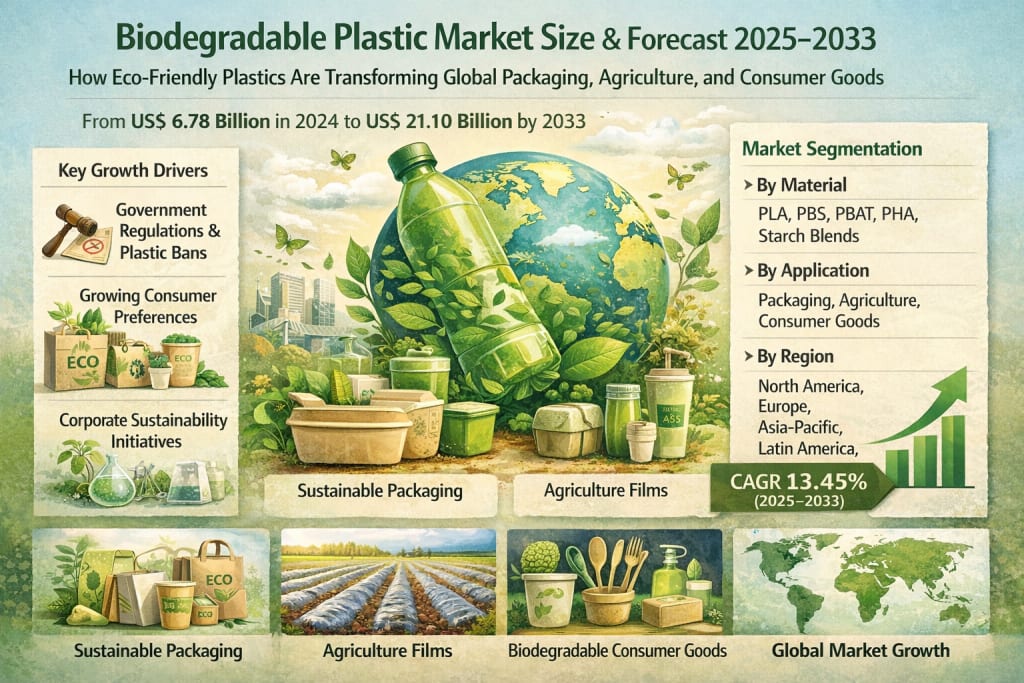
The global war on plastic pollution has entered a decisive phase. What was once a sustainability discussion is now a regulatory priority, a corporate mandate, and a consumer demand. Governments are banning single-use plastics. Brands are redesigning packaging. Consumers are actively choosing eco-friendly products.
At the center of this transformation is one rapidly expanding sector: the biodegradable plastic market.
According to industry projections, the global biodegradable plastic market is expected to grow from US$ 6.78 billion in 2024 to US$ 21.10 billion by 2033, registering a strong CAGR of 13.45% between 2025 and 2033. This surge reflects more than market expansion—it signals a structural shift in how materials are produced, consumed, and disposed of worldwide.
As sustainability becomes a competitive advantage rather than a marketing slogan, biodegradable plastics are moving from niche innovation to mainstream industrial solution.
________________________________________
What Are Biodegradable Plastics—and Why Are They Critical?
Biodegradable plastics are materials designed to break down naturally into water, carbon dioxide, and biomass through microbial activity. Unlike conventional petroleum-based plastics that can persist for hundreds of years, biodegradable alternatives decompose within months to a few years, depending on environmental conditions.
These plastics can be:
• Bio-based, made from renewable feedstocks such as corn starch, sugarcane, or cassava
• Synthetic biodegradable polymers, engineered to degrade under specific conditions
• Compostable plastics, which break down in industrial composting environments
Their importance lies in their environmental impact:
• Reduced landfill accumulation
• Lower marine plastic pollution
• Decreased microplastic formation
• Support for circular economy initiatives
• Reduced dependence on fossil fuels
As global awareness of climate change and plastic waste intensifies, biodegradable plastics are increasingly viewed as an essential component of sustainable development strategies.
________________________________________
Why the Biodegradable Plastic Market Is Accelerating
Several powerful drivers are fueling rapid growth in the biodegradable plastic industry.
1. Government Regulations and Plastic Bans
Countries worldwide are implementing strict policies against single-use plastics. From plastic bag bans in Europe to packaging regulations in Asia-Pacific, regulatory frameworks are creating immediate demand for biodegradable alternatives.
Mandatory compostable packaging in food service, plastic tax schemes, and extended producer responsibility (EPR) laws are pushing companies toward sustainable material solutions.
2. Changing Consumer Preferences
Modern consumers—especially Millennials and Gen Z—prioritize eco-conscious brands. Sustainable packaging now influences purchasing decisions across:
• Food and beverage
• Personal care products
• E-commerce shipments
• Household goods
Brands that fail to adapt risk losing market share in an increasingly environmentally aware marketplace.
3. Corporate ESG Commitments
Environmental, Social, and Governance (ESG) strategies are no longer optional. Global corporations are committing to:
• Net-zero emissions targets
• Plastic neutrality goals
• Sustainable packaging transitions
Switching to biodegradable plastics helps companies improve sustainability metrics while strengthening brand reputation.
4. Technological Advancements
Innovation is rapidly improving:
• Material strength and durability
• Moisture resistance
• Cost efficiency
• Industrial composting compatibility
Large-scale investments—such as SKC’s biodegradable plastic facility in Vietnam—highlight how industry players are scaling production to meet rising demand.
________________________________________
Key Growth Drivers in Detail
Rising Environmental Awareness
Public concern over ocean plastic pollution, wildlife harm, and microplastics in food chains has reached unprecedented levels. Viral imagery and scientific reports have reshaped global perception of conventional plastics.
Biodegradable alternatives offer a visible, tangible solution—making them increasingly attractive to businesses and policymakers.
Expansion of Sustainable Packaging
Packaging represents the largest and fastest-growing segment in the biodegradable plastic market. Food trays, compostable coffee cups, delivery packaging, and shopping bags are rapidly transitioning to biodegradable materials.
With e-commerce booming globally, sustainable packaging demand is expected to rise further through 2033.
Growth in Sustainable Agriculture
Agriculture is emerging as a high-potential application area. Biodegradable mulch films eliminate the need for plastic removal after harvest, reducing labor costs and soil contamination.
Countries promoting sustainable farming practices are accelerating adoption in this segment.
________________________________________
Market Challenges That Still Exist
Despite strong growth projections, the biodegradable plastic market faces notable challenges.
High Production Costs
Biodegradable plastics often cost more than conventional plastics due to:
• Raw material sourcing
• Complex processing technologies
• Smaller production scale
However, as economies of scale improve, costs are expected to decline.
Limited Composting Infrastructure
Many biodegradable plastics require industrial composting facilities to degrade efficiently. In regions lacking proper waste management systems, environmental benefits may not be fully realized.
Infrastructure investment will be critical for maximizing market potential.
Performance Limitations
Although innovation is narrowing the gap, certain high-stress applications still favor traditional plastics due to superior durability and moisture resistance.
Ongoing R&D is addressing these limitations.
________________________________________
Material Segmentation: Where Growth Is Concentrated
Polylactic Acid (PLA)
Derived from renewable sources, PLA dominates the biodegradable plastic market due to:
• Transparency
• Rigidity
• Food-contact safety
• 3D printing applications
Polybutylene Succinate (PBS)
PBS offers strong mechanical properties and compostability, making it ideal for packaging and agricultural films.
Starch Blends
Cost-effective and widely used in compost bags and films, starch blends are gaining traction in price-sensitive markets.
PBAT and PHA
These materials are increasingly used in flexible packaging and specialty applications due to improved flexibility and biodegradability.
________________________________________
Regional Outlook: Global Expansion in Motion
North America
The United States leads with strong consumer demand, corporate sustainability initiatives, and state-level plastic regulations.
Europe
The UK, Germany, France, and Italy are major adopters due to strict EU environmental directives and plastic reduction policies.
Asia-Pacific
China and India are among the fastest-growing markets. Government bans on non-degradable plastics and large manufacturing investments are driving rapid expansion.
Latin America & Middle East
Brazil and UAE show rising adoption driven by sustainability initiatives and growing environmental awareness.
________________________________________
Competitive Landscape
Leading companies shaping the biodegradable plastic market include:
• BASF SE
• Total Corbion
• Mitsubishi Chemical Holdings
• Toray Industries
• Amcor Limited
• Green Dot Bioplastics
These players are investing heavily in product innovation, plant expansion, and strategic partnerships to gain competitive advantage.
________________________________________
Market Forecast 2025–2033: What Lies Ahead?
With a projected value of US$ 21.10 billion by 2033, the biodegradable plastic market is positioned for sustained double-digit growth.
Future expansion will be driven by:
• Increased regulatory pressure
• Advancements in bio-based feedstocks
• Corporate ESG investments
• Circular economy initiatives
• Growing composting infrastructure
As innovation continues and costs decline, biodegradable plastics are expected to penetrate deeper into mainstream industrial applications.
________________________________________
Final Thoughts: A Turning Point for the Materials Industry
The biodegradable plastic market represents more than financial growth—it represents a transformation in industrial philosophy.
The question is no longer whether sustainable materials will replace conventional plastics.
The real question is: How quickly can industries scale biodegradable solutions to meet global demand?
With governments tightening regulations, corporations committing to sustainability, and consumers demanding greener products, the transition is already underway.
For investors, manufacturers, and policymakers, biodegradable plastics are not just a trend—they are a long-term structural shift toward a more sustainable global economy.
About the Creator
Adil Ali Khan
I’m a passionate writer who loves exploring trending news topics, sharing insights, and keeping readers updated on what’s happening around the world.
Keep reading
More stories from Adil Ali Khan and writers in Trader and other communities.
United States Diabetes Market Size, Trends, Growth & Forecast 2034: A Transforming Healthcare Landscape
The United States diabetes market is entering a new era of transformation. With millions of Americans living with diabetes and prediabetes, the condition remains one of the most pressing public health challenges in the country. However, alongside rising prevalence comes rapid innovation — from advanced insulin therapies to AI-powered glucose monitoring systems.
By Adil Ali Khan3 days ago in Trader
Australia Veterinary Market — Growth, Forecast & Strategic Outlook 2026–2034
The Australia veterinary market is experiencing strong growth as animal healthcare and services expand across both companion and production animals. According to IMARC Group, the market reached USD 2.1 billion in 2025 and is projected to grow to USD 4.9 billion by 2034, exhibiting a compound annual growth rate (CAGR) of 9.60% during 2026–2034.
By Amélie Belle2 days ago in Trader




Comments
There are no comments for this story
Be the first to respond and start the conversation.