
Automated Machine Learning Market Size and Forecast 2025–2033
How AutoML Is Reshaping the Future of AI Adoption Across Industries

Introduction: The Rise of Automated Intelligence
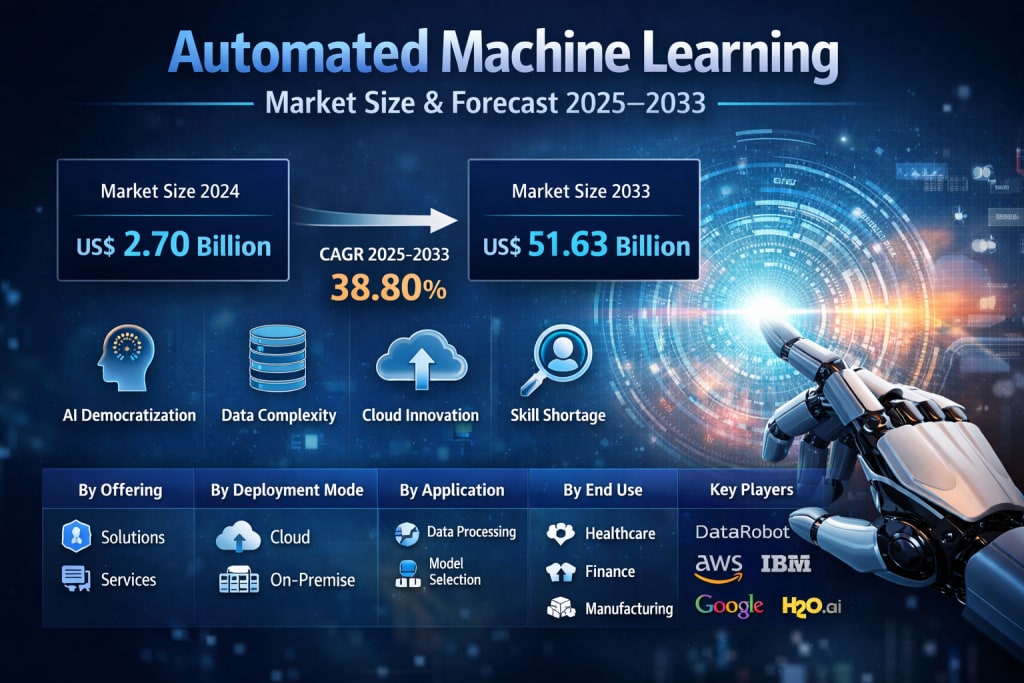
According to Renub Research’s latest industry outlook, the Automated Machine Learning (AutoML) Market is projected to surge from US$ 2.70 billion in 2024 to US$ 51.63 billion by 2033, expanding at a remarkable CAGR of 38.80% from 2025 to 2033. This extraordinary growth reflects a broader shift in how organizations across the world are adopting artificial intelligence—not as a niche, expert-only capability, but as a mainstream business tool.
AutoML is changing the rules of the game by simplifying one of the most complex areas of modern technology: machine learning model development. Traditionally, building accurate and reliable machine learning models required highly skilled data scientists, long development cycles, and significant infrastructure investment. Today, AutoML platforms automate many of these steps, allowing businesses to move faster, reduce costs, and unlock the value of data at scale.
As industries face mounting pressure to become more data-driven, efficient, and competitive, AutoML is emerging as a critical enabler of the next wave of digital transformation.
Market Overview: What Is Automated Machine Learning?
Automated Machine Learning, or AutoML, refers to the use of software platforms that automate key stages of the machine learning lifecycle, including data preprocessing, feature engineering, model selection, training, and hyperparameter optimization. By reducing the need for manual intervention, AutoML allows both technical and non-technical users to build high-quality machine learning models more quickly and reliably.
At its core, AutoML aims to make machine learning more accessible, scalable, and efficient. Instead of relying solely on scarce data science talent, organizations can use AutoML tools to experiment with multiple models, compare performance, and deploy solutions in a fraction of the time it would take using traditional approaches.
This automation is especially valuable in a business environment where data volumes are exploding, competition is intensifying, and decision-makers need faster insights. As a result, AutoML is no longer seen as just a productivity tool for data scientists—it is increasingly viewed as a strategic technology for enterprise-wide AI adoption.
Why the AutoML Market Is Growing So Fast
Several powerful forces are converging to drive the rapid expansion of the Automated Machine Learning market.
1. Explosion in Data Volume and Complexity
Modern organizations generate massive amounts of data from sources such as social media, IoT devices, digital transactions, customer interactions, and enterprise systems. Managing and extracting value from this data using traditional machine learning workflows is time-consuming and resource-intensive.
AutoML addresses this challenge by automating complex and repetitive tasks like data cleaning, feature selection, and model tuning. This allows companies to analyze large, complex datasets more efficiently and derive actionable insights faster. As data continues to grow in both volume and complexity, the demand for scalable and automated machine learning solutions is expected to rise sharply.
2. Shortage of Skilled Data Scientists
Despite the growing importance of AI, there is a well-documented global shortage of experienced data scientists and machine learning engineers. Many organizations, especially small and medium-sized enterprises (SMEs), struggle to build and maintain specialized AI teams.
AutoML helps bridge this gap by lowering the technical barrier to entry. Business analysts, engineers, and domain experts can use AutoML platforms to develop models without deep expertise in machine learning algorithms. This democratization of AI is a major factor behind the market’s strong growth trajectory.
3. Need for Faster Model Development and Deployment
In today’s fast-moving business environment, speed is a competitive advantage. Companies want to move from data to decisions as quickly as possible. Traditional machine learning pipelines can take weeks or even months to deliver production-ready models.
AutoML significantly shortens development cycles by automating experimentation, optimization, and validation. This enables organizations to deploy AI solutions faster, respond more quickly to market changes, and continuously improve their models over time.
4. Advancements in Cloud Computing and AI Infrastructure
Cloud computing has transformed the way AI solutions are built and deployed. Scalable, on-demand computing resources make it possible to run complex machine learning workloads without heavy upfront investment in hardware.
Major technology providers continue to enhance their AI platforms with more powerful models and tools. For example, in April 2024, IBM expanded its WatsonX AI and data platform with the integration of Meta Llama 3, strengthening its ecosystem of enterprise-ready AI models. Such developments enable AutoML platforms to train models faster, leverage pre-trained architectures, and deploy solutions more efficiently, further accelerating market adoption.
5. The Ongoing Democratization of AI
One of the most important long-term trends in technology is the democratization of artificial intelligence. AutoML plays a central role in this movement by making advanced machine learning capabilities accessible to a much broader audience.
Strategic partnerships also support this trend. Google Cloud and NVIDIA, for instance, have expanded their collaboration to accelerate machine learning and generative AI development, including the adoption of advanced AI computing platforms and cloud-based services. These initiatives provide developers and enterprises with the infrastructure needed to scale AI applications, reinforcing the growth of AutoML across industries.
Key Challenges Facing the AutoML Market
Despite its strong growth prospects, the AutoML market also faces several important challenges that could influence adoption patterns.
Data Privacy and Security Concerns
AutoML platforms often process large volumes of sensitive data, particularly in sectors such as healthcare, banking, and government. This raises serious concerns about data privacy, regulatory compliance, and cybersecurity.
Organizations must ensure compliance with regulations such as GDPR and HIPAA while also protecting their data from breaches and unauthorized access. Cloud-based AutoML solutions, while highly scalable, can increase exposure to security risks if not properly managed. As a result, trust in platform providers, strong encryption, and robust governance frameworks are essential for wider adoption.
Skill Gaps in Interpreting Results
While AutoML simplifies model development, it does not eliminate the need for human judgment. Interpreting results, understanding model limitations, and identifying potential biases still require a certain level of statistical and domain knowledge.
Without these skills, users risk misinterpreting outputs or making poor business decisions based on flawed insights. This challenge highlights the need for better explainability tools, improved user interfaces, and ongoing training to ensure responsible and effective use of AutoML technologies.
Regional Market Insights
United States: A Hub of Innovation and Adoption
The United States remains one of the most important markets for Automated Machine Learning, driven by strong demand from industries such as healthcare, finance, retail, and technology. Enterprises are increasingly using AutoML to improve operational efficiency, enhance customer experiences, and accelerate innovation.
A notable example of strategic investment in AI capabilities is Microsoft’s acquisition of Nuance Communications for US$ 19.7 billion in 2022. This move significantly strengthened Microsoft’s position in AI and AutoML, particularly in healthcare-focused applications such as speech recognition and clinical documentation. With continued advances in AI infrastructure and strong enterprise adoption, the U.S. AutoML market is expected to maintain robust growth.
Germany: Industrial Strength Meets AI Automation
Germany’s AutoML market is benefiting from the country’s strong industrial base and increasing focus on digitalization and smart manufacturing. AI adoption in the manufacturing sector has risen significantly in recent years, and this trend is expected to continue as companies seek to improve productivity, quality control, and predictive maintenance.
AutoML platforms are especially attractive in this context because they allow industrial firms to deploy machine learning solutions without building large in-house data science teams. This positions Germany as one of Europe’s leading centers for AI and AutoML innovation.
India: Rapid Digital Transformation Fuels Growth
India is emerging as a major growth market for Automated Machine Learning, supported by rapid digital transformation across sectors such as finance, healthcare, manufacturing, and e-commerce. Businesses are increasingly adopting AutoML to enhance data-driven decision-making and improve operational efficiency.
Government initiatives like the National Strategy for Artificial Intelligence further support this momentum by encouraging AI adoption and innovation. With rising investments, a growing tech ecosystem, and strong demand for scalable AI solutions, India is poised to play an important role in the global AutoML landscape.
Saudi Arabia: AutoML in the Era of Vision 2030
Saudi Arabia’s AutoML market is expanding in line with the country’s Vision 2030 strategy, which emphasizes digital transformation, smart cities, and innovation-driven growth. Industries such as healthcare, banking, and oil and gas are increasingly using AutoML to optimize processes, improve decision-making, and unlock new efficiencies.
The availability of cloud infrastructure and growing investment in technology talent are supporting this trend. While challenges remain, particularly around data protection and skills development, the long-term outlook for AutoML in Saudi Arabia remains highly positive.
Market Segmentation Overview
The Automated Machine Learning market can be analyzed across several key segments:
By Offering:
Solution
Service
By Enterprise Size:
SMEs
Large Enterprises
By Deployment Mode:
Cloud
On-Premise
By Application:
Data Processing
Model Ensembling
Feature Engineering
Hyperparameter Optimization Tuning
Model Selection
Others
By End Use:
Healthcare
Retail
IT and Telecommunication
Banking, Financial Services and Insurance
Automotive & Transportation
Advertising & Media
Manufacturing
Others
By Region and Country:
North America (United States, Canada)
Europe (France, Germany, Italy, Spain, United Kingdom, Belgium, Netherlands, Turkey)
Asia Pacific (China, Japan, India, Australia, South Korea, Thailand, Malaysia, Indonesia, New Zealand)
Latin America (Brazil, Mexico, Argentina)
Middle East & Africa (South Africa, United Arab Emirates, Saudi Arabia)
Competitive Landscape and Key Players
The AutoML market features a dynamic mix of global technology leaders and specialized AI companies. Key players analyzed across dimensions such as company overview, leadership, recent developments, SWOT analysis, and sales performance include:
DataRobot Inc.
Amazon Web Services Inc.
dotData Inc.
IBM Corporation
Dataiku
SAS Institute Inc.
Microsoft Corporation
Google LLC (Alphabet Inc.)
H2O.ai
Aible Inc.
These companies are investing heavily in platform innovation, partnerships, and ecosystem development to strengthen their positions in an increasingly competitive market.
Final Thoughts: The Future of AutoML
The global Automated Machine Learning market is entering a phase of extraordinary expansion, driven by the need for faster, more accessible, and more scalable AI solutions. With the market expected to grow from US$ 2.70 billion in 2024 to US$ 51.63 billion by 2033, AutoML is clearly moving from a niche technology to a core component of enterprise digital strategies.
While challenges around data security, governance, and skills remain, the long-term direction is unmistakable. AutoML is not just simplifying machine learning—it is reshaping who can use AI, how fast it can be deployed, and how deeply it can be embedded into everyday business decisions.
As organizations continue to seek competitive advantage through data and automation, AutoML will play a central role in defining the next era of intelligent, data-driven enterprises.
About the Creator
Sakshi Sharma
Content Writer with 7+ years of experience crafting SEO-driven blogs, web copy & research reports. Skilled in creating engaging, audience-focused content across diverse industries.
Keep reading
More stories from Sakshi Sharma and writers in Trader and other communities.
Global Taxi Market Size and Forecast 2025–2033: How Digital Mobility Is Redefining Urban Transport
Global Taxi Market at a Glance According to Renub Research’s latest industry outlook, the global taxi market is expected to grow from US$ 274.6 billion in 2024 to US$ 592.96 billion by 2033, expanding at a compound annual growth rate (CAGR) of 8.93% from 2025 to 2033. This impressive growth trajectory reflects more than just rising demand for transportation—it signals a fundamental shift in how people move within cities.
By Sakshi Sharmaabout 24 hours ago in Trader
Mexico Beauty and Personal Care Market Size, Share, Industry Trends and Forecast 2026-2034
How the Mexico Beauty and Personal Care Market Reflects Changing Identity and Self-Expression Beauty and personal care in Mexico are evolving beyond routine grooming. They are increasingly tied to identity, self-expression, and cultural pride. The Mexico beauty and personal care market mirrors shifts in social attitudes, consumer awareness, and lifestyle priorities. From skincare and cosmetics to grooming and wellness products, personal care has become a daily ritual that blends tradition with modern influence.
By Jackson Watson5 days ago in Trader
Block (Square) Stock Analysis: Is Block Positioned for Long-Term Growth in Fintech?
Introduction Block inc, formerly known as Square, has established itself as a major player in digital payments and financial technology. Block Inc provides payment processing solutions, point-of-sale systems, digital wallets, and financial services for businesses and individuals. With increasing global adoption of cashless transactions, Block stock has attracted significant investor attention. The key question is whether Block can sustain growth, expand its ecosystem, and continue to innovate in a competitive fintech landscape.
By Hammad Nawaz3 days ago in Trader




Comments
There are no comments for this story
Be the first to respond and start the conversation.