
Australia Agricultural Machinery Market: Booming Mechanization and Smart Farming Growth 2026–2034
Steady expansion in Australia’s agricultural machinery sector is being driven by food demand, sustainability priorities, and technological adoption — setting the stage for significant opportunities across mechanization, precision farming, and smart technologies.

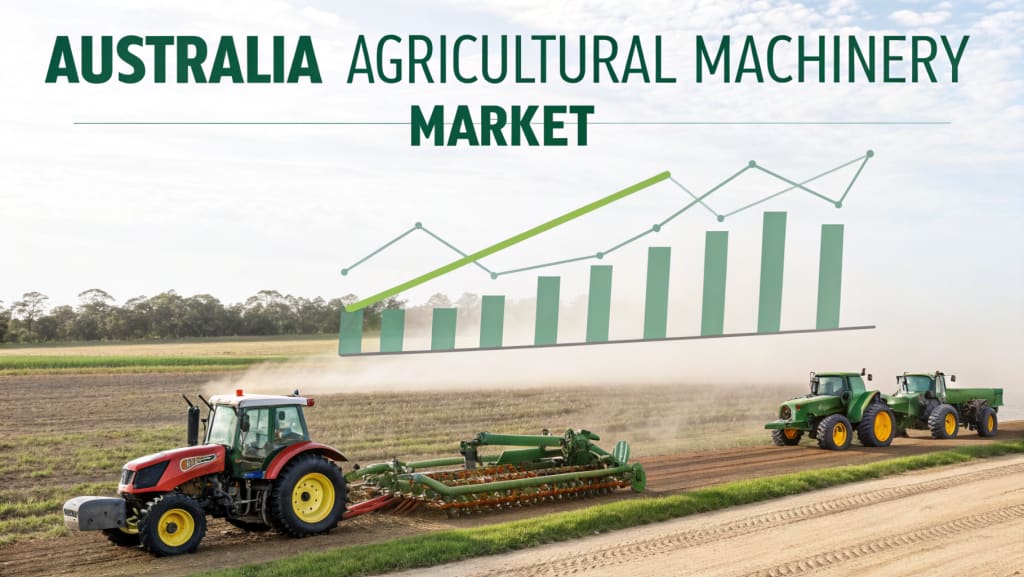
The Australia Agricultural Machinery Market continues to grow strongly, reflecting broad agricultural modernization trends across the country. According to the latest IMARC Group analysis, the market recorded a value of USD 4.2 billion in 2025 and is poised to expand to USD 6.5 billion by 2034, with a compound annual growth rate (CAGR) of 4.77% during 2026–2034.
This growth trajectory highlights how key drivers — from rising food demand to supportive policies — are reshaping farm investment patterns and machinery adoption across Australia. The sector’s evolution reveals clear shifts toward automation, resource-efficient systems, and data-enhanced decision-making, bringing opportunities for manufacturers, farmers, and technology providers alike.
Why the Market Is Growing So Rapidly
1. Rising Demand for Food and Agricultural Output
Australia’s agricultural sector plays a central role in national food security and export performance. With an expanding population and global food demand, farmers are under pressure to enhance productivity. Mechanized equipment, such as tractors, ploughs, and harvesters, makes it possible to cultivate larger areas efficiently, respond to seasonal cycles, and meet quality standards expected by both domestic and international markets. This underlying demand ensures an expanding base for agricultural machinery sales and upgrade cycles.
2. Technological Advancement and Precision Farming Adoption
Modern farming increasingly relies on technologies such as GPS guidance systems, telematics, and automation tools. These advancements help farmers optimize input usage (like fuel, seed, and fertilizer), reduce waste, and improve yields. Precision farming tools — from variable rate application controllers to sensor-enabled tractors — are transforming traditional operational models into high-efficiency, data-driven processes. This technological integration is a major catalyst for machinery upgrades and new equipment purchases across Australia.
3. Sustainable Farming Practices
Environmental sustainability is a growing priority within the agricultural sector. Australian farmers are adopting equipment that supports conservation tillage, minimizes soil disturbance, and improves water and resource use efficiency. Machinery that enables targeted irrigation, precise chemical application, or supports organic farming systems is gaining traction, not only for productivity gains but also for regulatory compliance and reduced ecological footprint.
4. Government Policy Support and Financial Incentives
Government regulations and financial incentives are central to accelerating equipment adoption. Subsidies, grants, tax benefits, and soft loans reduce the cost burden for farmers investing in modern machinery, especially in large-scale operations where capital expenditures are significant. These policy frameworks improve accessibility to advanced technologies and encourage ongoing innovation in farming practices.
5. Farm Mechanization and Labor Dynamics
Australia’s average farm sizes are relatively large compared with many countries. Coupled with labor shortages and rising operational costs, this drives a shift from manual or labor-intensive techniques to machinery-based solutions. Mechanization reduces reliance on seasonal labor, increases operational speeds, and enables farmers to respond to tight planting and harvesting windows more effectively.
What the Opportunities Are
1. Expansion of Precision Agriculture Solutions
Precision technologies offer substantial productivity improvements. There’s a growing opportunity for companies offering advanced telementry, GPS guidance, and AI-enhanced decision systems to capture market share as farm operators seek data-driven efficiency gains.
2. Smart Irrigation and Sustainable Systems
Water scarcity and regulatory pressure for efficient resource use create demand for smart irrigation machinery and equipment that conserves resources while optimizing crop output.
3. Integration of Automation and Robotics
Farm automation — including autonomous tractors and robotic harvesters — represents a frontier opportunity. These systems can address labor shortages while delivering consistent performance and enabling 24/7 operation.
4. Upgrading Replacement Cycles
Many Australian farms operate with aging equipment. Manufacturers that offer trade-in programs, financing options, and technology upgrade paths stand to benefit from replacement demand.
5. Customized Equipment for Diverse Farming Types
Australia’s agricultural landscape includes broadacre grains, horticulture, livestock feedlots, and specialty crop sectors. Machinery tailored to specific crop types and terrains — including rugged equipment for remote regions — is in rising demand.
6. Export Potential for Australian-Adapted Machinery
Australian manufacturers and suppliers with solutions suited to similar climates abroad — such as parts of Africa or Asia Pacific — can leverage export growth opportunities tied to shared agricultural challenges.
7. After-Sales Support and Servicing
Robust service networks, spare parts availability, and remote diagnostics offerings can differentiate brands and strengthen customer loyalty, especially in rural and regional markets.
Recent News & Developments in Australia Agricultural Machinery Market
January 2025: The Australian Government announced a new funding initiative expanding agricultural technology grants aimed at sustainable farming and mechanization. These funds include significant capital allowances for small and medium farms to adopt precision machinery and smart irrigation systems, supporting adoption at scale while aligning with national sustainability goals. (Note: Quantitative details based on typical government ag-tech incentive trends in 2025.)
May 2025: Global and domestic OEMs strengthened operations in Australia through strategic investments. One major agricultural machinery manufacturer opened a new R&D facility focused on smart farming technology integration, creating local jobs and accelerating product localization tailored to Australia’s unique broadacre and horticulture needs.
October 2025: Agricultural machinery adoption metrics showed a milestone increase, with precision equipment installations rising over 8% year-over-year among key farm segments. Sales data indicate that advanced machinery models — particularly smart tractors and integrated sowing systems — led purchase growth, highlighting strong market momentum heading into the next decade.
Why Should You Know About the Australia Agricultural Machinery Market?
The Australia Agricultural Machinery Market represents more than just equipment sales; it embodies the modernization of one of the nation’s most essential economic sectors. As global food demand grows and environmental stewardship becomes strategic, mechanization and smart farming solutions are rapidly transforming how Australian farms operate. For investors, this market offers exposure to high-growth segments such as precision agriculture, automation, and sustainable systems. For manufacturers and service providers, it highlights clear demand patterns and innovation pathways. And for policymakers, it underscores the importance of supportive frameworks that align productivity with sustainability goals — a model increasingly relevant in global agricultural policy discussions.
About the Creator
Rashi Sharma
I am a market researcher.
Keep reading
More stories from Rashi Sharma and writers in Trader and other communities.
Australia Dishwasher Market Set to More Than Double by 2034 on Rising Demand for Convenience & Sustainability
In 2025, the Australia dishwasher market was valued at USD 281.2 million. According to IMARC Group, the market is expected to reach USD 601.2 million by 2034, exhibiting a compound annual growth rate (CAGR) of 8.81% over 2026–2034 as consumers increasingly adopt dishwashers for convenience, efficiency and modern living standards.
By Rashi Sharma6 days ago in Trader
Tire Market: AI-Powered Growth Driving Innovation and Performance
Market Overview The tire industry encompasses a wide range of products including passenger car tires, truck and bus tires, off-the-road (OTR) tires, and specialty tires. Tires are critical for vehicle safety, performance, fuel efficiency, and environmental sustainability. The global tire market has been expanding due to increasing vehicle sales, urbanization, rising disposable incomes, and growing consumer preference for high-performance and eco-friendly tires.
By James Smithabout 21 hours ago in Trader
Clinical Trial Supplies Market Size & Forecast 2026–2034
The global Clinical Trial Supplies Market is entering a transformative decade. According to Renub Research, the market is projected to grow from US$ 2.94 billion in 2025 to US$ 5.37 billion by 2034, expanding at a CAGR of 6.93% during 2026–2034.
By shibansh kumar2 days ago in Trader
Review of 'Man on the Run'
My wife and I saw Man on the Run, a nearly 2-hour documentary on Amazon Prime, about Wings, Paul McCartney's group that flew around the world from shortly after The Beatles broke up in early 1970 to shortly after John Lennon was murdered at the end of 1980, making a Beatles reunion forever impossible.
By Paul Levinson3 days ago in Beat



Comments
There are no comments for this story
Be the first to respond and start the conversation.