
Australia Agricultural Biologicals Market 2026: Sustainable Farming Shift, Soil Health Innovation and Bio-Input Adoption
How organic agriculture growth, biotechnology advances and residue-free export demand are shaping Australia’s agricultural biologicals industry

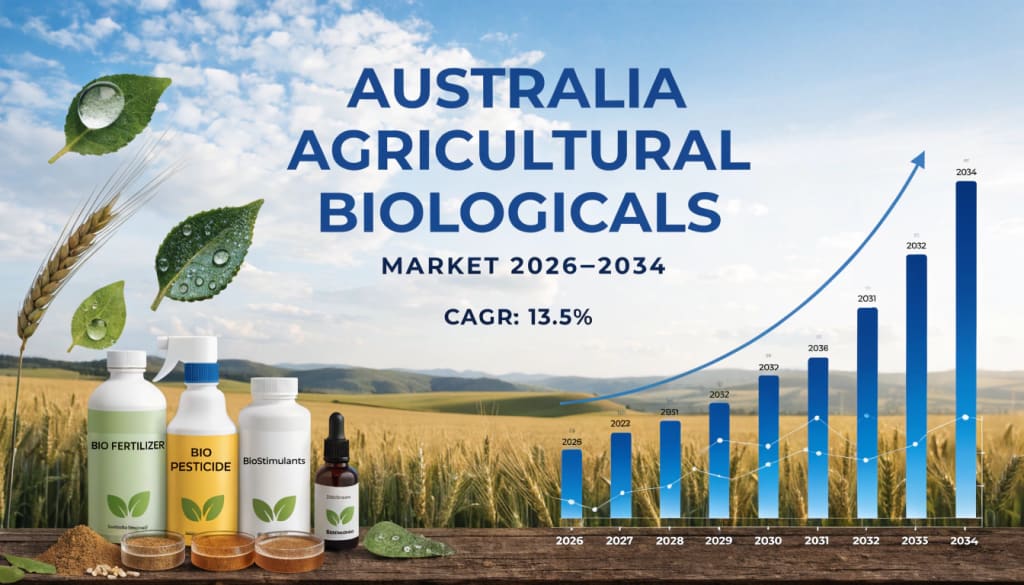
Australia Agricultural Biologicals Market Overview
Australia’s agricultural biologicals market is experiencing strong expansion as farmers increasingly transition toward sustainable crop production methods that prioritise soil health, environmental safety and long-term productivity. Agricultural biologicals — including biopesticides, biofertilizers and biostimulants — are emerging as eco-friendly alternatives to conventional agrochemicals, supporting integrated crop management and regenerative farming practices. With Australia’s leadership in organic agriculture and rising export demand for residue-free produce, biological inputs are becoming a critical component of modern agricultural strategies.
According to IMARC Group, the Australia agricultural biologicals market size reached USD 218 million in 2025 and is projected to grow to USD 680 million by 2034, exhibiting a compound annual growth rate (CAGR) of 13.5% during 2026–2034. Market growth is supported by increasing organic farming adoption, government incentives for sustainable agriculture and continued biotechnology innovation improving biological product effectiveness.
Key Market Drivers
Expansion of Organic and Sustainable Farming Practices
Australia maintains a strong organic agriculture footprint, with more than 53 million hectares of certified organic farmland, reinforcing demand for biological crop inputs that support certification requirements and sustainable production standards.
Growing Consumer Preference for Chemical-Free Produce
Rising consumer awareness regarding food safety and environmental impact is increasing demand for residue-free agricultural products, encouraging farmers to adopt biological alternatives that minimise synthetic chemical usage.
Government Incentives and Sustainability Policies
Policy support and funding initiatives promoting regenerative agriculture and environmentally responsible farming practices are accelerating adoption of biological crop protection and nutrition solutions.
Advancements in Biotechnology and AgTech Integration
Continuous innovation in microbial formulations, precision agriculture and soil monitoring technologies is improving biological product efficacy while enabling targeted application across crop systems.
Request a Sample Report with the Latest 2026 Data & Forecasts
What the Opportunities Are
Australia’s agricultural biologicals market presents substantial opportunities as sustainability priorities, agricultural innovation and export competitiveness converge.
Expansion of Biofertilizer and Soil Health Solutions
Increasing soil degradation concerns create strong demand for biological soil enhancement products that improve nutrient availability, microbial diversity and long-term soil fertility while reducing synthetic fertilizer dependence.
Growth of Biopesticides for Integrated Pest Management (IPM)
Biopesticides supporting integrated pest management frameworks offer opportunities to reduce chemical residues, delay resistance development and meet stringent international export standards.
Development of Crop-Specific Biological Formulations
Customised biological products tailored to specific crop types, climatic conditions and soil characteristics can enhance performance outcomes and strengthen farmer adoption rates.
Integration with Precision Agriculture and Digital Farming Platforms
Combining biological inputs with digital decision-support systems, satellite monitoring and AI-driven crop analytics can optimise application timing and effectiveness, creating next-generation biological farming ecosystems.
Export-Driven Sustainable Agriculture Positioning
As global markets increasingly demand traceable and sustainable agricultural products, biological input adoption can enhance Australia’s export competitiveness and support premium agricultural product positioning.
Collectively, these opportunities highlight biological inputs as foundational components of Australia’s regenerative agriculture and sustainable food production transition.
Recent News and Developments
March 2025: Market analysis confirmed the Australia agricultural biologicals market reached USD 218 million in 2025, reflecting strong uptake of sustainable crop inputs across organic and conventional farming systems.
June 2025: Industry adoption trends highlighted increasing use of biological crop inputs aligned with Australia’s 53 million-hectare organic farmland footprint, reinforcing sustained demand for bio-based agricultural solutions.
October 2025: Agricultural innovation momentum accelerated with widespread AgTech adoption among farmers — including digital soil monitoring and precision application tools — supporting effective biological input utilisation.
January 2026: Forecast outlook projections reaffirmed long-term growth trajectory with the market expected to reach USD 680 million by 2034, supported by biotechnology advances and sustainability policy momentum.
Why You Should Know About the Australia Agricultural Biologicals Market?
The Australia agricultural biologicals market reflects the broader transformation of agriculture toward sustainability, resilience and regenerative production systems. As climate pressures, soil health concerns and consumer expectations reshape farming practices, biological inputs are emerging as essential tools enabling environmentally responsible productivity gains.
With projected growth to USD 680 million by 2034, supported by organic farming leadership, innovation in biological formulations and export-driven sustainability requirements, the market offers compelling opportunities for input manufacturers, agri-tech providers and investors.
As Australia continues strengthening its position in sustainable agriculture and regenerative food production, the agricultural biologicals market is positioned for sustained expansion while serving as a cornerstone of eco-friendly crop management strategies.
About the Creator
Amyra Singh
Market research analyst who loves spotting patterns, digging into data, and turning insights into strategies that help brands grow and stay ahead of the curve.
Keep reading
More stories from Amyra Singh and writers in Trader and other communities.
Australia Interior Design Market 2026: Lifestyle Evolution, Sustainable Aesthetics and Renovation-Driven Growth
Australia Interior Design Market Overview Australia’s interior design market is expanding steadily as consumers increasingly prioritise aesthetic living environments, functional spaces and personalised home experiences. Interior design services — spanning residential, commercial and hospitality environments — are becoming central to property development and renovation strategies across the country. As hybrid work models reshape spatial requirements and sustainability considerations influence design choices, interior design is evolving into a strategic lifestyle and property value enhancement tool.
By Amyra Singhabout 18 hours ago in Trader
Dow Jones Trends: Simple Ways to Spot Market Changes Early
Dow Jones is one of the most important indicators of the U.S. stock market. Every day, investors check Dow Jones to see how top companies are performing. While most people focus on the daily gains or losses, there are hidden trends within Dow Jones that can reveal opportunities before the general public notices. They will explore Dow Jones trends, explain why they matter, and show you how to spot market changes early. For more beginner-friendly advice, see our guide on Investing for Beginners: How to Start Smart.
By John.doe7983 days ago in Trader
Coro Global Inc: Company Profile, Business Strategy, and Market Outlook
Introduction: Understanding Coro Global Inc Coro Global Inc has recently started attracting interest from investors, analysts, and business enthusiasts due to its unique positioning in the global business landscape. Although the company has limited publicly available data, its name signals a focus on international opportunities and potential expansion across multiple sectors.
By Hammad Nawazabout 15 hours ago in Trader



Comments
There are no comments for this story
Be the first to respond and start the conversation.