
Artificial Insemination Market Size and Forecast 2025–2033
Why Rising Infertility, Technology Breakthroughs, and Changing Family Structures Are Powering a Global Fertility Revolution

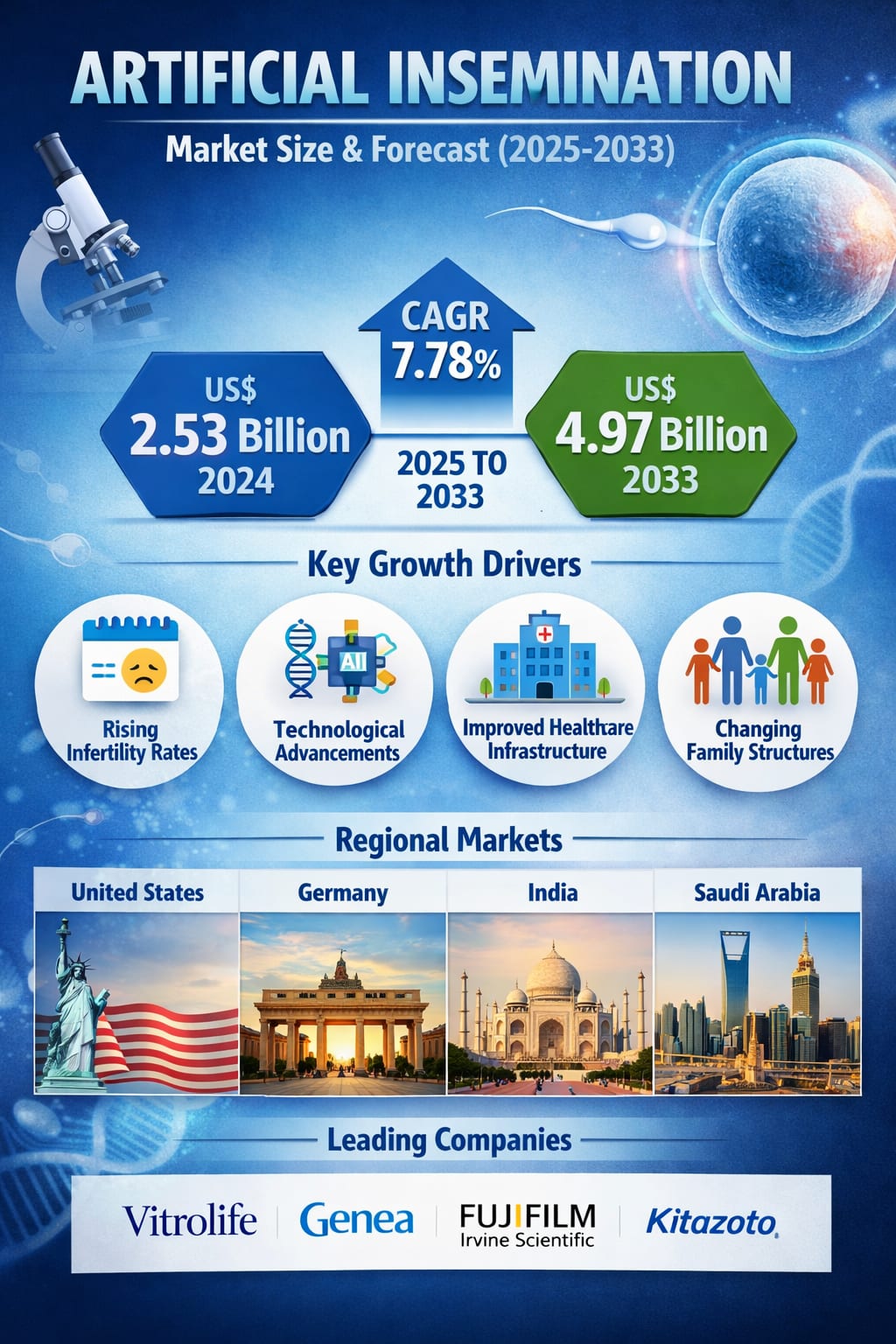
Global Artificial Insemination Market Set for Steady Growth Through 2033
The Global Artificial Insemination Market is projected to reach US$ 4.97 billion by 2033, rising from US$ 2.53 billion in 2024, registering a compound annual growth rate (CAGR) of 7.78% from 2025 to 2033. This sustained growth reflects a powerful convergence of medical, social, and technological trends reshaping how individuals and families approach fertility and reproductive health worldwide.
Artificial insemination (AI) has long been considered one of the most accessible and cost-effective assisted reproductive technologies (ART). As infertility rates climb globally and awareness of fertility treatments improves, artificial insemination is increasingly becoming the first-line option for couples, single individuals, and same-sex partners seeking to conceive. Combined with advances in reproductive technology, supportive healthcare infrastructure, and growing social acceptance of diverse family structures, the market is entering a phase of consistent and broad-based expansion.
In emerging economies, government programs and expanding private fertility clinics are further accelerating adoption. Meanwhile, in developed markets, technological refinement and insurance coverage improvements are making treatments more approachable for a wider population. Together, these factors are positioning artificial insemination as a cornerstone of modern reproductive care.
Artificial Insemination Market Overview
Artificial insemination is a medical procedure designed to assist conception by directly introducing sperm into a female’s reproductive system. Sperm—either from a partner or a donor—is collected, processed in a laboratory to concentrate healthy and motile sperm, and then placed into the cervix, uterus, or fallopian tubes around the time of ovulation.
The procedure is commonly used in cases of low sperm count, unexplained infertility, cervical mucus abnormalities, or when couples face timing or biological challenges in natural conception. It is also widely used by single women and same-sex couples who wish to build families. Compared to more complex treatments such as in vitro fertilization (IVF), artificial insemination is less invasive, simpler to perform, and significantly more affordable—making it an attractive first step in fertility treatment.
Over the past decade, artificial insemination has moved from being a niche medical solution to a mainstream reproductive option. Rising infertility rates, lifestyle changes, delayed parenthood, and growing awareness of fertility preservation are all contributing to higher demand. At the same time, improvements in sperm processing, cryopreservation, donor matching, and clinical protocols are steadily improving success rates and patient confidence.
Key Growth Drivers for the Artificial Insemination Market
Rising Infertility Rates Worldwide
One of the most important drivers of market growth is the global rise in infertility. According to the World Health Organization (WHO), around 17.5% of the adult population worldwide—roughly one in six people—will experience infertility at some point in their lives. This is a striking figure that highlights infertility as a major public health issue rather than a rare or isolated problem.
Several factors are contributing to this trend, including delayed childbearing, sedentary lifestyles, poor diet, obesity, chronic stress, environmental pollution, and underlying medical conditions. Both male and female infertility rates are increasing, creating a growing need for accessible and effective fertility treatments.
Artificial insemination is often the first medical intervention recommended because it is less invasive and more affordable than advanced procedures like IVF. As awareness increases and social stigma decreases, more individuals and couples are seeking early medical support, which is directly boosting demand for artificial insemination procedures across both developed and developing regions.
Technological Advancements in Reproductive Medicine
Technological progress is playing a transformative role in the artificial insemination market, improving accuracy, efficiency, and overall treatment outcomes. In recent years, fertility clinics have invested heavily in lab automation, improved cryopreservation techniques, and data-driven decision-making tools.
For example, in May 2022, Genea Limited launched initiatives aimed at overcoming long-standing challenges in artificial fertility processes by enhancing laboratory workflows and integrating advanced technologies. The company’s focus on better cryopreservation, automation, and AI-driven assessment tools reflects a broader industry trend toward precision medicine in fertility care.
Artificial intelligence (AI) and machine learning are increasingly being used to analyze large datasets, helping clinicians select healthier sperm samples and optimize treatment timing. Time-lapse imaging and preimplantation genetic testing (PGT), although more commonly associated with IVF, are also influencing how fertility clinics manage and refine insemination protocols.
These innovations not only improve success rates but also help reduce human error, shorten treatment cycles, and, over time, lower overall costs—making artificial insemination more accessible to a broader population.
Improved Healthcare Infrastructure
The expansion and modernization of healthcare infrastructure, particularly in emerging economies, is another major growth catalyst. Many countries are investing in advanced medical equipment, training specialized reproductive health professionals, and expanding the number of fertility clinics in both urban and semi-urban areas.
Public and private sector investments are improving diagnostic capabilities, laboratory standards, and patient care pathways. Telemedicine and mobile clinics are also helping extend fertility services to remote and underserved regions, reducing geographical barriers to treatment.
As healthcare systems become more capable of supporting specialized reproductive services, more patients are able to access artificial insemination safely and efficiently. This improved accessibility is directly contributing to higher procedure volumes and sustained market growth.
Challenges Facing the Artificial Insemination Market
High Cost of Treatment
Despite being more affordable than IVF, artificial insemination can still be financially burdensome for many patients—especially when multiple treatment cycles are required. Costs often include hormone therapies, diagnostic tests, ultrasounds, laboratory processing, and specialist consultations. In many regions, these expenses are not fully covered by insurance.
For middle- and lower-income populations, particularly in developing countries, these costs can be a significant barrier. As a result, financial constraints continue to limit widespread adoption and highlight the need for better insurance coverage and government support programs.
Psychological and Emotional Stress
Infertility and fertility treatments can place a heavy emotional and psychological burden on patients. The uncertainty of outcomes, repeated procedures, hormonal side effects, and social pressure can lead to anxiety, depression, and emotional exhaustion.
For many individuals and couples, the stress associated with treatment can affect relationships, work performance, and overall quality of life. Addressing these challenges through counseling services, emotional support programs, and patient education is essential—not only for patient well-being but also for improving treatment adherence and outcomes.
Regional Market Insights
United States Artificial Insemination Market
The United States remains one of the most significant markets for artificial insemination, driven by high awareness, advanced healthcare infrastructure, and widespread acceptance of assisted reproductive technologies. Intrauterine insemination (IUI) continues to be the most commonly used method due to its relative simplicity and favorable success rates.
Demand comes from a broad demographic base, including couples facing infertility, single individuals, and same-sex couples. Technological innovations, such as improved sperm processing techniques and AI-assisted screening tools, are further enhancing clinical outcomes. Expanding insurance coverage for fertility treatments is also helping more patients access care, supporting steady market growth.
Germany Artificial Insemination Market
Germany’s artificial insemination market is growing steadily, supported by a strong healthcare system, high treatment success rates, and increasing public awareness of reproductive health. IUI remains a widely used procedure due to its effectiveness and accessibility.
Changing social attitudes, including greater acceptance of single parenthood and same-sex families, are also contributing to rising demand. Government regulations and insurance policies play a key role in shaping access to fertility treatments, and overall, the market is expected to continue expanding in line with broader family planning and healthcare trends.
India Artificial Insemination Market
India represents one of the fastest-growing markets for artificial insemination, driven by rising awareness, technological adoption, and strong government support. Artificial insemination is widely used not only in human fertility treatments but also in livestock breeding to improve genetic quality and productivity.
In September 2024, the Punjab Animal Husbandry Department set an ambitious annual target of 30 lakh (3 million) artificial inseminations, highlighting the scale of adoption in the agricultural sector. Government initiatives such as the National Artificial Insemination Program (NAIP) and the Rashtriya Gokul Mission are further promoting the use of AI across the country.
Innovations like sex-sorted semen and mobile AI units are improving accessibility and efficiency, positioning India as a high-growth market for both reproductive healthcare and animal breeding technologies.
Saudi Arabia Artificial Insemination Market
In Saudi Arabia, the artificial insemination market is expanding gradually, driven largely by efforts to improve livestock productivity and strengthen food security. The government is investing in genetic improvement programs, veterinary infrastructure, and modern breeding facilities.
Artificial insemination is widely used in cattle, sheep, and goat breeding, with increasing interest in sexed semen and advanced techniques to improve success rates. Continued investment in training and infrastructure is helping Saudi Arabia establish itself as a regional leader in efficient and sustainable livestock breeding practices.
Recent Developments in the Artificial Insemination Market
September 2024: Lupane State University (LSU) launched an artificial insemination program to help farmers improve goat breeds and reduce reliance on expensive breeding stock.
September 2024: The Punjab Animal Husbandry Department set a yearly target of 30 lakh artificial inseminations across the state.
August 2024: Aetna®, a CVS Health® Company, added intrauterine insemination (IUI) as a covered medical benefit in eligible plans, helping members test fertility and improve chances of conception.
Artificial Insemination Market Segmentation
By Type:
Intrauterine
Intracervical
Intravaginal
Intratubal
By Source Type:
AIH – Husband
AID – Donor
By End Use:
Hospitals and Clinics
Fertility Centers
Other End Users
By Region:
North America: United States, Canada
Europe: France, Germany, Italy, Spain, United Kingdom, Belgium, Netherlands, Turkey
Asia Pacific: China, Japan, India, Australia, South Korea, Thailand, Malaysia, Indonesia, New Zealand
Latin America: Brazil, Mexico, Argentina
Middle East & Africa: South Africa, United Arab Emirates, Saudi Arabia
Key Players in the Artificial Insemination Market
Vitrolife
Genea Pty Limited
Rinovum Women’s Health, LLC
Pride Angel
HI-TECH SOLUTIONS
FUJIFILM Irvine Scientific
Kitazato Corporation
Rocket Medical plc
Conceivex, Inc.
All companies are analyzed across five key perspectives:
Company Overview, Key Persons, Recent Developments & Strategies, SWOT Analysis, and Sales Analysis.
Final Thoughts
The global artificial insemination market is entering a phase of steady and sustainable growth, fueled by rising infertility rates, rapid technological advancements, improving healthcare infrastructure, and evolving social attitudes toward family building. With the market projected to grow from US$ 2.53 billion in 2024 to US$ 4.97 billion by 2033, artificial insemination is set to remain one of the most important and accessible fertility treatments worldwide.
As technology continues to refine success rates and governments expand support for reproductive healthcare, artificial insemination will play an increasingly central role in helping individuals and families realize their dreams of parenthood—making it not just a growing market, but a deeply impactful one.
About the Creator
United States Jewelry Market Size, Share, Trends, Latest Insights and Forecast 2026-2034
How the United States Jewelry Market Reflects Identity, Celebration, and Modern Luxury Jewelry has always carried meaning beyond decoration. It marks milestones, symbolizes relationships, and reflects personal identity. The United States jewelry market reveals how culture, fashion, and emotional storytelling intersect in everyday consumer behavior. From engagement rings to everyday accessories, jewelry continues to evolve alongside changing values and lifestyles.
By Jackson Watson7 days ago in Trader
Wearable Technology Market Size and Forecast 2025–2033
Introduction The global technology landscape is undergoing a quiet but powerful transformation—one that sits not in our hands, but on our wrists, in our shoes, and even woven into our clothes. Wearable technology has evolved far beyond simple step counters and notification screens. Today, it plays a central role in health monitoring, fitness management, workplace safety, and even immersive digital experiences.
By shibansh kumarabout 2 hours ago in Trader




Comments
There are no comments for this story
Be the first to respond and start the conversation.