
Animal Parasiticides Market Size and Forecast 2026–2034
Rising Pet Ownership, Expanding Livestock Production, and Innovation in Preventive Care Drive a Steady Global Market Expansion

Introduction: A Growing Pillar of Modern Animal Healthcare
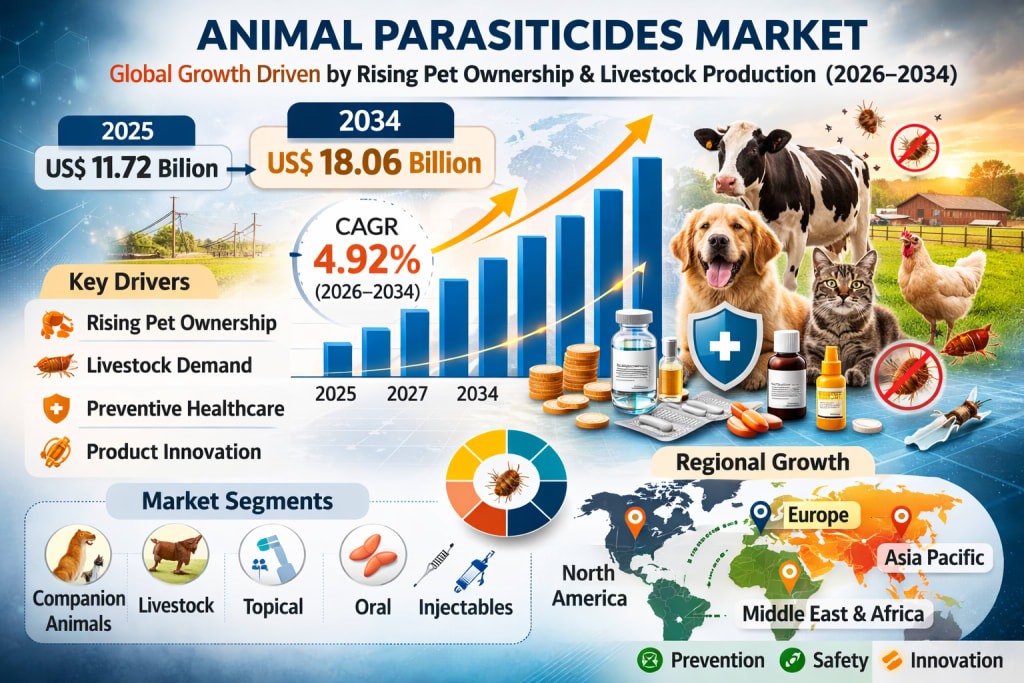
The global animal health industry is undergoing a significant transformation, and parasite control has emerged as one of its most critical pillars. According to Renub Research, the Animal Parasiticides Market is expected to reach US$ 18.06 billion by 2034, up from US$ 11.72 billion in 2025, growing at a compound annual growth rate (CAGR) of 4.92% from 2026 to 2034. This steady expansion reflects the rising importance of preventive veterinary care, the rapid growth of pet ownership worldwide, and the increasing need to protect livestock productivity against parasitic infections.
Animal parasiticides are chemical or biological agents designed to prevent, control, and eliminate parasites that affect both companion animals and livestock. These parasites—including fleas, ticks, mites, worms, and flies—can cause a wide range of health issues such as anemia, skin diseases, digestive disorders, and even severe systemic infections. Beyond animal health, parasites also pose risks to human populations through zoonotic disease transmission, making parasite control a public health priority in many regions.
With global meat and dairy consumption rising and pets increasingly being treated as family members, the demand for reliable, safe, and convenient parasite control solutions has never been stronger. The animal parasiticides market today stands at the intersection of veterinary medicine, food security, and public health.
Understanding the Animal Parasiticides Market
Animal parasiticides are available in multiple forms, including oral tablets, topical spot-on treatments, injectables, sprays, dips, and feed additives. Each delivery method serves different needs across species, environments, and management systems. In companion animals, especially dogs and cats, ease of administration and long-lasting protection are key priorities. In livestock, the focus is on cost-effectiveness, herd-level protection, and minimizing productivity losses caused by parasites.
The market is broadly driven by two major application areas: companion animals and livestock. In both segments, parasites remain a persistent and costly challenge. Internal parasites such as roundworms and tapeworms can reduce nutrient absorption and growth rates, while external parasites like ticks and fleas can transmit dangerous diseases and cause severe discomfort and skin conditions.
Over the past decade, the animal parasiticides industry has evolved from basic treatments to advanced, broad-spectrum, and combination therapies. These innovations aim to simplify parasite management, improve compliance among pet owners and farmers, and reduce the long-term risks associated with resistance and reinfestation.
Key Growth Drivers Shaping the Market
Rising Pet Ownership and Focus on Companion Animal Health
One of the strongest growth drivers for the animal parasiticides market is the global surge in pet ownership. Across both developed and emerging economies, pets are increasingly seen as integral members of the family. This cultural shift has led to higher spending on veterinary care, preventive treatments, and premium health products.
Pet owners today are far more aware of the risks posed by fleas, ticks, heartworms, and intestinal parasites. Social media, veterinary awareness campaigns, and easier access to animal health information have all contributed to a more proactive approach to parasite prevention. Routine check-ups and monthly preventive treatments are becoming standard practice in many households.
A notable market development occurred in April 2024, when Boehringer Ingelheim launched NexGard SPECTRA® in India after receiving approval from the Central Drugs Standard Control Organisation (CDSCO). This launch significantly expanded access to broad-spectrum parasite protection in one of the world’s fastest-growing companion animal markets, highlighting how emerging economies are becoming increasingly important to global market growth.
Urbanization also plays a role. As more pets are taken to parks, grooming centers, and shared public spaces, their exposure to parasites increases, further reinforcing the need for regular preventive care. Combined with rising disposable incomes and the trend of pet humanization, these factors are pushing demand toward premium, long-acting, and user-friendly formulations.
Expansion of Livestock Production and the Need for Higher Productivity
The second major pillar supporting market growth is the expansion of global livestock production. With rising demand for meat, milk, and other animal-derived products, farmers and producers are under constant pressure to improve efficiency, animal health, and output quality.
Parasites are a significant obstacle to these goals. They reduce feed efficiency, slow weight gain, impair fertility, and lower milk yields. In severe cases, parasitic infestations can lead to large-scale economic losses and even threaten food security in vulnerable regions.
As a result, routine parasite control programs are now a core part of modern livestock management. Large-scale farms increasingly rely on integrated parasite management strategies that combine diagnostics, targeted treatments, and preventive measures. Governments and international organizations also support disease-control initiatives to limit the spread of parasitic infections across borders.
In developing regions, where livestock industries are expanding rapidly, the adoption of veterinary parasiticides is accelerating. This trend aligns closely with broader goals of improving food security, farm profitability, and rural livelihoods, making livestock health a long-term structural driver of the animal parasiticides market.
Technological Advancements and Innovative Formulations
Innovation is reshaping the competitive landscape of the animal parasiticides market. Pharmaceutical companies are investing heavily in long-acting formulations, combination therapies, and more convenient delivery systems to improve treatment outcomes and user compliance.
A major milestone was reached in January 2025, when Elanco introduced Credelio Quattro at VMX, the first six-in-one monthly oral tablet for dogs. This product offers protection against tapeworms, roundworms, hookworms, heartworms, ticks, and fleas in a single dose, reflecting the industry’s shift toward comprehensive, all-in-one solutions.
Beyond oral tablets, advances in injectables, chewable formats, and waterproof topical treatments are making parasite prevention easier and more reliable. Digital diagnostic tools and smart monitoring technologies are also supporting earlier detection and more targeted treatment strategies.
At the same time, manufacturers are paying increasing attention to environmental sustainability and resistance management, developing formulations that are more selective, safer for non-target species, and less likely to contribute to long-term resistance problems. These technological trends are strengthening the role of parasiticides as a cornerstone of preventive veterinary care.
Challenges Facing the Animal Parasiticides Market
Growing Parasite Resistance
One of the most serious challenges confronting the industry is the growing resistance of parasites to existing treatments. Overuse, underdosing, and repeated reliance on the same active ingredients have reduced the effectiveness of several widely used products.
Resistance not only threatens animal health and livestock productivity but also increases costs for farmers and pet owners, who may need more frequent or more expensive treatments. Developing new active compounds is both time-consuming and costly, and regulatory approval processes can further delay market entry.
Without stronger emphasis on responsible use, rotation of active ingredients, and integrated parasite management strategies, resistance could continue to erode the long-term effectiveness of current solutions.
Regulatory Constraints and Environmental Concerns
The animal parasiticides market is also shaped by strict regulatory frameworks designed to ensure safety for animals, humans, and the environment. While these regulations are essential, they significantly increase development costs and time-to-market for new products.
Environmental concerns are becoming particularly important. Issues such as chemical runoff, impact on aquatic ecosystems, and harm to non-target species have led to tighter restrictions in several regions. Some parasiticides have faced usage limitations or bans due to residue concerns in food-producing animals.
Balancing effective parasite control with sustainability and environmental protection remains a complex challenge for manufacturers, regulators, and veterinarians alike.
Regional Market Highlights
United States
The United States represents one of the largest and most advanced animal parasiticides markets globally. High pet ownership rates, strong spending on companion animal healthcare, and a large, technologically advanced livestock sector all support robust demand. The country benefits from a well-developed veterinary infrastructure and a strong presence of leading pharmaceutical companies. However, resistance concerns and environmental scrutiny are increasingly influencing product development and usage patterns.
Germany
Germany’s market is shaped by a strong focus on animal welfare, high veterinary standards, and strict regulatory oversight. Both companion animal and livestock segments contribute to steady demand, with growing emphasis on responsible use and sustainable formulations. The country also plays a leading role in promoting practices aimed at reducing resistance across Europe.
India
India is emerging as one of the most dynamic markets in Asia. Rising pet ownership, improving access to veterinary care, and increasing awareness of animal health are driving growth in the companion animal segment. The April 2024 launch of NexGard SPECTRA® highlights the growing importance of the Indian market for global players. In livestock, demand is supported by the need to improve milk yields, weight gain, and disease prevention amid rising meat and dairy consumption.
Saudi Arabia
Saudi Arabia’s market is supported by expanding livestock production, rising pet ownership, and increasing investment in veterinary healthcare. Government initiatives focused on food security and farm productivity are strengthening demand for parasite control solutions, although reliance on imports and regulatory complexity remain challenges.
Recent Developments in the Market
The animal parasiticides industry has seen a series of notable developments in recent years:
April 2025: The FDA approved a label expansion for Simparica Trio, adding prevention of flea tapeworm infections.
April 2025: Vetoquinol acquired Australian rights to the Drontal and Profender product families from Elanco.
January 2025: Elanco launched Credelio Quattro, a six-in-one monthly oral parasite protection for dogs.
July 2023: Bimeda introduced SpectoGard in the U.S., the first bioequivalent generic spectinomycin injectable for cattle.
July 2023: The U.S. EPA reaffirmed the safety and registration of the Seresto flea and tick collar.
June 2023: Norbrook launched Tauramox (moxidectin) injectable in the U.S.
May 2023: Merck Animal Health received authorization in Australia for a 12-month BRAVECTO injectable for dogs.
January 2023: Merck Animal Health secured FDA approval for an additional indication for BRAVECTO chews against Asian longhorned ticks.
Market Segmentation Overview
By Type:
Ectoparasiticides
Endoparasiticides
Endectocides
By Animal Type:
Companion Animals
Livestock Animals
By End User:
Veterinary Clinics and Hospitals
Animal Farms
Home Care Settings
By Region:
North America, Europe, Asia Pacific, Latin America, Middle East & Africa
Competitive Landscape
Key companies operating in the global animal parasiticides market include:
Bimeda Group, Boehringer Ingelheim GmbH, Merck & Co. Inc., PetIQ LLC, Vetoquinol S.A., Virbac, Zoetis Inc., Sanofi, and Eli Lilly and Company. These companies compete through product innovation, geographic expansion, portfolio diversification, and strategic acquisitions.
Final Thoughts
The global animal parasiticides market is on a steady and sustainable growth path, driven by rising pet ownership, expanding livestock production, and continuous innovation in preventive veterinary care. With the market projected by Renub Research to grow from US$ 11.72 billion in 2025 to US$ 18.06 billion by 2034 at a CAGR of 4.92%, the sector offers strong long-term opportunities for pharmaceutical companies, veterinarians, and investors alike.
While challenges such as resistance and regulatory pressures remain, the industry’s shift toward smarter, broader-spectrum, and more sustainable solutions is reshaping the future of parasite control. In a world where animal health, food security, and public health are increasingly interconnected, animal parasiticides will continue to play a vital and growing role in global healthcare systems.
About the Creator
Sakshi Sharma
Content Writer with 7+ years of experience crafting SEO-driven blogs, web copy & research reports. Skilled in creating engaging, audience-focused content across diverse industries.
Keep reading
More stories from Sakshi Sharma and writers in Trader and other communities.
Baby Oral Care Products Market Size and Forecast 2026–2034
Introduction The global baby oral care products market is steadily emerging as an essential segment within the broader baby care and healthcare industries. According to Renub Research, the Baby Oral Care Products Market is expected to reach US$ 2.01 billion by 2034, growing from US$ 1.42 billion in 2025, at a CAGR of 3.91% from 2026 to 2034. This growth is being driven by rising awareness of infant oral hygiene, increasing parental focus on preventive healthcare, stronger pediatric dental recommendations, and growing demand for safe, natural, and age-appropriate products.
By Sakshi Sharma2 days ago in Trader
Indonesia Logistics Market Analysis: Growth Potential & Market Forecast
According to IMARC Group's latest research publication, "Indonesia Logistics Market Size, Share, Trends and Forecast by Model Type, Transportation Mode, End Use, and Region, 2026-2034", the Indonesia logistics market size reached USD 72.4 Billion in 2025. The market is expected to reach USD 132.2 Billion by 2034, exhibiting a growth rate (CAGR) of 6.91% during 2026-2034.
By Abhishek Dixit3 days ago in Trader
S&P 500 Index Insights: Warning Signs Most Investors Miss
The S&P 500 Index is one of the most important tools for tracking the U.S. stock market. Millions of investors rely on it to understand market trends and make investment decisions. But there are hidden warning signs in the S&P 500 Index that many people overlook. Recognizing these signs early can protect your money and prevent unexpected losses.
By hamza mirza3 days ago in Trader


Comments
There are no comments for this story
Be the first to respond and start the conversation.