
Aerospace Fasteners Market Size and Forecast 2026–2034
How Lightweight Materials, Rising Aircraft Demand, and Defense Modernization Are Powering a US$ 12.59 Billion Global Market

Aerospace Fasteners Market: Global Outlook
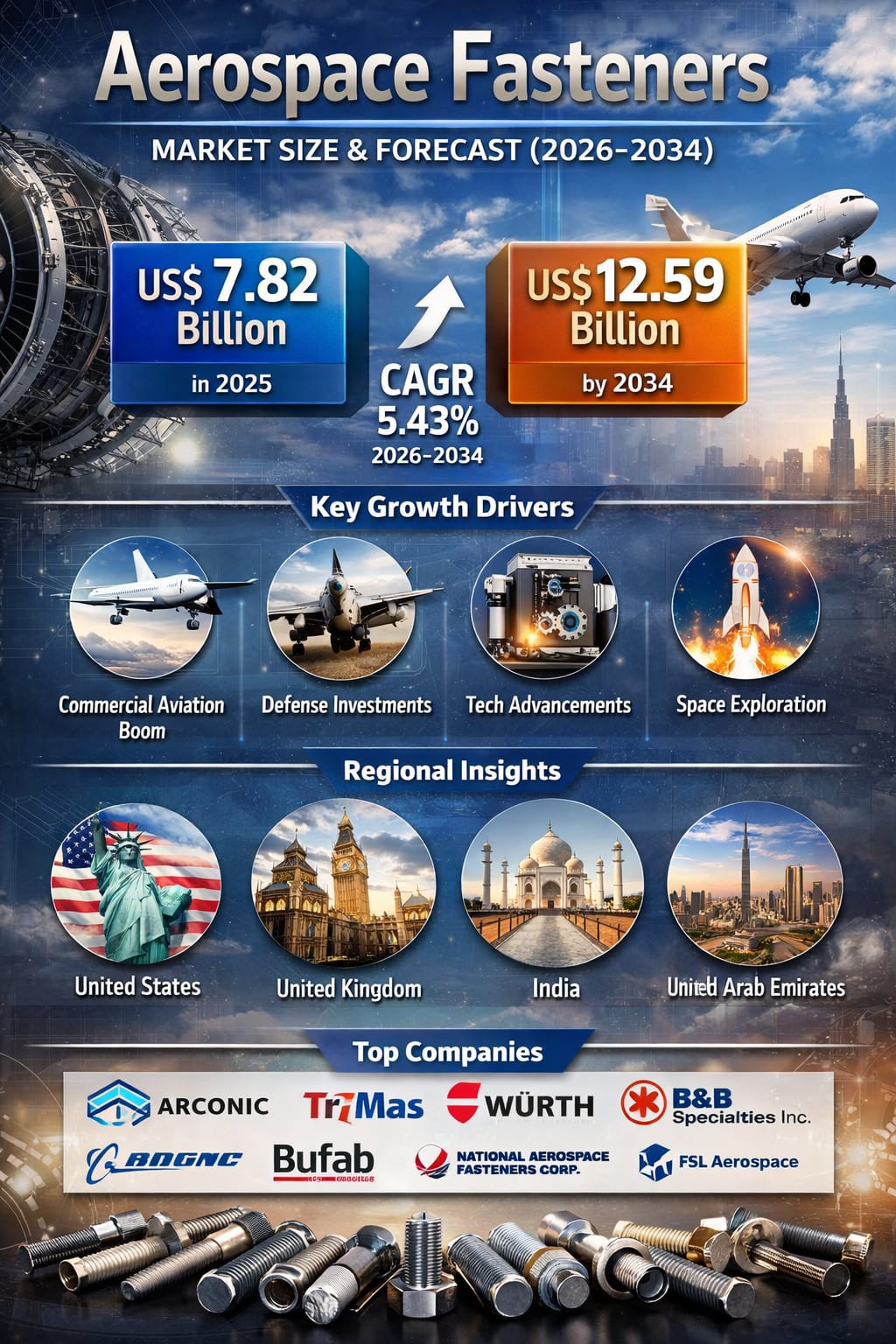
The Aerospace Fasteners Market is expected to reach US$ 12.59 billion by 2034, up from US$ 7.82 billion in 2025, growing at a CAGR of 5.43% from 2026 to 2034. This steady expansion reflects the broader transformation underway across the global aerospace industry, driven by rising commercial aviation demand, increasing defense budgets, stricter safety regulations, fuel-efficient aircraft designs, and a growing focus on reducing maintenance downtime. At the same time, expanding space exploration initiatives, strategic partnerships, and a strong aftermarket for aircraft components are reinforcing long-term market momentum.
Aerospace fasteners may appear to be small components, but they play a mission-critical role in ensuring the structural integrity, safety, and performance of aircraft, spacecraft, and defense platforms. From bolts and screws to rivets, pins, and advanced locking mechanisms, these components must perform reliably under extreme stress, vibration, temperature fluctuations, and corrosive environments. As aircraft designs become more advanced and materials more sophisticated, the role of high-performance fasteners has become even more central to the aerospace value chain.
Aerospace Fasteners Industry Overview
The aerospace fasteners industry forms a foundational layer of the global aerospace manufacturing ecosystem. Fasteners are essential in the assembly of airframes, engines, interiors, landing gear, and structural subassemblies, as well as in ongoing maintenance, repair, and overhaul (MRO) activities. Unlike standard industrial fasteners, aerospace-grade fasteners must meet exceptionally strict performance, safety, and certification standards.
The industry serves a wide range of end users, including commercial aviation, military and defense aircraft, space exploration programs, and unmanned aerial vehicles (UAVs). Each of these segments imposes unique technical requirements. Commercial aircraft demand lightweight, corrosion-resistant fasteners to improve fuel efficiency and lifecycle costs. Military platforms require ultra-high-strength and fatigue-resistant fasteners capable of withstanding extreme operational environments. Space applications push requirements even further, demanding materials and designs that can tolerate vacuum conditions, radiation exposure, and extreme temperature swings.
Growth in the aerospace fasteners market is closely tied to trends in aircraft production and fleet expansion. Rising global air travel, especially in emerging economies, is driving new aircraft orders and fleet modernization programs. At the same time, governments are increasing investments in defense aviation, including fighter jets, transport aircraft, and UAVs. Technological advancements in materials—such as titanium, superalloys, and composite-compatible fasteners—are enhancing strength-to-weight ratios and improving resistance to corrosion and fatigue.
Manufacturing processes are also evolving rapidly. Precision machining, additive manufacturing, and automated inspection systems are improving production efficiency and quality consistency. In parallel, the industry is seeing a gradual shift toward smart manufacturing and digital quality control, enabling tighter tolerances and better traceability. Sustainability considerations are also gaining importance, with manufacturers exploring recyclable materials and more resource-efficient production methods. Together, these trends are positioning the aerospace fasteners market for stable, innovation-driven growth over the next decade.
Key Growth Drivers for the Aerospace Fasteners Market
Expansion of Commercial Aviation and Airline Fleets
The continued growth of commercial aviation is one of the most powerful drivers of demand for aerospace fasteners. Rising passenger traffic worldwide has encouraged airlines to expand their fleets and replace aging aircraft with newer, more fuel-efficient models. Every new aircraft requires tens of thousands of fasteners across its structure, engines, and systems, creating substantial and recurring demand for high-performance components.
Modern aircraft designs place a strong emphasis on weight reduction, fuel efficiency, and long-term durability. This has increased the adoption of advanced fasteners made from aluminum alloys, titanium, and nickel-based materials. These fasteners offer an optimal balance of strength, corrosion resistance, and lightweight performance. The rise of low-cost carriers, increased regional connectivity, and strong growth in Asia-Pacific and the Middle East are further accelerating fleet expansion. As commercial aviation continues its long-term growth trajectory, the aerospace fasteners market benefits directly from sustained production and maintenance activity.
Rising Defense and Military Aircraft Investments
Defense modernization programs across North America, Europe, and Asia-Pacific represent another major growth engine for the aerospace fasteners market. Military aircraft operate in some of the most demanding environments, requiring fasteners that meet exceptionally high standards for strength, reliability, and fatigue resistance. Fighter jets, transport aircraft, helicopters, and UAVs all rely on specialized fasteners designed for mission-critical performance.
Governments are investing heavily in upgrading existing fleets and developing next-generation platforms, including stealth aircraft and advanced unmanned systems. These programs typically involve long production cycles and high-value contracts, providing stable demand for certified aerospace fasteners. In addition, the increasing complexity of military aircraft systems is driving the need for more advanced fastening solutions, including high-temperature and vibration-resistant designs. As geopolitical tensions and defense preparedness remain key priorities globally, defense aviation spending is expected to remain a strong pillar of market growth.
Technological Advancements in Materials and Manufacturing
Innovation in materials science and manufacturing technology is reshaping the aerospace fasteners landscape. The shift toward lightweight, high-strength materials such as titanium and superalloys is helping aircraft manufacturers improve fuel efficiency and performance without compromising safety. At the same time, the growing use of composite materials in airframes has created demand for specialized fasteners that are compatible with these structures and prevent issues such as galvanic corrosion.
On the manufacturing side, precision CNC machining, additive manufacturing, and automated inspection systems are enabling higher consistency, tighter tolerances, and lower defect rates. These technologies also support faster development cycles and more flexible production. An emerging trend is the development of smart fasteners with embedded sensors, which can support structural health monitoring and predictive maintenance strategies. Together, these technological advancements are not only improving product performance but also strengthening the long-term competitiveness of the aerospace fasteners market.
Challenges in the Aerospace Fasteners Market
High Manufacturing Costs and Material Constraints
One of the most significant challenges facing the aerospace fasteners market is the high cost of materials and production. Aerospace-grade fasteners must be manufactured from premium materials such as titanium, superalloys, and specialized steels, all of which are expensive and subject to price volatility. These materials also require advanced processing techniques and highly controlled manufacturing environments, further increasing costs.
In addition, aerospace fasteners must meet extremely tight tolerances and rigorous quality standards, which demands sophisticated machinery and skilled labor. For smaller manufacturers or suppliers operating under tight margins, these cost pressures can be particularly challenging. Supply chain disruptions and fluctuations in the availability of critical metals add another layer of uncertainty. Balancing cost efficiency with uncompromising quality and reliability remains a persistent strategic challenge for industry players.
Stringent Regulatory and Certification Requirements
The aerospace industry is one of the most heavily regulated sectors in the world, and fasteners are no exception. Products must comply with strict standards set by regulatory bodies such as the FAA, EASA, and various defense authorities, as well as quality systems like AS9100. Achieving and maintaining certification requires extensive testing, documentation, audits, and continuous process control.
These requirements significantly increase time-to-market and development costs, especially for new products or new entrants. Any failure in compliance can result in serious financial and reputational consequences, including product recalls or loss of approved supplier status. While these regulations are essential for ensuring safety and reliability, they also create high barriers to entry and limit flexibility in adopting new designs or materials. For manufacturers, continuous investment in quality systems and regulatory compliance is not optional—it is a core cost of doing business in this market.
Regional Market Insights
United States Aerospace Fasteners Market
The United States represents one of the largest and most technologically advanced markets for aerospace fasteners. The country is home to major commercial aircraft manufacturers, defense contractors, and space companies, all of which generate consistent demand for high-performance fastening solutions. Fasteners are critical across airframes, engines, and systems, supporting both new aircraft production and extensive MRO activities.
Growth in the U.S. market is supported by airline fleet expansion, defense modernization programs, and strong investment in next-generation and unmanned platforms. The emphasis on advanced materials, precision manufacturing, and strict quality standards further strengthens the country’s position as a global leader in aerospace fasteners. With a robust supply chain and strong R&D ecosystem, the United States is expected to remain a key driver of global market growth.
United Kingdom Aerospace Fasteners Market
The United Kingdom plays a strategically important role in the global aerospace supply chain, supported by a strong base of OEMs and Tier-1 suppliers. Aerospace fasteners are essential to the country’s commercial and defense aviation sectors, where reliability, lightweight design, and durability are critical requirements.
Market growth is driven by fleet modernization, rising adoption of UAVs, and participation in next-generation aircraft programs. Advances in materials and manufacturing technologies are helping UK suppliers deliver high-value, precision-engineered fasteners that meet stringent certification standards. As a result, the UK market remains innovation-driven and closely integrated into global aerospace production networks.
India Aerospace Fasteners Market
India’s aerospace fasteners market is experiencing steady growth, fueled by the rapid expansion of commercial aviation, defense modernization, and increasing activity in the space sector. Rising domestic air travel is driving airline fleet growth, while government initiatives are supporting the development of indigenous aerospace manufacturing capabilities.
Strategic partnerships with global OEMs and suppliers are helping transfer technology and build local expertise. The adoption of advanced materials and precision manufacturing processes is improving product quality and competitiveness. With strong policy support and long-term demand drivers, India is emerging as an increasingly important market within the Asia-Pacific region.
United Arab Emirates Aerospace Fasteners Market
The UAE is steadily strengthening its position in the aerospace and defense ecosystem, supported by major investments in aviation infrastructure, military modernization, and space technologies. Demand for aerospace fasteners is rising in line with aircraft acquisitions, MRO expansion, and the development of local manufacturing capabilities.
Government-backed initiatives and partnerships with global aerospace companies are encouraging the adoption of advanced materials and high-precision components. With a focus on quality, reliability, and technological advancement, the UAE market is positioning itself as a growing regional hub for aerospace components, including fasteners.
Recent Developments in the Aerospace Fasteners Market
The industry has seen several notable developments highlighting continued investment and innovation. In June 2025, the U.S. Department of Defense awarded IperionX Limited a USD 99 million contract to produce titanium components, including high-performance fasteners, supporting domestic titanium production for defense applications. In February 2025, TriMas Corporation and Airbus signed a multi-year global agreement for robotic-assembly-ready fasteners for major Airbus programs.
In September 2024, LISI AEROSPACE installed a smart manufacturing line at its Rugby plant in collaboration with the University of Sheffield AMRC, enhancing productivity and competitiveness. Earlier, in July 2024, Howmet Aerospace announced a USD 27.9 million expansion in Morristown, Tennessee, creating new jobs and reinforcing its commitment to growth and innovation.
Market Segmentation Overview
The market is segmented by Type (including narrow body aircraft, wide body aircraft, very large aircraft, regional transport aircraft, business jets, fighter jets, and others), Material (aluminum, steel, superalloys, titanium), and Product (screws, nuts and bolts, rivets, pins, and others). Geographically, it spans North America, Europe, Asia-Pacific, Latin America, and the Middle East & Africa, with major countries including the United States, Canada, key European nations, China, Japan, India, and the UAE.
All key players are evaluated across five perspectives: business overview, key persons, recent developments, SWOT analysis, and financial insights. Leading companies include Arconic Corporation, TriMas Corporation, Würth Group, B&B Specialties, Boeing Distribution Services, Bufab International, National Aerospace Fasteners Corporation, and FSL Aerospace.
Final Thoughts
The aerospace fasteners market may be built on small components, but its importance to the global aerospace industry is enormous. As aircraft become more advanced, lightweight, and efficient, the demand for high-performance, reliable, and certified fasteners will only continue to grow. With the market projected to reach US$ 12.59 billion by 2034, supported by strong commercial aviation growth, defense modernization, and technological innovation, the industry is set for a decade of steady and strategically important expansion. For manufacturers, suppliers, and investors alike, aerospace fasteners represent a critical and resilient segment of the broader aerospace value chain.
About the Creator
Taiwan Private Equity Market Size, Industry Trends, Share, Growth and Forecast to 2033
Market Overview The Taiwan private equity market has evolved significantly over the past decade, driven by economic resilience, technological leadership, and a mature manufacturing ecosystem. Taiwan is globally recognized for its strength in semiconductors, electronics manufacturing, and precision engineering. These core industries have created a fertile environment for private equity (PE) firms seeking growth-stage and buyout opportunities.
By Jackson Watson3 days ago in Trader
Mexico Dog Food Market Size, Share, Industry Overview, Trends and Forecast 2026-2034
Why the Mexico Dog Food Market Is Accelerating: Trends & Future Outlook Mexico’s pet care industry is undergoing rapid transformation, and the dog food segment is emerging as one of its strongest growth areas. As dog ownership rises and pets increasingly become valued family members, consumer spending on high-quality nutrition continues to expand. The Mexico Dog Food Market is evolving beyond basic feeding solutions toward premium, health-focused, and customized products.
By Jackson Watson4 days ago in Trader
Magic
Note from the Author: I want to let you know that this is an unusual story, and it has been written purely from whatever is in my unconscious mind, because before I start writing, I get into a flow state that reaches my unconsciousness. I also write in my subconscious mind, which is like a mid-flow state between the conscious and unconscious mind.
By Denise Larkin4 days ago in Fiction




Comments
There are no comments for this story
Be the first to respond and start the conversation.