
What Happened to Healthcare?
The Democrats dig in to take on unpopular ICE policies, but leave those needing Obamacare subsidies out to dry.

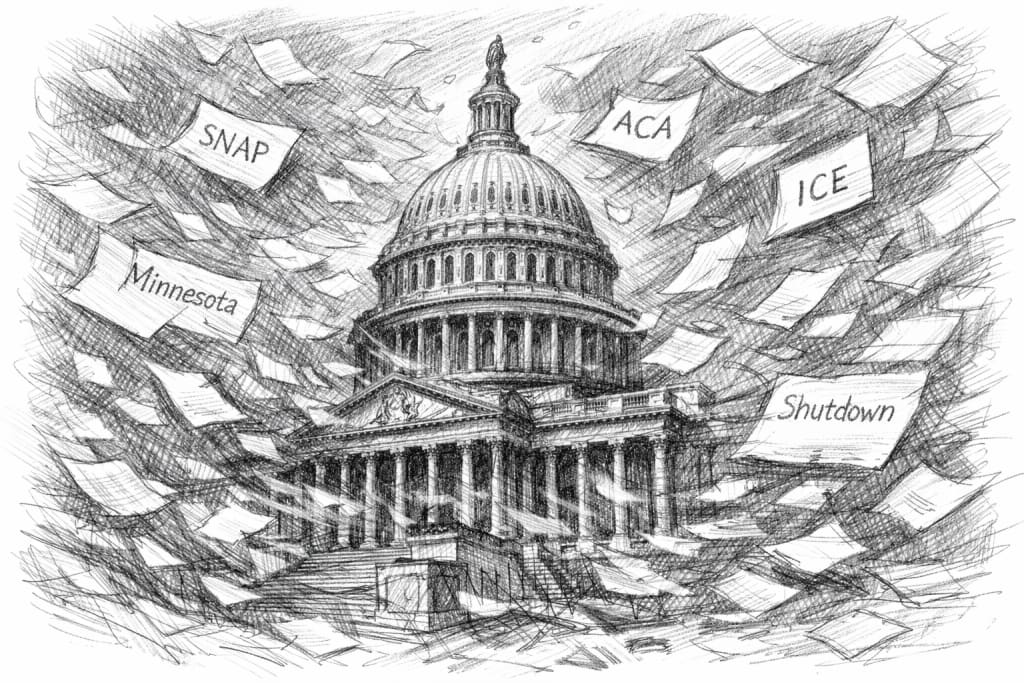
— Bret Stephens, writing in The New York Times
The most successful strategy used by the Trump administration may best be described as the shotgun approach. The President inundates the American people with lies, morally outrageous policies, and behavior that many consider illegal, often announced in a flurry of late-night social media posts. The effect is to overwhelm the public sphere and fragment sustained opposition. Each shocked response to an unprecedented action evaporates the moment the next outrage arrives.
Last year, Democrats attempted to focus attention on one issue amid surrounding chaos. As part of his “Big Beautiful Bill,” Trump and the party he controls rescinded subsidies for insurers participating in the Affordable Care Act (ACA) marketplaces, popularly known as Obamacare. This threatened to increase insurance prices for more than 24 million Americans enrolled in ACA marketplace plans and jeopardize years of progress in decreasing the number of uninsured Americans left vulnerable in the event of a personal health-care crisis.
Polls showed that Americans shared the party’s concern about rising premiums. Sparked into action, Democratic lawmakers escalated the standoff, leading to a government shutdown in an effort to restore these subsidies.
The stakes of this fight were reinforced as Americans began to receive their insurance quotes without the subsidies. As the Democrats had warned, benchmark Silver-plan premiums rose by an average of roughly 20 percent nationwide, with some state-level increases approaching 67 percent.
While the shutdown dragged on longer than any in history, it did not accomplish what Democrats had hoped. With Trump ignoring precedent and withholding SNAP benefits, food insecurity grew rapidly. With food pantries overwhelmed by unpaid federal workers and families whose SNAP lifelines had been interrupted, the cost of the shutdown became too great. The party had no choice but to retreat. In exchange for a promise to allow a vote on extending the lifeline for millions of Americans, Democrats provided enough votes to fund the government until January.
The promise made by the Democratic leadership to the party's base was that its negotiating position would be stronger when the new deadline approached. The agreement had also included a provision to fund SNAP for a longer term, eliminating the ability to use it again as leverage. The table was set to force relief for those struggling to maintain health-care coverage.
But as negotiations started, the desperate need for the subsidies to be reinstated disappeared from the conversation. A new crisis had eclipsed it. With federal forces deployed in Minnesota, this was the new focus of Democratic efforts.
There is no doubt that the actions of Trump's militarized immigration forces demanded the Democrats' attention. The policy of mass deportation has long since moved away from promises to rid the country of the “worst of the worst." While the violent criminals and sexual predators are sometimes apprehended in Trump's massive dragnet, the majority have been people who have led law-abiding lives in their adopted home country—college students on the way to surprise their families for Thanksgiving, fathers detained during scheduled immigration check-ins who were the sole caregivers for their critically ill sons, and preschoolers arriving home from school.

Speaking out against these actions is enough to get you classified as a "domestic terrorist" under this administration. Forget about the First Amendment and the Constitution’s guarantee of due process; blowing a whistle is now treated as a violent act that can get you abducted off the street and disappeared. Taking a cell-phone video of agents can get you killed.
There is something wrong when ending a federal operation requires recovery plans as if the state had just been hit by a natural disaster. If FEMA were not currently shut down because of the budget impasse, could Tim Walz ask for aid? If necessary, he could outline the damages with a Sharpie on a map of Minnesota.
But all this does not explain why the Democrats cannot fight to rein in Trump's immigration enforcement while also working to lower health-care premiums. ICE is increasingly unpopular with the American people, but so is Trump's increasing the costs of their health insurance. Can the party not walk and chew gum at the same time?
ICE is increasingly unpopular. So is paying more for health insurance. Why can’t Democrats fight both?
With Trump's approval ratings plummeting and Republicans in Congress too beholden to Trump to confront even the most controversial of his ideas, the Democrats are hoping for a blue wave of epic proportions this November. They should know that nothing will kill these dreams faster than an electorate that loses faith in their ability to confront Trump head-on and stall the unpopular parts of his agenda.
It is not enough for Democrats to oppose Trump; they must show now that they can take him on in ways that produce real change. Otherwise, they are looking at another four years stuck in the badlands of the political frontier.
About the Creator
Carl J. Petersen
Carl Petersen is a former Green Party candidate for the LAUSD School Board and a longtime advocate for public education and special needs families. Now based in Washington State, he writes about politics, culture, and their intersections.
Keep reading
More stories from Carl J. Petersen and writers in The Swamp and other communities.
Creating Gray: The Newspeak Era
“Thou shalt not bear false witness against thy neighbor." — The Ten Commandments This is the fourth entry in the Gray trilogy. In this installment, I examine how lies and distractions blur the lines between black and white. Few recent moments illustrate this better than the government’s response to the killing of Alex Pretti.
By Carl J. Petersen6 days ago in The Swamp
A Gathering of Evil Bosses
“I’m the queen of chin jutting while I smooth my hair, attacking, insulting, and deflecting to protect my appointer.” “Oh, please, Blondi, my hair is curled, highlighted, and longer than yours. I feature television commercials telling immigrants that we will give them a free plane ride home, and if they voluntarily turn themselves in, they will be allowed to legally apply for re-entry. It runs everywhere, and I look good in it! You can’t compete because of your blond hair. Mine is nicer, and my lips are prettier than yours.”
By Andrea Corwin 4 days ago in The Swamp
Craft Over Catharsis Challenge Winners
Craft Over Catharsis? What the hell does that even mean? The phrase came out of a curation meeting as a genuine question. We had been noticing that many challenge entries, across prompts, naturally gravitate toward trauma, grief, and personal reckoning. That makes sense. Writing is often cathartic. It's one of the ways we process what we've lived through.
By Vocal Curation Team4 days ago in Resources




Comments
There are no comments for this story
Be the first to respond and start the conversation.