
United States Wi-Fi Chipset Market Size and Forecast 2026–2034
How Next-Generation Wireless Standards Are Powering America’s Connected Future

United States Wi-Fi Chipset Market Overview
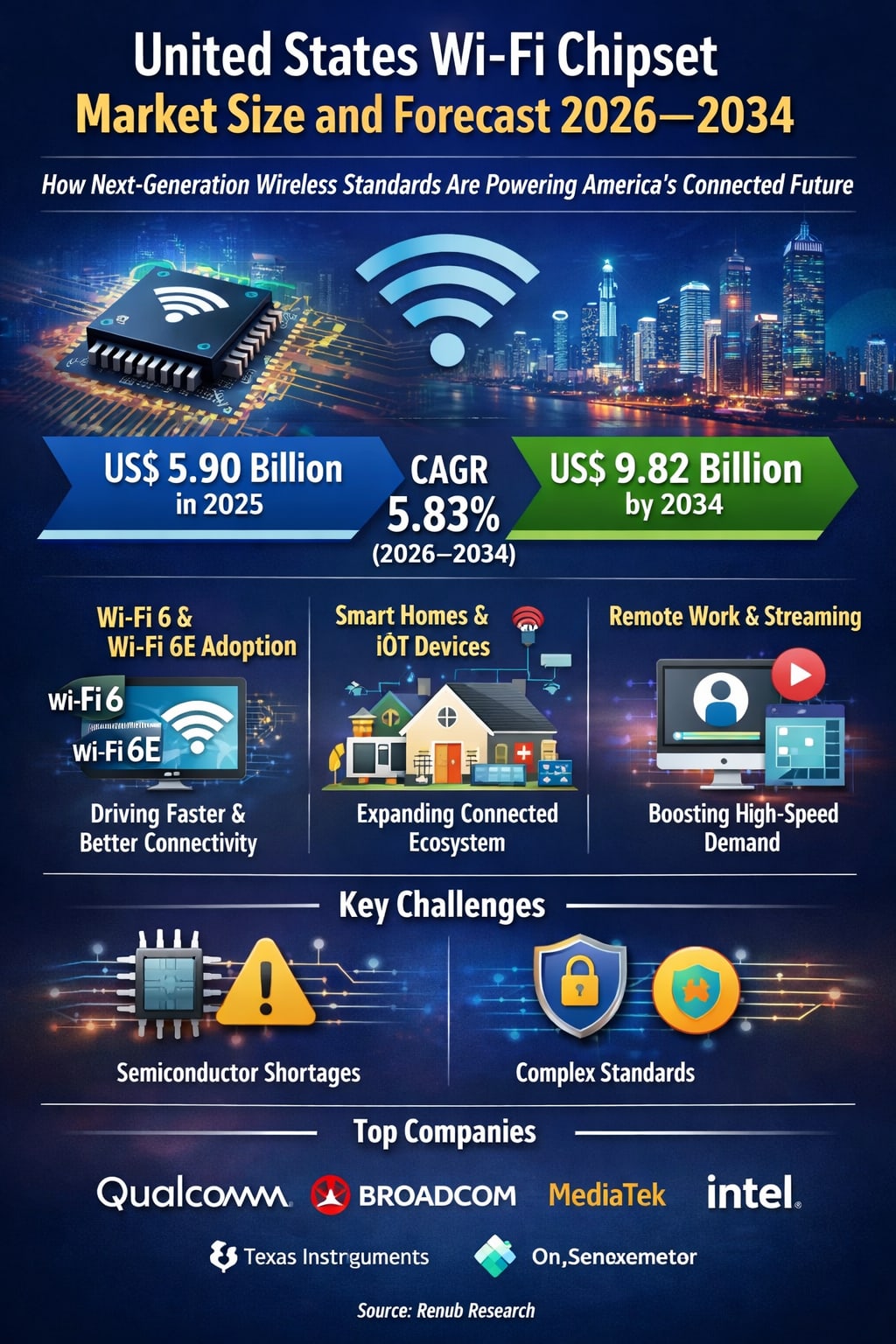
The United States Wi-Fi Chipset Market is projected to grow substantially, expanding from US$ 5.90 Billion in 2025 to US$ 9.82 Billion in 2034, registering a robust CAGR of 5.83% from 2026–2034, according to Renub Research. This sustained growth reflects the country’s accelerating demand for high-speed, reliable wireless connectivity across consumer electronics, enterprise networks, and industrial environments.
Wi-Fi chipsets serve as the foundational semiconductor components that enable devices to connect wirelessly to local and wide-area networks. These chipsets manage radio frequency signals, data transmission, network security, and power efficiency while supporting multiple wireless standards such as Wi-Fi 5, Wi-Fi 6, Wi-Fi 6E, and emerging next-generation protocols. Today, Wi-Fi chipsets are embedded across a vast range of products, including smartphones, laptops, tablets, routers, smart televisions, home appliances, industrial machines, and a growing universe of Internet of Things (IoT) devices.
In the United States, strong digital infrastructure, high internet penetration, and a technology-driven consumer base have positioned Wi-Fi connectivity as an essential utility. The expansion of smart homes, remote work models, online education platforms, and cloud-based services has further elevated the importance of high-performance Wi-Fi chipsets. As data consumption increases and device density grows, advanced chipset solutions are becoming critical to sustaining network quality, speed, and security.
United States Wi-Fi Chipset Market Outlook
The U.S. Wi-Fi chipset market continues to benefit from early adoption of new wireless standards and rapid innovation within the semiconductor ecosystem. Consumers and enterprises alike are upgrading to Wi-Fi 6 and Wi-Fi 6E-enabled devices to achieve faster speeds, lower latency, and improved performance in crowded environments. These advancements are particularly important in urban settings, office complexes, and multi-device households where network congestion can severely affect user experience.
Beyond residential use, enterprises across sectors such as healthcare, manufacturing, education, logistics, and finance rely heavily on advanced Wi-Fi networks to support automation, cloud computing, real-time collaboration, and data-intensive operations. Industrial IoT deployments and smart infrastructure projects further increase demand for robust and scalable wireless solutions. As the U.S. continues to lead in digital transformation, Wi-Fi chipsets remain a cornerstone technology enabling seamless connectivity across the economy.
Growth Drivers of the United States Wi-Fi Chipset Market
Rapid Adoption of Wi-Fi 6, Wi-Fi 6E, and Emerging Standards
One of the strongest growth drivers in the U.S. Wi-Fi chipset market is the rapid adoption of next-generation wireless standards. Wi-Fi 6 and Wi-Fi 6E chipsets deliver higher throughput, reduced latency, and improved efficiency in environments with multiple connected devices. These features are increasingly critical as households and workplaces support simultaneous video conferencing, cloud gaming, streaming, and smart device connectivity.
Consumers are upgrading routers, smartphones, laptops, and smart home devices to take advantage of these performance improvements. Enterprises are also modernizing their network infrastructure to support higher device density and data volumes. The United States’ early-adopter culture encourages manufacturers to integrate advanced Wi-Fi capabilities quickly, making next-generation chipsets an essential component in new product launches.
In October 2025, for instance, a leading telecom equipment provider introduced next-generation wireless platforms built on advanced Wi-Fi 8 technology, highlighting the market’s continuous evolution and readiness for future standards.
Expansion of Smart Homes, IoT, and Connected Ecosystems
The rapid expansion of smart homes and IoT ecosystems is another major factor driving demand for Wi-Fi chipsets in the United States. Smart thermostats, security cameras, voice assistants, lighting systems, and connected appliances depend on stable and high-capacity wireless connections to function efficiently. Wi-Fi chipsets offer the flexibility and bandwidth needed to support dozens of devices operating simultaneously within a single network.
In commercial and industrial settings, IoT applications in healthcare monitoring, logistics tracking, smart buildings, and industrial automation further fuel chipset demand. The U.S. market’s emphasis on convenience, automation, and digital integration ensures continued adoption of advanced Wi-Fi solutions across residential, enterprise, and industrial environments.
Regulatory and security initiatives also play a role. In March 2025, the Federal Communications Commission launched a cybersecurity labeling program for consumer IoT devices, encouraging manufacturers to integrate secure and certified connectivity components, including advanced Wi-Fi chipsets.
Growth of Remote Work, Streaming, and Cloud-Based Applications
The shift toward remote and hybrid work models has permanently reshaped connectivity requirements in the United States. Video conferencing, cloud collaboration tools, and enterprise software platforms require consistent, low-latency wireless connections. Households now support multiple users simultaneously engaged in work, education, entertainment, and gaming.
Advanced Wi-Fi chipsets with features such as MU-MIMO, OFDMA, and beamforming are essential to manage network congestion and maintain stable performance. Streaming services delivering 4K and emerging 8K content further increase bandwidth requirements. As digital lifestyles become embedded in daily routines, consumers and enterprises continue investing in upgraded devices and networking equipment, sustaining long-term growth in the Wi-Fi chipset market.
Challenges in the United States Wi-Fi Chipset Market
Semiconductor Supply Chain Constraints and Cost Volatility
Despite strong demand, the U.S. Wi-Fi chipset market faces challenges related to global semiconductor supply chain disruptions. Dependence on advanced fabrication nodes, limited foundry capacity, and geopolitical factors contribute to supply uncertainty and cost volatility. Chip shortages can delay product launches, increase device prices, and slow adoption rates.
Rising manufacturing and raw material costs also pressure profit margins for chipset vendors. While investments in domestic semiconductor manufacturing are increasing, achieving stable and cost-efficient large-scale production remains a long-term challenge for the industry.
Increasing Complexity of Standards and Security Requirements
As Wi-Fi standards evolve, chipset development becomes increasingly complex. Supporting multiple frequency bands, backward compatibility, and advanced security protocols requires extensive research, testing, and certification. Cybersecurity concerns further necessitate stronger encryption and protection mechanisms, adding to development costs.
Manufacturers must balance performance, power efficiency, and security while maintaining competitive pricing. Rapid standard evolution can shorten product life cycles, increasing R&D investments and market risk, particularly for smaller players.
Market Segmentation Insights
United States Dual Wi-Fi Chipset Market
Dual-band Wi-Fi chipsets, typically supporting 2.4 GHz and 5 GHz frequencies, remain widely adopted across the U.S. market. These chipsets offer improved performance and reduced interference compared to single-band solutions, making them ideal for smartphones, laptops, routers, and smart televisions. Their cost-effectiveness and broad compatibility ensure continued demand across mid-range and premium devices.
United States MU-MIMO Wi-Fi Chipset Market
MU-MIMO technology enables simultaneous data transmission to multiple devices, significantly improving network efficiency. In high-density environments such as offices, campuses, and multi-device households, MU-MIMO chipsets reduce latency and enhance user experience. As network congestion increases, MU-MIMO capability has become a key differentiator in advanced Wi-Fi solutions.
United States IEEE 802.11ad Wi-Fi Chipset Market
IEEE 802.11ad chipsets operate in the 60 GHz band and enable ultra-high-speed, short-range wireless communication. In the U.S., these chipsets are primarily used in specialized applications such as wireless docking, VR/AR systems, and high-speed data transfer. While limited in range, their low latency and high throughput make them valuable for niche enterprise and industrial use cases.
Application-Based Market Analysis
Smartphones represent one of the largest application segments for Wi-Fi chipsets in the United States. Consumers expect seamless connectivity across home, public, and enterprise networks, driving integration of advanced Wi-Fi standards in new devices.
Laptops also rely heavily on high-performance Wi-Fi chipsets to support productivity, education, and entertainment. Remote work and online learning continue to sustain demand for laptops with robust wireless capabilities, including low-power operation and high throughput.
Connected home devices, tablets, desktop PCs, and other electronics further contribute to market expansion, reflecting the growing diversity of Wi-Fi-enabled products.
Regional Insights: Key U.S. States Driving Market Growth
California remains a major hub for Wi-Fi chipset innovation due to its strong semiconductor ecosystem, technology leadership, and concentration of hardware and software companies. Early adoption of next-generation standards and continuous R&D investment position the state as a trendsetter in wireless connectivity.
New York benefits from its dense urban environment, where high-capacity Wi-Fi networks are essential for residential buildings, enterprises, and public spaces. Demand is driven by finance, media, professional services, and a growing smart home market.
Washington continues to experience steady growth supported by cloud service providers, data centers, and technology-driven enterprises. The state’s focus on digital transformation and IoT adoption fuels demand for advanced Wi-Fi chipset solutions.
Competitive Landscape
The U.S. Wi-Fi chipset market is highly competitive, with leading players focusing on innovation, performance optimization, and strategic partnerships. Major companies covered in the market include:
Qualcomm Technologies Inc.
Broadcom Inc.
MediaTek Inc.
Intel Corporation
Texas Instruments Incorporated
STMicroelectronics N.V.
Samsung Electronics Co., Ltd.
NXP Semiconductors N.V.
ON Semiconductor Corporation
Espressif Systems
Each company is analyzed across five viewpoints: overview, key personnel, recent developments, SWOT analysis, and revenue performance.
Final Thoughts
The United States Wi-Fi Chipset Market is set for strong and sustained growth through 2034, underpinned by rapid adoption of next-generation Wi-Fi standards, expansion of smart homes and IoT ecosystems, and rising demand for high-performance connectivity across consumer and enterprise applications. While challenges such as supply chain constraints and increasing technical complexity remain, continuous innovation and investment position the market for long-term success.
As wireless connectivity becomes ever more central to digital lifestyles and economic activity, Wi-Fi chipsets will continue to play a critical role in shaping the future of communication, productivity, and connected living in the United States.




Comments
There are no comments for this story
Be the first to respond and start the conversation.