
United States Business Intelligence Market Size and Forecast 2026–2034
How Cloud Adoption and AI-Driven Analytics Are Redefining Data-Powered Decision Making Across U.S. Enterprises

Introduction
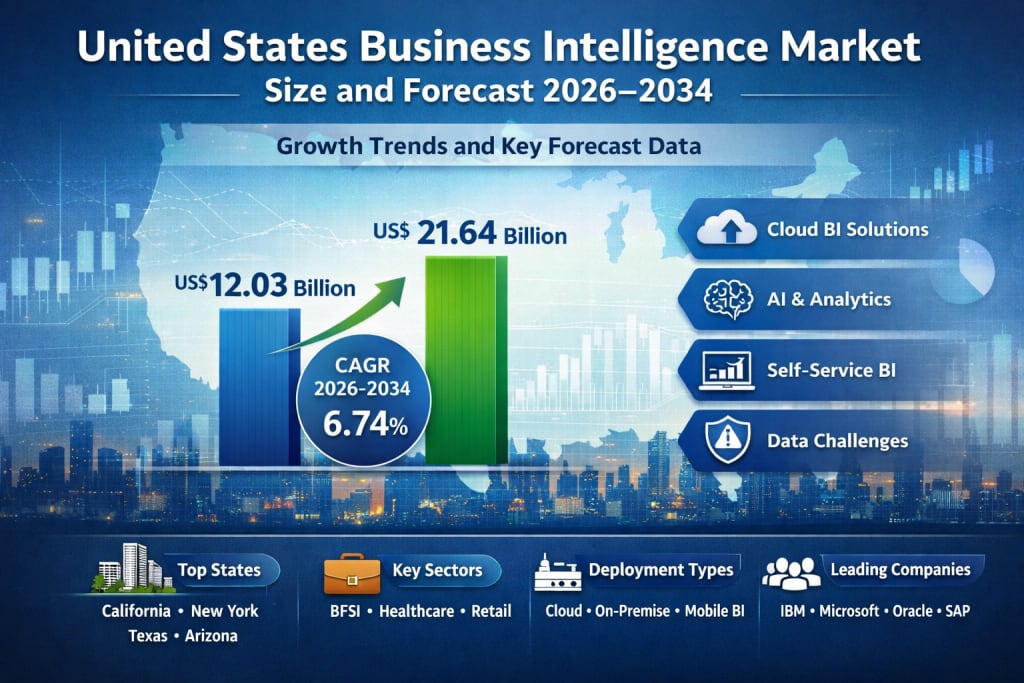
The United States Business Intelligence (BI) market is undergoing a pivotal transformation as organizations increasingly rely on data-driven strategies to navigate complexity, competition, and rapid digital change. According to Renub Research, the U.S. Business Intelligence market is projected to expand from US$ 12.03 Billion in 2025 to US$ 21.64 Billion by 2034, registering a compound annual growth rate (CAGR) of 6.74% during the forecast period 2026–2034.
This sustained expansion reflects a structural shift in how enterprises capture, analyze, and monetize data. With cloud-based platforms, artificial intelligence (AI), and self-service analytics reshaping traditional reporting models, business intelligence has evolved from a back-office support function into a core strategic capability. Across industries such as finance, healthcare, retail, manufacturing, government, and technology, BI platforms now play a central role in real-time decision-making, performance optimization, and competitive positioning.
United States Business Intelligence Market Outlook
Business Intelligence refers to a broad set of technologies, tools, and methodologies that enable organizations to collect, process, analyze, and visualize data for informed decision-making. BI systems support critical functions such as data mining, performance measurement, forecasting, trend analysis, and operational reporting.
In the United States, BI adoption has accelerated significantly as enterprises transition toward data-centric business models. The rapid growth of digital transactions, online platforms, IoT deployments, and enterprise applications has generated unprecedented volumes of structured and unstructured data. Traditional reporting systems can no longer keep pace with the velocity and complexity of this data, making advanced BI platforms essential.
Modern BI solutions increasingly integrate cloud computing, artificial intelligence, and machine learning, enabling predictive analytics, automation, and near real-time insights. As data becomes a strategic asset, business intelligence is no longer optional—it is foundational to enterprise resilience and long-term growth in the U.S. market.
Growth Drivers of the United States Business Intelligence Market
Enterprise Data Explosion and Demand for Real-Time Analysis
The exponential increase in enterprise data is one of the most significant drivers of BI adoption in the United States. Organizations generate massive data volumes from ERP systems, CRM platforms, financial transactions, IoT devices, and digital communications. Managing this data effectively requires scalable and intelligent analytics solutions.
Business intelligence platforms enable organizations to consolidate data sources into unified dashboards, automate reporting, and generate forward-looking insights. Executives and managers increasingly rely on BI to support operational monitoring, customer behavior analysis, supply chain optimization, and financial forecasting.
In October 2025, Microsoft introduced enhanced AI-powered capabilities within Power BI to simplify data analysis and automate insight generation. This development highlights a broader industry trend toward embedding AI directly into BI platforms to improve accessibility, user engagement, and decision velocity.
Digital Transformation and Enterprise Automation Initiatives
Digital transformation remains a major catalyst for BI market growth in the United States. Organizations across industries are modernizing legacy IT infrastructure, migrating workloads to the cloud, and automating core business processes. Business intelligence serves as the analytical backbone of these initiatives, enabling enterprises to measure performance, track key performance indicators (KPIs), and quantify digital ROI.
BI tools are deeply embedded in finance, marketing, human resources, and operations, offering near real-time insights into business performance. Advanced BI platforms integrated with AI, machine learning, and robotic process automation (RPA) support sophisticated use cases such as anomaly detection, predictive modeling, and scenario forecasting.
In July 2024, Deloitte announced a multi-year strategic alliance with Amazon Web Services, strengthening capabilities in generative AI, data analytics, and cloud-based intelligence solutions. Such collaborations underscore the strategic role of BI within enterprise digital ecosystems.
Rising Adoption of Self-Service Analytics
Self-service analytics is transforming BI consumption patterns across U.S. enterprises. Modern BI platforms empower business users—rather than IT teams—to create dashboards, generate reports, and analyze data independently. This democratization of analytics accelerates decision-making and promotes a data-driven organizational culture.
Sales teams analyze performance metrics in real time, marketing professionals optimize campaigns instantly, and operations managers monitor efficiency without technical bottlenecks. Advances in data visualization, natural language queries, and AI-driven recommendations continue to reduce the technical barrier to BI adoption.
In August 2025, Oracle expanded its cloud analytics capabilities, reinforcing its commitment to scalable, self-service BI solutions. Such developments reflect growing enterprise demand for flexible, user-friendly analytics platforms.
Challenges Facing the United States Business Intelligence Market
Data Integration and Data Quality Complexity
Despite technological advancements, data integration remains a critical challenge for BI adoption. U.S. organizations often manage fragmented data across on-premise systems, cloud environments, and third-party applications. Data silos, inconsistent standards, duplication, and missing records undermine analytics accuracy.
Addressing these challenges often requires expensive middleware, complex integration projects, and strong governance frameworks. Smaller enterprises, in particular, face resource constraints that limit their ability to fully leverage BI solutions. Without reliable data quality and integration, the value of BI insights remains constrained.
High Implementation Costs and Skills Shortages
While cloud-based BI tools have reduced entry barriers, enterprise-scale BI deployments still involve significant costs related to infrastructure, customization, and integration. In addition, there is an ongoing shortage of skilled BI developers, data engineers, and analytics professionals in the U.S. labor market.
Talent gaps can delay implementation, limit system utilization, and reduce overall return on investment. Although low-code and automated BI platforms are easing some of these constraints, cost and skills challenges continue to influence adoption, particularly among small and mid-sized enterprises.
United States Cloud Business Intelligence Market
Cloud BI represents the fastest-growing segment within the U.S. BI market. Organizations favor cloud-based platforms due to scalability, cost efficiency, rapid deployment, and seamless integration with SaaS applications such as CRM and ERP systems.
Cloud BI supports remote and hybrid work models by enabling secure, anytime access to analytics dashboards. Automatic updates, elastic storage, and AI-powered enhancements reduce the burden on internal IT teams. Subscription-based pricing further expands accessibility for mid-sized and growing enterprises.
Although data security and compliance remain concerns in regulated industries, cloud BI continues to dominate new deployments and serves as the primary growth engine of the U.S. business intelligence ecosystem.
United States Mobile Business Intelligence Market
Mobile BI extends analytics capabilities to smartphones and tablets, supporting field operations and decentralized decision-making. Sales teams monitor pipelines, logistics managers track shipments, and healthcare administrators review patient metrics on mobile devices.
Features such as push notifications, geo-location analytics, and offline access improve responsiveness and productivity. While challenges remain around security, interface limitations, and device compatibility, expanding 5G connectivity and mobile-first business models will continue to drive mobile BI adoption across the United States.
On-Premise Business Intelligence Market in the United States
On-premise BI remains relevant in highly regulated industries such as government, defense, healthcare, and financial services. These organizations prioritize data sovereignty, compliance, and direct control over analytics infrastructure.
Although on-premise deployments involve higher capital investment and longer implementation cycles, they continue to generate steady demand through system upgrades and hybrid BI architectures. Security-driven requirements ensure that on-premise BI retains a strategic role within mission-critical U.S. industries.
Large Enterprise Business Intelligence Market
Large enterprises represent the largest revenue-contributing segment of the U.S. BI market. These organizations deploy BI platforms across multiple departments, geographies, and customer segments to support strategic planning, risk management, and executive reporting.
Enterprise BI requires high-performance data processing, advanced visualization, predictive analytics, and robust governance frameworks. As corporations increasingly adopt enterprise-wide data strategies, BI platforms function as centralized decision-support systems driving sustained investment.
BFSI Business Intelligence Market in the United States
The BFSI sector is among the most data-intensive adopters of BI in the U.S. Financial institutions rely on BI for fraud detection, credit risk modeling, regulatory reporting, and customer segmentation. Real-time analytics enhance operational efficiency while supporting personalized digital banking experiences.
With rising competition from fintech firms and increasing regulatory scrutiny, BI remains a mission-critical technology for BFSI organizations seeking innovation, compliance, and competitive differentiation.
Healthcare Business Intelligence Market in the United States
Healthcare BI adoption is driven by clinical optimization, cost control, and regulatory compliance. Providers and payers use BI to analyze patient outcomes, predict readmissions, optimize staffing, and manage population health trends.
While data integration from electronic health records and billing systems remains complex, BI is becoming increasingly strategic as healthcare organizations pursue value-based care and operational efficiency.
State-Level Business Intelligence Market Overview
California leads the U.S. BI market due to strong technology ecosystems, cloud adoption, and AI innovation.
New York remains analytics-intensive, driven by BFSI, media, and healthcare sectors.
Texas is a fast-growing BI market supported by energy, manufacturing, healthcare, and logistics industries.
Arizona represents an emerging BI market fueled by healthcare expansion, manufacturing growth, and business migration.
Market Segmentation Overview
By Technology: Cloud BI, Mobile BI, Social BI
By Deployment: Cloud, On-Premise
By Enterprise Size: Large Enterprises, SMEs
By End Use: BFSI, IT & Telecom, Manufacturing, Retail, Healthcare, Others
By Geography: Major U.S. states including California, Texas, New York, Florida, and others
Key Companies Covered
IBM Corporation
Microsoft
Oracle
Sisense Ltd
QlikTech International AB
SAP SE
Board International
MicroStrategy Incorporated
(All companies analyzed across five viewpoints: overview, key personnel, recent developments, SWOT analysis, and revenue performance.)
Final Thoughts
The United States Business Intelligence market is set for steady and sustained growth through 2034, supported by cloud adoption, AI-powered analytics, and enterprise digital transformation. As organizations increasingly depend on real-time, data-driven insights, BI platforms will continue to evolve as strategic assets rather than operational tools.
While challenges related to data integration, costs, and talent shortages persist, ongoing innovation and platform democratization are expanding BI accessibility across enterprises of all sizes. In an economy defined by data intensity and digital competition, business intelligence will remain central to how U.S. organizations plan, perform, and prosper.
About the Creator
Keep reading
More stories from shibansh kumar and writers in The Swamp and other communities.
Germany Silicon Carbide (SiC) Wafer Market Size & Forecast 2025–2034
Introduction The Germany Silicon Carbide (SiC) Wafer Market is entering a decisive growth phase as the country accelerates electrification, clean-energy deployment, and advanced semiconductor manufacturing. According to Renub Research, the market was valued at US$ 48.49 million in 2025 and is projected to grow at a compound annual growth rate (CAGR) of 12.41% between 2026 and 2034, reaching US$ 138.96 million by 2034.
By shibansh kumarabout 12 hours ago in Trader
Nigerian Farmers Speak Out on How Climate Change Is Hitting Staple Food Crops — and What Can Help
Across Nigeria’s farmlands — from the dry expanses of the north to the wetter soils of the south — farmers are confronting a stark new reality: climate change is reshaping the landscape of food production and threatening the country’s ability to feed itself. For millions of smallholder farmers who grow staple crops like maize, cassava, rice, millet, sorghum and yam, erratic weather, prolonged droughts and sudden floods are no longer distant predictions — they are everyday challenges that jeopardize harvests, incomes and food security.
By Salaar Jamali4 days ago in The Swamp
Russia Is Trying to Bomb and Freeze Ukrainians Into Submission, EU Warns
Attacks on energy infrastructure raise humanitarian and security concerns across Europe The European Union’s foreign policy chief has warned that Russia is attempting to break Ukraine’s resistance by targeting both cities and essential energy systems, leaving civilians exposed to cold, darkness, and fear. The strategy, described as an effort to “bomb and freeze” Ukrainians into submission, has renewed concerns about the humanitarian impact of the war as winter deepens. As missile and drone strikes continue to hit power plants, heating systems, and water facilities, millions of Ukrainians face daily challenges that go far beyond the battlefield. European leaders say the attacks highlight the urgent need for continued international support for Ukraine. A Strategy Beyond the Front Lines Military analysts say the focus on energy infrastructure marks a shift toward psychological and civilian pressure rather than purely military targets. By disrupting electricity and heating, Russia appears to be aiming to weaken morale and strain Ukraine’s ability to function as winter temperatures drop. Homes without heat, hospitals relying on generators, and communities facing rolling blackouts create conditions that affect every aspect of daily life. EU officials argue that such tactics are designed to exhaust the population and force political concessions. Winter as a Weapon Cold weather has become a major factor in the conflict. In many parts of Ukraine, winter temperatures fall well below freezing. Without reliable electricity and heating, families struggle to stay warm, cook food, and access clean water. Humanitarian organizations report increased risks of: Hypothermia among vulnerable groups Disrupted medical services Food supply challenges Displacement as families seek safer areas European leaders say using winter conditions as leverage raises serious ethical and legal questions under international humanitarian law. Impact on Civilians The civilian toll continues to grow. While air defense systems have intercepted many incoming attacks, enough strikes still get through to cause widespread disruption. Parents worry about keeping children warm. Elderly residents face isolation and health risks. Schools are forced to close or operate remotely. For many Ukrainians, daily survival has become as much about enduring the cold as avoiding explosions. The EU’s foreign policy chief emphasized that targeting civilian infrastructure does not weaken military forces alone—it directly harms ordinary people. Europe’s Response In response to the ongoing attacks, the European Union has: Increased humanitarian aid deliveries Supplied generators and emergency heating equipment Expanded energy infrastructure support Continued military and financial assistance to Ukraine EU officials stress that helping Ukraine restore power quickly is critical not only for comfort but for national resilience. Keeping lights on and homes heated sends a message that the country cannot be easily broken. Broader Security Concerns European leaders warn that the conflict’s effects extend beyond Ukraine’s borders. Energy instability, refugee flows, and regional security risks affect the entire continent. There is also concern that allowing attacks on civilian infrastructure to succeed could set a dangerous precedent. EU officials argue that failure to respond firmly may encourage similar tactics in future conflicts elsewhere. International Law and Accountability Human rights groups continue to document damage to civilian infrastructure, gathering evidence for potential future investigations. Attacks that deliberately target civilian populations or essential services may violate international law. The EU has repeatedly called for accountability, stating that those responsible for targeting civilians must face consequences. While legal processes take time, documentation remains a priority. Ukraine’s Resilience Despite the pressure, Ukrainian officials highlight the country’s resilience. Engineers work around the clock to repair power lines. Communities share generators. Volunteers deliver supplies to the most vulnerable. This resilience, European leaders say, is one reason the strategy of freezing civilians into submission has not achieved its intended effect. The Road Ahead As winter continues, the situation remains fragile. The EU warns that continued attacks on energy infrastructure could worsen humanitarian conditions if support slows or repairs fall behind. European leaders insist that sustained assistance is essential. They argue that helping Ukraine endure winter conditions is not just about survival, but about defending the principle that civilians should never be used as tools of war. Conclusion The EU’s warning that Russia is trying to bomb and freeze Ukrainians into submission underscores the changing nature of modern conflict. By targeting energy systems and civilian infrastructure, the war has expanded far beyond the front lines. As winter tightens its grip, the humanitarian stakes continue to rise. European leaders maintain that supporting Ukraine through this period is critical—not only for the country’s survival, but for upholding international norms that protect civilians during war.
By Fiaz Ahmed 4 days ago in The Swamp
Trouble at the Tea Leafing Café
The rain had started right around the time that Annie was buttering her second thick slice of homemade toast for breakfast, and hadn’t paused since. Not that anyone could tell. The windows of the café were fogged over, and with every seat filled with happy customers munching on fresh baked pastries or steaming bowls of the delicious soup of the day, it was hardly surprising. Annie looked around the room, finally taking a moment to breathe after the lunch time rush. Her old life already felt like a bad memory, a part of her history, always, but just that. History.
By Hannah Moore3 days ago in Fiction



Comments
There are no comments for this story
Be the first to respond and start the conversation.