
Trump Floats New Retirement Benefit for 54 Million Workers
Proposal Signals Renewed Focus on Social Security and Middle-Class Economic Security


Former U.S. President Donald Trump has floated a new retirement benefit proposal that he claims could impact as many as 54 million American workers. The idea, still in its early stages, signals a renewed emphasis on retirement security and middle-class financial stability—an issue that continues to resonate deeply with voters across the political spectrum.
While details remain limited, the proposal reportedly aims to expand financial support mechanisms tied to retirement savings, Social Security, or tax incentives for older workers. The announcement has already sparked debate among policymakers, economists, and advocacy groups, who are weighing the potential fiscal and political implications.
The Context: Retirement Anxiety in America
Retirement security remains a pressing concern in the United States. Rising living costs, inflationary pressures, and longer life expectancy have placed additional strain on both public systems and private savings. Many Americans approaching retirement worry that existing benefits may not be sufficient to cover healthcare, housing, and daily expenses.
Programs like Social Security Administration have long served as the backbone of retirement income for millions. However, projections have warned that without reforms, Social Security trust funds could face shortfalls in the coming decades.
Trump’s floated proposal appears designed to address these concerns, potentially positioning retirement reform as a central issue in upcoming policy debates.
What the Proposal Could Involve
Although formal legislative language has not yet been introduced, analysts suggest several possible components:
Expanded tax deductions for retirement savings
Enhanced Social Security payments for certain income brackets
Incentives for delayed retirement
A new federal savings mechanism tailored to middle-income earners
Trump has previously advocated for protecting Social Security from benefit cuts, even as some lawmakers in both parties have debated restructuring options. If structured as an expansion rather than a reform, the proposal could appeal to older voters and working-class households concerned about long-term stability.
Economic Implications
Any large-scale retirement benefit affecting 54 million workers would carry significant fiscal implications. Expanding benefits or introducing new incentives would require federal funding, potentially increasing budgetary pressures unless offset by spending reductions or revenue increases elsewhere.
Economists caution that without careful planning, new benefits could widen federal deficits. At the same time, supporters argue that strengthening retirement income can stimulate economic activity by increasing consumer spending among retirees.
The debate also touches on broader economic themes such as workforce participation. Incentivizing delayed retirement could help mitigate labor shortages, while enhanced benefits might provide financial security that allows older Americans to exit the workforce with dignity.
Political Dimensions
Retirement policy has long been a politically sensitive issue. Social Security, in particular, is often described as a “third rail” of American politics—touching it can carry electoral risks.
Trump’s move could signal a strategy to consolidate support among older voters, a demographic that plays a pivotal role in national elections. By proposing a benefit expansion rather than reform measures perceived as cuts, the initiative may aim to distinguish his platform from austerity-focused proposals.
Democratic leaders have also emphasized protecting and expanding retirement benefits, setting the stage for bipartisan competition over who can offer the most appealing plan to American workers.
Reactions from Policy Experts
Policy analysts have responded cautiously, noting that any new retirement benefit must address long-term sustainability. The financial health of the Social Security system is already under scrutiny, and additional obligations could accelerate funding challenges.
Some experts argue that reforms should focus on structural adjustments—such as payroll tax modifications or benefit formula recalculations—rather than expansions. Others believe that economic growth and productivity gains could offset increased expenditures if managed effectively.
Labor organizations and retiree advocacy groups have largely welcomed discussions centered on benefit protection, though they emphasize the need for clarity and detailed policy frameworks.
Broader Retirement Reform Landscape
The conversation around retirement benefits extends beyond Social Security. Private retirement accounts, such as 401(k) plans and Individual Retirement Accounts (IRAs), form a critical component of many Americans’ retirement strategies. However, access to employer-sponsored retirement plans remains uneven, particularly among small businesses and gig economy workers.
If Trump’s proposal incorporates new federal savings tools or tax credits, it could potentially address gaps in coverage. Expanding retirement plan accessibility has bipartisan appeal, particularly in an economy where traditional pension systems have largely disappeared.
Challenges Ahead
Turning a floated proposal into enacted policy would require congressional approval. Given the polarized nature of Washington politics, achieving consensus on retirement expansion could prove challenging.
Budgetary constraints, competing legislative priorities, and debates over tax policy are likely to shape the trajectory of any proposed benefit. Additionally, actuarial assessments would be needed to evaluate long-term solvency impacts.
Transparency and detailed cost projections will be essential in determining whether the initiative gains traction.
Conclusion
The idea floated by Donald Trump to introduce a new retirement benefit for 54 million workers has reignited discussion about the future of retirement security in the United States. While specifics remain unclear, the proposal underscores growing concern over financial stability for aging Americans.
As policymakers evaluate the economic and fiscal implications, retirement reform is poised to remain a central topic in national discourse. Whether through expanded benefits, tax incentives, or structural adjustments, the debate reflects a broader recognition that retirement security is not merely a policy issue—but a cornerstone of economic dignity for millions of workers.
In the months ahead, further details will determine whether this proposal evolves into actionable legislation or remains part of a broader campaign narrative surrounding economic protection and middle-class support.
About the Creator
Asad Ali
I'm Asad Ali, a passionate blogger with 3 years of experience creating engaging and informative content across various niches. I specialize in crafting SEO-friendly articles that drive traffic and deliver value to readers.
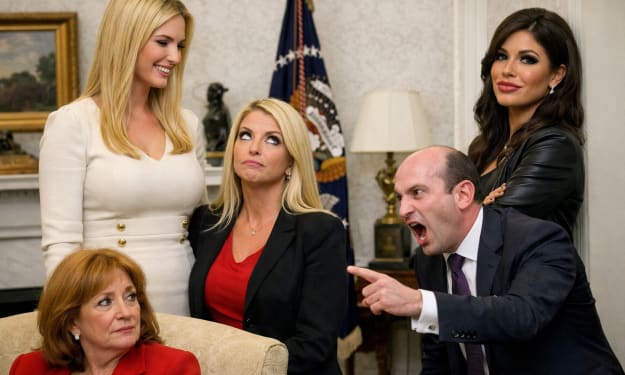
A Gathering of Evil Bosses
“I’m the queen of chin jutting while I smooth my hair, attacking, insulting, and deflecting to protect my appointer.” “Oh, please, Blondi, my hair is curled, highlighted, and longer than yours. I feature television commercials telling immigrants that we will give them a free plane ride home, and if they voluntarily turn themselves in, they will be allowed to legally apply for re-entry. It runs everywhere, and I look good in it! You can’t compete because of your blond hair. Mine is nicer, and my lips are prettier than yours.”
By Andrea Corwin 8 days ago in The Swamp



Comments
There are no comments for this story
Be the first to respond and start the conversation.