
The World’s Most Import-Dependent Countries, Ranked
A closer look at the nations that rely most heavily on foreign goods—and what that dependence means for their economies and global stability.

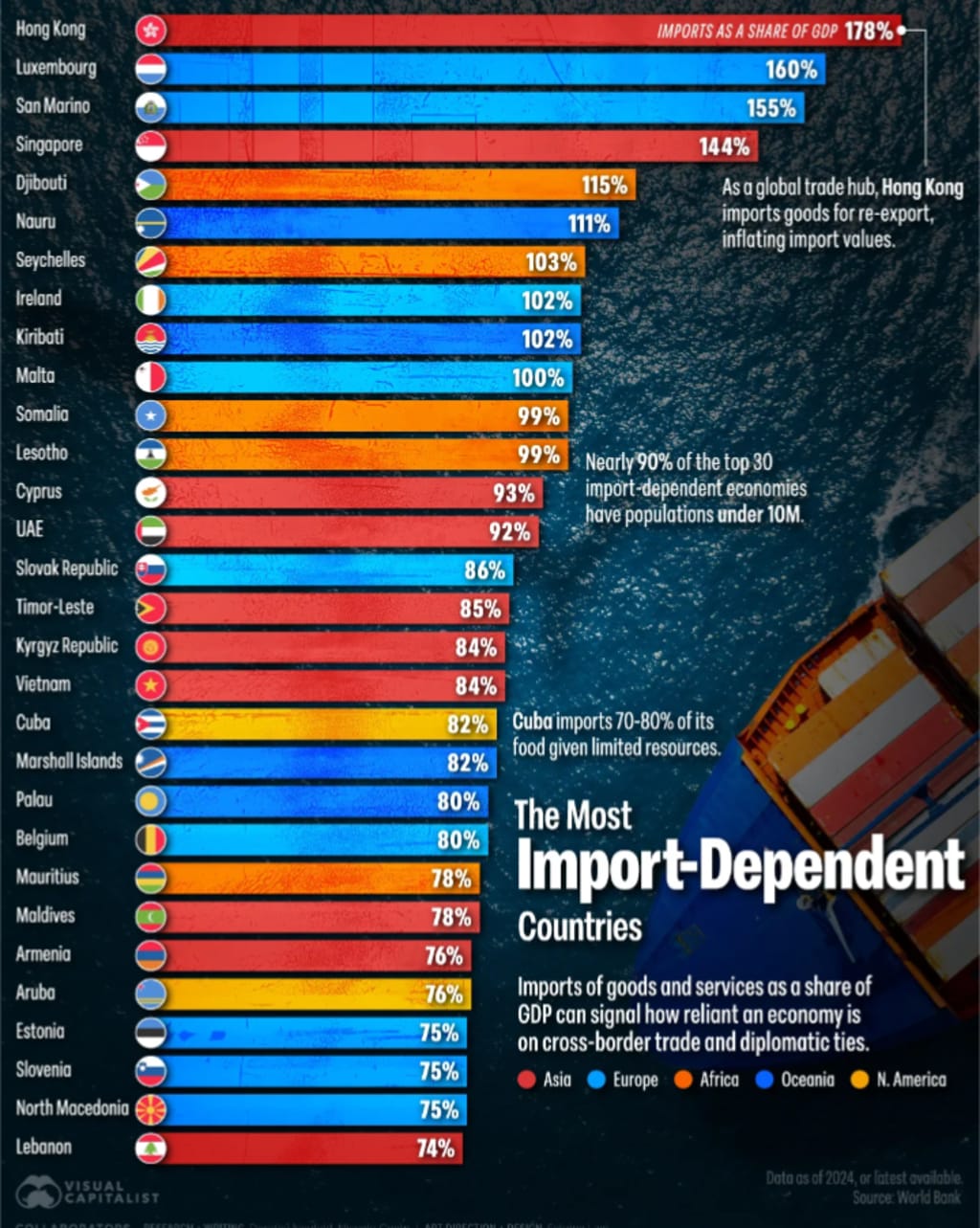
In today’s interconnected global economy, few countries can survive without imports. From food and fuel to technology and raw materials, international trade keeps modern societies functioning. However, some nations rely on imports far more than others. These highly import-dependent countries depend on foreign suppliers for essential goods, making them especially vulnerable to global disruptions such as wars, pandemics, supply chain breakdowns, and inflation shocks.
Understanding which countries are the most import-dependent helps reveal how fragile certain economies can be—and how deeply globalization shapes everyday life. These rankings are typically measured by comparing the value of imports to a country’s Gross Domestic Product (GDP). The higher the percentage, the more dependent the country is on foreign goods and services.
Why Import Dependence Matters
Import dependence is not necessarily a sign of weakness. In many cases, it reflects a country’s economic structure. Small nations with limited natural resources often specialize in finance, tourism, or services while importing food, energy, and manufactured goods.
However, high dependence also creates risk. Rising fuel prices, shipping delays, or geopolitical conflicts can quickly translate into shortages and higher costs for consumers. The COVID-19 pandemic and recent global conflicts exposed just how vulnerable import-heavy economies can be when supply chains are interrupted.
1. Luxembourg
Luxembourg consistently ranks as one of the world’s most import-dependent countries. With a small land area and limited agricultural or industrial production, the country relies heavily on imports for food, fuel, and manufactured goods.
Its strong financial services sector allows Luxembourg to afford these imports, but its dependence makes it sensitive to European supply chain disruptions. Despite this, its high-income economy and strategic location within the EU help mitigate major risks.
2. Singapore
Singapore is a classic example of a nation built on trade. With almost no natural resources and minimal farmland, the city-state imports nearly everything—from food to water to energy.
Yet Singapore has turned this dependence into strength. Its world-class ports, logistics systems, and free trade policies make it one of the most important trading hubs on Earth. Still, its reliance on imports means that regional instability or shipping disruptions could have immediate economic consequences.
3. Malta
Malta’s small size and limited natural resources make it heavily reliant on imports for energy, food, and industrial goods. Tourism and services dominate its economy, leaving little domestic production to meet internal demand.
Fluctuating fuel prices and shipping costs have a significant impact on Malta’s inflation rates, showing how import dependence directly affects everyday living expenses.
4. Cyprus
Cyprus imports most of its energy and consumer goods. As an island nation, it depends heavily on maritime trade routes. Political tensions in surrounding regions can increase uncertainty and transportation costs, making the country vulnerable to external shocks.
While Cyprus has diversified its economy through tourism and financial services, its heavy reliance on imports remains a structural challenge.
5. Ireland
Ireland’s economy is export-driven, especially in pharmaceuticals and technology, but it is also highly import-dependent. The country imports most of its energy and many consumer goods.
Because Ireland hosts many multinational corporations, trade flows in and out of the country are enormous compared to its population size. This creates a unique scenario where both imports and exports represent very large shares of GDP.
6. The Netherlands
The Netherlands is one of Europe’s largest trading hubs. Rotterdam, the largest port in Europe, handles massive volumes of imports that are later distributed across the continent.
While the country produces food and manufactured goods domestically, it still depends heavily on imported energy, raw materials, and industrial inputs. Its economy thrives on being a gateway for global trade.
7. Belgium
Belgium’s economy is tightly linked to international trade. With limited natural resources, it relies on imports of fuel, minerals, and industrial components.
Like the Netherlands, Belgium’s ports and logistics infrastructure make it a central player in European supply chains. Any disruption in global shipping quickly affects domestic industries.
8. Japan
Japan is one of the most technologically advanced countries in the world, yet it imports nearly all of its fossil fuels and many raw materials. Its mountainous terrain and lack of energy resources make it dependent on foreign suppliers.
After the Fukushima nuclear disaster, Japan’s reliance on imported energy increased even further, highlighting the risks of energy insecurity in import-dependent economies.
9. South Korea
South Korea’s manufacturing powerhouse relies heavily on imported oil, gas, and raw materials to fuel its industries. Electronics, automobiles, and shipbuilding all depend on global supply chains.
This makes South Korea sensitive to fluctuations in global energy prices and trade tensions between major powers.
10. United Arab Emirates
Despite its oil wealth, the UAE imports most of its food and many consumer goods. Harsh desert conditions limit agricultural production, forcing reliance on international suppliers.
The UAE has invested heavily in food security initiatives and logistics hubs to reduce risk, but import dependence remains a defining feature of its economy.
The Risks of High Import Dependence
Countries that rely heavily on imports face several challenges:
Price vulnerability: Global inflation quickly affects domestic markets.
Supply chain disruptions: Wars, pandemics, and shipping bottlenecks cause shortages.
Currency risk: A weaker national currency makes imports more expensive.
Political leverage: Supplier nations can gain influence over dependent countries.
These risks have pushed many governments to rethink their trade strategies and invest in domestic production or regional supply chains.
A Changing Global Trade Landscape
In recent years, nations have begun prioritizing resilience over efficiency. Policies encouraging local manufacturing, renewable energy, and food security aim to reduce overreliance on imports.
However, full independence is unrealistic. Global trade remains essential, especially for small and resource-poor nations. The challenge lies in balancing openness with preparedness.
Final Thoughts
The world’s most import-dependent countries highlight both the power and fragility of globalization. While trade allows nations to thrive beyond their natural limitations, it also ties their fortunes to distant markets and political events.
As climate change, geopolitical tensions, and economic uncertainty reshape global commerce, understanding import dependence becomes more important than ever. These rankings serve as a reminder that in today’s world, economic survival is rarely achieved alone—it is built through networks of cooperation, exchange, and trust across borders.
About the Creator
Sajida Sikandar
Hi, I’m Sajida Sikandar, a passionate blogger with 3 years of experience in crafting engaging and insightful content. Join me as I share my thoughts, stories, and ideas on a variety of topics that matter to you.
Keep reading
More stories from Sajida Sikandar and writers in The Swamp and other communities.
Iran Wants to Change Venue and Format of Nuclear Talks With the U.S., Axios Reports
Diplomacy is often shaped not only by what is discussed, but also by where and how discussions take place. According to a recent Axios report, Iran has requested changes to both the venue and the format of its upcoming nuclear talks with the United States. This move has drawn international attention, as it signals a shift in Iran’s diplomatic strategy and raises questions about the future of negotiations aimed at preventing further nuclear escalation.
By Sajida Sikandara day ago in The Swamp
Why Black History Matters in America?
The United States of America is celebrating their 250th anniversary in 2026. I'm proud to be an American and as someone who was born here, I wouldn't imagine myself living anywhere else. This is a country where opportunities are possible. Where anyone can be successful in anything they desire to do. Equality, community, and togetherness are the backbones of what America is and should be about. However, we have an administration who wants to erase and disregard those who have made positive, meaningful impacts in our country, specifically Black figures, such as Martin Luther King, Jr., Rosa Parks, and Maya Angelou. President Trump and his administration have been constantly complaining and fighting against what they call the "Woke agenda". They use this excuse as a distraction from other issues they refuse to address, such as the high cost of living, climate change, and inflation. That equality is dividing America, when in reality, it's bringing us together. Being woke is not tied to a specific political party. No matter where you stand on the political spectrum, you can still care about other people and their plights. Compassion and empathy for others isn't tied to a political party, either. We were taught as children to treat others the way we want to be treated and not judge others because they're different from us. Caring about others isn't a personal attack on your beliefs. It doesn't make you any less of a person. People who are easily offended over African American figures, past or present, or anything related to it, are grasping at straws. Current and future generations need to know who people like Harriet Tubman and Shirley Chisholm were, especially in the classroom. Black History is part of American History. It should be recognized, not hidden or forgotten. Besides, you can't shield children from everything, just because your feelings are easily hurt.
By Mark Wesley Pritchard 3 days ago in The Swamp
melinda gates
Melinda Gates, widely known as Melinda French Gates, has long been recognized as one of the most influential philanthropists of the modern era. While many first learned her name through her marriage to Microsoft co-founder Bill Gates, her identity and impact extend far beyond that association. Over the years, Melinda Gates has built a reputation grounded in leadership, advocacy for women, and a deep commitment to global health and social equity. In recent times, however, public discussions around the Bill Gates Epstein files have added a new layer of attention to her personal and professional journey.
By Saboor Brohi about 23 hours ago in The Swamp
Off the Book
It ended like every other stupid idea. Badly, and alone. I’m researching digital confession ethics, he said. A tech ethicist. He gestured at floating data I couldn’t see then pulled out a physical notebook. Actual paper, fountain pen. He held it up like he was showing me scripture.
By Nicky Frankly6 days ago in Fiction




Comments
There are no comments for this story
Be the first to respond and start the conversation.