
The Top 25 U.S Defense Contractors Driving the Military-Industrial Complex
Inside the military-industrial complex: the corporations shaping U.S. wars, budgets, and foreign policy.

This article was assisted by AI for research and drafting purposes. All views are presented by DJ for Change, aiming to break down the hidden systems that shape our world.
Introduction: The Money Machine of War
The military-industrial complex (MIC)—a term first warned about by President Dwight D. Eisenhower in 1961—refers to the tight relationship between the U.S. government, the Pentagon, and the corporations that profit from endless war and military spending. The U.S. spends more on defense than the next 10 countries combined—over $850 billion annually in recent years.
Behind those budgets are the corporations. Some build jets and bombs, some make IT networks, and others profit from logistics and private contracting. Below is a breakdown of the 25 most influential defense contractors, their impact across decades, and how much money flows through their doors.
The Top 25 U.S. Defense Contractors
1. Lockheed Martin
Revenue: ~$67 billion in 2023, ~70% from defense contracts.
Key Products: F-35 fighter jet, Black Hawk helicopters, missile defense systems.
Impact: The #1 contractor for decades. Lockheed Martin defines modern U.S. air power. The F-35 alone is projected to cost $1.7 trillion over its lifetime—the single most expensive weapons program in history.
2. Raytheon Technologies (RTX)
Revenue: ~$69 billion in 2023 (merged with United Technologies in 2020).
Key Products: Patriot missiles, Tomahawk cruise missiles, radar, jet engines.
Impact: Heavily involved in U.S. wars in Iraq, Afghanistan, and Ukraine. Its missiles are “the product of choice” whenever Washington authorizes strikes abroad.
3. Boeing Defense, Space & Security
Revenue: ~$24 billion defense segment (2023).
Key Products: F/A-18 Super Hornet, Apache helicopter, KC-46 tanker, satellites.
Impact: Once Lockheed’s rival for dominance, Boeing shifted focus to commercial aviation but remains a defense giant.
4. Northrop Grumman
Revenue: ~$36 billion defense.
Key Products: B-2 and B-21 stealth bombers, drones (Global Hawk), nuclear modernization.
Impact: Major player in Cold War nuclear strategy, now leading U.S. nuclear modernization with the Ground Based Strategic Deterrent (ICBMs).
5. General Dynamics
Revenue: ~$42 billion (2023), half defense.
Key Products: M1 Abrams tank, Virginia-class submarines, Gulfstream jets.
Impact: Dominates armored vehicles and nuclear submarine construction—pillars of U.S. land and sea power.
6. BAE Systems (U.S. subsidiary of UK giant)
Revenue: ~$25 billion in U.S. contracts.
Key Products: Bradley Fighting Vehicle, artillery, naval guns.
Impact: Shows how “foreign” defense companies become integrated into the U.S. MIC.
7. L3Harris Technologies
Revenue: ~$19 billion defense.
Key Products: Communications, avionics, surveillance.
Impact: Key in military electronics, mergers in 2019 created this giant.
8. Huntington Ingalls Industries (HII)
Revenue: ~$11 billion.
Key Products: U.S. Navy aircraft carriers and amphibious assault ships.
Impact: Without them, no aircraft carriers exist—vital for U.S. global dominance.
9. Textron
Revenue: ~$13 billion, ~40% defense.
Key Products: Bell helicopters, drones, armored vehicles.
Impact: Supplier of helicopters used in Vietnam through today.
10. Leidos
Revenue: ~$15 billion.
Key Products: IT services, cyber defense, surveillance.
Impact: Example of defense contractors moving from hardware to digital warfare.
Other Major Players (11–25)
SAIC (Science Applications International Corp.) – Cyber, IT, and consulting.
DynCorp (acquired by Amentum) – Private contracting, logistics, training.
Bechtel – Construction for military bases and nuclear facilities.
CACI International – Intelligence, data, and surveillance tech.
ManTech – Cybersecurity and federal IT.
Peraton – Space, intelligence, cyber operations.
Kratos Defense – Drone and space tech.
Aerojet Rocketdyne (now owned by LMT) – Rocket engines, missiles.
KBR, Inc. – Logistics powerhouse, tied to Iraq/Afghanistan wars.
Parsons Corp. – Military engineering, space.
VSE Corp. – Maintenance and logistics for military fleets.
Amentum – Spinout of AECOM’s government services, big in logistics.
Booz Allen Hamilton – Consulting, intelligence analysis, contractor for NSA.
Jacobs Engineering – Military infrastructure and nuclear support.
Fluor Corp. – Construction and energy infrastructure for defense.
Historical Impact by Era
Mid-20th Century (1940s–1970s):
Boeing (B-52), General Dynamics (nuclear subs), Northrop (stealth development).
These giants created the backbone of Cold War nuclear deterrence.
Post-9/11 Era (2001–2015):
Halliburton/KBR, DynCorp, and Fluor profited massively from Iraq and Afghanistan.
Logistics and private security contracts exploded.
Last Decade (2013–2023):
Lockheed’s F-35, Raytheon’s missiles, and Northrop’s B-21 bomber lead the way.
Cyber and IT firms like Booz Allen, Leidos, and CACI rise with surveillance and cyberwarfare contracts.
The Money Trail
Lockheed Martin: $46 billion in U.S. contracts in 2022.
Raytheon: $40 billion.
General Dynamics: $28 billion.
Northrop Grumman: $26 billion.
Boeing Defense: $22 billion.
The top 5 defense contractors alone take over 40% of the Pentagon’s contract spending.
Conclusion: The Business of War
The U.S. military-industrial complex is less a conspiracy than a well-oiled business machine. Corporations lobby, politicians approve budgets, and the Pentagon funnels money. Whether it’s an F-35 flying over Europe, a Patriot missile in the Middle East, or a surveillance network at home, these companies are the true pillars of American empire.
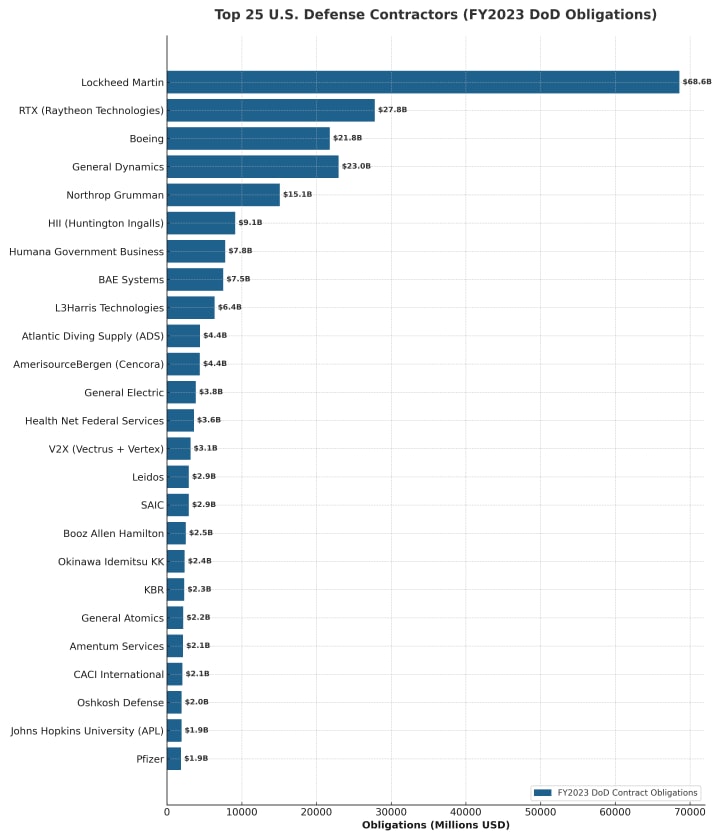
Top 25 U.S. Defense Contractors (by FY2023 DoD Obligations)
Methodology note: Ranked by U.S. Department of Defense prime contract obligations for FY2023 (latest comprehensive year), compiled from USAspending.gov by Forecast International. Figures are rounded to the nearest $ million.
Darley
# Company FY23 DoD Obligations Notable programs / roles (examples)
1 Lockheed Martin $68,590M F-35 Lightning II; PAC-3 MSE; Aegis/Trident missiles
2 RTX (Raytheon Technologies) $27,820M Patriot & NASAMS; AMRAAM; Tomahawk; P&W F135 engines
3 Boeing $21,790M KC-46 tanker; P-8A; F-15EX; Apache; MQ-25
4 General Dynamics $22,965M Virginia/Columbia-class subs (Electric Boat); M1 Abrams
5 Northrop Grumman $15,094M B-21 Raider; Sentinel (GBSD) ICBM; missile warning/space
6 HII (Huntington Ingalls) $9,130M Sole builder of U.S. Navy aircraft carriers; amphibs/sub work
7 Humana Government Business $7,780M TRICARE health services
8 BAE Systems (Inc./PLC) $7,530M Bradley IFV; M109 howitzer; naval guns; EW
9 L3Harris Technologies $6,373M Tactical radios; ISR avionics; space payloads
10 Atlantic Diving Supply (ADS) $4,424M Tactical gear & equipment distribution
11 AmerisourceBergen (Cencora) $4,392M Pharmaceuticals distribution for DoD
12 General Electric $3,845M Turboshaft/jet engines (e.g., T700/T901); avionics
13 Health Net Federal Services $3,601M TRICARE health services (West Region)
14 V2X (Vectrus + Vertex) $3,146M Base ops, aviation services, logistics
15 Leidos $2,919M IT/cyber; intel services; airborne ISR
16 SAIC $2,910M Enterprise IT, engineering, training
17 Booz Allen Hamilton $2,525M Cyber/AI, intel & defense consulting
18 Okinawa Idemitsu KK $2,359M Fuel supply in Japan
19 KBR $2,302M Logistics/base support; contingency ops
20 General Atomics $2,158M MQ-9 Reaper/Gray Eagle UAVs
21 Amentum Services $2,145M Maintenance, logistics, nuclear/DOE support
22 CACI International $2,070M C4ISR, EW, intel analytics
23 Oshkosh Defense $1,959M JLTV, tactical trucks
24 Johns Hopkins University (APL) $1,939M DoD FFRDC—missile defense, hypersonics R&D
25 Pfizer $1,866M Vaccines & pharmaceuticals
Source: Forecast International, Top 100 Defense Contractors 2023 (compiled from USAspending.gov).
Darley
Context on Defense News’ global defense-revenue list (separate metric) and its exclusion of medical/pharma firms is here.
Defense News
How to use the table (for your readers)
“Obligations” vs. “revenue”: These numbers are DoD contract dollars obligated in FY23, not total company revenue. For a global look by defense revenue, see the Defense News Top 100 (Lockheed, RTX, Northrop, GD, Boeing lead).
Defense News
Why health care & fuel appear: USAspending obligations include TRICARE (Humana, Health Net) and pharma/fuel distributors (AmerisourceBergen, Pfizer, Okinawa Idemitsu). That’s part of the modern MIC money flow, even if they don’t build weapons.
Darley
Shipbuilding note: HII is the sole builder of U.S. aircraft carriers; it also co-builds nuclear subs, which is why it ranks high even with fewer programs.
HII
About the Author: I’m DJ for Change, a writer and community-builder dedicated to exposing the systems that shape our lives—from war profiteering to local economies. I use AI tools to assist my writing, but every word is chosen to bring truth and clarity to the people.
About the Creator
DJ for Change
Remixing ideas into action. I write about real wealth, freedom tech, flipping the system, and community development. Tune in for truth, hustle, hacks, and vision, straight from the Capital District!
https://buymeacoffee.com/djforchange
Keep reading
More stories from DJ for Change and writers in The Swamp and other communities.
Shocking Truth Behind Why the IRS is Armed: A Deep Dive Into America's Civilian Control Strategy
Introduction to the Armed IRS Controversy In recent years, a peculiar question has sparked debate across the political spectrum: Why is the IRS armed? This seemingly bureaucratic agency, best known for collecting taxes and issuing refunds, has quietly amassed a well-trained, well-equipped law enforcement wing. For many Americans, the image of IRS agents with firearms feels out of place. But this reality isn't new—nor is it unfounded.
By DJ for Change7 months ago in The Swamp
A Gathering of Evil Bosses
“I’m the queen of chin jutting while I smooth my hair, attacking, insulting, and deflecting to protect my appointer.” “Oh, please, Blondi, my hair is curled, highlighted, and longer than yours. I feature television commercials telling immigrants that we will give them a free plane ride home, and if they voluntarily turn themselves in, they will be allowed to legally apply for re-entry. It runs everywhere, and I look good in it! You can’t compete because of your blond hair. Mine is nicer, and my lips are prettier than yours.”
By Andrea Corwin 7 days ago in The Swamp




Comments
There are no comments for this story
Be the first to respond and start the conversation.