
Sony’s 2026 Smartphone Just Changed My Mind About Upgrades Forever
I swore I was done chasing new phones, then Sony’s 2026 release hit me right where I actually live: in the gap between specs and real life

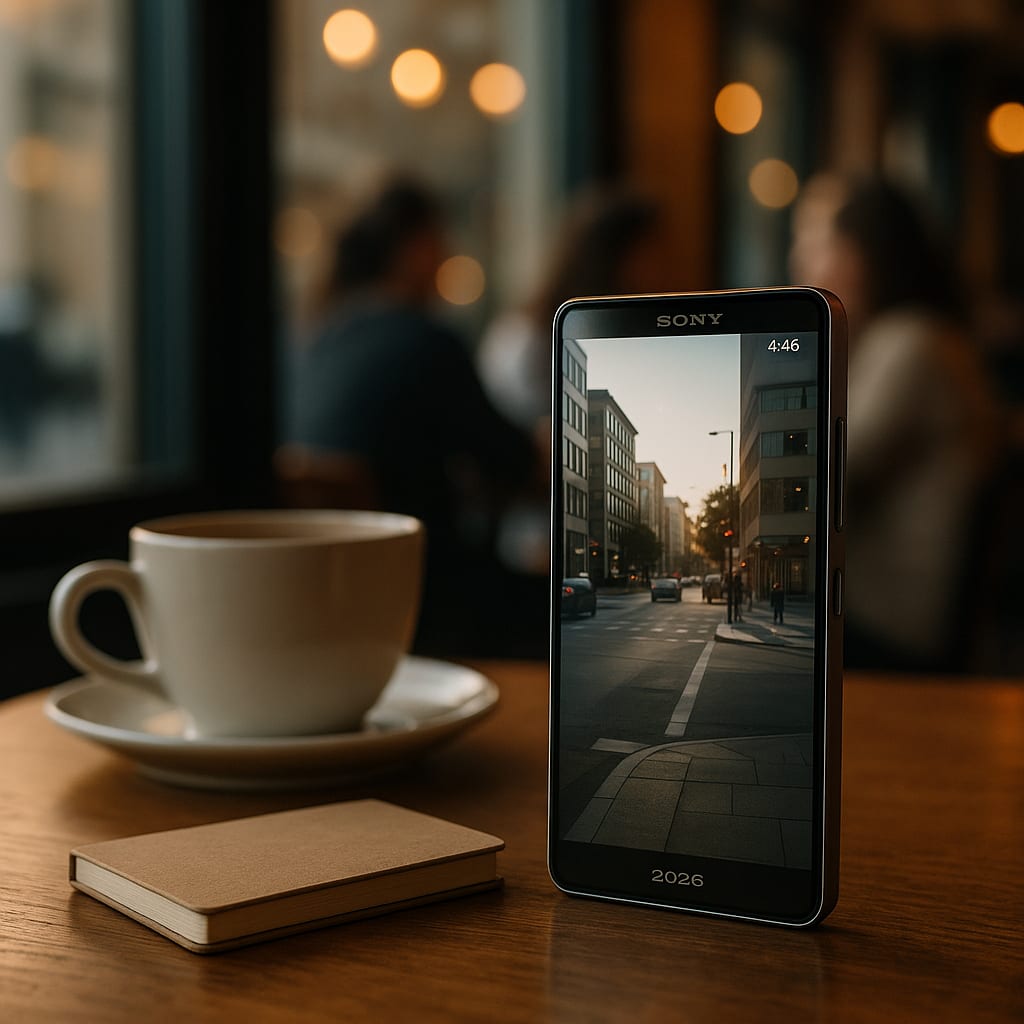
I swore I was done chasing new phones—then Sony’s 2026 release hit me right where I actually live: in the gap between specs and real life
The last time I got excited about a new phone launch, I was still that person who watched three-hour livestreams and argued about benchmarks in group chats.
Then, somewhere around the third “revolutionary” camera bump and the fifth “best display ever,” something in me went quiet.
The launches started to blur together. The phones got shinier, but my sense of wonder didn’t.
So when rumors of Sony’s big 2026 smartphone started leaking, my first reaction was…nothing.
Just another rectangle, I thought. Another promise that this time, the future fits in your pocket.
But that changed the night I watched my dad try to capture a video of my niece blowing out her birthday candles—and completely miss the moment because his phone froze on a random pop-up.
He looked at the screen, confused, like the device had betrayed him.
And I realized: this is the real gap. Not 120Hz vs 144Hz. Not 4K vs 8K.
It’s the distance between what phones could be for us, and what they actually are.
Sony’s 2026 smartphone—whatever slick name they finally stamp on it—feels like the first time in years a big company is quietly admitting that gap exists, and actually trying to do something about it.
Not with marketing slogans.
With choices.
The quiet loyalty of Sony smartphone people
There’s a certain type of person who still buys Sony phones in 2026.
You’ve probably met them. You might be one of them.
They’re the ones who say things like, “The camera just feels more honest,” or, “I don’t need my phone to be a circus.”
I was never that person.
I grew up on iPhones, flirted with Samsung flagships, and played around with folding screens like they were the future of everything.
Sony, in my head, was that brand for camera nerds and headphone purists. Respectable. Niche. Not…central.
But every time I saw someone using a Sony Xperia, there was this odd pattern.
They never felt desperate to show it off.
They didn’t wave specs in your face. They just…used it. Calmly. Like a tool they trusted.
There’s a quiet loyalty there you don’t see with most smartphone brands anymore.
It’s not loud fandom. It’s not “green bubble vs blue bubble” wars.
It’s more like the way someone talks about their favorite mechanical watch, or the one pair of headphones that got them through a breakup and a five-hour flight in the same week.
So when I started digging into Sony’s 2026 smartphone release, I realized the story wasn’t just about new hardware.
It was about whether that kind of loyalty still has a place in a world addicted to tech drama.
What Sony actually changed in 2026 (and what it says about us)
The 2026 Sony smartphone isn’t going to scream at you from billboards.
It’s not trying to fold, flip, roll, or turn into a tablet halfway through a text message.
But if you look closely, you see a pattern—a kind of quiet rebellion against where smartphones have drifted.
Here’s what stood out to me, beyond the spec sheet.
A camera that finally respects people who aren’t influencers
Sony has always leaned into “pro” camera modes, pulled straight from their Alpha line.
That’s great if you live for manual controls and color science debates.
But the 2026 phone seems to do something different: it bends that pro heritage toward normal people.
The default camera app doesn’t shove filters and face-smoothing in your face.
Skin looks like actual skin. Street lights at night look like, well, light, not neon mush.
It’s still powerful if you know what you’re doing—manual focus, RAW, all of it—but it no longer feels like you’re being punished for just wanting to hit record and not miss a moment.
It feels like Sony finally saw my dad at that birthday party.
Battery and performance that answer the question no one seems to ask: “What about year three?”
Most launches brag about “all-day battery life,” as if the story ends at 11:59 PM on day one.
What Sony talks about this year is different: sustained performance over years.
Better thermal design. Smarter battery health management. Actual durability above the surface-level stats.
No, that won’t trend on TikTok.
But if you’ve ever watched your once-snappy phone turn into a laggy mess after a couple of updates, you feel this in your bones.
Sony leaning into longevity is quietly radical in a market trained to make you feel outdated every 12 months.
A screen designed for eyes, not showrooms
The 2026 display is still ridiculously sharp, bright, and color-accurate.
Of course it is. Sony can do screens in its sleep.
But the choices around it feel human.
Adaptive refresh rates that don’t blast max power for no reason.
Color profiles that aren’t oversaturated candy by default.
After staring at it for a while, I realized something odd: my eyes didn’t feel tired.
That sounds small. It isn’t.
I spend more time looking at this slab of glass than any human face on weekdays.
A company finally optimizing for comfort instead of shock value feels…unexpectedly intimate.
Software restraint in a world allergic to silence
This might be the most controversial thing: Sony’s 2026 phone feels…quiet.
Fewer pre-installed apps. Less aggressive “engagement” nudging.
No weird “AI friend” shoved in your face during setup before you’ve even hit the home screen.
Yes, they’ve got AI features.
But they seem built around actual tasks—auto-transcribing interviews, cleaning up audio, smarter photo sorting—rather than replacing your personality with a chatbot.
The phone doesn’t try to be your therapist, your life coach, and your content manager.
It just tries to help. When you ask.
I didn’t realize how rare that felt until I noticed I wasn’t constantly going into settings to turn things off.
The real tension: who are phones actually for now?
Every new smartphone release pretends it’s for “everyone.”
That’s a lie we all politely go along with.
Most flagships in 2026 are designed for maximum spectacle:
the loudest unboxing videos, the flashiest features, the highest numbers on paper.
Sony’s 2026 smartphone, for better or worse, feels like it picked a side.
It’s not for the person who wants their phone to be a stunt.
It’s for the person who wants it to be an instrument.
The tension is this: are there enough of those people left?
I think there are.
I think there are more than we realize.
People who are exhausted by their attention being a battlefield.
People who like tech, but don’t want their personality shaped around it.
People who are okay spending money on something if it feels like it’s built to respect them, not manipulate them.
The struggle is that we’ve been trained for over a decade to believe that “tech progress” means “more.”
More cameras. More pixels. More features. More shortcuts. More, more, more.
Sony’s new phone quietly suggests another path: not more, but better.
That’s a harder story to tell in a 10-second ad.
But it’s a story a lot of us have been waiting to hear.
The moment I realized this release wasn’t about specs at all
There was this one specific moment that flipped the switch for me.
I was sitting in a café, testing out the 2026 Sony alongside my old phone.
Nothing dramatic. Just a regular afternoon, half-work, half-escape.
At the table next to me, two college kids were recording a quick video on their phone—some kind of mini-podcast, just propping the device up against a water bottle.
On my current phone, I know exactly what that audio would have sounded like:
background noise, clattering dishes, a murmur of voices drowning out anything that mattered.
I tried the same setup with the Sony, not expecting much.
And then I played it back.
The difference wasn’t “cinematic.” It wasn’t something that jumps out in a spec sheet or a promo clip.
It was this: I could hear them. Clearly.
The conversation sounded like it actually felt to be there. The background was still present, but it wasn’t the main character anymore.
It hit me that this is what people are secretly asking from their phones in 2026:
Not perfection.
Not spectacle.
Just a more faithful version of their life.
Because that’s what a smartphone really is now: the recorder of small, ordinary, irreplaceable moments.
A baby’s first laugh.
A terrible cover song at 2 a.m.
The voice note you listen to three years after someone is gone.
Sony’s 2026 phone feels like it understands that role deeply.
It’s not trying to impress you with what it can invent. It’s trying to honor what you give it.
Why this Sony release feels different from the upgrade treadmill
I’ve been on the yearly upgrade cycle.
The quick thrill of a new unboxing, the honeymoon, the slow creep of indifference.
By month three, you’re no longer holding a futuristic object. You’re just holding…your phone. Again.
Sony’s 2026 smartphone feels like it’s designed to do something different: grow on you, not just attract you.
That shows up in small ways:
Buttons that feel like they were designed by someone who actually presses them all day.
Haptics that don’t buzz like a cheap toy but tap you on the shoulder.
A fingerprint reader that just…works. Not three times out of five. Five out of five.
None of this will dominate headlines.
But it’s the kind of thing you notice when you’re on a crowded train, juggling bags, trying to answer one last message before you lose signal.
It’s the kind of thing you notice when you’re tired, stressed, and in no mood for your phone to decide it suddenly doesn’t recognize you.
The real insight I got from using this thing is simple, and honestly a little uncomfortable:
Most phones are designed to win launch day.
This one feels designed to win year three.
And that messes with the way the whole industry trains us to think.
Who this 2026 Sony smartphone is actually for (and who should skip it)
This phone isn’t going to win everyone.
If your joy comes from owning whatever’s loudest and most obviously futuristic, you’ll probably be underwhelmed.
If you want your phone to double as a folding tablet or a conversation starter at parties, this won’t scratch that itch.
But if any of this sounds familiar, it might be for you:
You care about photos and video, but not for social clout—more for memory, meaning, and capturing real skin, real light.
You’re tired of feeling like your phone is slowly hijacking your attention with “smart” features that mostly benefit the company.
You’d rather have something that feels better in year two than a gimmick that impresses for a weekend.
It’s not a saintly “minimalist” device.
It’s still a high-end smartphone. It still does way more than any human realistically needs.
But you can feel the restraint.
You can feel that someone, somewhere in the design chain, fought for a bit of sanity.
And if you’ve been feeling a quiet resentment toward your current phone—not because it’s bad, but because it’s exhausting—that restraint feels almost luxurious.
The takeaway I didn’t expect from a 2026 phone launch
I went into this curious about specs, features, and where Sony fits in the 2026 smartphone landscape.
I walked away thinking about something else entirely: respect.
Not the kind brands demand from us.
The kind they rarely offer.
This Sony smartphone doesn’t treat you like a data point.
It doesn’t assume you want everything automated, filtered, and optimized for engagement.
It seems to assume something more vulnerable and true:
That your life is already interesting enough.
That your moments don’t need to be exaggerated.
That your attention is worth protecting, not squeezing.
That’s what stuck with me.
Under all the buzzwords and silicon and glass, the real question any new phone in 2026 has to answer is simple:
Do you see me as a person, or as a user?
Sony’s new release isn’t perfect. No phone is.
But for the first time in a while, I held a flagship and felt like the people who made it were on my side.
And maybe that’s the quiet revolution happening here—not another camera upgrade, not another display spec, but something stranger:
A piece of technology that finally remembers it’s here to serve a human life, not stage a performance.
If more phones in the next few years follow that lead, the future of smartphones might not look as wild as we imagined.
But it might feel a lot more like home.
About the Creator
abualyaanart
I write thoughtful, experience-driven stories about technology, digital life, and how modern tools quietly shape the way we think, work, and live.
I believe good technology should support life
Abualyaanart
Keep reading
More stories from abualyaanart and writers in The Swamp and other communities.
A Gathering of Evil Bosses
“I’m the queen of chin jutting while I smooth my hair, attacking, insulting, and deflecting to protect my appointer.” “Oh, please, Blondi, my hair is curled, highlighted, and longer than yours. I feature television commercials telling immigrants that we will give them a free plane ride home, and if they voluntarily turn themselves in, they will be allowed to legally apply for re-entry. It runs everywhere, and I look good in it! You can’t compete because of your blond hair. Mine is nicer, and my lips are prettier than yours.”
By Andrea Corwin 9 days ago in The Swamp
Winterthorne
Winterthorne stood alone at the edge of the park. The beautiful snow that had surrounded him was all trampled now, from the feet of all of the children who had built him. He missed the sparkly clean snow blanket, but he was happy that so many children had come out to make him.
By Laura DePace6 days ago in Fiction



Comments
There are no comments for this story
Be the first to respond and start the conversation.