
Review of 'Munich: The Edge of War'
A Brilliant Tinge of Alternate History

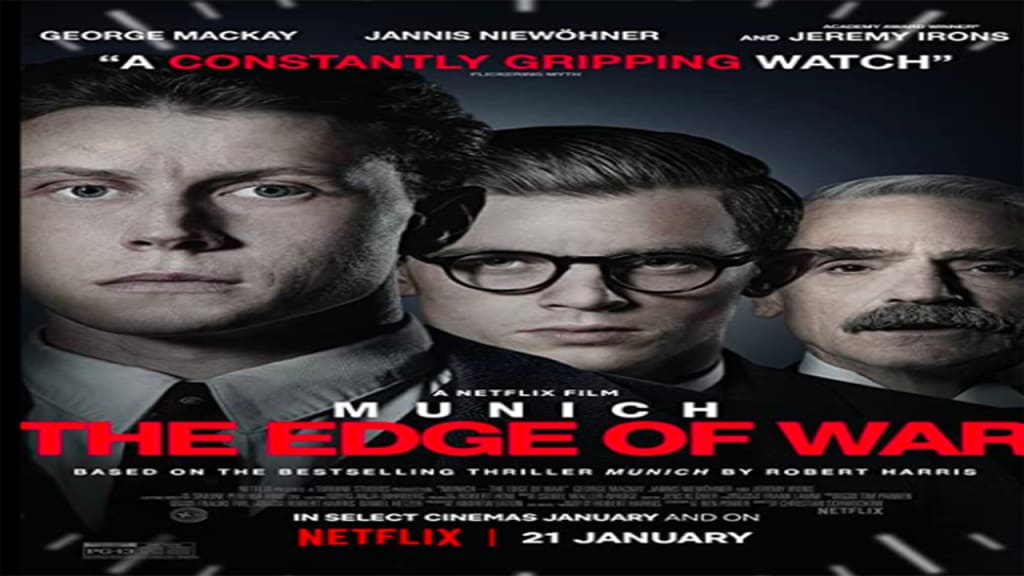
I guess this was a perfect night to watch Munich: The Edge of War on Netflix. Russia is on the verge of invading Ukraine. The Trumpists -- including Trump himself -- have still not been brought to justice for their insurrection and attack on our Capitol last January 6. And the movie is based on the novel Munich by Robert Harris, author of the alternate-history masterpiece Fatherland, in which Germany won the Second World War. Not as much of a masterpiece as Philip K. Dick's The Man in the High Castle (made into an incandescent series on Amazon), for sure, but I'd watch a movie based on a Harris novel any time.
And Munich: The Edge of War is one memorable powerhouse of a movie. As Neville Chamberlain goes to Munich to sign a deal with Hitler which gave Germany a piece of Czechoslovakia, which as we learned in school led to Chamberlain proclaiming "peace in our time" and Hitler to start gobbling up the rest of Europe less than a year later, two young diplomats, a Brit and a German, formerly classmates at Oxford, try to stop that deal from happening.
Their failure is a fact of history. Their existence, I assume, is not. What I'm not sure about is the way Chamberlain is portrayed in this brilliant film, in which he seems to really know what he's doing, deliberately delaying a hot war with Germany to give Britain and the United States crucial time to build up their forces. That's what we get for watching a movie based on a novel by an author who is so deft at writing alternate histories.
But the movie, just the same, is brilliant, as I said, and eminently worth seeing. Historical dramas can be powerful and suspenseful even if we know the ending. As a measure of how good this movie was, I felt bad that these two central characters -- the British and German friends -- didn't really exist. That's probably because they are fiction, and where the rise of Hitler is concerned, fiction can often be better than reality -- unless we're talking about Fatherland or The Man in the High Castle.
About the Creator
Paul Levinson
Novels The Silk Code, The Plot To Save Socrates, It's Real Life: An Alternate History of The Beatles; LPs Twice Upon A Rhyme & Welcome Up; nonfiction The Soft Edge & Digital McLuhan, translated into 15 languages. Prof, Fordham Univ.
Keep reading
More stories from Paul Levinson and writers in The Swamp and other communities.
Review of 'Borat 2 (Borat Subsequent Moviefilm)'
My wife and I just saw Borat 2 aka Borat Subsequent Moviefilm on Amazon Prime Video. As with the first Borat movie in 2006, it was at turns and sometimes all together (and altogether) hilarious, horrifying, over the top, sobering, and vulgar. And there's the already infamous Rudy Giuliani scene near the end.
By Paul Levinson5 years ago in The Swamp
The Saddest Thing - The Billionaires Who Rule America Aren't Even Enjoying Themselves
This single post says more about our ruling class than a thousand policy papers. The saddest thing about today's system is that the men robbing the rest of us - sabotaging our economic prospects, our pensions, our access to affordable healthcare - are not even happy.
By Scott Christenson🌴13 days ago in The Swamp




Comments (1)
This review peaked my interest. I will check it out on Netflix.