
Ranked: Countries Spending the Most on Research and Development
How global R&D investment is shaping innovation, economic power, and the future of technology
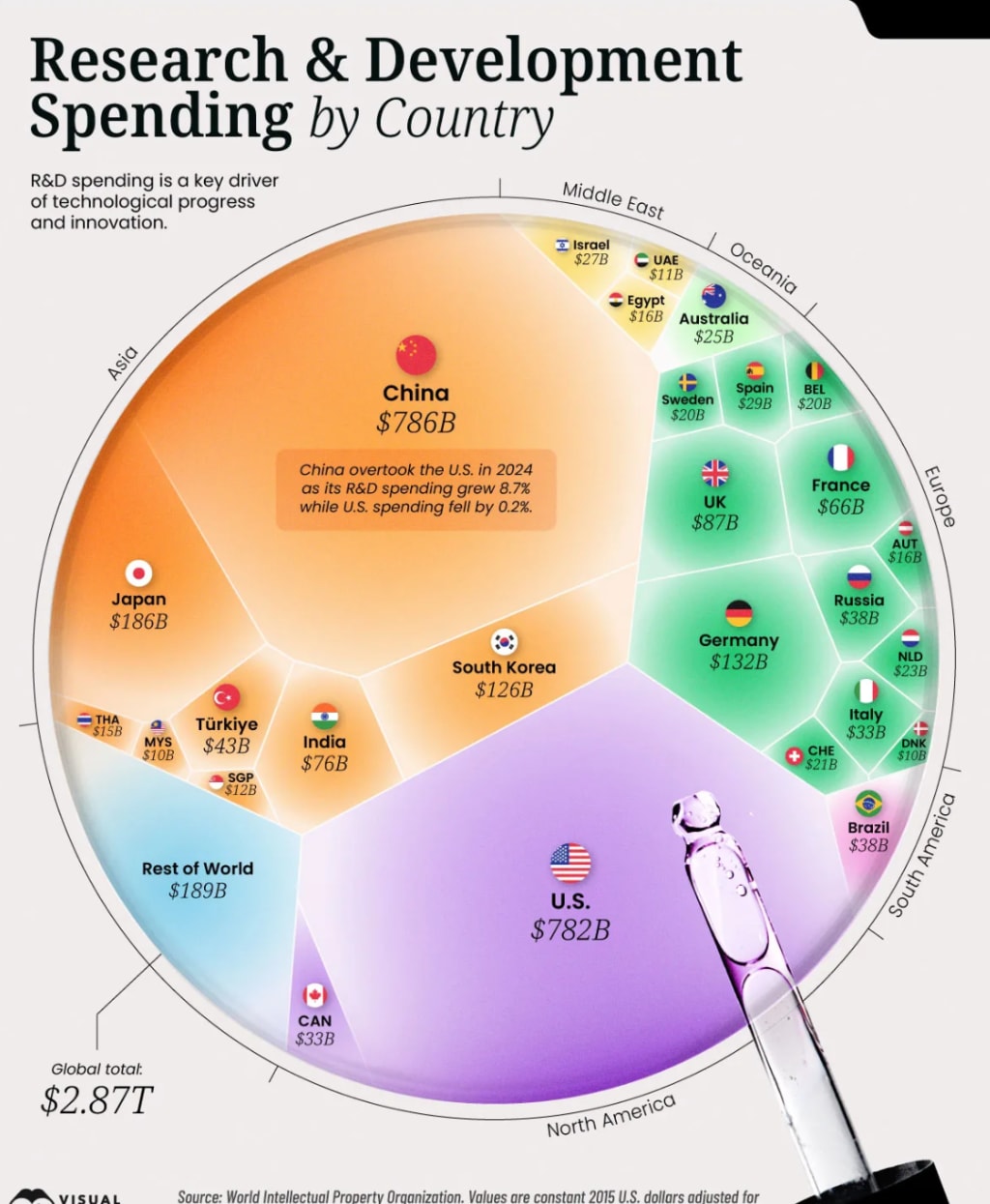
Research and Development (R&D) spending is one of the most important indicators of a country’s commitment to innovation, technology, and long-term economic growth. Nations that invest heavily in R&D often lead in scientific discoveries, advanced manufacturing, artificial intelligence, healthcare breakthroughs, and military technology. In today’s knowledge-driven economy, R&D spending is not just an expense—it is a strategic investment in the future.
This article ranks the countries spending the most on research and development, explores why these investments matter, and explains how R&D shapes global power and prosperity.
Why R&D Spending Matters
R&D fuels innovation. It leads to new products, services, and industries that drive economic growth and improve quality of life. From vaccines and renewable energy to smartphones and space exploration, most modern breakthroughs are the result of sustained research investment.
Countries that prioritize R&D typically experience higher productivity, stronger economies, and global competitiveness. They also attract top talent, foreign investment, and multinational companies.
Top Countries by R&D Spending
1. United States
The United States remains the world’s largest spender on research and development in absolute terms. Federal agencies, universities, and private companies invest hundreds of billions of dollars annually in innovation.
Tech giants like Google, Apple, Microsoft, and Amazon spend billions on AI, cloud computing, and robotics. The U.S. government also funds research in defense, healthcare, space, and energy. This massive investment has helped the country maintain leadership in science and technology.
2. China
China has rapidly increased its R&D spending over the past two decades, becoming the second-largest investor globally. The country focuses on artificial intelligence, semiconductor manufacturing, biotechnology, and renewable energy.
China’s government-driven innovation strategy aims to reduce reliance on foreign technology and position the nation as a global tech leader. Massive state funding and private-sector growth have accelerated its progress.
3. Japan
Japan is known for its strong culture of innovation, especially in electronics, robotics, and automotive technology. Japanese corporations such as Toyota, Sony, and Panasonic invest heavily in R&D to maintain global competitiveness.
The country also supports research in materials science, pharmaceuticals, and advanced manufacturing. Japan’s consistent R&D investment has kept it at the forefront of technological development.
4. Germany
Germany is Europe’s largest R&D spender and a global leader in engineering and industrial innovation. The country invests heavily in automotive technology, renewable energy, and industrial automation.
German research institutions and companies collaborate closely, creating a strong innovation ecosystem. This has helped Germany maintain its reputation as a manufacturing powerhouse.
5. South Korea
South Korea has one of the highest R&D spending levels as a percentage of GDP. Companies like Samsung and LG invest heavily in semiconductors, smartphones, and display technology.
The country’s government also supports research in biotechnology, AI, and green technology. South Korea’s commitment to innovation has transformed it into a global tech leader.
6. France
France is another major European investor in research and development. The country focuses on aerospace, nuclear energy, pharmaceuticals, and artificial intelligence.
French universities and research institutions collaborate with industry to drive innovation. Government support plays a key role in sustaining R&D investment.
7. United Kingdom
The United Kingdom invests significantly in life sciences, AI, and financial technology. Universities like Oxford and Cambridge are global research leaders.
Government initiatives aim to boost R&D spending to strengthen the country’s global competitiveness, especially after Brexit.
8. India
India’s R&D spending is growing, particularly in space technology, pharmaceuticals, and information technology. The country’s space agency, ISRO, has gained global recognition for cost-effective missions.
However, India’s R&D spending as a percentage of GDP remains lower than developed nations, highlighting the need for greater investment.
9. Canada
Canada invests in artificial intelligence, clean energy, and healthcare research. The country has strong academic institutions and government-supported research programs.
Canadian tech hubs like Toronto and Vancouver are becoming innovation centers, attracting global companies and startups.
10. Russia
Russia invests heavily in defense, aerospace, and nuclear research. Government-funded institutions play a significant role in scientific research and technological development.
However, economic challenges and geopolitical tensions have affected its overall R&D growth.
R&D Spending as a Percentage of GDP
While total spending matters, R&D spending as a percentage of GDP is another important metric. Countries like South Korea, Israel, Japan, and Germany rank high in R&D intensity, showing strong commitment to innovation relative to their economies.
High R&D intensity indicates a long-term strategy for technological leadership and economic resilience.
Private Sector vs Government Funding
In many countries, private companies fund the majority of R&D. Tech giants, pharmaceutical firms, and automotive manufacturers invest billions in innovation to stay competitive.
Government funding focuses on basic research, defense, public health, and space exploration. Public-private partnerships are increasingly important for large-scale research projects.
Economic and Geopolitical Implications
R&D spending is closely linked to global power. Countries leading in AI, semiconductors, and biotechnology gain strategic advantages in defense, economy, and diplomacy.
Technological dominance can shape global standards, trade policies, and security strategies. This makes R&D a key battleground in international competition.
Challenges in R&D Investment
Despite its importance, R&D investment faces challenges. Developing countries often struggle with limited funding, brain drain, and weak research infrastructure.
Even developed nations face rising costs, talent shortages, and the need to balance innovation with ethical and social concerns, especially in AI and biotechnology.
The Future of Global R&D Spending
Global R&D spending is expected to grow as countries compete in AI, quantum computing, renewable energy, and space technology. Emerging economies are increasing their investments to catch up with developed nations.
Collaboration across borders will also play a crucial role in addressing global challenges like climate change, pandemics, and energy security.
Conclusion
R&D spending is a powerful driver of innovation, economic growth, and global influence. Countries that invest heavily in research and development are shaping the future of technology and society.
As global competition intensifies, R&D investment will continue to determine which nations lead in science, technology, and economic power. The rankings of R&D spending reveal not just financial priorities, but strategic visions for the future.
About the Creator
Why Black History Matters in America?
The United States of America is celebrating their 250th anniversary in 2026. I'm proud to be an American and as someone who was born here, I wouldn't imagine myself living anywhere else. This is a country where opportunities are possible. Where anyone can be successful in anything they desire to do. Equality, community, and togetherness are the backbones of what America is and should be about. However, we have an administration who wants to erase and disregard those who have made positive, meaningful impacts in our country, specifically Black figures, such as Martin Luther King, Jr., Rosa Parks, and Maya Angelou. President Trump and his administration have been constantly complaining and fighting against what they call the "Woke agenda". They use this excuse as a distraction from other issues they refuse to address, such as the high cost of living, climate change, and inflation. That equality is dividing America, when in reality, it's bringing us together. Being woke is not tied to a specific political party. No matter where you stand on the political spectrum, you can still care about other people and their plights. Compassion and empathy for others isn't tied to a political party, either. We were taught as children to treat others the way we want to be treated and not judge others because they're different from us. Caring about others isn't a personal attack on your beliefs. It doesn't make you any less of a person. People who are easily offended over African American figures, past or present, or anything related to it, are grasping at straws. Current and future generations need to know who people like Harriet Tubman and Shirley Chisholm were, especially in the classroom. Black History is part of American History. It should be recognized, not hidden or forgotten. Besides, you can't shield children from everything, just because your feelings are easily hurt.
By Mark Wesley Pritchard 4 days ago in The Swamp
As West goes after Russia’s oil fleet, Moscow fears for its war funding
Western governments have intensified efforts to target Russia’s so-called “shadow fleet” of oil tankers, raising fresh concerns in Moscow that a crucial source of funding for its war effort could be severely disrupted. The campaign, driven by tighter sanctions enforcement and growing international coordination, aims to choke off the revenue Russia earns from exporting crude oil despite existing restrictions. Since the introduction of price caps and shipping sanctions following the invasion of Ukraine, Russia has relied heavily on an informal network of aging tankers operating outside mainstream insurance and regulatory systems. These vessels, often registered under obscure flags and owned through shell companies, have allowed Moscow to continue exporting millions of barrels of oil each day to buyers in Asia, the Middle East, and Africa. Now, Western officials say they are closing loopholes that allowed this fleet to operate with relative impunity. A Critical Revenue Stream Oil and gas sales remain the backbone of Russia’s economy and its largest source of state revenue. According to energy analysts, proceeds from crude exports help finance military operations, weapons procurement, and domestic subsidies designed to cushion the impact of sanctions. “The shadow fleet has been essential to keeping Russia’s oil flowing,” said one European energy policy expert. “If that fleet is significantly disrupted, it will hit Moscow where it hurts most—its ability to fund the war.” Recent measures include stricter monitoring of ship-to-ship transfers, penalties on ports and insurers that assist sanctioned vessels, and expanded blacklists of tanker operators suspected of helping Russia evade the price cap on oil exports. The United States and European Union have also increased intelligence sharing on vessel movements, using satellite tracking and maritime databases to identify suspicious patterns such as tankers switching off transponders or changing flags shortly before entering restricted waters. Moscow’s Growing Anxiety Russian officials have publicly dismissed Western actions as ineffective, but privately there is growing concern that sustained pressure could disrupt export volumes. Several industry insiders say shipping costs have risen sharply in recent months, forcing Russian exporters to offer deeper discounts to buyers willing to accept legal and logistical risks. “This is becoming more expensive and more complicated every month,” said a Moscow-based oil trader. “Insurance is harder to obtain, routes are longer, and vessels are under constant scrutiny.” There are also fears that accidents involving poorly maintained tankers could lead to environmental disasters, prompting international intervention and further restrictions. Many ships in the shadow fleet are more than 20 years old and operate with limited oversight. Russia’s energy ministry has reportedly warned the government that any major interruption in tanker availability could cause bottlenecks at ports and reduce export capacity just as military spending remains high. Western Strategy: Closing the Gaps Western governments say their goal is not to disrupt global oil markets but to limit the revenue Russia earns from each barrel it exports. The price cap mechanism allows Russian oil to be sold only if it remains below a set threshold and uses Western shipping and insurance services. However, Moscow’s workaround—using non-Western tankers and insurers—has blunted the policy’s effectiveness. The latest push seeks to deter companies and countries from facilitating these arrangements. New sanctions have targeted specific shipping firms in the Middle East and Asia accused of enabling Russian exports. Some ports have begun denying entry to tankers suspected of carrying Russian oil in violation of international rules. “This is about enforcement,” a senior Western official said. “The rules already exist. Now we are making sure they are followed.” Impact on Global Markets Analysts warn that overly aggressive action against the shadow fleet could have unintended consequences for global energy prices. If Russia’s exports drop sharply, supply shortages could push prices higher, affecting consumers worldwide. So far, markets have reacted cautiously, with oil prices fluctuating but not surging dramatically. Much depends on whether Russia can find alternative shipping arrangements or whether buyers such as India and China will continue purchasing Russian crude despite increased scrutiny. “These countries are walking a fine line,” said an energy economist. “They want cheap oil, but they don’t want to be caught in the middle of a sanctions enforcement campaign.” Russia’s Countermeasures In response, Moscow has accelerated efforts to build its own maritime insurance systems and expand cooperation with non-Western partners. Officials are also exploring the purchase of additional tankers through intermediaries and strengthening ties with shipping companies in countries that have not joined sanctions. Some Russian lawmakers have called for more state control over oil exports, arguing that national security requires tighter oversight of transport and sales. At the same time, the Kremlin is promoting alternative payment systems and trade in local currencies to reduce reliance on the dollar and euro. These moves are part of a broader strategy to insulate Russia’s economy from Western pressure. A Test of Endurance The battle over Russia’s oil fleet underscores the central role energy plays in the conflict. For Ukraine’s allies, restricting oil revenue is seen as one of the most effective non-military tools to weaken Moscow’s ability to sustain the war. For Russia, maintaining exports is vital not only economically but politically, as domestic stability depends on continued government spending. “This is becoming a war of logistics and finance as much as of weapons,” said a security analyst. “Whoever controls the flow of money and fuel will have a major advantage.” Uncertain Future As Western scrutiny tightens, the future of Russia’s shadow fleet looks increasingly uncertain. More vessels may be seized, denied insurance, or blocked from ports. Accidents or legal challenges could further disrupt operations. Yet Russia has repeatedly shown an ability to adapt to sanctions, finding new routes and partners when old ones are closed. For now, the struggle continues on the high seas, where tankers quietly carry the resources that help sustain a distant battlefield. Whether Western pressure can truly cut off this lifeline remains one of the most important economic questions of the war. What is clear is that the fight over Russia’s oil fleet has become a central front in the broader effort to limit Moscow’s capacity to finance its military campaign—and the outcome will shape not only the conflict but also the future of global energy trade.
By Fiaz Ahmed Brohiabout 15 hours ago in The Swamp
The Devil's Triangle
The sails ruffled in the breeze as we cruised along. The Sea Breeze was a mid-size catamaran that sailed out of Royal Naval Dockyard in Bermuda. We had booked this trip weeks in advance and were now looking at our Captain, Spike and two boat hands. Paddy and Wilson seemed like nice guys, joking around with the passengers and telling us some stories about Bermuda that only locals would know. Their island accents sounded almost British but they were pleasant to listen to.
By Barbara Gode Wiles3 days ago in Fiction



Comments
There are no comments for this story
Be the first to respond and start the conversation.