
Let's Make America Better!
Drowning to Breathing Again


I am a single mother with a five-month-old son. I recently was asked to leave a shelter we were staying at because it (the program) didn't work with my work schedule. Now I'm forced to sleep in a car with my son. During this time, I've noticed how no one cares about you truly nor will bend over backwards for you unless you're a relative, blood, or have known for a while. There is no more hospitality in America! I'm a hard worker and would lose sleep to do whatever it takes, but no matter what happens, I have no one that has my back but myself. I have so-called friends and once knowing my situation, knowing I'm with child now, I still can't get a helping hand. I just want to make a better life for my son. All I know is when I do become successful and I see a girl in the same situation as me, I'm going to make sure I give them a safe place and support so they can get back on their feet and be the person they're meant to be! Living in America is so sad now and I hate to say I'm American. Babies are on the street in your backyard, yet what are we doing about it? Oh, but quick to complain to change a law because someone disrespected you. America is so messed up and I'm ashamed of it.
As I sit here and think about how bad/tough it is to simply do what it takes to get ahead and continue to get the short end of the stick, I realize now more than ever to continue with my non-profit organization to help other homeless people in need. Yes, it can become expensive but instead of thinking about money all the time, we need to think about the actual solution! I not only want to help other single moms that are in my situation but I want to also help any type of homeless person because it should just not be a thing, especially because people in other countries fight hard to make it to America.
To me, sometimes the word America can now be so cliche because what we have done over the years. We wonder why these young kids are shooting up schools but don't want to take ownership of the fact that WE are the problem! We seriously need to get back to our nature and hospitality because America can be great but only once we put our selfish needs aside and take a deep look into a mirror and get our (blank) (whatever you would like to add there) and truly make America great again.
I will continue to fight the good fight and do whatever it takes to succeed so I can go out and serve my people/community and put some kind of dent in changing the world. When my son grows up, I want him to be able to say, "Thank you for fighting for what you believe in." I can't ask my son to be a better person if I don't fight hard for what I believe and show him that it can be done. I am breaking that cycle! I want to start a movement and it never ends, I want to change history, and I want us to get back to reality and why we are truly here. Let's not wait until it's too late to make that change and have regrets on our deathbed. We can and I know we will someday get back on track, while we continue to evolve. I am so excited to see what is to come and I hope to see you all making a movement.
-Love Rai
About the Creator
LaRaina Lewis
Just a single mom trying to make a difference <3
Keep reading
More stories from writers in The Swamp and other communities.
Why Black History Matters in America?
The United States of America is celebrating their 250th anniversary in 2026. I'm proud to be an American and as someone who was born here, I wouldn't imagine myself living anywhere else. This is a country where opportunities are possible. Where anyone can be successful in anything they desire to do. Equality, community, and togetherness are the backbones of what America is and should be about. However, we have an administration who wants to erase and disregard those who have made positive, meaningful impacts in our country, specifically Black figures, such as Martin Luther King, Jr., Rosa Parks, and Maya Angelou. President Trump and his administration have been constantly complaining and fighting against what they call the "Woke agenda". They use this excuse as a distraction from other issues they refuse to address, such as the high cost of living, climate change, and inflation. That equality is dividing America, when in reality, it's bringing us together. Being woke is not tied to a specific political party. No matter where you stand on the political spectrum, you can still care about other people and their plights. Compassion and empathy for others isn't tied to a political party, either. We were taught as children to treat others the way we want to be treated and not judge others because they're different from us. Caring about others isn't a personal attack on your beliefs. It doesn't make you any less of a person. People who are easily offended over African American figures, past or present, or anything related to it, are grasping at straws. Current and future generations need to know who people like Harriet Tubman and Shirley Chisholm were, especially in the classroom. Black History is part of American History. It should be recognized, not hidden or forgotten. Besides, you can't shield children from everything, just because your feelings are easily hurt.
By Mark Wesley Pritchard 4 days ago in The Swamp
CNA Explains: Why China Mattered in the Expiry of the Last US–Russia Nuclear Treaty
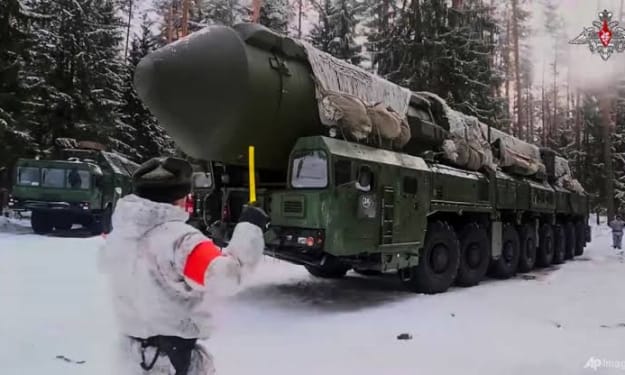
The collapse of the last major nuclear arms control agreement between the United States and Russia, the New START treaty, has triggered significant concern in international diplomatic and security circles. While the treaty's expiry in 2026 was largely driven by the geopolitical dynamics between the U.S. and Russia, the role of China looms large in the background. Beijing’s growing nuclear arsenal and refusal to be part of the treaty negotiations became a key factor that complicated discussions between Washington and Moscow, driving both nations toward a new phase in the arms race. Background: The End of New START The New Strategic Arms Reduction Treaty (New START), signed in 2010 by Presidents Barack Obama and Dmitry Medvedev, was the last remaining arms control agreement between the U.S. and Russia after a series of Cold War-era treaties were abandoned or expired. The treaty imposed limits on the number of deployed nuclear warheads, delivery systems, and missile defense systems, with an aim to curb the further spread of nuclear weapons and ensure transparency between the two countries. However, the expiration of the treaty at the beginning of 2026 marks a crucial shift in the nuclear arms control landscape. Over the past decade, both the U.S. and Russia have pointed to one primary reason for the growing irrelevance of arms control treaties: the rise of China as a nuclear power. With Beijing accelerating its nuclear capabilities and refusing to engage in arms control talks, the U.S. and Russia have found it increasingly difficult to address their nuclear arsenals without considering China’s growing nuclear stockpile. China's Nuclear Growth: A Strategic Concern China’s nuclear policy has historically been characterized by its minimalist approach — maintaining a relatively small arsenal under the principle of "no first use" (NFU), which signified its commitment to not being the first to deploy nuclear weapons in a conflict. However, in recent years, China has significantly expanded its nuclear weapons capabilities, which has stirred growing unease in Washington and Moscow. The Stockholm International Peace Research Institute (SIPRI) estimates that China has increased its nuclear warhead stockpile by over 30% in the past decade, with plans to build a nuclear triad capable of delivering missiles from land, air, and sea. This expansion is part of China’s broader military modernization efforts, which include the development of new intercontinental ballistic missiles (ICBMs), nuclear-capable submarines, and advanced missile defense systems. Unlike Russia and the U.S., China has not agreed to engage in multilateral arms control talks, leading both superpowers to question the fairness and effectiveness of a nuclear treaty that leaves out the third-largest nuclear power. The U.S. and Russia's Dilemma The U.S. and Russia have both acknowledged that arms control efforts are no longer effective in the absence of China’s involvement. In 2019, the U.S. withdrew from the Intermediate-Range Nuclear Forces (INF) Treaty, accusing Russia of violating its terms, but also expressing frustration at China’s growing missile capabilities, which were not subject to the treaty’s limitations. Similarly, the Open Skies Treaty and other arms control agreements also began to unravel, with the issue of China's nuclear expansion surfacing as a key motivator for these exits. President Joe Biden and Russian President Vladimir Putin have expressed a desire to continue nuclear arms control talks, yet without China’s involvement, both sides are finding it difficult to agree on the next steps. The New START treaty’s expiration is thus viewed as a symbol of how difficult it has become to manage nuclear competition in the 21st century without including China in the framework. As both the U.S. and Russia focus on their strategic relations, China’s refusal to engage in arms control negotiations casts a shadow over any potential future agreements. China's Stance: Non-Engagement with Arms Control Talks China’s decision not to engage in nuclear arms control discussions is not a recent development. For years, Beijing has maintained that its nuclear stockpile is proportionate to its national defense needs and that it remains committed to its NFU policy. While this stance was reasonable during the Cold War, as China’s nuclear arsenal was far smaller than those of the U.S. and Russia, the dynamic has changed with Beijing’s ongoing military expansion. China has consistently rejected U.S. and Russian calls for including its nuclear capabilities in any future arms control agreements, arguing that its stockpile remains small in comparison to those of the U.S. and Russia, and that the U.S. should reduce its own nuclear forces first. The Chinese government views nuclear arms control agreements as a relic of the Cold War era and believes that they should evolve to reflect the changing global security environment. Beijing has also cited the fact that it faces no nuclear threat from its immediate neighbors, particularly from Russia, and as such, sees no immediate need to alter its nuclear posture. However, this position has led to frustration in Washington and Moscow. U.S. policymakers have argued that strategic stability cannot be achieved with a treaty framework that ignores China’s growing influence in the nuclear arena. Russia has expressed similar concerns, with some officials even suggesting that without China’s participation, arms control agreements between the U.S. and Russia are essentially futile. The Impact on Global Nuclear Stability The absence of China from arms control negotiations could have far-reaching consequences for global nuclear stability. As the U.S., Russia, and China account for more than 90% of the world’s nuclear warheads, a trilateral arms control agreement would be necessary for effective global non-proliferation efforts. Without such a framework, the risk of nuclear arms races and the potential for miscalculations in the use of nuclear weapons will continue to rise. In recent years, China has also pursued closer military cooperation with Russia, including joint military exercises and shared interests in countering U.S. global influence. This cooperation complicates the arms control situation even further, as a strategic alignment between the two nuclear powers raises concerns in Washington about the long-term balance of power. Possible Pathways Forward Despite the challenges, there are possible pathways for addressing these growing tensions. One approach could be for the U.S., Russia, and China to engage in trilateral talks with a focus on nuclear transparency and risk reduction. However, convincing China to participate in such discussions would require significant diplomatic engagement and a shift in Beijing’s long-standing stance on nuclear arms control. Another option could involve developing new arms control frameworks that consider the technological advancements of modern warfare, such as cyber capabilities, missile defense, and space-based weapons systems. As these technologies increasingly intertwine with nuclear deterrence, the next generation of arms control agreements may need to adapt to the realities of contemporary global security challenges. Conclusion The expiry of the New START treaty marks a pivotal moment in nuclear arms control, but it is not solely the result of U.S. and Russian dynamics. China’s growing nuclear capabilities and its refusal to join in arms control talks have played a crucial role in the breakdown of the arms control framework that once governed U.S.-Russia relations. As global security continues to evolve, the need for a new, inclusive approach to nuclear arms control is becoming more urgent. Whether this involves trilateral talks or new multilateral frameworks remains uncertain, but without China’s involvement, meaningful progress will be difficult to achieve.
By Fiaz Ahmed about 6 hours ago in The Swamp
Choose Your Own Adventure: St Helena Station
*****Preface***** I have been obsessed with Choose Your Own Adventure stories since I was a kid. I credit them with my love of reading and writing. I've been struggling to get my own kids to embrace words the same way I have but they love video games and our occasional Dungeon's and Dragon's game... which gave me an idea. I'll write an interactive story. So far its working; my middle son loves it and can't wait for the next section to come out.
By Sandor Szaboa day ago in Fiction



Comments
There are no comments for this story
Be the first to respond and start the conversation.