
Gold’s Rocket Run Shatters Wall Street Targets as $8,500 Comes Into View
After blasting past Goldman Sachs’ fresh forecast, a bold JPMorgan scenario fuels debate over whether gold is entering a historic supercycle
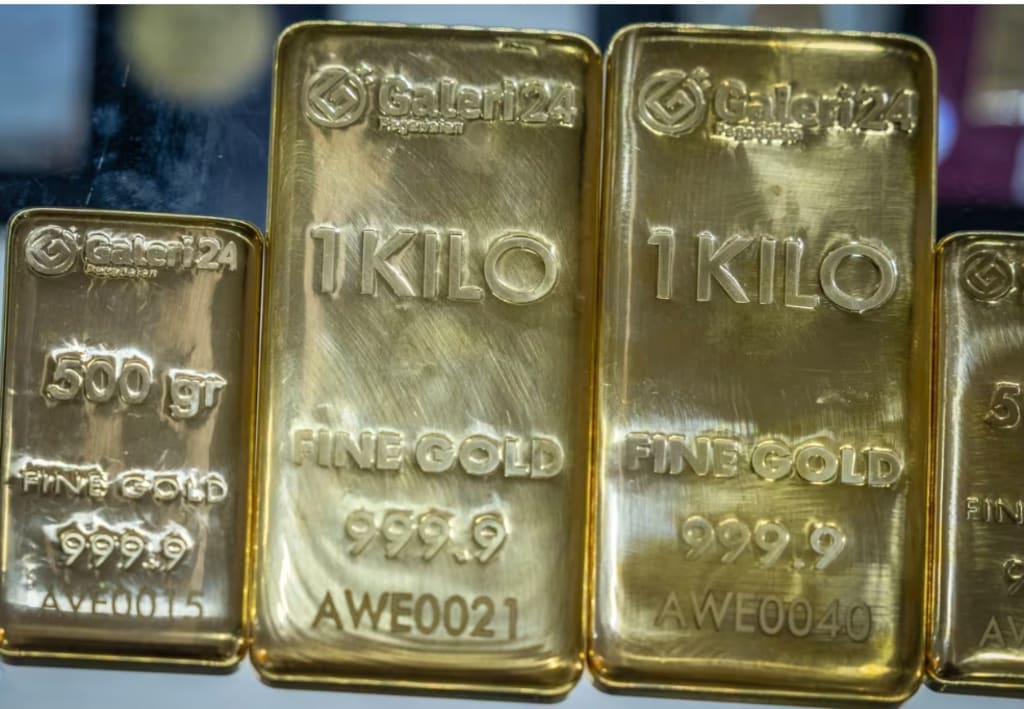
Gold’s relentless surge has once again caught Wall Street flat-footed. Barely a week after Goldman Sachs lifted its price target, the yellow metal sprinted past it, forcing analysts and investors alike to reassess how high—and how fast—gold can really go. Now, in a projection that would have sounded outlandish just months ago, a JPMorgan analyst has outlined a pathway that could eventually take gold to an eye-watering $8,500 an ounce.
This is not just another incremental upgrade. It is a signal that gold’s rally may be less about short-term speculation and more about a deep, structural shift in the global financial system.
A Rally That Refuses to Slow
Gold’s rise has been anything but orderly. Prices have surged in sharp bursts, pausing briefly before pushing higher again, repeatedly defying the traditional headwinds of rising yields or a stronger dollar. The speed of the move is what has startled markets most. Goldman’s revised target—set only last week—was supposed to reflect bullish fundamentals such as central-bank demand and geopolitical uncertainty. Instead, it was overtaken almost immediately.
For traders, this kind of price action often signals that a market has moved beyond incremental valuation models. Momentum, positioning, and fear of missing out begin to amplify what were already strong fundamentals.
Why the Old Targets Broke
Traditional gold forecasts often rely on familiar drivers: inflation expectations, real interest rates, and currency moves. Those relationships still matter, but they no longer tell the whole story.
Central banks, particularly in emerging markets, have been buying gold at a pace not seen in decades. This is not speculative buying—it is strategic. Many countries are actively reducing their reliance on the U.S. dollar, seeking assets that carry no counterparty risk. Gold fits that need perfectly.
At the same time, global debt levels have ballooned. Governments facing persistent deficits and rising interest costs have limited room to maneuver. In such an environment, gold increasingly looks less like a commodity and more like an alternative monetary anchor.
The $8,500 Scenario Explained
The JPMorgan analyst’s $8,500 projection is not a near-term price call. Rather, it is a scenario analysis built on what happens if several powerful trends converge.
First is de-dollarization. If global trade and reserves continue to shift—even gradually—away from the dollar, demand for neutral reserve assets could rise sharply. Gold, with its deep liquidity and long history as money, would likely absorb much of that flow.
Second is financial repression. If inflation remains sticky while policymakers cap yields to manage debt burdens, real interest rates could stay negative for years. Historically, prolonged periods of negative real rates have been rocket fuel for gold.
Third is investor reallocation. Compared to stocks, bonds, and even real estate, gold remains under-owned in many institutional portfolios. A modest shift in allocation percentages—from, say, 1% to 3%—would represent massive inflows into a relatively small market.
Under such conditions, JPMorgan’s analysis suggests that gold would need to reprice dramatically higher to balance supply and demand, potentially pushing it into the multi-thousand-dollar range.
Echoes of a Supercycle
Veteran market watchers are increasingly using the word “supercycle” to describe gold’s behavior. Unlike typical bull markets driven by economic growth, a gold supercycle is often driven by systemic stress: currency debasement, geopolitical fragmentation, and loss of confidence in financial institutions.
In past decades, similar dynamics fueled long-lasting rallies in commodities. What makes this moment different is that gold is responding not to industrial demand, but to a rethinking of what constitutes a safe asset in a fractured world.
Skeptics Still Have a Case
Despite the excitement, skeptics warn that extrapolating current trends too far can be dangerous. Gold has a long history of sharp corrections after parabolic runs. If inflation cools decisively, or if real yields rise meaningfully, the metal could face periods of consolidation or pullbacks.
Others argue that new technologies, including digital assets, could eventually compete with gold’s role as a store of value. While gold has the advantage of millennia of trust, markets are evolving, and younger investors often look elsewhere first.
What It Means for Investors
For investors, the message is not necessarily to chase headlines or anchor portfolios to extreme price targets. Instead, gold’s surge is a reminder of the importance of diversification and risk awareness.
Even a modest allocation to gold can act as insurance against scenarios that traditional portfolios struggle with—currency instability, financial crises, or geopolitical shocks. Whether gold reaches $3,000, $5,000, or JPMorgan’s distant $8,500 scenario, its renewed relevance is hard to ignore.
A Market Redefining Itself
Gold blowing past a freshly minted Wall Street target is more than a forecasting embarrassment—it is a sign that the market is redefining gold’s role. What was once treated as a hedge on the margins is increasingly being viewed as a core strategic asset.
As analysts scramble to update their models and investors debate how much higher is “too high,” one thing is clear: gold is no longer quietly waiting in the wings. It has seized center stage, and its next act may reshape assumptions that have guided global markets for decades.
About the Creator
Ground Rents to Be Capped at £250 a Year: What It Means for UK Leaseholders
For years, leaseholders across England and Wales have faced growing financial pressure from ground rent charges that often seemed arbitrary, unfair, and in some cases, exploitative. Now, a proposed cap on ground rents at £250 per year marks a significant turning point in the UK’s long and often controversial leasehold system. The reform aims to bring relief to millions of homeowners and restore balance to a housing model that critics argue has disproportionately favored freeholders and developers.
By Ayesha Lashari7 days ago in The Swamp
Chris Mason: Both Tories and Labour Feel the Reform Heebie-Jeebies
British politics has a habit of reinventing its anxieties, and right now, one name keeps cropping up in whispered briefings and not-so-whispered TV debates: Reform UK. As BBC political editor Chris Mason has repeatedly observed, both the Conservatives and Labour are feeling the “Reform heebie-jeebies” — a nervous unease that this insurgent party could reshape electoral calculations in ways neither side fully controls. At first glance, this might seem odd. Reform UK holds no seats in Westminster and has never formed a government. Yet its influence is less about raw parliamentary power and more about mood, momentum, and messaging. Reform has become a vessel for frustration — with immigration, political elites, economic stagnation, and a sense that the main parties are offering variations of the same cautious script. Why the Conservatives Are Looking Over Their Shoulder For the Conservatives, the threat from Reform is existential in a very practical sense. Reform’s appeal overlaps heavily with the Tory base: older voters, Brexit supporters, and those instinctively suspicious of large government and cultural change. When Reform polls at 10–15 percent, it doesn’t need to win seats to cause damage. It only needs to split the vote. Chris Mason has highlighted how this fear quietly shapes Conservative strategy. Tougher rhetoric on immigration, symbolic battles over culture wars, and repeated promises to “stop the boats” are not just policy choices — they are defensive moves. Reform’s presence makes it harder for Tory leaders to pivot toward the political centre, even when that might be electorally sensible. There’s also a psychological component. Reform represents a reminder of unfinished business from Brexit. Many voters who backed leaving the EU feel that the promises of sovereignty and control were diluted or betrayed. Reform taps into that grievance, framing the Conservatives as managers of decline rather than agents of transformation. For a governing party already bruised by years of internal division, that narrative stings. Labour’s Discomfort Runs Deeper Than It Admits Labour, on paper, should feel more relaxed. Reform draws more directly from Conservative support, and any erosion of the Tory vote could ease Labour’s path to power. But Chris Mason notes that Labour’s nerves are real — and growing. Why? Because Reform doesn’t just attack the right. It attacks the system. Its message resonates in post-industrial towns, coastal communities, and places Labour once took for granted. Voters who feel ignored by Westminster don’t always care about left-right labels. They care about whether anyone sounds like they’re listening. Labour’s current strategy is built around discipline, moderation, and reassuring sceptical voters that it is “safe” to govern. Reform’s rise disrupts that framing. It injects volatility into the electorate and reminds Labour that voter loyalty is thinner than it looks. A disengaged Labour voter who stays home — or casts a protest vote — can be just as consequential as a defection to the Conservatives. The Farage Factor Nigel Farage looms large over all of this, whether or not he formally leads Reform at any given moment. Chris Mason has often pointed out Farage’s unique political skill: he is less interested in policy detail than in emotional connection. He speaks fluently the language of resentment, humour, and defiance — and does so without sounding scripted. That scares both major parties. Conservatives remember how UKIP hollowed out their vote in the 2010s. Labour remembers how populist movements elsewhere in Europe have eaten into centre-left support by reframing debates around identity and national belonging. Farage doesn’t need Reform to win power. He needs it to matter. And it already does. A Symptom, Not Just a Threat One of Mason’s more subtle observations is that Reform’s rise says as much about the main parties as it does about Reform itself. Voters turn to insurgents when they feel the political mainstream is closed, managerial, or complacent. Reform thrives on the perception that Westminster operates as a closed shop. That’s why both Labour and the Conservatives struggle to respond. Attack Reform too aggressively, and they risk validating its anti-establishment narrative. Ignore it, and they allow its message to spread unchecked. Co-opt its language, and they risk looking insincere. The Bigger Picture The “Reform heebie-jeebies” aren’t just about one party’s polling numbers. They reflect a deeper anxiety about control — over voters, over narratives, over the political agenda. Chris Mason’s analysis cuts through the noise by showing that this is not a temporary wobble but a structural shift in British politics. As the next general election approaches, Reform UK may not decide who governs. But it could decide how they govern, what they talk about, and how boldly — or nervously — they act. And that, more than seat counts or slogans, is why both Tories and Labour keep glancing sideways, wondering just how loud that knocking at the door might get.
By Aqib Hussain7 days ago in The Swamp
One Unchecked Box
"Republished" because it was the only way to add the embed for the newly recorded audio version of this story due to the Top Story badge. Plus it serves as a nice, informal announcement of the podcast's revival for another season (go subscribe!):
By Stephen A. Roddewig6 days ago in Fiction



Comments
There are no comments for this story
Be the first to respond and start the conversation.