
Antonio Tejero Molina, 93, Dies; Spanish Colonel Led Failed Coup
The former Civil Guard officer whose armed takeover of parliament shook Spain’s young democracy leaves behind a deeply divisive legacy
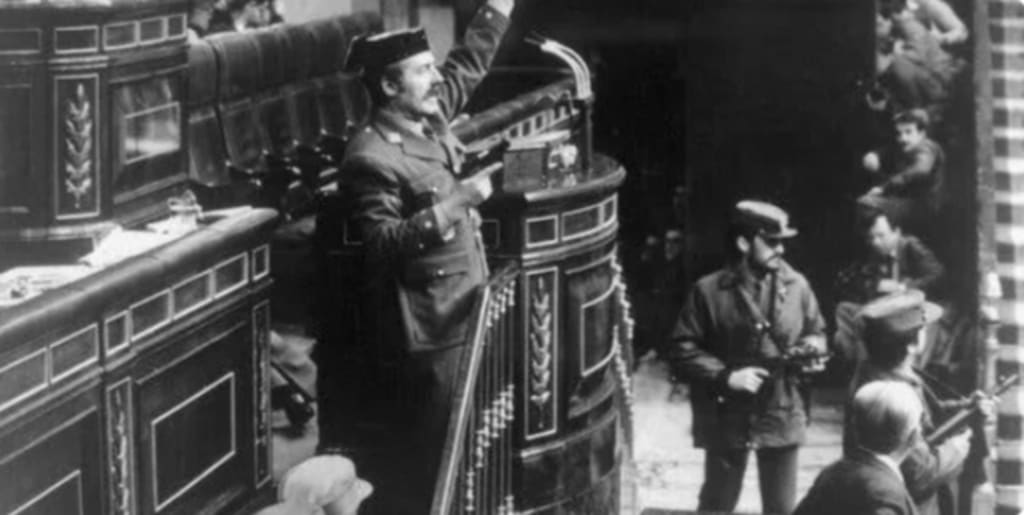
A Face of Spain’s Darkest Democratic Test
Antonio Tejero Molina, the Spanish Civil Guard lieutenant colonel who led the dramatic but ultimately failed coup attempt of February 23, 1981, has died at the age of 93. His name remains synonymous with one of the most perilous moments in Spain’s transition from dictatorship to democracy.
For many Spaniards, Tejero’s image—tricorn hat perched firmly on his head, pistol raised as he stormed the Congress of Deputies—captures a chilling instant when the country’s fragile democratic experiment teetered on the brink. His death closes a chapter of living memory tied to the attempted overthrow of a constitutional order that was still finding its footing after decades of authoritarian rule.
The Coup That Stunned a Nation
On the evening of February 23, 1981—known in Spain simply as 23-F—Tejero led approximately 200 armed members of the Civil Guard into the lower house of parliament during a vote to confirm a new prime minister. As lawmakers ducked under their seats, gunshots echoed through the chamber. The spectacle unfolded live on radio and television, sending shockwaves across Spain and beyond.
The coup attempt occurred during a turbulent period. Spain was navigating the transition from the dictatorship of Francisco Franco, who had ruled until his death in 1975. Political reforms, legalization of parties, regional autonomy debates, and economic instability created uncertainty that some hardline elements viewed as chaos.
Tejero and his co-conspirators claimed to be acting in defense of national unity and order. They opposed decentralization, feared the rise of separatist movements, and rejected the direction of democratic reforms. However, their gamble underestimated both institutional resilience and public appetite for dictatorship’s return.
The King’s Televised Intervention
The turning point came hours later when Juan Carlos I delivered a nationally televised address in full military uniform. Firmly backing the constitution and rejecting the coup, the king ordered the armed forces to remain loyal to democratic institutions. His intervention is widely credited with defusing the crisis.
Military units that had hesitated fell back in line. By the following day, Tejero and his fellow plotters surrendered. The attempted coup collapsed without full-scale violence, though its psychological impact lingered for years.
For supporters of Spain’s constitutional monarchy, Juan Carlos’s stance cemented his reputation as a defender of democracy. For critics, later controversies surrounding the monarch’s personal life complicated that narrative. Yet in 1981, his decisive action marked a defining moment in Spain’s modern political history.
Trial and Imprisonment
Tejero was arrested and later tried by a military court. In 1982, he was sentenced to 30 years in prison for rebellion. Several other military officers also received prison terms. The trial was seen as an affirmation of civilian supremacy and rule of law in a country still emerging from authoritarianism.
During his incarceration, Tejero reportedly showed little remorse. He remained unapologetic about his motivations, portraying himself as a patriot who had attempted to correct what he saw as national decline. His steadfastness ensured that he remained a polarizing figure long after the coup attempt faded from daily headlines.
Tejero was eventually released in 1996 after serving 15 years, benefiting from sentence reductions. He largely retreated from public life, though he occasionally surfaced in far-right circles and maintained his hardline views.
A Divisive Legacy
Antonio Tejero Molina’s legacy is inseparable from Spain’s democratic consolidation. For many citizens, he embodies the last serious threat to constitutional governance in post-Franco Spain. The image of lawmakers lying on the chamber floor remains etched in collective memory as a reminder of democracy’s fragility.
Yet his story also reflects the deep ideological divisions that marked Spain’s transition. The late 1970s and early 1980s were characterized by political assassinations, attempted insurrections, and intense debates over regional autonomy. Some sectors of society feared that reforms moved too quickly; others believed they did not go far enough.
Tejero’s actions crystallized those tensions. The overwhelming public rejection of the coup ultimately strengthened democratic institutions. In the years that followed, Spain joined the European Economic Community (now the European Union), modernized its economy, and solidified its parliamentary system.
Historical Reckoning
As Spain continues to grapple with its 20th-century past—including debates over historical memory laws and the legacy of Franco—Tejero’s death revives reflection on how the country navigated its democratic transition. The failed coup stands as both a warning and a testament: a warning of how swiftly constitutional order can be threatened, and a testament to the resilience of institutions when leaders and citizens stand firm.
Younger generations know 23-F primarily through textbooks and archival footage. For them, Tejero may appear as a relic of a bygone era. For older Spaniards, however, memories of that tense February night remain vivid—radios crackling with uncertainty, rumors spreading, and fears of tanks rolling through city streets.
The End of an Era
Antonio Tejero Molina died at 93, decades removed from the dramatic episode that defined his public life. He never returned to political prominence, nor did he express regret in a way that reshaped public perception. His name will forever be linked to the moment when Spain’s fledgling democracy faced its sternest internal challenge.
In assessing his life, historians often emphasize the broader narrative: that Spain’s institutions, though young and imperfect, withstood a direct assault. The failure of the coup accelerated the normalization of democratic politics and diminished the political role of hardline military factions.
Tejero’s passing does not erase the shock of 23-F, nor does it fully settle debates about the transition era. But it does mark the departure of one of the last principal actors in a drama that tested a nation’s resolve.
In the end, his life serves as a stark reminder that democracy is not self-sustaining. It requires vigilance, leadership, and public commitment. Spain’s experience in 1981 illustrates how close a country can come to losing its constitutional path—and how decisive action can preserve it.
Antonio Tejero Molina will be remembered not for governing or legislating, but for attempting to halt a democratic journey. That he failed remains one of the defining achievements of modern Spain.
About the Creator
A Gathering of Evil Bosses
“I’m the queen of chin jutting while I smooth my hair, attacking, insulting, and deflecting to protect my appointer.” “Oh, please, Blondi, my hair is curled, highlighted, and longer than yours. I feature television commercials telling immigrants that we will give them a free plane ride home, and if they voluntarily turn themselves in, they will be allowed to legally apply for re-entry. It runs everywhere, and I look good in it! You can’t compete because of your blond hair. Mine is nicer, and my lips are prettier than yours.”
By Andrea Corwin 9 days ago in The Swamp
Is America Attacking Iran?
In short: No large-scale American attack on Iran is happening right now. There are serious tensions between the United States and Iran, and both sides are preparing and warning each other — but as of today there is no confirmed full-scale US invasion or full military strike currently underway. Instead, the situation shows a mix of military buildup, intense rhetoric, and ongoing diplomacy.
By shaoor afridi3 days ago in The Swamp




Comments
There are no comments for this story
Be the first to respond and start the conversation.