
Why Some DeFi Protocols Survive While Others Disappear
Examining the patterns behind protocol durability across market cycles

DeFi has matured enough to show recurring patterns. Each market cycle introduces new protocols, token models, and claims of efficiency. During expansion phases, liquidity is widely available and growth appears sustainable. When conditions tighten, many of those projects lose activity and relevance. What remains is a smaller group of protocols that continue to operate steadily without depending on constant attention.
Several of the top DeFi projects in 2026 are not the ones that expanded the fastest. They are the ones that maintained usage after incentives declined.
Growth Does Not Equal Durability
Liquidity incentives can increase deposits quickly, but they do not necessarily create lasting usage. A protocol may show strong TVL growth simply by distributing tokens. That figure alone does not indicate whether users value the underlying service. When incentives fall, capital that arrived for rewards often leaves for the same reason.
Protocols that persist usually support repeat financial activities. Borrowing, collateral management, and stable asset swaps serve practical needs. Even when yields compress, these functions remain relevant. For that reason, platforms built around clear utility often retain a portion of their user base across cycles.
Market Stress Reveals Design Choices
Bull markets can make most systems appear stable because collateral values rise and liquidations are limited. Stress periods reveal how a protocol is actually designed. Oracle accuracy, liquidation speed, and parameter flexibility all become critical when prices move quickly. Protocols that adjust risk settings and monitor exposures closely tend to remain functional, while rigid systems face greater strain.
Why Some Protocols Continue Operating
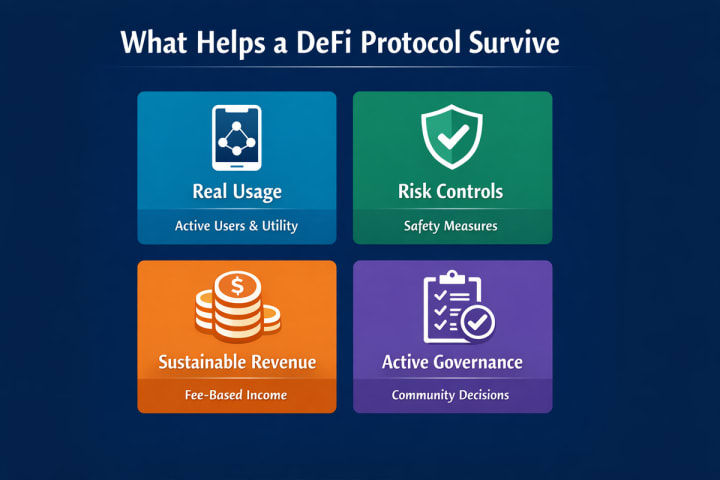
Some protocols are still around simply because they were built carefully. They do not allow extreme leverage, and they are picky about which assets they list. That can feel slow when markets are hot, but it helps when things turn ugly. A few lending platforms tightened their collateral rules after getting burned by volatility early on. Later, those same rules kept them steadier during bigger swings.
Money coming in also matters. Protocols that earn from real borrowing or trading activity are in a healthier spot than those relying on token rewards. Incentives are useful at the start, but they are not a forever strategy. Fee income, on the other hand, helps pay for audits and ongoing work without constantly diluting the token.
Governance only works if people show up. When users actually vote and review risk changes, a protocol can adjust in time. When nobody pays attention, decisions drag, and that can make rough markets even rougher.
History counts more than people admit. A protocol that has already handled liquidations in a downturn has seen real stress. That does not make it bulletproof, but it is different from something that has only lived in good conditions. Many users quietly prefer systems that have survived a few storms over ones that only look good in calm weather.
Durability Versus Rapid Growth: A Practical Comparison
Protocols focused on rapid growth often prioritize expansion, new listings, and attractive yields. This can accelerate adoption, but it also increases exposure to volatility and operational strain. Systems built for durability usually expand more slowly, apply stricter listing criteria, and adjust parameters conservatively. They may look less competitive in strong markets, yet they often remain stable when conditions reverse. The difference is not about which model is superior in theory, but which model aligns with a protocol’s ability to manage risk across cycles.
What This Comparison Suggests
This contrast highlights a simple tradeoff. Growth-driven models can scale quickly but depend on favorable conditions. Durability-focused models sacrifice speed for resilience. For users, the practical takeaway is that protocol design philosophy matters as much as headline metrics. Observing how a platform balances growth and caution can reveal more than short-term performance figures.
Conclusion
No DeFi protocol is truly safe, and just being around for a long time does not remove risk. Smart contract bugs still happen. Oracles can fail. Liquidity can dry up faster than people expect. Those risks never fully go away, no matter how established a platform looks. The difference now is that the industry has been through enough cycles for patterns to feel familiar.
High yields get attention because they are easy to compare. Durability is quieter. It usually comes from having a product people actually use, managing risk sensibly, and earning real revenue. The protocols that last are often the ones that keep running without drama, not the ones growing the fastest. In a space that moves quickly, steady performance rarely makes headlines, but it tends to matter more over time.
FAQs
Are older DeFi protocols always safer than new ones?
Not necessarily. Age alone does not make a protocol safe, but a longer operating history shows how it behaves under stress. Protocols that have gone through multiple market cycles provide more data about their risk management and reliability. Newer protocols can be well designed, but they have less real-world testing.
Does higher TVL mean a DeFi protocol is trustworthy?
High TVL can indicate user interest, but it does not automatically mean a protocol is safe. Liquidity may be driven by short-term incentives rather than long-term usage. It is more useful to look at how TVL is composed and whether the protocol has consistent activity beyond reward programs.
Why do some DeFi protocols fail so quickly?
Many fail because they rely heavily on token incentives without building sustainable usage. When rewards decline, users leave. Others fail due to weak risk controls, poor governance participation, or smart contract vulnerabilities. Long-term survival usually requires a mix of utility, risk management, and stable revenue sources.
About the Creator
Nikoleta Vassilou
Tech and finance writer focused on crypto, blockchain, and innovation. Breaking down complex trends into clear insights for investors, builders, and the curious.
Keep reading
More stories from Nikoleta Vassilou and writers in The Chain and other communities.
Is Hexydog (HEXY) Legit or Another Presale Scam?
In the digital asset space, finding projects that stand for something real is increasingly rare. Many tokens appear overnight, promising innovation without backing it up. As someone who approaches each project with caution, I was looking for a crypto initiative that was both structured and rooted in practical application. That is when I came across Hexydog.
By Nikoleta Vassilou7 months ago in The Chain
Multi-Chain Stablecoin Adoption: The Future of On-Chain Liquidity
The rapid evolution of blockchain ecosystems has fundamentally altered how liquidity is created, distributed, and sustained across decentralized networks. As decentralized finance matures, the limitations of single-chain asset deployment are becoming increasingly apparent. This shift has accelerated interest in the Multi-Chain Stablecoin model, which enables value transfer, settlement, and liquidity provisioning across multiple blockchain environments without compromising price stability.
By Siddarth Dabout 13 hours ago in The Chain


Comments