
The Habit You Don’t Notice That Keeps You Emotionally Stuck
Why familiar pain feels safer than unfamiliar peace

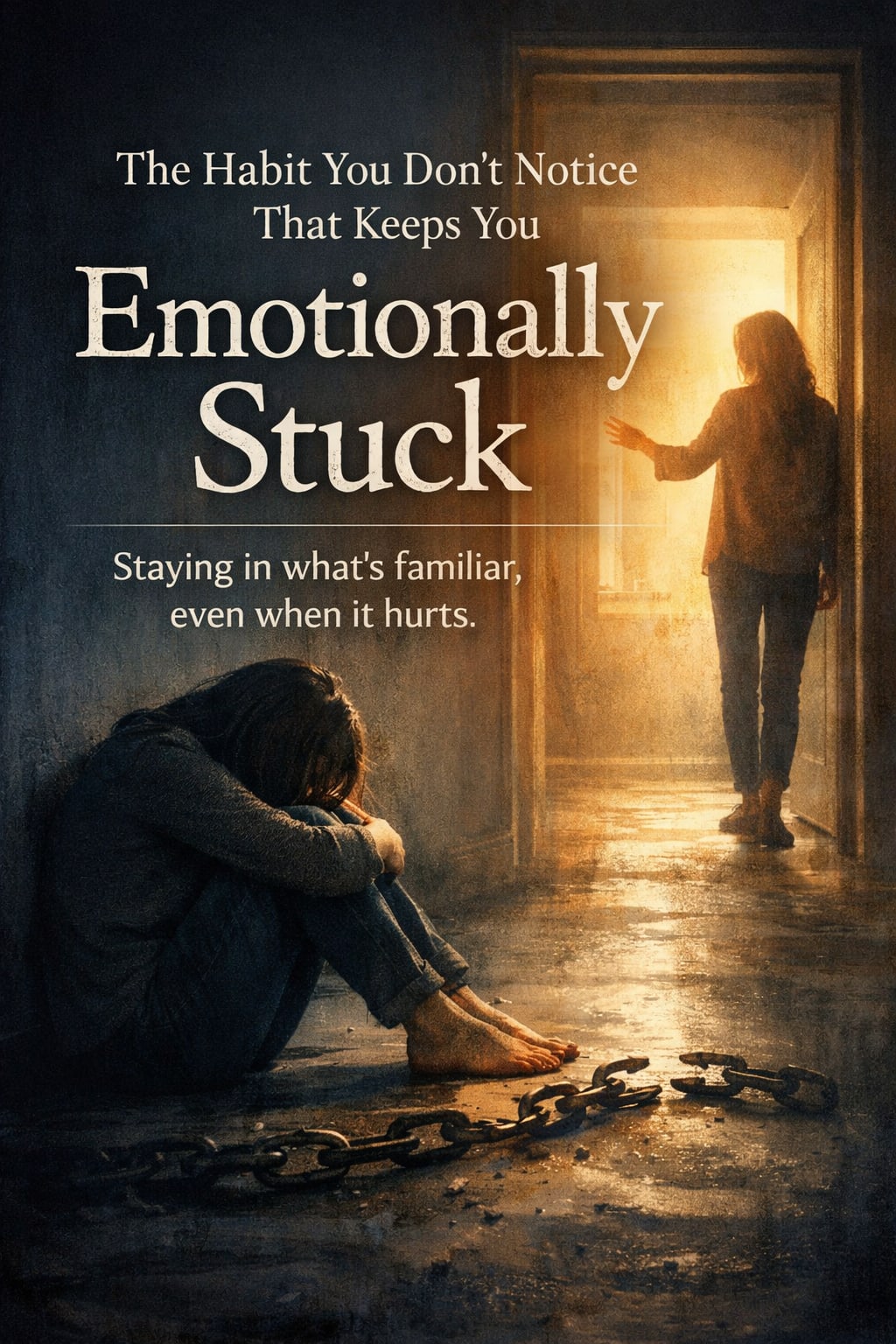
Most people think they’re stuck because of bad luck, weak discipline, or the wrong environment.
But emotional stagnation rarely comes from something dramatic.
It comes from a quiet habit you repeat every day without realizing it.
The habit is this: **returning to what feels familiar, even when it hurts.**
Not because you like pain.
But because your mind values predictability more than peace.
Your brain is not designed to make you happy.
It is designed to keep you safe.
And “safe,” psychologically, often means *known*, not *good*.
That’s why people stay in exhausting relationships, repeat the same mistakes, and replay old thought patterns they claim to hate. The discomfort is familiar. The outcome is predictable. And predictability feels safer than uncertainty.
So the mind chooses the known cage over the unknown freedom.
This habit starts early.
If you grew up around emotional distance, your nervous system learned that distance equals normal. If chaos was common, calm now feels suspicious. If you had to earn attention, effort feels like love.
None of this is conscious.
It’s conditioning.
Later in life, when healthier options appear, something inside you resists. Not because the option is wrong—but because it’s unfamiliar. Your body doesn’t recognize it as “home.”
So you sabotage it quietly.
You delay replies.
You overthink kind gestures.
You pick fights.
You withdraw right when things feel stable.
Then you tell yourself a story: *“It just didn’t feel right.”*
But what you often mean is: *“It didn’t feel familiar.”*
This is why self-sabotage rarely feels like self-hate in the moment.
It feels like instinct.
Your brain is running an old survival program: *Stick with what you know. At least you know how it ends.*
That’s also why insight alone doesn’t free you.
You can understand your patterns perfectly and still repeat them.
Because the habit isn’t intellectual.
It’s emotional.
Your nervous system is attached to certain emotional states—stress, longing, disappointment—not because they’re pleasant, but because they’re known. They feel controllable. You know how to survive them.
Change threatens that certainty.
That’s why growth feels unsettling before it feels empowering.
Before peace feels peaceful, it feels empty.
Before calm feels safe, it feels boring.
Before healthy connection feels warm, it feels exposed.
So the mind pulls you back.
Back to overthinking.
Back to proving yourself.
Back to chasing unavailable people.
Back to postponing change.
Not out of weakness—but out of conditioning.
This habit also shows up in how you think.
If you’re used to self-criticism, kindness toward yourself feels fake. If you’re used to doubt, confidence feels arrogant. If you’re used to emotional noise, silence feels uncomfortable.
So you recreate the inner environment you recognize.
The problem isn’t that you don’t know better.
The problem is that your system hasn’t learned a new baseline.
Emotional growth isn’t about forcing new behaviors.
It’s about tolerating unfamiliar emotional states long enough for them to become familiar.
That’s the part most people skip.
They expect change to feel good immediately.
But psychologically, change often feels wrong at first.
Healing can feel lonely.
Boundaries can feel cruel.
Stability can feel dull.
Peace can feel undeserved.
And because it doesn’t match your old emotional map, your mind flags it as danger.
So you retreat.
The shift begins when you notice the habit in real time—not to judge it, but to name it.
When you feel the urge to go back to what you already know, pause and ask:
*Is this familiar, or is it healthy?*
Those are not the same thing.
Growth doesn’t require dramatic reinvention.
It requires staying present when your instincts tell you to escape.
Sitting with calm instead of filling it with noise.
Allowing consistency instead of chasing intensity.
Letting good things stay without interrogating them.
Slowly, your nervous system updates its definition of safety.
And one day, without realizing when it happened, the old patterns stop pulling as hard.
Not because you fought them.
But because they’re no longer the only place your mind feels at home.
The habit that kept you stuck wasn’t laziness or fear.
It was loyalty to the familiar.
And the moment you see that clearly, you’re already loosening its grip.
About the Creator
Keep reading
More stories from S.A Charles and writers in Psyche and other communities.
Craft Over Catharsis Challenge Winners
Craft Over Catharsis? What the hell does that even mean? The phrase came out of a curation meeting as a genuine question. We had been noticing that many challenge entries, across prompts, naturally gravitate toward trauma, grief, and personal reckoning. That makes sense. Writing is often cathartic. It's one of the ways we process what we've lived through.
By Vocal Curation Team6 days ago in Resources



Comments
There are no comments for this story
Be the first to respond and start the conversation.